September 8, 2026

Canada has invited 3,500 healthcare and social services professionals to apply for Permanent Residency (PR) through the Express Entry system. The latest category-based draw held on September 4, 2026, targeted candidates with eligible healthcare and social services work experience and required a minimum CRS score of 475.

For healthcare professionals in India and around the world, this latest Canada Express Entry draw highlights the continued demand for skilled workers in healthcare and social services occupations.

In this guide, we explain the latest Canada healthcare Express Entry draw, CRS score, eligibility requirements, eligible occupations, work experience requirements, and what healthcare professionals should do next.

📢 Latest Canada PR Update – September 2026
Invitations issued: 3,500
Category: Healthcare and Social Services Occupations
Minimum CRS score: 475
Draw date: September 4, 2026
Immigration system: Express Entry

Canada Healthcare Express Entry Draw 2026: Key Details

The latest healthcare and social services Express Entry selection demonstrates Canada’s continued focus on attracting skilled professionals who can help address labour needs in important sectors.

Draw Information Details
Draw Date September 4, 2026
Category Healthcare and Social Services Occupations
Invitations to Apply 3,500
Minimum CRS Score 475
Immigration Pathway Express Entry
Purpose Permanent Residence

IRCC’s category-based selection system allows Canada to prioritize candidates with skills and experience in occupations considered important to the country’s economic and labour-market needs.

What Is Canada’s Healthcare and Social Services Category?

The Healthcare and Social Services Occupations category is one of Canada’s Express Entry category-based selection groups.

Instead of relying only on general Express Entry draws, category-based selection allows Immigration, Refugees and Citizenship Canada (IRCC) to identify candidates who have experience in selected occupations.

For 2026, Canada renewed the healthcare and social services category and increased the minimum work-experience requirement from six months to 12 months of eligible experience within the previous three years. The experience can be obtained in Canada or abroad.

Who Can Benefit From the Latest Canada Healthcare PR Draw?

The draw may be particularly relevant to skilled professionals working in eligible healthcare and social services occupations who also meet the requirements of an Express Entry-managed immigration program.

Potentially relevant professionals include:

  • 👩‍⚕️ Nurses and nurse practitioners
  • 👨‍⚕️ Physicians and medical specialists
  • 💊 Pharmacists
  • 🦷 Dentists
  • 👁️ Optometrists
  • 🧠 Psychologists
  • 🗣️ Audiologists and speech-language pathologists
  • 🥗 Dietitians and nutritionists
  • 🧑‍⚕️ Chiropractors
  • 🔬 Medical laboratory and healthcare professionals
  • 🤝 Social service professionals
  • 🏥 Other occupations included in Canada’s official healthcare and social services category

The exact occupation list and NOC requirements should always be checked against the current IRCC instructions before creating or updating an Express Entry profile.

What CRS Score Was Required?

The minimum CRS score in the September 4, 2026 healthcare and social services draw was 475.

However, candidates should not assume that scoring 475 guarantees an invitation in a future draw. Express Entry cut-offs can change depending on the number of candidates in the pool, the number of invitations issued and the type of draw conducted by IRCC.

⚠️ Important: A CRS score of 475 was the cut-off for this specific draw. It is not a permanent minimum score for every future healthcare Express Entry draw.

How Does CRS Work for Canada Express Entry?

The Comprehensive Ranking System (CRS) is Canada’s points-based system for ranking eligible Express Entry candidates.

Your CRS score can be influenced by factors such as:

  • 🎓 Age and education
  • 🗣️ English or French language ability
  • 💼 Skilled work experience
  • 🇨🇦 Canadian work experience
  • 👩‍❤️‍👨 Spouse or partner factors
  • 🎓 Canadian education
  • 💼 Eligible job offers, where applicable
  • 🇨🇦 Provincial nomination
  • 🗣️ French-language ability and other additional factors

IRCC ranks eligible candidates in the Express Entry pool using the CRS and invites high-ranking candidates during different types of invitation rounds.

Canada PR Eligibility for Healthcare Workers in 2026

Being a healthcare professional does not automatically qualify someone for Canadian permanent residence. Candidates must satisfy both the Express Entry program requirements and the requirements of the healthcare and social services category.

1. Eligible Express Entry Program

You must be eligible for at least one of the three programs managed through Express Entry:

  • Federal Skilled Worker Program (FSWP)
  • Canadian Experience Class (CEC)
  • Federal Skilled Trades Program (FSTP)

IRCC states that candidates must meet the minimum criteria for Express Entry as well as the specific requirements of the category-based round.

2. Healthcare or Social Services Work Experience

For the renewed 2026 category, candidates generally need at least 12 months of full-time work experience, or an equivalent amount of part-time experience, within the previous three years in a listed occupation.

The experience may have been obtained in Canada or abroad.

3. Language Test

Applicants must meet the language requirements of the Express Entry program for which they qualify. Depending on the applicant’s situation, approved English or French language testing may be required.

For Indian applicants, improving English language scores can also be an important strategy for strengthening their overall Express Entry profile.

4. Educational Credentials

Education can contribute significantly to your CRS score and program eligibility. Applicants educated outside Canada may need an Educational Credential Assessment (ECA) for immigration purposes, depending on the program and circumstances.

5. Express Entry Profile

Eligible candidates need to create an Express Entry profile and enter the candidate pool. IRCC then calculates the CRS score and ranks eligible candidates against others in the pool.

Is Canada PR Possible for Indian Healthcare Professionals?

Yes, eligible Indian healthcare and social services professionals can potentially use Express Entry as a pathway to Canadian permanent residence.

The important point is that the applicant must satisfy the applicable Express Entry program requirements, have qualifying work experience in an eligible occupation and meet the requirements of the relevant category-based draw.

Indian professionals should therefore evaluate their complete profile instead of looking only at their job title.

What Should Healthcare Workers Do If Their CRS Score Is Below 475?

If your CRS score is below the latest cut-off, it does not necessarily mean that Canada PR is impossible.

You can explore strategies that may improve your ranking, such as

  • 📈 Improving your English or French language test score
  • 🎓 Completing additional eligible education
  • 💼 Gaining additional skilled work experience
  • 🇨🇦 Exploring eligible Canadian work experience pathways
  • 🏫 Reviewing provincial immigration opportunities
  • 🇫🇷 Improving French-language proficiency where applicable
  • 👩‍❤️‍👨 Reviewing spouse-related CRS factors
  • 📝 Ensuring your NOC and work experience are correctly documented

The best strategy depends on your age, education, language results, work history, marital status and other profile factors.

What Happens After Receiving an Invitation to Apply?

Receiving an Invitation to Apply (ITA) is an important milestone, but it is not the same as receiving Canadian permanent residence.

After receiving an ITA, the applicant must complete the permanent residence application and provide the required supporting documents within the applicable deadline.

IRCC states that an Express Entry invitation is valid for 60 days. Applicants should therefore begin collecting documentation as soon as they receive an ITA.

Documents Healthcare Professionals Should Prepare

Depending on your individual profile and program, documents may include:

  • 📘 Passport
  • 🎓 Educational certificates and transcripts
  • 📄 Educational Credential Assessment, where required
  • 🗣️ Valid language test results
  • 💼 Employment reference letters
  • 📑 Proof of work experience
  • 💰 Proof of funds, where applicable
  • 👨‍👩‍👧 Marriage and family documents, where applicable
  • 🧾 Police certificates
  • 🩺 Medical examination documents
  • 📋 Other documents requested by IRCC

Why Is Canada Targeting Healthcare Professionals?

Canada continues to use category-based Express Entry selection to target candidates whose skills and experience align with identified labour-market priorities.

Healthcare and social services remain one of the renewed 2026 categories. Canada’s category-based selection system is designed to help address critical labour gaps while selecting candidates from the Express Entry pool.

Canada Healthcare Express Entry Draws in 2026

The latest selection is part of Canada’s broader 2026 focus on healthcare and social services occupations.

2026 Healthcare Draw Invitations CRS Cut-off
February 20, 2026 4,000 467
June 25, 2026 4,000 475
September 4, 2026 3,500 475

These figures show why healthcare professionals should monitor category-based Express Entry draws rather than focusing only on general draws.

What Does the Latest Draw Mean for Indian Healthcare Workers?

For Indian healthcare professionals, the September 2026 draw is an important signal that Canada continues to use occupation-focused immigration selection to attract skilled workers.

However, candidates should avoid assuming that every nurse, doctor, pharmacist, therapist or social services worker will automatically qualify. Your occupation, NOC classification, work experience, language results, education and Express Entry program eligibility all matter.

🇨🇦 Thinking about Canada PR?
If you work in healthcare or social services, now is a good time to check your Express Entry eligibility and calculate your CRS score before planning your next immigration step.

Frequently Asked Questions

How many healthcare workers did Canada invite in September 2026?

Canada issued 3,500 invitations to apply in the September 4, 2026 Express Entry draw for healthcare and social services occupations.

What was the CRS score for the September 2026 healthcare draw?

The minimum CRS score was 475.

Can Indian healthcare workers apply for Canada PR?

Yes. Eligible Indian healthcare and social services professionals may qualify for Express Entry category-based selection if they meet the applicable Express Entry and category requirements.

How much healthcare work experience is required for Canada’s 2026 healthcare category?

For the renewed 2026 healthcare and social services category, candidates need at least 12 months of eligible work experience within the previous three years in a listed occupation. The experience can be in Canada or abroad.

Does a CRS score of 475 guarantee Canada PR?

No. A CRS score of 475 was the cut-off for this particular draw. Future draw requirements can be higher or lower.

Is an ITA the same as Canadian permanent residence?

No. An Invitation to Apply allows the candidate to submit a permanent residence application. IRCC must still assess the complete application before permanent residence is granted.

How long do I have to submit my PR application after receiving an ITA?

IRCC states that an Express Entry ITA is valid for 60 days. Applicants should submit a complete application before the invitation expires.

Final Takeaway

Canada’s latest 3,500-ITA healthcare and social services Express Entry draw is significant for skilled professionals looking to obtain Canadian permanent residence.

With a CRS cut-off of 475, the September 4, 2026 draw demonstrates that healthcare and social services professionals continue to receive dedicated consideration through Canada’s category-based Express Entry system.

If you are a healthcare professional in India or another country, the right approach is to assess your NOC, work experience, education, language score and CRS profile before deciding on your immigration strategy.

🇨🇦 Apply for Canada PR

Are you a healthcare or social services professional planning to move to Canada?
Get your profile assessed and explore your possible Canada PR pathways.

    🇨🇦 Apply for Canada PR – Free Consultation

    Fill out the form below and our experts will contact you shortly.

    Important Disclaimer

    This article is for general information and educational purposes only. Canadian immigration rules, Express Entry categories, occupation lists, CRS cut-offs and eligibility requirements can change. Always verify the latest requirements and instructions published by Immigration, Refugees and Citizenship Canada (IRCC) before submitting an immigration application.

    Sources: Immigration, Refugees and Citizenship Canada (IRCC), Government of Canada.

    June 6, 2026

    French for Canada PR has become one of the most searched immigration topics among Indian students in 2026. While IELTS remains important for Canadian immigration, many students are now learning French to increase their CRS scores, improve Express Entry rankings, and access exclusive immigration pathways that can lead to Canadian Permanent Residency faster.


    The Changing Face of Canadian Immigration

    Canada has long recognized both English and French as its official languages. To support economic growth and strengthen French-speaking communities outside Quebec, the Canadian government has introduced several initiatives aimed at attracting French-speaking immigrants.

    As a result, candidates who demonstrate proficiency in French often receive:

    ✔ Additional CRS points
    ✔ Better Express Entry rankings
    ✔ Access to French-speaking immigration streams
    ✔ More invitations through category-based draws
    ✔ Improved employment opportunities
    ✔ Greater long-term settlement advantages

    For many Indian students, learning French is now viewed as a strategic immigration tool rather than simply a language skill.


    Why IELTS Alone Is No Longer Enough for Many Applicants

    A few years ago, scoring well in IELTS was often sufficient to remain competitive in the Express Entry pool. Today, competition has intensified.

    Thousands of applicants achieve excellent IELTS scores every year, creating challenges such as:

    • Higher CRS cut-off scores
    • Increased competition among candidates
    • Limited gains from retaking IELTS multiple times
    • Longer waiting periods for invitations

    Many applicants reach a point where improving their English score further offers minimal CRS benefits. Learning French, however, can create a significant competitive advantage.


    Understanding CRS Scores and Why They Matter

    Canada’s Express Entry system uses the Comprehensive Ranking System (CRS) to rank immigration candidates.

    The CRS evaluates:

    • Age
    • Education
    • Work Experience
    • Language Skills
    • Adaptability Factors

    Candidates with higher CRS scores are more likely to receive an Invitation to Apply (ITA) for Permanent Residency.

    Since language proficiency is a major component of CRS calculations, improving your language profile can directly impact your immigration prospects.


    How French Can Increase Your CRS Score

    French language proficiency is one of the few factors that can substantially improve an applicant’s CRS score.

    When candidates demonstrate strong French abilities through approved language tests such as TEF Canada or TCF Canada, they may receive:

    • Additional language points
    • Bonus points for bilingual proficiency
    • Improved ranking in the Express Entry pool

    For many candidates, investing time in French provides a greater return than repeatedly attempting to improve an already strong IELTS score.


    CRS Advantage: IELTS vs IELTS + French

    Profile Immigration Competitiveness
    IELTS Only Moderate
    High IELTS Score Competitive
    IELTS + French Highly Competitive
    Strong French + English Excellent PR Prospects

    This is one of the primary reasons why immigration consultants increasingly recommend a bilingual strategy.


    Canada’s French-Speaking Immigration Programs

    One of the biggest reasons Indian students are turning toward French is the growing number of immigration opportunities available specifically for French-speaking candidates.

    Canada has introduced category-based Express Entry draws that prioritize French-speaking applicants.

    Benefits include:

    Lower CRS Requirements

    French-language draws often have lower CRS thresholds compared to general draws.

    Reduced Competition

    The pool of French-speaking candidates is smaller than the general Express Entry pool.

    More Frequent Invitations

    Eligible candidates may receive invitations sooner.

    Faster Pathways to Permanent Residency

    French proficiency can significantly accelerate immigration timelines.


    What Is TEF Canada?

    To claim French language points, candidates must complete an approved French language test.

    The most popular option is:

    TEF Canada (Test d’Évaluation de français)

    This examination evaluates:

    • Reading
    • Listening
    • Writing
    • Speaking

    The results are converted into Canadian Language Benchmarks (CLB) and used in immigration applications.


    What Is TCF Canada?

    Another accepted French proficiency test is:

    TCF Canada (Test de connaissance du français)

    Like TEF Canada, it measures:

    • Reading comprehension
    • Listening comprehension
    • Oral expression
    • Written expression

    Both tests are recognized by Canadian immigration authorities.


    Why Indian Students Are Starting French Earlier Than Ever

    Students planning for Canadian education and immigration are no longer waiting until graduation to begin learning French.

    Instead, they are starting:

    • During high school
    • Before applying for study permits
    • While pursuing undergraduate degrees
    • During postgraduate studies
    • While working in India

    This proactive approach provides a significant advantage when they eventually enter the Express Entry system.


    Major Benefits of Learning French for Canada PR

    1. Increased CRS Score

    French proficiency can substantially improve your ranking in the Express Entry pool.

    Higher rankings often translate into quicker invitations.


    2. More Immigration Opportunities

    French speakers may qualify for:

    • Category-based Express Entry draws
    • Provincial Nominee Programs
    • Francophone immigration initiatives

    These programs provide additional pathways to PR.


    3. Better Employment Opportunities

    Many Canadian employers actively seek bilingual professionals.

    Industries with strong demand include:

    • Information Technology
    • Customer Service
    • Healthcare
    • Banking
    • Education
    • Government Services
    • Hospitality

    French-speaking employees often enjoy access to a wider range of positions.


    4. Long-Term Settlement Benefits

    Being bilingual can make daily life easier in many Canadian regions.

    Benefits include:

    • Better integration into communities
    • Greater networking opportunities
    • Improved workplace communication
    • Enhanced career growth

    5. Stronger Immigration Profile

    Candidates who demonstrate proficiency in both English and French often appear more attractive to immigration authorities and employers.


    Best Provinces for French-Speaking Immigrants

    Although Quebec is the most famous French-speaking province, opportunities exist throughout Canada.

    Popular destinations include:

    Ontario

    Ontario actively supports Francophone immigration initiatives.

    New Brunswick

    Canada’s only officially bilingual province.

    Nova Scotia

    Offers programs encouraging French-speaking newcomers.

    Manitoba

    Supports Francophone communities and immigration pathways.

    Prince Edward Island

    Provides opportunities for bilingual professionals.

    Alberta

    Growing demand for skilled bilingual workers.


    Can French Help International Students Studying in Canada?

    Absolutely.

    International students can benefit from French language skills by:

    • Increasing future PR eligibility
    • Expanding employment options
    • Strengthening post-graduation immigration profiles
    • Improving Express Entry competitiveness

    Students planning to transition from study permits to permanent residency should strongly consider French language training.


    How Long Does It Take to Learn French for Canadian Immigration?

    The learning timeline depends on your dedication and learning method.

    Level Estimated Duration
    Beginner to A1 2–3 Months
    Beginner to A2 4–6 Months
    Beginner to B1 6–9 Months
    Beginner to B2 9–15 Months

    Most immigration-focused candidates aim for B2-level proficiency to maximize benefits.


    Best Ways to Learn French in India

    Classroom Coaching

    Structured learning with instructor support and speaking practice.

    Online French Courses

    Flexible and suitable for working professionals and students.

    Hybrid Learning

    Combines live instruction with self-paced learning.

    Immigration-Focused French Programs

    Specialized courses designed specifically for TEF Canada and Canadian immigration requirements.


    Is Learning French Worth It for Canada PR in 2026?

    The answer is a clear yes.

    As Canada’s immigration system increasingly prioritizes bilingual candidates, French proficiency has become one of the most valuable assets for aspiring immigrants.

    Learning French can help:

    ✔ Increase CRS scores
    ✔ Access French-targeted immigration programs
    ✔ Improve employment prospects
    ✔ Enhance settlement opportunities
    ✔ Accelerate Permanent Residency goals

    For Indian students planning to study, work, or immigrate to Canada, French is no longer just an optional language—it is becoming a strategic advantage that can transform an immigration application.


    Frequently Asked Questions (FAQs)

    Does French help in getting Canada PR?

    Yes. French language proficiency can improve CRS scores and provide access to French-speaking immigration pathways.


    Which French exam is accepted for Canada immigration?

    TEF Canada and TCF Canada are the most widely accepted French language tests for immigration purposes.


    Is IELTS still required if I learn French?

    English proficiency remains valuable. However, combining IELTS and French usually creates a much stronger immigration profile.


    Can French increase my CRS score?

    Yes. French proficiency can significantly improve CRS rankings, depending on your language benchmark levels.


    Is French mandatory for Canada PR?

    No. French is not mandatory, but it can greatly improve your chances of receiving an Invitation to Apply (ITA).


    Can Indian students learn French while studying?

    Yes. Many students begin learning French before or during their studies to prepare for future immigration goals.


    Why Choose CIES for Canada Immigration Guidance?

    At CIES, we help students and professionals build strong immigration profiles through expert counseling, study abroad guidance, IELTS preparation, PTE coaching, visa assistance, and Canada PR consulting.

    Our Services

    ✅ Canada Student Visa
    ✅ Study in Canada Counseling
    ✅ IELTS Coaching
    ✅ PTE Coaching
    ✅ French Language Guidance
    ✅ Canada PR Consultation
    ✅ Express Entry Assistance
    ✅ Immigration Services

    Book Your Free Consultation Today

    Whether you’re planning to study in Canada, improve your CRS score, prepare for IELTS, or explore French language pathways for Canadian Permanent Residency, our experienced counselors can help you create a personalized immigration strategy.

    Call Now: +91-9968239372 / +91-9968239373
    Email: info@cies.org.in
    Website: www.cies.org.in

    Start your Canada PR journey with confidence and discover how learning French can give you a competitive advantage in Canada’s immigration system.

      🇨🇦 Apply for Canada PR – Free Consultation

      Fill out the form below and our experts will contact you shortly.

      May 27, 2026

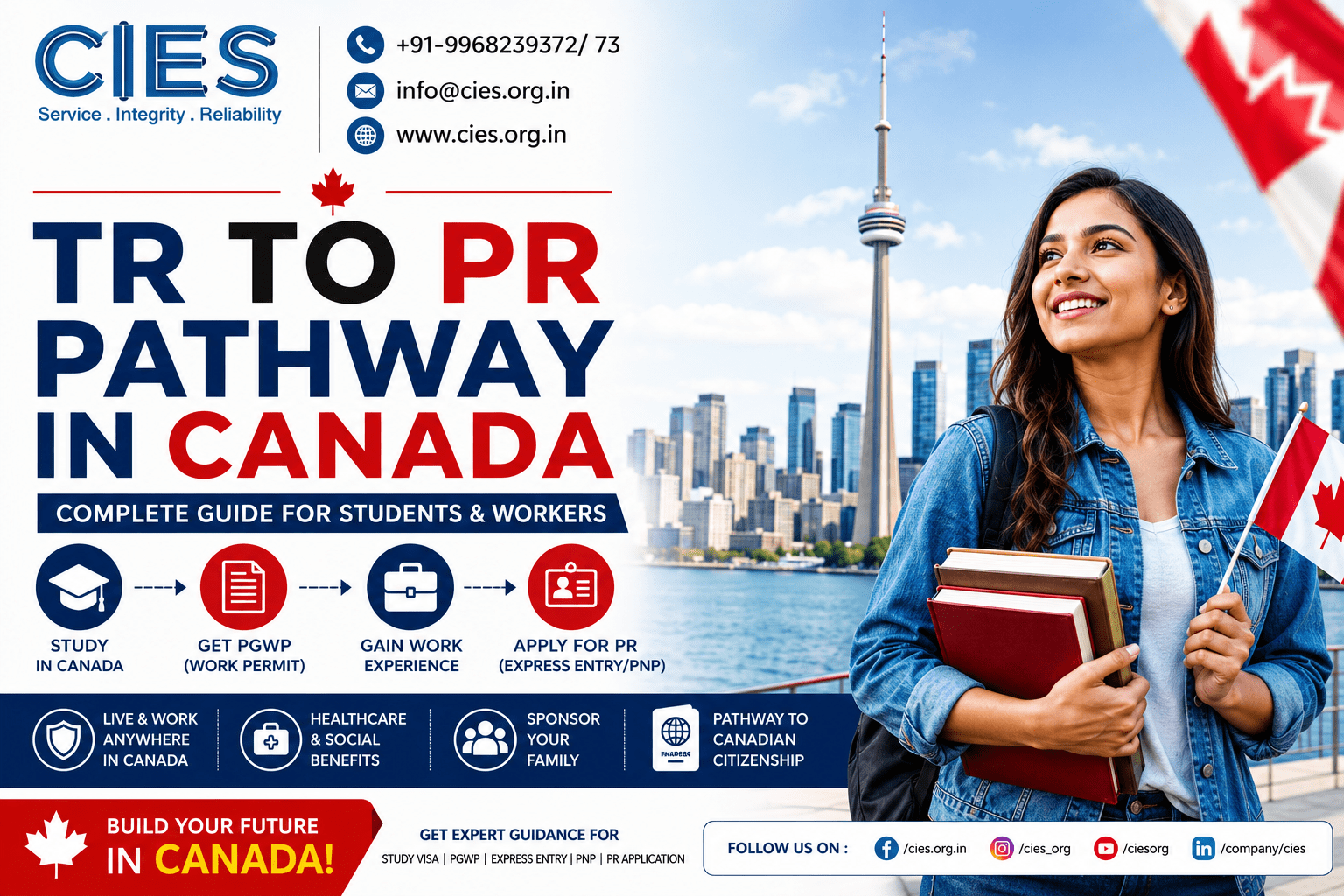
      What is the TR to PR Pathway?

      The TR to PR pathway stands for Temporary Resident to Permanent Resident pathway in Canada. It allows international students, skilled workers, and temporary foreign workers to transition from a temporary visa status to permanent residency.

      This pathway has become one of the most popular immigration routes for individuals who:

      • Studied in Canada
      • Worked in Canada on a work permit
      • Have Canadian work experience
      • Want long-term settlement opportunities

      Canada encourages skilled immigrants through various PR programs to fill labor shortages and strengthen the economy.


      Why Choose Canada’s TR to PR Pathway?

      Benefits of Moving from TR to PR in Canada

      1. Permanent Residency Status

      You can live, work, and study anywhere in Canada permanently.

      2. Access to Healthcare & Benefits

      PR holders receive access to public healthcare and social benefits.

      3. Pathway to Canadian Citizenship

      After meeting residency requirements, you may apply for Canadian citizenship.

      4. Family Sponsorship Opportunities

      Permanent residents can sponsor eligible family members.

      5. Better Career Opportunities

      PR holders often receive better employment options and salary packages.


      Popular TR to PR Pathways in Canada (2026)

      1. Express Entry

      Immigration, Refugees and Citizenship Canada manages Express Entry for skilled workers.

      Main Express Entry Programs

      • Canadian Experience Class (CEC)
      • Federal Skilled Worker Program (FSWP)
      • Federal Skilled Trades Program (FSTP)

      Best For

      • International graduates
      • Skilled workers with Canadian work experience
      • High CRS score candidates

      2. Provincial Nominee Program (PNP)

      Every province in Canada offers PNP streams for international students and workers.

      Popular Provinces

      • Ontario
      • British Columbia
      • Alberta
      • Saskatchewan
      • Manitoba

      Benefits of PNP

      • Lower CRS requirements
      • Faster PR chances
      • Province-specific job opportunities

      3. Atlantic Immigration Program (AIP)

      The AIP helps skilled workers and international graduates settle in Atlantic Canada.

      Provinces Under AIP

      • Nova Scotia
      • New Brunswick
      • Prince Edward Island
      • Newfoundland and Labrador

      4. Rural and Francophone Community Immigration Pilots

      Canada is expanding immigration opportunities in smaller communities.

      These pathways support:

      • Skilled workers
      • Healthcare professionals
      • Trades workers
      • French-speaking candidates

      Eligibility for Canada TR to PR Pathway

      Basic Requirements

      Educational Qualification

      • Canadian degree, diploma, or certificate preferred
      • Foreign education may require an ECA

      Work Experience

      Most programs require:

      • Skilled Canadian work experience
      • NOC TEER category jobs

      Language Requirements

      Accepted language tests:

      Valid Status in Canada

      Applicants should usually hold:

      • Study Permit
      • Work Permit
      • Post-Graduation Work Permit (PGWP)

      Best TR to PR Route for International Students

      International students in Canada commonly follow this process:

      Step 1: Study in Canada

      Choose a Designated Learning Institution (DLI).

      Step 2: Obtain PGWP

      After graduation, apply for a Post-Graduation Work Permit.

      Step 3: Gain Canadian Work Experience

      Work in a skilled occupation to increase CRS score.

      Step 4: Apply for PR

      Use:

      • Express Entry
      • PNP
      • AIP

      TR to PR Pathway for Work Permit Holders

      Temporary foreign workers can qualify through:

      • Canadian work experience
      • Employer support
      • Provincial nomination
      • Occupation-specific streams

      High-demand sectors include:

      • Healthcare
      • IT
      • Engineering
      • Construction
      • Trucking
      • Hospitality

      CRS Score Tips to Improve PR Chances

      How to Increase CRS Score

      Improve IELTS/CELPIP Score

      Higher language scores significantly improve rankings.

      Gain More Work Experience

      Canadian experience increases points.

      Apply Through PNP

      Provincial nomination adds 600 CRS points.

      Study in Canada

      Canadian education gives extra points.

      Add Spouse Credentials

      Language scores and education of spouse may help.


      Documents Required for TR to PR Pathway

      Common Documents

      • Passport
      • Study Permit or Work Permit
      • IELTS/CELPIP results
      • Educational documents
      • ECA report
      • Work experience letters
      • Proof of funds
      • Police clearance certificate
      • Medical examination

      Processing Time for Canada PR

      Processing times vary depending on the immigration program.

      Estimated Processing Times (2026)

      • Express Entry: 5–8 months
      • PNP: 8–18 months
      • AIP: 6–12 months

      Common Mistakes to Avoid

      1. Low Language Scores

      Strong IELTS or CELPIP results are crucial.

      2. Incorrect NOC Code

      Choosing the wrong TEER category may lead to refusal.

      3. Incomplete Documents

      Missing documents can delay applications.

      4. Expired Status

      Always maintain valid temporary resident status.


      Is Canada TR to PR Pathway Worth It?

      Yes. Canada remains one of the best destinations for:

      • International students
      • Skilled workers
      • Families seeking long-term settlement

      The country offers:

      • High quality of life
      • Excellent healthcare
      • Strong economy
      • Immigration-friendly policies

      Frequently Asked Questions (FAQs)

      Can international students get PR in Canada?

      Yes, many international students transition to PR through Express Entry and PNP programs.

      How much work experience is required for PR in Canada?

      Usually, at least 1 year of skilled work experience is preferred for many programs.

      Is IELTS mandatory for Canada PR?

      Yes, language proficiency proof is generally required.

      Which province is easiest for PR in Canada?

      Provinces like Saskatchewan, Alberta, and Manitoba are often considered more accessible depending on occupation demand.

      Can I apply for PR without a job offer?

      Yes, many Express Entry candidates receive PR without a job offer.


      Conclusion

      The TR to PR pathway in Canada provides excellent opportunities for international students and skilled workers who want permanent settlement. With proper planning, strong language scores, and Canadian work experience, transitioning from a temporary resident to a permanent resident becomes achievable.

      Whether you are studying, working, or planning your future in Canada, understanding the right immigration pathway can help you build a successful long-term future.


      Start Your Canada PR Journey Today

      Looking to study, work, or settle in Canada? Get expert guidance for:

      Contact CIES today for personalized Canada immigration assistance.

        🇨🇦 Apply for Canada PR – Free Consultation

        Fill out the form below and our experts will contact you shortly.