January 20, 2026

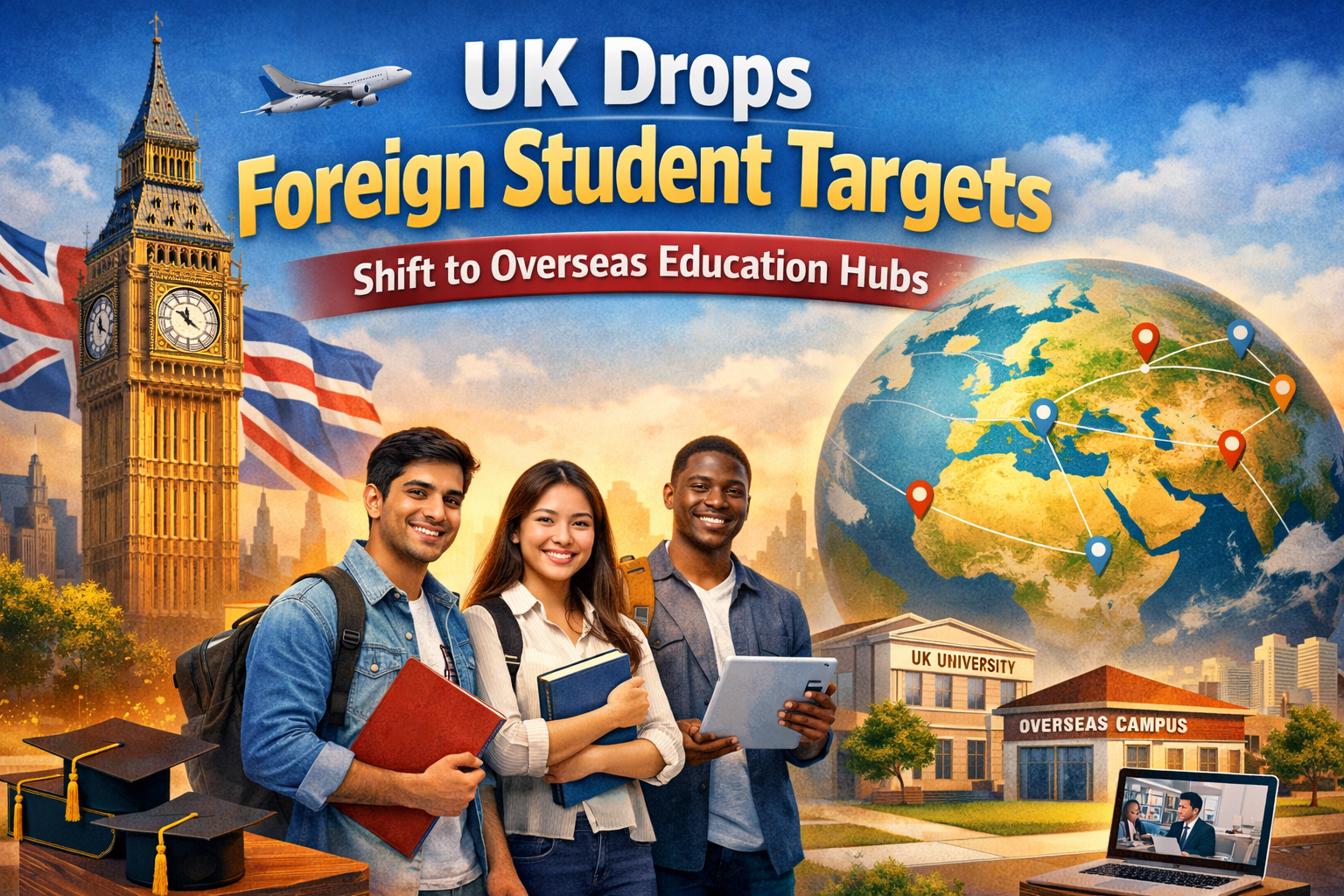
London: The United Kingdom has signaled a major shift in its international education strategy by moving away from fixed foreign student targets and placing increased emphasis on overseas education hubs and transnational education models, according to recent policy indications.

The move comes amid ongoing debates around immigration, housing shortages, and pressure on public services, with international students frequently included in broader migration discussions. While the UK continues to value overseas learners for their economic and academic contributions, policymakers are now looking to expand the country’s global education footprint without relying solely on student mobility.

Shift Away From Numbers-Based Targets

For years, the UK’s higher education sector benefited from a steady rise in international student enrolments, particularly from India and China. However, officials have increasingly avoided setting numerical targets for foreign students, instead focusing on sustainability and long-term global engagement.

The new approach seeks to separate international education from migration politics while maintaining the UK’s position as a leading global education provider.

Expansion of Overseas Education Hubs

Central to the revised strategy is the expansion of overseas education hubs—locations outside the UK where British universities deliver degree programs through branch campuses, partnerships, or franchised arrangements.

UK institutions already operate campuses and partnerships across Asia, the Middle East, and Africa. These initiatives allow students to obtain UK-accredited degrees without relocating, often at lower costs and with greater flexibility.

In addition to physical campuses, universities are also scaling up online and blended learning offerings as part of broader transnational education (TNE) efforts.

Maintaining Global Influence Through Education

By investing in overseas delivery models, the UK aims to continue exporting education, knowledge, and academic standards while easing domestic pressures linked to migration and infrastructure.

Education analysts note that this model enables the UK to reach a larger global student base, diversify revenue streams, and strengthen diplomatic and cultural ties—without increasing the number of international arrivals.

What It Means for International Students

The shift does not indicate a closure of UK study routes. Universities remain open to international applicants, and demand for onshore UK education remains strong. However, competition for places may increase, particularly at top-ranked institutions.

At the same time, students now have additional options to pursue UK qualifications closer to home, including joint degrees, twinning programs, and overseas branch campuses.

Implications for Indian Students

Indian students, who form one of the largest international cohorts in the UK, are expected to be significantly impacted by the changes. Education experts suggest the strategy could lead to more UK–India academic collaborations and expanded access to UK degrees within India.

Hybrid study models—where students begin their education locally and complete part of it in the UK—are also expected to gain traction.

Sector Response

Universities and education consultants have welcomed the clarity, stating that diversified delivery models provide stability amid policy uncertainty. However, they emphasize the need for clear communication to students to avoid confusion around visa rules and post-study opportunities.

Looking Ahead

The UK’s move reflects a broader global trend in international education, where countries are rethinking mobility-heavy models in favor of flexible, borderless learning systems.

As the strategy unfolds, students are being encouraged to plan carefully, assess multiple pathways, and seek reliable guidance to navigate an increasingly complex global education landscape.
January 3, 2026

Executive Summary

This white paper explores how international education influences career trajectories,
comparing outcomes for students who study abroad with those whose education is
completed entirely in their home country. Drawing on multiple studies and statistical
data, we highlight employment outcomes, salary differences, skill development, and
broader career advantages linked to global academic experiences.

1. Introduction

In an increasingly globalized economy, higher education is not only about academic
credentials but also about skills, adaptability, and international exposure. Many students
today choose to pursue part or all of their education abroad, expecting not just
academic enrichment but also improved career prospects. This section synthesizes
available research on the value proposition and measurable impact of international
education on career success.

2. Methodology

This analysis draws on research reports, academic studies, institutional surveys, and
labor market data. Key comparative metrics include:

  • Employment rates within 6–12 months of graduation
  • Starting salary comparisons
  • Development of career-relevant skills
  • Graduate satisfaction and career trajectory outcomes

3. Career Outcomes: Employment and Salary

3.1 Employment Rates

  • Study Abroad Advantage:
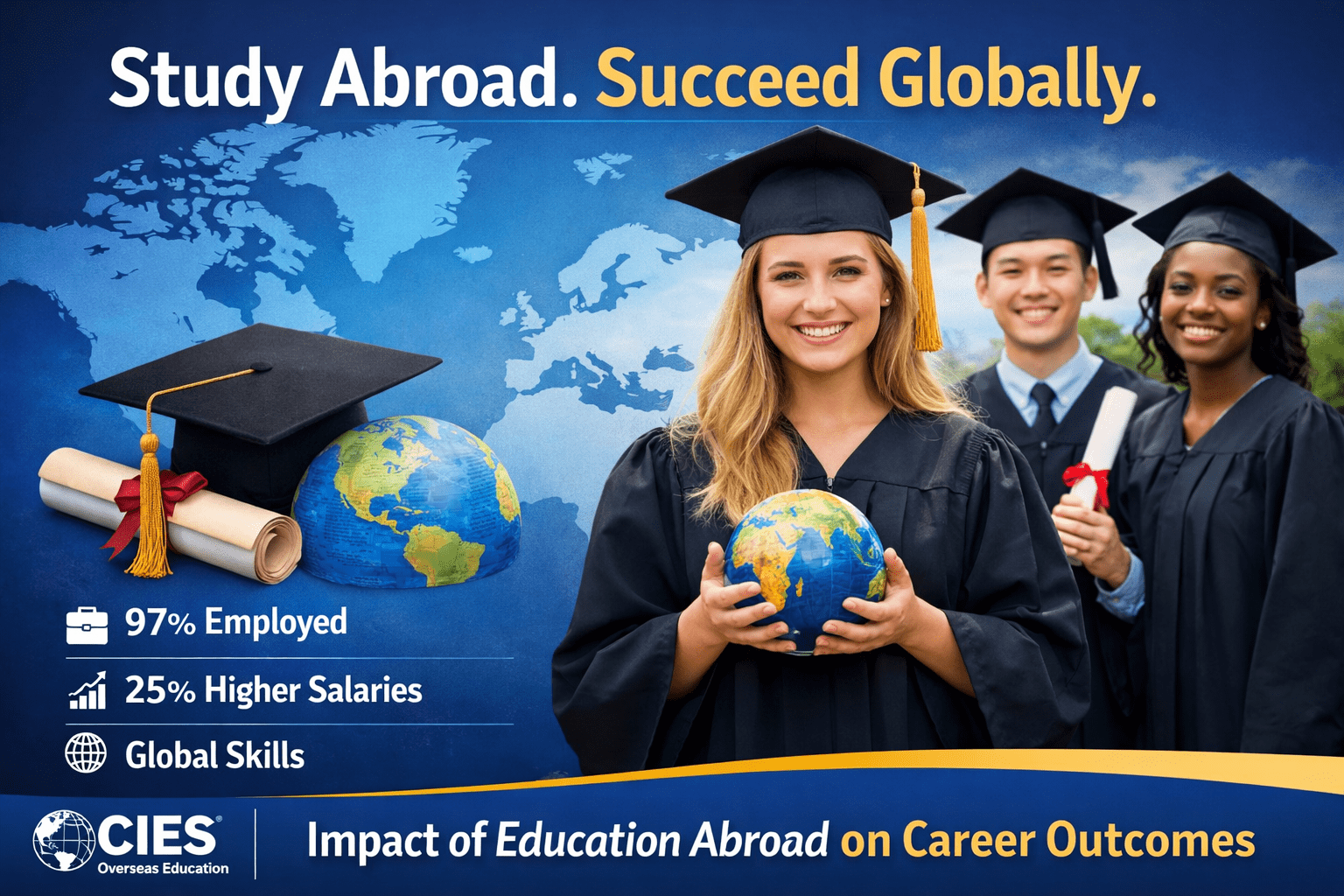
    According to compiled statistics, 97% of students who studied abroad found
    employment within 12 months of graduation, compared with only 49% of
    graduates who did not study abroad, indicating nearly double the likelihood of
    securing a job quickly.
  • Faster Job Placement:
    Among study abroad alumni, 90% landed a job within 6 months, compared to
    significantly lower figures for domestic-only graduates.

3.2 Salary Comparisons

  • Starting Salaries:
    On average, graduates who studied abroad earn approximately 25% higher
    starting salaries compared to their domestically educated peers.
  • Long-Term Earnings:
    Over a typical career span, this salary premium can translate into hundreds of
    thousands of dollars (or equivalent) in additional lifetime earnings.
  • Business Majors Example:
    A U.S. report found that business students with study abroad experience
    earned about $4,159 more in their first job compared to those without.

4. Skill Development and Career Readiness

4.1 Transferable Skills


Students studying abroad report significant gains in critical workplace skills:

  • Intercultural competence
  • Communication and language skills
  • Adaptability
  • Problem-solving
  • Teamwork
    A prominent study found that students reported improvements in 14 out of 15 key skills
    linked with career success.

4.2 Employer Perception

  • 94% of study abroad alumni feel their experience helped them build job-related skills.
  • 90% believe international education is a significant asset for career success.

5. Career Satisfaction and Direction

5.1 Job Satisfaction

  • 70% of study abroad alumni reported they were more satisfied with their job
    and career path due to their international experience.

5.2 Career Clarity and Graduate Education

  • 90% of study abroad alumni who applied to graduate programs got into their top
    choices.
  • About 34% said their time abroad helped them choose their career field.

6. Comparative Analysis: Domestic vs. International Education

MetricStudents Studying AbroadDomestic-Only Students
Employment within 12 months~97%~49%
Job placement within 6 months~90%Significantly lower
Average starting salary+25% increaseBaseline
Skill development reporting84–94% report major gainsLower soft-skill gains
Graduate school acceptance~90%Lower comparative rates

Key Insights:

  • Employability: International education correlates with higher employability
    shortly after graduation.
  • Skill Sets: Students with global exposure tend to develop broader, transferable
    skills that employers value.
  • Salary: Study abroad frequently corresponds with higher earnings early in
    careers.
  • Network and Mobility: Global networks formed overseas often expand career opportunities beyond domestic markets.

7. Challenges and Considerations

While data points to measurable benefits, studying abroad also involves considerations:

  • Cost and Financial Burden: Higher tuition and living expenses may offset shortterm gains (especially for students from developing economies).
  • Cultural Adjustment: Not all students adapt successfully, which can impact
    academic performance.
  • Recognition of Credentials: Some local job markets may not value foreign
    credentials equally, especially if the overseas institution lacks a strong reputation
    domestically.

Conclusion

The evidence suggests that education abroad provides concrete career advantages —
including higher employment rates, increased salaries, skill development, and global
professional networks — compared to solely domestic education. While not every
student will experience identical outcomes, trends across multiple studies point to
strong long-term career benefits for those who pursue international academic
experiences.

References

Key sources used in this white paper:

  • IIE study on employment edge and skill gains.
  • Career outcomes survey by IES Abroad.
  • Comparative statistics from the UC Merced study abroad report.
  • Forum on Education Abroad earnings impact report.
  • Additional employer perception and skill development statistics.

This white paper has been compiled by www.cies.org.in, and republishing without the consent of the author is illegal.

    December 2, 2025

    Introduction

    In an increasingly interconnected world, global awareness and cultural understanding are no longer optional—they are essential. Today’s students must be prepared not just for local opportunities, but for global careers and international collaboration. One of the most transformative ways to achieve this is through international exposure, gained via student exchange programs, study tours, and short-term courses abroad.

    These experiences shape students beyond academics by building confidence, leadership, adaptability, and real-world understanding. Even a short international program can open doors to global networking, scholarships, internships, and career opportunities.

    Why International Exposure Matters in Modern Education

    Academic qualifications alone are not enough to stand out in competitive career markets. Employers increasingly look for individuals who can think globally, communicate across cultures, and handle diverse work environments.
    International exposure helps students develop exactly those skills by immersing them in real-life global settings.

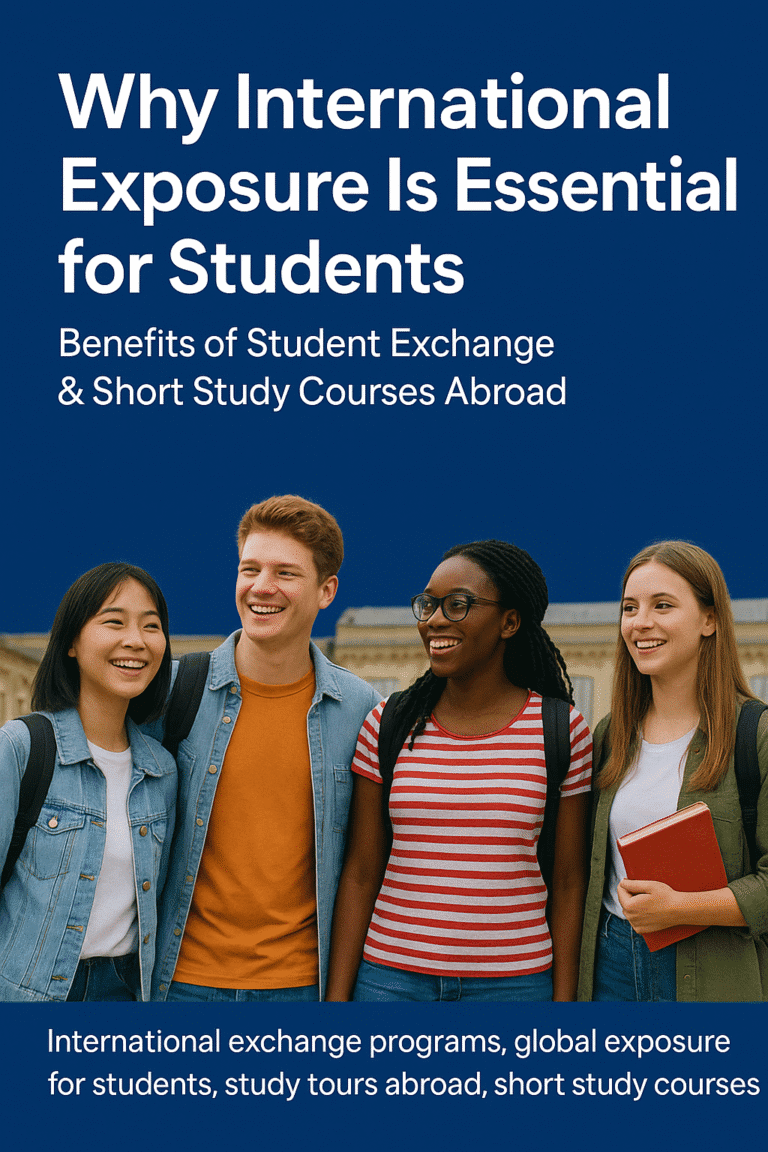
    Why International Exposure Is Essential for Students | Benefits of Student Exchange & Short Study Courses Abroad

    Key Advantages of Student Exchange Programs & Short Courses Abroad

    1. Experience New Cultures Firsthand

    Cultural learning is something no textbook can fully provide.
    Students gain real-world understanding of different lifestyles,
    values, traditions, and global perspectives. This helps them become
    more open-minded, confident, and culturally aware—qualities highly
    valued worldwide.

    Benefits include:

    • Improved communication and social skills
    • Increased confidence and independence
    • Broader worldview and respect for diversity

    2. Easier Visa Approvals & Strong Government Support

    Many countries actively promote student exchange initiatives
    because they strengthen global partnerships.
    As a result, short-term study programs and exchange visas are processed faster,
    with simpler requirements and high approval success.

    Students benefit through:

    • Quick processing times
    • Supportive policies for academic and cultural trips
    • Minimal documentation compared to long-term visas

    3. Affordable International Travel Opportunities

    One of the biggest myths is that international study is expensive—
    but structured programs are surprisingly economical.

    • Institutions abroad often provide subsidized accommodation
    • Group travel reduces logistics costs like airfare, transport & meals
    • Many universities offer grants, funding & partial scholarships

    This makes global learning accessible to students from all backgrounds.

    Why Every Student Must Gain Global Exposure at Least Once

    Participating in a study tour, exchange program, or short course abroad is a
    life-changing experience. Students return with stronger self-belief,
    global networks, and clarity about their future goals.

    Long-term Benefits

    • Global career competitiveness
    • Leadership & problem-solving mindset
    • International networking & friendships
    • Better academic and professional opportunities

    The Role of Educational Institutions

    Every school, college, and university should actively create global pathways for students by:

    • Building partnerships with foreign universities
    • Offering structured exchange and study-tour programs
    • Encouraging parents to support global learning
    • Providing financial planning assistance and guidance

    Institutions that offer international exposure produce confident, globally ready leaders.


    Conclusion

    International exposure is no longer a luxury—it’s a necessity for every student’s future.
    Even a single international experience can transform mindset, confidence,
    personality, and career opportunities. Educational institutions must prioritize
    access to global learning and ensure that every student has the chance to explore
    the world at least once during their academic journey.

    🌍 Let’s empower the next generation of global achievers.

    Start Your International Exposure Journey with CIES

    Looking for student exchange programs, short study courses abroad or international exposure opportunities?
    Connect with our experts now.

    💬 Chat on WhatsApp

    📞 +91-99682 39372
    info@cies.org

    CIES – International Exposure & Study Abroad Experts