September 22, 2026

Study in Australia for Indian students is an attractive option for students looking for internationally recognised education, career-focused courses and international exposure. Australia offers undergraduate, postgraduate and vocational programmes across areas such as business, IT, engineering, healthcare, data science, management and more.

If you are planning to study in Australia from India, this comprehensive guide explains the important aspects of studying in Australia, including popular courses, tuition fees, universities, scholarships, admission requirements, English-language requirements, student visa information and the application process.

Get Free Australia Study Abroad Counselling

Confused about the right course, university, fees or student visa for Australia? Fill in the form below and our counsellors can help you understand your options.

    Quick Answer: Is Australia a Good Study Destination for Indian Students?

    Australia can be a suitable study destination for Indian students seeking internationally recognised qualifications, a wide range of courses and international academic and professional exposure. However, your decision should be based on your course, university, budget, academic profile, career goals and current visa eligibility.

    Why Study in Australia for Indian Students?

    Australia has a large international education sector with universities, colleges and vocational institutions offering programmes to students from around the world.

    For Indian students, commonly considered advantages include:

    • Internationally recognised qualifications
    • Wide choice of undergraduate and postgraduate programmes
    • Courses in technology, business, engineering, healthcare and other fields
    • English-medium education
    • Multicultural student communities
    • Research and innovation opportunities
    • Industry-focused programmes
    • International academic and professional exposure
    • Multiple study locations across Australia

    However, studying abroad requires careful financial planning and compliance with Australia’s current admission and student visa requirements.

    Popular Courses to Study in Australia for Indian Students

    The right course depends on your previous education, academic performance, interests and long-term career plans.

    1. Information Technology & Computer Science

    IT is one of the major areas considered by international students. Popular programmes include:

    • Computer Science
    • Information Technology
    • Software Engineering
    • Cybersecurity
    • Artificial Intelligence
    • Data Science
    • Cloud Computing
    • Business Analytics

    2. Business & Management

    Popular business-related programmes include:

    • Master of Business Administration
    • Master of Management
    • International Business
    • Finance
    • Marketing
    • Accounting
    • Business Analytics
    • Entrepreneurship

    3. Engineering

    Students can explore a range of engineering programmes, including:

    • Civil Engineering
    • Mechanical Engineering
    • Electrical Engineering
    • Electronics Engineering
    • Software Engineering
    • Environmental Engineering
    • Mining Engineering

    4. Healthcare & Nursing

    Healthcare-related study options can include:

    • Nursing
    • Public Health
    • Health Administration
    • Biomedical Science
    • Medical Laboratory Science
    • Occupational Therapy
    • Physiotherapy

    Some healthcare professions have separate professional registration requirements. Students should check the requirements applicable to their intended profession.

    5. Data Science & Artificial Intelligence

    Students interested in technology and data-driven careers can explore:

    • Data Science
    • Artificial Intelligence
    • Machine Learning
    • Business Analytics
    • Data Analytics
    • Information Systems

    6. Hospitality & Tourism

    Popular programmes include:

    • Hospitality Management
    • Tourism Management
    • Hotel Management
    • Event Management
    • Culinary Arts

    Best Universities in Australia for Indian Students

    Australia has several globally recognised universities. Some well-known institutions include:

    • University of Melbourne
    • University of Sydney
    • Australian National University
    • University of Queensland
    • Monash University
    • University of New South Wales
    • University of Adelaide
    • University of Western Australia
    • University of Technology Sydney
    • RMIT University

    The right university should not be selected based only on rankings. Students should compare course curriculum, tuition fees, location, entry requirements, accreditation, career relevance and total cost of study.

    CIES Tip

    Don’t select a university only because it offers a scholarship. Compare the final tuition cost, course quality, location, living expenses and career relevance before accepting an offer.

    Australia Study Fees for Indian Students

    The total cost of studying in Australia depends on your university, course, qualification level and city.

    Estimated Tuition Fees

    Study Level Approximate Annual Tuition
    Bachelor’s Degree AUD 20,000–45,000+
    Master’s Degree AUD 22,000–50,000+
    MBA AUD 25,000–60,000+
    Vocational Courses AUD 10,000–25,000+

    These are indicative planning ranges rather than fixed fees. Actual tuition can vary considerably between universities and programmes.

    Cost of Living in Australia

    Students also need to budget for:

    • Accommodation
    • Food
    • Transportation
    • Health insurance
    • Study materials
    • Mobile and internet expenses
    • Personal expenses

    Your actual cost of living will depend heavily on your city, accommodation type and lifestyle.

    Scholarships to Study in Australia

    Indian students may be eligible for different scholarships depending on their university, academic profile, programme and eligibility criteria.

    • University-specific scholarships
    • Merit-based scholarships
    • International student scholarships
    • Research scholarships
    • Government-funded scholarship programmes

    Scholarship availability, eligibility and award amounts can change. Always check the latest information directly with the university or scholarship provider.

    Admission Requirements to Study in Australia

    Requirements vary according to the university and course.

    For Bachelor’s Courses

    • Class 12 qualification
    • Required academic percentage or grades
    • English-language proficiency
    • Course-specific prerequisites, where applicable
    • Valid passport
    • Supporting documents

    For Master’s Courses

    • Recognised bachelor’s degree
    • Required academic performance
    • English-language proficiency
    • Relevant academic background, depending on the course
    • CV or resume for certain programmes
    • Statement of Purpose or other supporting documents, where required

    IELTS Requirement for Australia

    Many Australian institutions accept English-language tests such as IELTS, although accepted tests and minimum scores vary by institution and programme.

    Depending on your course and university, you may need a specific overall score as well as minimum scores in individual sections.

    Other English-language tests may also be accepted by some institutions. Before booking your test, check the current English-language requirement of your selected university and course.

    Need Help With IELTS or PTE?

    If you are planning to study in Australia, your English-language score can be an important part of your application. CIES provides IELTS, PTE, CELPIP and other English-language coaching options with online and offline classes.

    Get your profile evaluated and understand which test and score may be suitable for your study plan.

    Talk to a Counsellor

    Australia Student Visa for Indian Students

    International students generally need an Australian student visa to study in Australia.

    The process can involve several stages:

    1. Choose a suitable course and institution.
    2. Check the admission requirements.
    3. Submit your university application.
    4. Receive an offer from the institution.
    5. Complete the required enrolment process.
    6. Obtain the required enrolment documentation.
    7. Prepare your student visa application.
    8. Provide supporting documents and information.
    9. Complete health or biometric requirements if applicable.
    10. Submit the visa application.
    11. Wait for the immigration authority’s decision.

    Visa requirements and procedures can change, so students should always refer to the latest official Australian immigration information before applying.

    Documents Required to Study in Australia

    Depending on your university and visa application, documents may include:

    • Passport
    • Academic certificates
    • Mark sheets and transcripts
    • English-language test results
    • CV or resume
    • Statement of Purpose or applicable Genuine Student documentation
    • Offer letter
    • Enrolment documentation
    • Financial documents
    • Health insurance documentation
    • Visa application documents

    How Much Money Do I Need to Study in Australia?

    Your overall budget can include:

    Tuition Fees + Living Expenses + Health Insurance + Visa Costs + Travel + Accommodation + Personal Expenses

    Because tuition fees and living expenses vary significantly, Indian students should create a course-specific budget before applying.

    A good financial plan should account for the entire duration of the programme rather than only the first semester.

    Intakes in Australia

    Australian universities and institutions can have different intakes depending on the course and institution.

    Common intake periods include:

    • February Intake
    • July Intake

    Some institutions and courses may also offer additional intakes.

    Students should begin preparation several months before their intended intake because university applications, English tests, financial planning and visa preparation all require time.

    How to Apply to Australian Universities from India

    Step 1: Check Your Profile

    Review your academic qualifications, English score, work experience, budget, course preferences and career goals.

    Step 2: Select Your Course

    Choose a programme that matches your previous education and career plans.

    Step 3: Shortlist Universities

    Compare universities based on:

    • Course content
    • Tuition fees
    • Location
    • Entry requirements
    • Scholarships
    • Accreditation
    • Career relevance

    Step 4: Prepare Documents

    Collect your academic, identification and supporting documents.

    Step 5: Apply

    Submit applications to your selected institutions.

    Step 6: Receive Your Offer

    If successful, the university may issue an offer letter.

    Step 7: Complete Enrolment

    Follow the institution’s instructions to complete the enrolment process.

    Step 8: Prepare Your Visa Application

    Prepare the required documents and submit the relevant Australian student visa application.

    Study in Australia After 12th

    Indian students who have completed Class 12 can explore undergraduate programmes in Australia.

    Popular fields include:

    • Business
    • Computer Science
    • Information Technology
    • Engineering
    • Nursing
    • Hospitality
    • Design
    • Accounting
    • Media
    • Environmental Science

    Your Class 12 subjects and academic results may affect eligibility for particular programmes.

    Study in Australia After Graduation

    Students who already have a bachelor’s degree can explore postgraduate programmes such as:

    • Master’s degrees
    • Graduate certificates
    • Graduate diplomas
    • MBA programmes
    • Research degrees

    The appropriate qualification depends on your previous education, experience and career objectives.

    Can Indian Students Work While Studying in Australia?

    International student work rights are governed by Australian immigration rules and visa conditions.

    If you plan to work while studying, make sure you understand the current work restrictions attached to your visa rather than relying on older information available online.

    Your primary purpose should remain compliance with your study and visa conditions.

    Post-Study Opportunities in Australia

    Depending on their qualification, circumstances and eligibility, some international graduates may explore Australian post-study or other graduate visa pathways.

    However, post-study work rights and migration pathways can change. Eligibility can depend on factors such as qualification, occupation, location and the immigration rules applicable at the time.

    Students should assess these pathways before choosing a course rather than assuming that every Australian degree automatically leads to permanent residency.

    Study in Australia vs Other Countries

    Students often compare Australia with Canada, the UK, USA and other study destinations. Instead of choosing a country solely based on popularity, compare the factors that matter to your individual profile.

    Factor What to Consider
    Tuition Total annual and programme cost
    Living Expenses City and accommodation costs
    Course Curriculum and career relevance
    University Reputation and accreditation
    English Test Required score and accepted tests
    Visa Current eligibility and documentation
    Work Rights Current visa conditions
    Post-Study Options Current eligibility rules
    Scholarships Availability and eligibility
    Career Industry and employment environment

    Why Choose CIES for Study in Australia?

    CIES Overseas Education helps students understand their options for studying in Australia and other international destinations.

    Our support can include:

    • Profile evaluation
    • Course selection
    • University shortlisting
    • Application guidance
    • Scholarship guidance
    • Documentation support
    • Statement of Purpose guidance
    • Student visa guidance
    • IELTS and PTE preparation
    • Pre-departure assistance
    • Air ticketing support

    With 10+ years of experience and 5000+ students since 2016, CIES provides guidance for students planning international education.

    Planning to Study in Australia?

    Get your profile evaluated and understand your course, university, budget and application options.

    BOOK FREE COUNSELLING

    Frequently Asked Questions

    Is Australia good for Indian students?

    Australia offers a wide range of internationally recognised courses and study options for international students. Whether it is suitable for you depends on your academic profile, budget, chosen course, university and long-term goals.

    How much does it cost to study in Australia for Indian students?

    Tuition fees vary by course and university. Indian students should also budget for accommodation, food, transportation, health insurance, visa costs and other expenses.

    Which course is best in Australia for Indian students?

    Popular areas include IT, computer science, engineering, business, data science, healthcare, nursing and hospitality. The appropriate course depends on your academic background and career objectives.

    Can I study in Australia after Class 12?

    Yes. Indian students who meet the academic and English-language requirements can apply for eligible undergraduate programmes in Australia.

    What IELTS score is required for Australia?

    The required IELTS score varies by university, course and visa-related requirements. Students should check the current requirements applicable to their specific programme and circumstances.

    How can I get a student visa for Australia from India?

    You generally need to secure admission or enrolment in an eligible Australian course and then meet the applicable student visa requirements, including providing the required documentation and information.

    How much bank balance is required for an Australia student visa?

    Financial requirements can change. Students should check the latest official Australian immigration requirements for the amount and evidence applicable to their circumstances.

    Can I work while studying in Australia?

    International students may have work rights subject to their visa conditions. Always check your current visa conditions and Australian immigration rules before working.

    Can studying in Australia lead to PR?

    Studying in Australia does not automatically result in permanent residency. Some graduates may have pathways depending on their qualification, occupation, location and eligibility under the immigration rules in force at the time.

    Final Thoughts

    Study in Australia for Indian students can provide access to internationally recognised education, diverse courses and international academic and professional exposure.

    However, the right decision depends on more than choosing a popular destination. Your course, university, budget, academic profile, English-language score, career objectives and visa eligibility should all be considered together.

    If you are planning to study in Australia in 2027, start your preparation early and get your profile evaluated before selecting a course or university.

    Start Your Australia Study Abroad Journey with CIES

    Looking for guidance on courses, universities, scholarships, IELTS/PTE, applications or student visas for Australia?

    Get FREE counselling and a personalised profile evaluation.

    CONTACT CIES OVERSEAS EDUCATION

    September 21, 2026

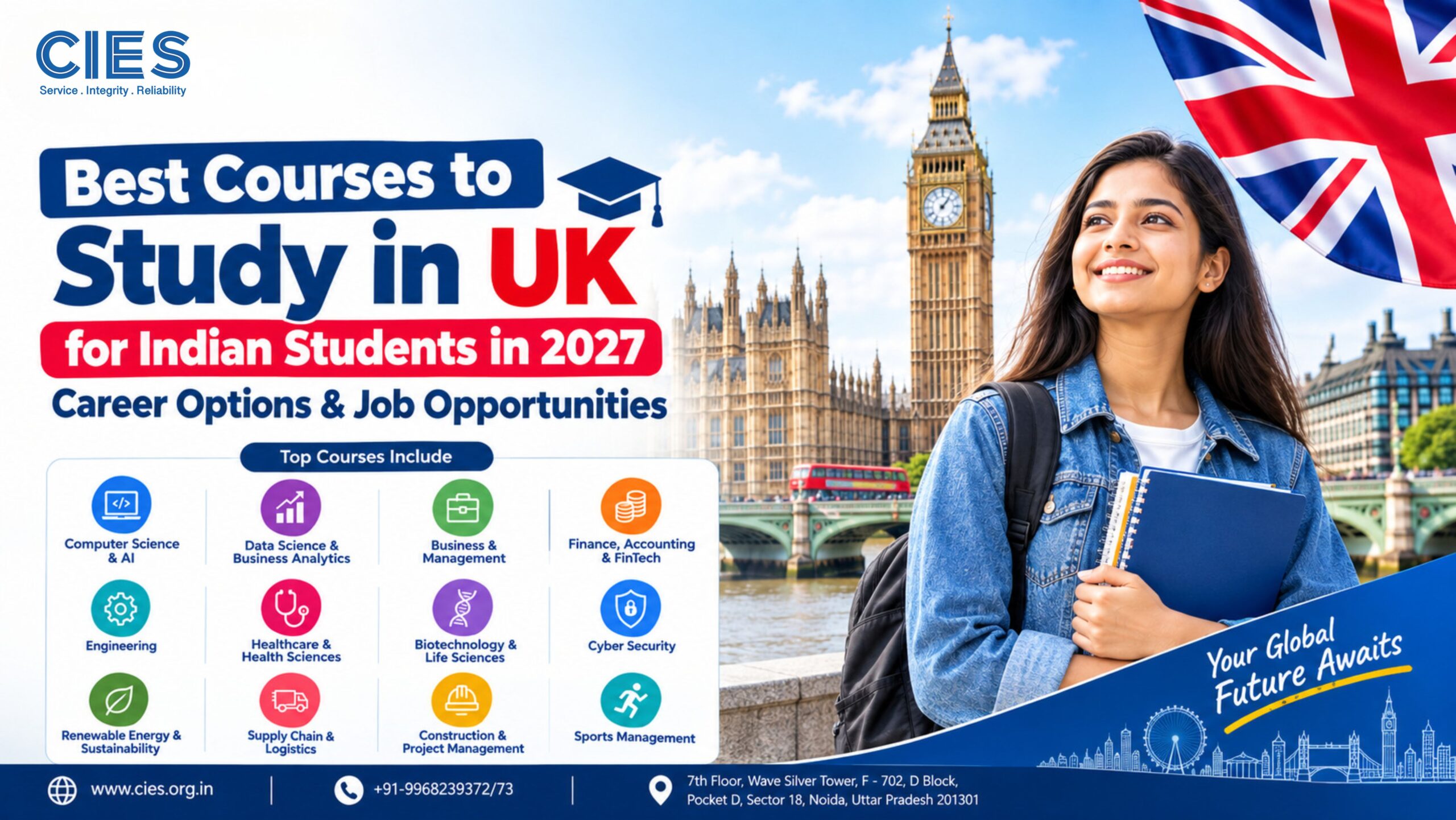
    Looking for the best courses to study in UK for Indian students in 2027? The UK offers a wide range of undergraduate and postgraduate programmes in areas such as Artificial Intelligence, Computer Science, Data Science, Business Analytics, Finance, Engineering, Healthcare, Cyber Security, Biotechnology, Sustainability and Supply Chain Management.

    For Indian students, choosing the right UK course should involve more than looking at university rankings or current popularity. Your academic background, career objective, tuition budget, location preference, course curriculum, practical experience and future employment plans should all be considered before applying.

    This guide explains the best courses to study in the UK in 2027 for Indian students, potential career options, job-related skills, factors to consider when selecting a course, the current Graduate visa position and how to plan your UK study application.

    Quick Answer: What Are the Best Courses to Study in the UK in 2027?

    There is no single best UK course for every Indian student. The most relevant areas to research for 2027 include:

    • Computer Science & Artificial Intelligence – technology and software careers
    • Data Science & Business Analytics – data and analytical careers
    • Business & Management – management, consulting and business careers
    • Finance, Accounting & FinTech – finance and financial technology
    • Engineering – technical, infrastructure and engineering careers
    • Healthcare & Health Sciences – healthcare, research and management
    • Biotechnology & Life Sciences – pharmaceutical and research careers
    • Cyber Security – information and digital security
    • Renewable Energy & Sustainability – environmental and energy careers
    • Supply Chain & Logistics – procurement and operations
    • Construction & Project Management – infrastructure and project careers
    • Sports Management – sports business, events and marketing

    The right course depends on your academic profile, career goals, budget and eligibility.

    Why Study in the UK in 2027?

    The UK is a popular destination for Indian students because it provides access to internationally recognised universities, specialised programmes and a wide variety of academic disciplines.

    Depending on the university and course, students can find programmes with practical projects, industry exposure, placements, research opportunities and career support.

    • Globally recognised UK qualifications
    • Wide choice of undergraduate and postgraduate courses
    • Specialised master’s programmes
    • Industry-focused modules and projects
    • International learning environment
    • Opportunities to develop professional skills
    • Potential post-study work options for eligible graduates

    Important: UK immigration rules can change. Students should check the latest official UK Government guidance before making decisions about study, work or immigration.

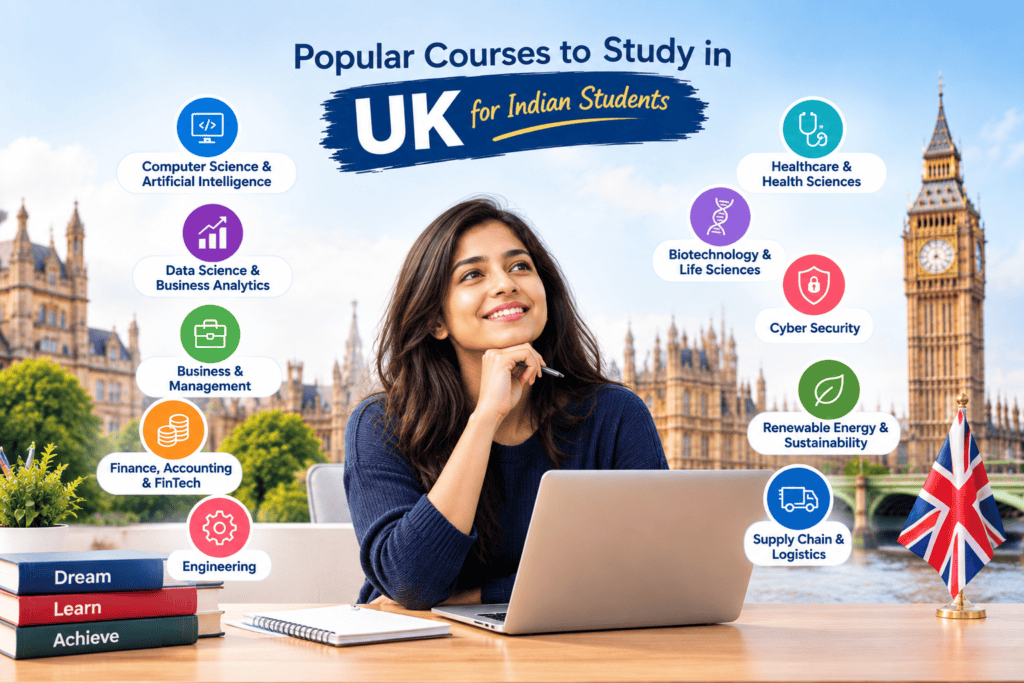
    Popular courses to study in the UK for Indian students in 2027Best Courses to Study in UK for Indian Students in 2027

    The following course areas can be considered by Indian students depending on their educational background and career objectives.

    1. Computer Science & Artificial Intelligence

    Computer Science and Artificial Intelligence are popular study areas for students interested in software, technology, machine learning, automation and digital products.

    Popular UK Courses

    • MSc Computer Science
    • MSc Artificial Intelligence
    • MSc Machine Learning
    • MSc Software Engineering
    • MSc Cloud Computing
    • MSc Artificial Intelligence & Data Science

    Potential Career Options

    • Software Engineer
    • Software Developer
    • AI Engineer
    • Machine Learning Engineer
    • Cloud Engineer
    • Technology Consultant

    Useful skills: Python, SQL, cloud technologies, machine learning, software development and data analytics.

    2. Data Science & Business Analytics

    Data Science and Business Analytics courses can suit students who enjoy mathematics, statistics, technology and business decision-making.

    Popular Courses

    • MSc Data Science
    • MSc Business Analytics
    • MSc Data Analytics
    • MSc Business Intelligence
    • MSc Financial Data Science
    • MSc AI & Data Science

    Potential Career Options

    • Data Analyst
    • Data Scientist
    • Business Analyst
    • Business Intelligence Analyst
    • Analytics Consultant
    • Risk Analyst

    3. Business & Management

    Business and management courses can be considered by students interested in leadership, consulting, marketing, entrepreneurship, operations and international business.

    Popular Courses

    • MSc Management
    • MSc International Business
    • MSc Marketing
    • MSc International Marketing
    • MSc Entrepreneurship
    • MBA
    • MSc Operations Management

    Potential Career Options

    • Business Analyst
    • Management Consultant
    • Marketing Professional
    • Business Development Professional
    • Project Manager
    • Operations Professional

    4. Finance, Accounting & FinTech

    Students interested in financial markets, accounting, investment, banking and financial technology can explore specialised finance courses in the UK.

    Popular Courses

    • MSc Finance
    • MSc Accounting & Finance
    • MSc Investment Management
    • MSc Financial Technology
    • MSc Banking
    • MSc Financial Risk Management

    Potential Career Options

    • Financial Analyst
    • Investment Analyst
    • Risk Analyst
    • FinTech Analyst
    • Finance Associate
    • Accounting Professional

    5. Engineering

    Engineering remains a broad field with opportunities to specialise in mechanical, civil, electrical, electronic, aerospace, automotive, chemical and renewable-energy disciplines.

    Popular Engineering Courses

    • Mechanical Engineering
    • Civil Engineering
    • Electrical Engineering
    • Electronic Engineering
    • Aerospace Engineering
    • Automotive Engineering
    • Chemical Engineering
    • Renewable Energy Engineering
    • Engineering Management

    Potential Career Areas

    • Engineering
    • Manufacturing
    • Infrastructure
    • Energy
    • Automotive
    • Aerospace
    • Project Management

    6. Healthcare & Health Sciences

    Indian students interested in healthcare, research, health policy and healthcare management can explore a range of health-related programmes.

    Popular Courses

    • Public Health
    • Healthcare Management
    • Biomedical Sciences
    • Clinical Research
    • Health Data Science
    • Nursing
    • Physiotherapy

    Important: Some UK healthcare professions are regulated. Check the relevant professional registration requirements before choosing a course.

    7. Biotechnology & Life Sciences

    Biotechnology and life sciences can be relevant for students with backgrounds in biology, biotechnology, pharmacy, biomedical science and related disciplines.

    • MSc Biotechnology
    • MSc Biomedical Science
    • MSc Molecular Biology
    • MSc Bioinformatics
    • MSc Pharmaceutical Science
    • MSc Clinical Research
    • MSc Genetics

    Potential Career Areas

    • Biotechnology
    • Pharmaceutical Research
    • Clinical Research
    • Laboratory Science
    • Bioinformatics
    • Life Sciences Research

    8. Cyber Security

    Cyber security is an important area for students interested in protecting networks, systems, applications and digital information.

    Popular Courses

    • MSc Cyber Security
    • MSc Information Security
    • MSc Network Security
    • MSc Digital Forensics
    • MSc Cyber Security Management

    Potential Career Options

    • Cyber Security Analyst
    • Security Consultant
    • Security Engineer
    • Information Security Analyst
    • Digital Forensics Analyst
    • SOC Analyst

    9. Renewable Energy & Sustainability

    Students interested in climate, clean energy, environmental management and sustainable development can explore programmes connected with sustainability and renewable energy.

    • Renewable Energy Engineering
    • Sustainability Management
    • Environmental Management
    • Environmental Science
    • Energy Systems
    • Sustainable Development
    • Environmental Engineering

    Potential Career Options

    • Sustainability Consultant
    • Environmental Consultant
    • Energy Analyst
    • Renewable Energy Professional
    • ESG Professional
    • Environmental Project Manager

    10. Supply Chain & Logistics

    Supply chain and logistics programmes can suit students interested in international trade, procurement, transportation, operations and business management.

    • MSc Supply Chain Management
    • MSc Logistics Management
    • MSc Procurement & Supply
    • MSc Operations Management
    • MSc International Logistics

    Potential Career Options

    • Supply Chain Analyst
    • Procurement Analyst
    • Logistics Manager
    • Operations Analyst
    • Demand Planner
    • Supply Chain Consultant

    11. Construction & Project Management

    Students with backgrounds in civil engineering, architecture, construction or business can consider specialised programmes in construction and project management.

    • MSc Construction Management
    • MSc Project Management
    • MSc Quantity Surveying
    • MSc Civil Engineering
    • MSc Infrastructure Management

    Potential Career Options

    • Project Manager
    • Construction Manager
    • Quantity Surveyor
    • Project Coordinator
    • Construction Consultant

    12. Sports Management

    Sports management combines sports with business, marketing, events, sponsorship, operations and analytics.

    • MSc Sports Management
    • Sports Business
    • Sports Marketing
    • Sports Analytics
    • International Sports Management

    Potential Career Options

    • Sports Marketing
    • Sports Operations
    • Sports Event Management
    • Sponsorship
    • Sports Business Development
    • Sports Analytics

    UK Courses & Career Opportunities: Quick Comparison

    Study Area Popular Courses Potential Career Areas
    Technology Computer Science, AI, Software Engineering Software, AI, Cloud
    Data Data Science, Business Analytics Data & Analytics
    Business Management, International Business Management, Consulting
    Finance Finance, Accounting, FinTech Finance, Banking, Risk
    Engineering Civil, Mechanical, Electrical Engineering, Infrastructure
    Healthcare Public Health, Health Sciences Healthcare, Research
    Life Sciences Biotechnology, Biomedical Science Pharma, Research
    Cyber Security Cyber Security, Information Security Security, Risk
    Sustainability Renewable Energy, Sustainability Energy, ESG
    Supply Chain Supply Chain, Logistics Procurement, Operations

    How to Choose the Right Course to Study in the UK in 2027

    Choosing the right UK course should be a structured decision. Use the following factors before submitting your university application.

    1. Match the Course With Your Academic Background

    Check whether your previous degree and subjects meet the university’s academic requirements. Some courses may require specific subjects, grades, work experience or prerequisite knowledge.

    2. Define Your Career Goal

    Think about the type of role or industry you want to enter after graduation. Then compare courses based on the skills and knowledge they provide.

    3. Compare Course Modules

    Two courses with similar names can have very different modules. Read the curriculum carefully and identify whether it includes practical projects, specialist modules, research or industry exposure.

    4. Check University Location

    Location can influence accommodation costs, transport, lifestyle and access to local employers. Consider the overall cost of studying in the city rather than looking only at tuition fees.

    5. Research Practical Experience

    • Internships
    • Industry projects
    • Placement opportunities
    • Employer events
    • Career services
    • Professional certifications

    6. Check Current Immigration Rules

    If your plans include working in the UK after graduation, understand the current Student visa and Graduate route requirements before choosing your programme.

    Job Opportunities After Studying in the UK

    The career opportunities available after graduation depend on your course, skills, experience, employer requirements and the wider UK labour market.

    Students can improve their employability by combining their academic qualification with practical experience and relevant technical or professional skills.

    Skills That Can Support Employability

    Technology: Programming, cloud computing, software development, and AI.

    Data: Python, SQL, statistics, data visualization, and analytics.

    Business: Excel, communication, analytics, and project management.

    Finance: Financial modelling, Excel, analytics, and accounting knowledge.

    Marketing: Digital marketing, SEO, analytics, and content.

    Cyber Security: Networking, cloud security, security operations, and risk management.

    UK Graduate Visa 2027: What Indian Students Need to Know

    The UK Graduate route is an important consideration for international students who plan to work or look for work after completing an eligible UK course.

    Current Graduate Route Position

    • Eligible bachelor’s and master’s graduates applying from 1 January 2027 will generally receive 18 months.
    • Eligible PhD and doctoral graduates can receive 3 years.
    • The Graduate route is unsponsored.
    • Eligible graduates can work or look for work.
    • The Graduate route itself is not a settlement route.

    Always verify the latest rules on GOV.UK before making an immigration decision. Visa policies and requirements may change.

    How to Apply to Study in the UK in 2027

    Step 1: Choose Your Course

    Identify suitable programmes based on your academic background, career objectives, budget and preferred location.

    Step 2: Shortlist UK Universities

    Compare course content, entry requirements, tuition fees, facilities, location, practical experience and career support.

    Step 3: Prepare Your Documents

    • Passport
    • Academic transcripts
    • Degree certificate
    • English-language test result, where required
    • CV
    • Statement of Purpose
    • Letters of Recommendation, where required
    • Work experience documents, where applicable

    Step 4: Submit University Applications

    Submit your applications according to the requirements and deadlines of your selected universities.

    Step 5: Meet Offer Conditions

    If your offer is conditional, complete the required conditions before proceeding with the next stage.

    Step 6: Apply for Your Student Visa

    Once you have the required university documentation, check the latest UK Student visa requirements and prepare your visa application.

    🎓 Need Help Choosing Your UK Course?

    Get a personalised profile evaluation and guidance on suitable UK courses and universities.

    Get FREE Study Abroad Counselling

    Frequently Asked Questions

    What are the best courses to study in UK for Indian students in 2027?

    Popular areas to research include Computer Science, Artificial Intelligence, Data Science, Business Analytics, Finance, Engineering, Healthcare, Cyber Security, Biotechnology, Sustainability and Supply Chain Management. The right course depends on your academic background and career goals.

    Which course is best for a job in the UK?

    There is no course that guarantees a job. Career outcomes depend on the course, your skills, practical experience, employer requirements and labour-market conditions. Students should research their target occupation before selecting a degree.

    What are the best master’s courses in the UK for Indian students?

    Students can explore master’s programmes in areas such as Artificial Intelligence, Computer Science, Data Science, Business Analytics, Finance, Engineering, Cyber Security, Public Health, Biotechnology, Supply Chain Management and Sustainability, depending on their previous qualification.

    Can Indian students work in the UK after studying?

    Eligible international graduates may apply for the UK Graduate route after completing an eligible course. Current rules should be checked before applying because immigration requirements can change.

    How long is the UK Graduate Visa for students graduating in 2027?

    Under the current rules, eligible bachelor’s and master’s graduates applying for the Graduate route from 1 January 2027 generally receive 18 months. Eligible doctoral graduates can receive three years.

    Is IELTS required to study in the UK?

    English-language requirements vary by university and course. Some institutions may accept IELTS, while others may accept alternative English-language tests or specific previous-study qualifications. Always check the requirements of your chosen university.

    How much does it cost to study in the UK?

    The total cost depends on your university, course, city, accommodation and lifestyle. Compare tuition fees and estimated living costs for each university before making your final decision.

    When should Indian students apply for the UK 2027 intake?

    Students should begin researching courses and universities well before their intended intake. Application deadlines vary by university and course, and some popular programmes can have earlier or limited application windows.

    💡 CIES Tip for Indian Students

    Don’t choose a UK course only because it is trending. Compare your academic profile, career goal, course curriculum, university, tuition fee, location, practical experience, employability skills and current immigration rules before making your decision.

    Conclusion: Choosing the Right UK Course for 2027

    For Indian students planning to study in the UK in 2027, selecting the right course should be based on a combination of academic suitability, career objectives, skills development, university choice, budget and future plans.

    Courses in technology, AI, data science, business analytics, finance, engineering, healthcare, cyber security, life sciences, sustainability, and supply chain management can provide different academic and professional pathways.

    There is no universally best UK course. The best-fit programme is the one that matches your profile, interests and realistic career objectives.

    🇬🇧 Planning to Study in the UK in 2027?

    Get personalised guidance on UK courses, universities, eligibility, applications, scholarships and student visa requirements.

    Book FREE counselling with CIES Overseas Education.

    Book FREE Counselling

    Related Study Abroad Resources

    🎓 Get FREE UK Study Counselling

    Share your academic profile and get guidance on suitable UK courses and universities.

      September 16, 2026

      Choosing the best courses to study abroad in 2027 can help Indian students make informed decisions about their education, career goals, budget and preferred study destination. From Artificial Intelligence and Data Science to Engineering, Business, Healthcare and Sustainability, international universities offer a wide range of career-focused programs for students planning to study overseas.

      Quick Answer: Which Are the Best Courses to Study Abroad in 2027?

      Some of the most relevant study-abroad programs for 2027 include AI & Machine Learning, Data Science, Computer Science, Cybersecurity, Engineering, Business Analytics, Finance & FinTech, Healthcare, Biotechnology, Renewable Energy, Sustainability, Architecture and Design. The best course for you depends on your academic background, career goals, budget, admission requirements and preferred destination.

      Why Choose the Right Course Before Studying Abroad?

      Studying overseas is a significant academic and financial investment. Therefore, selecting a course should involve more than simply choosing a popular subject. You should consider the curriculum, university requirements, tuition and living costs, available career pathways, internship opportunities and the rules applicable to international students.

      A well-planned course and destination combination can make your international education journey more focused and manageable.

      Top Courses to Study Abroad in 2027

      1. Artificial Intelligence & Machine Learning

      Artificial Intelligence and Machine Learning continue to be important areas of study across technology and business. International universities offer programs covering machine learning, deep learning, natural language processing, computer vision, robotics and AI applications.

      Popular study areas: Artificial Intelligence, Machine Learning, Robotics, Applied AI, Computational Intelligence.

      2. Data Science & Data Analytics

      Data-focused programs combine statistics, programming, analytics and business decision-making. Students may study data visualization, predictive analytics, big data, statistical modelling and machine learning.

      Popular study areas: Data Science, Business Analytics, Data Analytics, Big Data and Applied Statistics.

      3. Computer Science & Software Engineering

      Computer Science remains a broad option for students interested in software development, computing systems, algorithms and emerging technologies. Depending on the university, students can specialize in areas such as cloud computing, software engineering, artificial intelligence and distributed systems.

      Popular study areas: Computer Science, Software Engineering, Cloud Computing, Computing and Information Technology.

      4. Cybersecurity & Information Security

      As organizations increasingly depend on digital infrastructure, cybersecurity has become an important academic specialization. Programs can cover network security, digital forensics, information assurance, ethical security practices and risk management.

      5. Engineering

      Engineering offers a wide range of international study options. Depending on your previous education and interests, you may consider mechanical, electrical, civil, chemical, environmental, industrial or computer engineering.

      Popular specializations: Mechanical Engineering, Electrical Engineering, Civil Engineering, Chemical Engineering, Industrial Engineering and Environmental Engineering.

      6. Business Analytics & Management

      Business-related programs can be suitable for students interested in management, strategy, entrepreneurship, marketing and data-driven decision-making. Business Analytics can be particularly useful for students who want to combine business knowledge with analytical skills.

      7. Finance, Accounting & FinTech

      Students with an interest in financial systems can explore Finance, Accounting, Financial Technology and related programs. Depending on the university, programs may include investment management, corporate finance, financial modelling, accounting and digital finance.

      8. Healthcare & Health Sciences

      Healthcare and health-science programs cover a broad range of academic disciplines. Students can explore public health, healthcare management, biomedical sciences, nursing and other health-related programs, subject to individual university and professional licensing requirements.

      9. Biotechnology & Life Sciences

      Biotechnology and life-science programs can suit students with backgrounds in biology, chemistry, biotechnology and related subjects. Areas of study may include molecular biology, genetics, biomedical research, bioinformatics and pharmaceutical sciences.

      10. Renewable Energy, Sustainability & Environmental Studies

      Sustainability and environmental studies bring together science, engineering, policy and business perspectives. International universities offer programs related to renewable energy, climate studies, environmental management, sustainable development and green technologies.

      11. Architecture, Design & Creative Industries

      Students with creative interests can consider architecture, graphic design, interaction design, product design, animation, fashion and related programs. Portfolio requirements can be an important part of admission for many creative courses.

      💡 CIES Tip

      Do not choose a course only because it is currently popular. Compare the course curriculum with your previous education, strengths and long-term career objectives before applying.

      Top Study Destinations for International Students in 2027

      The right destination depends on your preferred course, academic profile, budget, language requirements and future plans. Countries commonly considered by Indian students include the UK, Germany, Ireland, Finland, Denmark, Sweden, the Netherlands, Australia and Canada.

      Destination Popular Study Areas What to Research
      UK Business, Computing, Engineering, Healthcare University requirements, tuition, visa rules
      Germany Engineering, IT, Data, Sciences Program language, tuition structure, admission requirements
      Ireland IT, Business, Pharma, Data Course fees, entry requirements, immigration rules
      Finland Technology, Business, Engineering Program language, tuition and scholarship options
      Denmark Engineering, Business, IT, Sustainability Program requirements, fees and residence rules
      Sweden Technology, Engineering, Sustainability University selection, tuition and scholarship availability
      Netherlands Business, Engineering, Technology Institution type, tuition and admission criteria
      Australia Business, IT, Engineering, Healthcare Course costs, visa conditions and eligibility
      Canada IT, Business, Engineering, Healthcare Institution, program eligibility and current immigration rules

      Popular Courses Based on Your Academic Background

      Academic Background Possible Course Areas
      Computer Science / IT AI, Data Science, Cybersecurity, Software Engineering
      Engineering Engineering specializations, Technology, Data, Sustainability
      Commerce / B.Com Finance, Accounting, Business Analytics, Management
      Science Biotechnology, Life Sciences, Data, Environmental Studies
      Arts / Humanities Design, Management, Social Sciences, Communication
      Architecture / Design Architecture, Product Design, UX/UI, Creative Programs

      How to Choose the Right Course to Study Abroad

      1. Match the Course With Your Academic Background

      Check whether your previous degree or subjects meet the university’s academic prerequisites. Some programs require specific subjects, credits or relevant work experience.

      2. Compare the Curriculum

      Two courses with similar names can have very different curricula. Review modules, practical projects, internships, research opportunities and specialization options.

      3. Check University Admission Requirements

      Review academic scores, English-language requirements, standardized tests, portfolios, work experience and other requirements before shortlisting universities.

      4. Calculate the Complete Budget

      Do not consider tuition alone. Your budget should also account for accommodation, food, transportation, insurance, application costs and other living expenses.

      5. Check English-Language Requirements

      Universities may accept IELTS, PTE, TOEFL or other approved tests depending on the program and institution. Always verify the exact requirement of your chosen university.

      If you are preparing for an English-language test, explore our IELTS Coaching in Noida Sector 18 and IELTS Coaching in Delhi resources.

      6. Consider Career-Relevant Skills

      Look beyond the course title. Consider what technical, analytical, research, communication or practical skills you can develop through the program.

      7. Review Current Visa and Post-Study Rules

      Visa, work and post-study policies can change. Before applying, verify the latest rules through official government and university sources for your destination.

      🎓 Plan Your Study Abroad Journey With CIES

      Not sure which course, university or destination fits your profile? CIES Overseas Education can help you evaluate your academic background, shortlist suitable options and understand the application process.

      Get a profile evaluation and discuss your study-abroad options.

      🚀 Ready to Choose Your Course for 2027?

      Get personalised guidance on courses, universities, destinations, applications and student visa requirements.

      📲 WhatsApp CIES📞 Book Free Counselling

      2027 Study Abroad Application Timeline

      Period Recommended Action
      Early Planning Research courses, destinations and universities.
      Profile Preparation Prepare English test, academic documents and shortlist.
      Application Stage Submit applications and required supporting documents.
      Offer Stage Review offers, finances and accommodation options.
      Visa Preparation Prepare the student visa application and supporting documents.

      Common Mistakes Students Should Avoid

      • Choosing a course only because it is trending.
      • Ignoring university-specific eligibility criteria.
      • Comparing tuition fees without considering living costs.
      • Applying without checking English-language requirements.
      • Selecting a university without researching the actual curriculum.
      • Relying on outdated information about visa or immigration rules.
      • Waiting until the last minute to prepare documents.

      How CIES Can Help With Your Study Abroad Plans

      Choosing the right international education pathway can involve comparing several universities, countries and courses. CIES Overseas Education provides guidance throughout the study-abroad planning process.

      • Profile evaluation and course selection
      • University and destination shortlisting
      • Application guidance
      • SOP and documentation guidance
      • English-language test preparation
      • Student visa guidance
      • Accommodation and air-ticketing support

      Learn more about our Study Abroad Consultants in Noida and explore our Visa Services.

      📩 Get Study Abroad Guidance

      Fill out the form and our counsellors can help you explore suitable courses and study destinations.

        Frequently Asked Questions

        What are the best courses to study abroad in 2027?

        Popular and career-oriented options include Artificial Intelligence, Data Science, Computer Science, Cybersecurity, Engineering, Business Analytics, Finance, Healthcare, Biotechnology and Sustainability. The right choice depends on your individual profile and goals.

        Which country is best for studying abroad in 2027?

        There is no single destination that is suitable for every student. Your choice should consider the course, university, tuition, living expenses, admission requirements and current visa rules.

        Which courses are suitable for Indian students after 12th?

        Depending on your subjects and interests, options can include Computer Science, Engineering, Business, Data-related programs, Life Sciences, Design, Architecture and other undergraduate disciplines.

        Which courses can students consider after graduation?

        Graduates can consider master’s programs aligned with their previous education, including Data Science, AI, Business Analytics, Engineering, Finance, Management, Healthcare, Biotechnology and other specialized disciplines.

        Do I need IELTS to study abroad?

        Many universities require proof of English proficiency, but accepted tests and exemptions vary by institution and program. Always check the exact requirements of your chosen university.

        How early should I start planning for 2027?

        Starting early gives you more time to research programs, prepare for English-language tests, collect documents, write your SOP and complete applications. Exact deadlines vary by country and institution.

        Final Thoughts

        The best courses to study abroad in 2027 are not necessarily the courses with the most attention online. A strong choice is one that matches your academic background, interests, budget and long-term objectives.

        Research the course curriculum, compare universities and verify the latest admission and visa requirements before making your final decision. If you need help evaluating your options, connect with CIES Overseas Education for personalised study-abroad counselling.

        🎓 Your 2027 Study Abroad Journey Starts With the Right Course

        Talk to CIES Overseas Education for course selection, university shortlisting and study visa guidance.

        📲 WhatsApp: +91-9968239372📞 Contact CIES

        Disclaimer

        Course availability, tuition fees, admission criteria, scholarships, visa regulations and immigration policies can change. Students should verify current requirements with the relevant university and official government sources before applying.

        September 15, 2026

        Planning to study a Master’s in UK in 2027? 🇬🇧 The UK continues to be a popular destination for Indian students looking for globally recognised universities, specialised postgraduate courses, international exposure and career-focused education.

        From Computer Science, Artificial Intelligence and Data Science to Business, Finance, Engineering, Healthcare, Law and Sustainability, UK universities offer a wide range of Master’s programmes for international students.

        But choosing the right Master’s programme involves more than looking at university rankings. Indian students should compare tuition fees, living costs, course duration, entry requirements, scholarships, university location, career opportunities and UK Student Visa requirements before making a decision.

        Quick Answer: A Master’s in the UK can be an attractive option for Indian students because many taught Master’s programmes can be completed in around one year. Tuition fees vary significantly by university and course, while living costs are generally higher in London. For the 2027 intake, students should also plan according to the latest UK Student Visa and Graduate Visa rules.

        🎓 Planning Your Master’s in the UK?

        Get personalised guidance on UK universities, Master’s courses, scholarships, applications and Student Visa planning for the 2027 intake.

        📞 Book FREE Counselling 💬 WhatsApp CIES

        🇬🇧 Why Study a Master’s in the UK?

        The UK has a long-established higher education system and offers postgraduate programmes across a wide range of academic and professional fields. For Indian students, the combination of internationally recognised universities, specialised courses and a multicultural environment makes the UK an important study-abroad destination.

        • 🎓 Globally recognised universities and qualifications
        • ⏱️ Many taught Master’s programmes can be completed in around one year
        • 📚 Wide choice of specialised postgraduate courses
        • 🌍 International and multicultural learning environment
        • 💼 Opportunities to develop industry-relevant skills
        • 🔬 Strong research and innovation ecosystem
        • 🇮🇳 Large Indian student community in many UK cities

        🎓 Popular Master’s Courses in the UK for Indian Students

        Indian students can choose from hundreds of postgraduate specialisations. The right course depends on your previous degree, career goals, academic profile and long-term plans.

        Course Area Popular Master’s Courses
        💻 Technology MSc Computer Science, Artificial Intelligence, Data Science, Cyber Security, Software Engineering
        📊 Business MSc Management, International Business, Finance, Marketing, Business Analytics
        ⚙️ Engineering Mechanical Engineering, Civil Engineering, Electrical Engineering, Electronics, Renewable Energy
        🏥 Healthcare Public Health, Healthcare Management, Health Sciences, Biomedical Sciences
        📈 Economics & Finance Economics, Financial Economics, Banking, Investment and Finance
        ⚖️ Law LLM International Law, Commercial Law, Corporate Law, Human Rights Law
        🎨 Creative Fields Design, Fashion, Media, Film, Architecture and Creative Industries
        🌱 Sustainability Environmental Management, Sustainability, Climate Change and Renewable Energy

        🏆 Top Universities in the UK for Master’s 2027

        The UK has several internationally recognised universities. However, the best university for you depends on your chosen subject, academic background, budget and career objectives.

        When shortlisting universities, don’t look only at overall rankings. Compare the specific course, modules, faculty, research strengths, industry connections, location, tuition fees and graduate career opportunities.

        University Popular Study Areas
        University of Oxford Business, Economics, Computer Science, Engineering, Social Sciences and Law
        University of Cambridge Engineering, Computer Science, Management, Natural Sciences and Economics
        Imperial College London Engineering, Computing, AI, Business, Science and Healthcare
        UCL Business, Computer Science, Architecture, Engineering, Education and Health
        University of Edinburgh Computer Science, Data Science, Business, Engineering and Medicine
        King’s College London Law, Business, International Relations, Health and Social Sciences
        University of Manchester Engineering, Business, Computer Science, Management and Life Sciences
        University of Bristol Engineering, Computer Science, Business, Data Science and Science
        London School of Economics and Political Science Economics, Finance, Management, Politics and Social Sciences
        University of Warwick Business, Management, Economics, Engineering and Computer Science
        💡 CIES Tip: Don’t choose a university only because it appears high in a global ranking. A course with strong modules, relevant skills, industry exposure and career alignment can be a better choice for your individual profile.

        💰 Master’s in UK Fees for Indian Students 2027

        The cost of studying a Master’s in the UK depends on the university, course, location and duration. International tuition fees can vary considerably, so students should always check the official fee for their specific 2027 programme.

        Expense Planning Range / Requirement What Affects the Cost?
        🎓 Tuition Fees Often around £15,000–£40,000+ for international Master’s programmes University, subject and programme
        🏠 Accommodation Varies by city and accommodation type London vs other cities, location and room type
        🍽️ Food & Daily Living Varies by lifestyle Personal spending and city
        🚆 Transport Varies City and commuting requirements
        🛂 Student Visa £558 under the current published fee UK government fee at the time of application
        🏥 Immigration Health Surcharge Additional charge applies Visa duration and applicable government rate

        Important: The tuition figures above are broad planning estimates, not fixed UK-wide fees. Individual universities can charge substantially different amounts for different Master’s programmes.

        💷 UK Student Visa Financial Requirement for 2027

        Students applying for a UK Student Visa generally need to demonstrate that they have enough money to pay the relevant course fees and support themselves in the UK, unless they qualify for an applicable exemption.

        For applications covered by the new rules taking effect on 30 November 2026, the maintenance requirement is scheduled to increase to:

        • £1,570 per month for study in London, for up to 9 months.
        • £1,203 per month for study outside London, for up to 9 months.

        The UK government published these changes in September 2026, with the new figures scheduled to take effect on 30 November 2026.

        ⚠️ Important for 2027 applicants: Visa financial requirements can change. Before submitting your Student Visa application, always verify the latest maintenance requirement and evidence rules on GOV.UK.

        🎓 Entry Requirements for Master’s in UK

        Entry requirements vary by university and course, but Indian students commonly need to meet academic, English-language and documentation requirements.

        1. Academic Qualification

        Most Master’s programmes require a relevant bachelor’s degree or an equivalent qualification. The required percentage, CGPA or grade depends on the university and specific programme.

        2. English Language Requirement

        Universities may accept English-language tests such as IELTS Academic, PTE Academic or TOEFL iBT, depending on their policies.

        • IELTS Academic
        • PTE Academic
        • TOEFL iBT
        • Other accepted English-language evidence, depending on the university

        Required scores vary by programme. Some Master’s courses may require higher overall scores or minimum scores in individual sections.

        Need help preparing for IELTS? Explore our IELTS Coaching options.

        3. Work Experience

        Work experience is not mandatory for every Master’s programme. However, certain professional programmes, including some MBA courses, may prefer or require relevant professional experience.

        4. Statement of Purpose

        A strong Statement of Purpose should explain your academic background, motivation for the selected course, reasons for choosing the university and your future career objectives.

        5. Supporting Documents

        • Academic transcripts and certificates
        • Valid passport
        • English-language test score, where required
        • CV/resume, where required
        • Statement of Purpose
        • Letters of recommendation, where required
        • Work experience documents, where applicable

        📩 Not Sure Which UK University Is Right for You?

        CIES can help you evaluate your academic profile, career goals and budget to shortlist suitable UK universities and Master’s courses.

        Book FREE Counselling WhatsApp Now

        📋 Application Process for UK Master’s 2027

        1. Choose your preferred course and specialisation.
        2. Shortlist suitable UK universities.
        3. Check academic and English-language requirements.
        4. Prepare your SOP, CV and supporting documents.
        5. Submit university applications.
        6. Receive and evaluate offers.
        7. Meet any conditions attached to your offer.
        8. Pay the required deposit, if applicable.
        9. Receive your CAS.
        10. Prepare your Student Visa application.
        11. Arrange accommodation and travel.

        🛂 UK Student Visa for Master’s Students 2027

        International students coming to the UK for an eligible Master’s programme generally apply through the UK Student Visa route.

        The current published Student Visa application fee for applications from outside the UK is £558. Applicants also need to pay the applicable Immigration Health Surcharge as part of the visa process.

        Documents Commonly Required

        • Valid passport
        • CAS (Confirmation of Acceptance for Studies)
        • Financial evidence, where required
        • English-language evidence, where required
        • TB test certificate, where required
        • ATAS certificate, where applicable
        • Academic documents
        • Other documents requested by UKVI

        Students studying at Master’s level or above may need an Academic Technology Approval Scheme (ATAS) certificate depending on the course and circumstances.

        👨‍👩‍👧 Can Master’s Students Bring Dependants to the UK?

        Current UK rules restrict dependants for many international students. Eligibility can depend on the type of postgraduate programme and the student’s circumstances.

        Students should not assume that every Master’s programme allows a spouse or children to accompany them. Always check the latest GOV.UK rules for the exact course and visa category before making family plans.

        ⚠️ Don’t rely on old information: Some older websites still describe previous UK dependant rules. Check the current UKVI requirements before applying.

        💼 Graduate Visa After a UK Master’s

        The UK Graduate route allows eligible international students to stay in the UK after successfully completing an eligible course.

        For students planning the 2027 intake, an important change is the reduction in the Graduate Visa period for applications made from 1 January 2027.

        • Applications made on or before 31 December 2026: generally 2 years for eligible Bachelor’s/Master’s graduates.
        • Applications made on or after 1 January 2027: generally 18 months for eligible Bachelor’s/Master’s graduates.
        • Eligible PhD or other doctoral graduates: generally 3 years.

        The current GOV.UK guidance confirms that the Graduate Visa lasts 18 months for applications made on or after 1 January 2027 and 3 years for eligible doctoral graduates.

        The Graduate Visa cannot be extended. However, eligible graduates may be able to switch to another immigration route, such as the Skilled Worker route, if they meet the relevant requirements.

        🔎 Important: The Graduate Visa is not a guaranteed pathway to permanent residence. Students should understand the eligibility requirements and explore future visa options based on their individual circumstances.

        💰 Scholarships for Indian Students in the UK

        Scholarships can help reduce the overall cost of studying in the UK. Availability, eligibility and deadlines vary by university, course and scholarship provider.

        • 🏫 University-specific scholarships
        • 🎓 Merit-based scholarships
        • 🌍 International student scholarships
        • 📚 Department-specific awards
        • 💼 Business school scholarships
        • 🇬🇧 UK government or external scholarship opportunities

        Start researching scholarships early. Some awards have separate application deadlines and may require additional documents.

        📅 When Should Indian Students Apply for the UK 2027 Intake?

        For a September 2027 intake, students should ideally begin preparation well in advance. Starting early gives you more time to prepare for English tests, shortlist universities, write your SOP and arrange financial documents.

        Period Recommended Action
        2026 Research courses, universities, fees and career objectives.
        Late 2026 Prepare IELTS/PTE, SOP, CV and academic documents.
        Late 2026–Early 2027 Shortlist universities and submit applications.
        Early–Mid 2027 Review offers, scholarships and financial planning.
        After CAS Prepare Student Visa documents and application.
        Before departure Arrange accommodation, travel and essential documents.

        Exact application deadlines vary by university and course. Some programmes can be highly competitive or have limited places, so applying early can be beneficial.

        🏙️ Best UK Cities for Indian Master’s Students

        London

        London offers a large choice of universities, industries, networking opportunities and professional services. However, students should plan carefully because living costs can be significantly higher than in many other UK cities.

        Manchester

        Manchester is a major student city with options across business, technology, engineering, healthcare and other disciplines.

        Birmingham

        Birmingham has a large student population and provides access to a major UK business and employment centre.

        Edinburgh

        Edinburgh can be an attractive option for students interested in technology, business, finance, data and research.

        Leeds

        Leeds is a major UK centre for business, finance, healthcare and professional services and has a strong student community.

        Bristol

        Bristol has strengths across engineering, technology, aerospace and creative industries, making it worth considering for relevant Master’s programmes.

        💡 CIES Tip: The cheapest city is not automatically the best city. Compare university quality, course content, living costs, transport, employment opportunities and your personal preferences.

        📊 What Should Indian Students Consider Before Choosing a UK Master’s?

        • 🎓 Does the course match your academic background?
        • 🏫 Is the university strong in your chosen subject?
        • 💰 Can you comfortably manage tuition and living costs?
        • 📚 Does the course offer the modules and skills you need?
        • 💼 What are the career opportunities after graduation?
        • 📍 Is the city suitable for your budget and lifestyle?
        • 🛂 Do you understand the latest UK visa rules?
        • 🎓 Are scholarships available for your profile?

        🚫 Common Mistakes Indian Students Should Avoid

        • ❌ Choosing a university only because of its overall ranking
        • ❌ Selecting a course without checking its modules
        • ❌ Ignoring the total cost of living
        • ❌ Applying too late
        • ❌ Using the same generic SOP for every university
        • ❌ Ignoring scholarship deadlines
        • ❌ Assuming every Master’s student can bring dependants
        • ❌ Using outdated Student Visa or Graduate Visa information
        • ❌ Ignoring ATAS requirements where applicable
        • ❌ Selecting a course that does not support your long-term career goals

        🎯 How CIES Helps Indian Students Study in the UK

        Choosing a UK Master’s programme involves several decisions, from course and university selection to applications, documentation, visa preparation and pre-departure planning.

        CIES Overseas Education provides study-abroad guidance for students planning international education and can help you understand your available study options.

        • 🎓 Course and university shortlisting
        • 📋 Profile evaluation
        • 📝 Application guidance
        • ✍️ SOP and documentation guidance
        • 💰 Scholarship guidance
        • 🛂 Student Visa guidance
        • 🏠 Pre-departure support
        • ✈️ Air ticketing assistance

        Explore our Study Abroad Consultants in Noida service or speak to a counsellor about your UK study plans.

        🇬🇧 Your UK Master’s Journey Starts With the Right Plan!

        Not sure which course or university matches your profile? Let CIES evaluate your academic background, goals and budget.

        Get personalised guidance for the UK 2027 intake.

        💬 WhatsApp: +91-9968239372 📞 Book FREE Counselling

        📝 UK Master’s Enquiry Form

        Planning to study Master’s in the UK in 2027? Fill out the form below and our counsellors can help you explore suitable study options.

          ❓ Frequently Asked Questions

          1. How much does a Master’s in the UK cost for Indian students?

          International Master’s tuition fees vary by university and course. As a broad planning range, many programmes can fall around £15,000–£40,000+ per year, but students should always check the exact 2027 tuition fee published by their chosen university.

          2. Is a one-year Master’s available in the UK?

          Yes. Many UK taught Master’s programmes are designed to be completed in approximately one year, although the duration varies by programme and university.

          3. Which are the best universities in the UK for Master’s?

          Leading universities include Oxford, Cambridge, Imperial College London, UCL, Edinburgh, King’s College London, Manchester, Bristol, LSE and Warwick. The best choice depends on your subject, academic profile, budget and career objectives.

          4. What IELTS score is required for a UK Master’s?

          Requirements vary by university and course. Many programmes may ask for an IELTS Academic score around 6.5 or higher, but some courses can require higher scores or specific minimum scores in individual sections.

          5. Can I study a Master’s in the UK without IELTS?

          Some universities may accept alternative evidence of English proficiency or previous education in English, depending on their policies. Students should check the exact requirements of their chosen university.

          6. What is the UK Student Visa fee for 2027?

          The current published Student Visa application fee for applications from outside the UK is £558. Students should also budget for the applicable Immigration Health Surcharge and other study-related costs.

          7. How much money do I need for a UK Student Visa in 2027?

          For applications covered by the new rules from 30 November 2026, the scheduled maintenance requirement is £1,570 per month for study in London and £1,203 per month for study outside London, for up to 9 months. Students should verify the latest rules before applying.

          8. Can I bring my spouse to the UK while studying for a Master’s?

          Not automatically. Current UK rules restrict dependants for many international students. Eligibility depends on the type of postgraduate course and other circumstances, so students should check the latest GOV.UK requirements.

          9. How long is the Graduate Visa after a Master’s in 2027?

          Under the current rules, eligible Bachelor’s and Master’s graduates who apply for the Graduate Visa on or after 1 January 2027 can generally receive an 18-month Graduate Visa. Eligible doctoral graduates can receive three years.

          10. When should I start applying for the UK 2027 intake?

          Ideally, start preparing several months before your intended intake. Early preparation gives you more time for English tests, university shortlisting, SOP preparation, applications, scholarships and financial planning.

          📌 Final Verdict: Is a Master’s in the UK Worth It for Indian Students?

          Yes, a UK Master’s can be an excellent option for Indian students who choose the right course and university and plan their finances, applications and visa requirements carefully.

          The UK offers internationally recognised universities, specialised postgraduate programmes and an international learning environment. However, students should not make their decision based only on rankings or advertisements.

          For the 2027 intake, focus on:

          • 🎓 Course relevance
          • 🏫 University quality
          • 💰 Total tuition and living costs
          • 🎓 Scholarship opportunities
          • 📚 Entry requirements
          • 🛂 Current UK Student Visa rules
          • 💼 Career and employability prospects
          • 🇬🇧 Current post-study immigration options

          The right Master’s course can be a major investment in your international career—so choose strategically.

          🚀 Ready to Study a Master’s in the UK?

          Get your profile evaluated by CIES Overseas Education.

          We’ll help you explore suitable UK universities, Master’s courses, application requirements and visa planning for the 2027 intake.

          📞 Book FREE Counselling 💬 WhatsApp +91-9968239372

          📝 UK Master’s 2027 Enquiry Form

          Planning to study a Master’s in the UK? Fill out the form below and our counsellors will help you explore suitable universities and courses based on your academic profile, career goals and budget.

          🇬🇧 Get FREE UK Study Counselling

          Tell us about your study plans and our team will guide you through the next steps.

            September 3, 2026

            For Indian students planning to study abroad, the UK and Europe are two of the most popular choices. But which destination offers better value for money, affordable tuition fees, scholarships, post-study work opportunities and long-term career prospects?

            The answer depends on your budget, chosen course, career goals, preferred country and post-study plans.

            Quick Answer: UK vs Europe

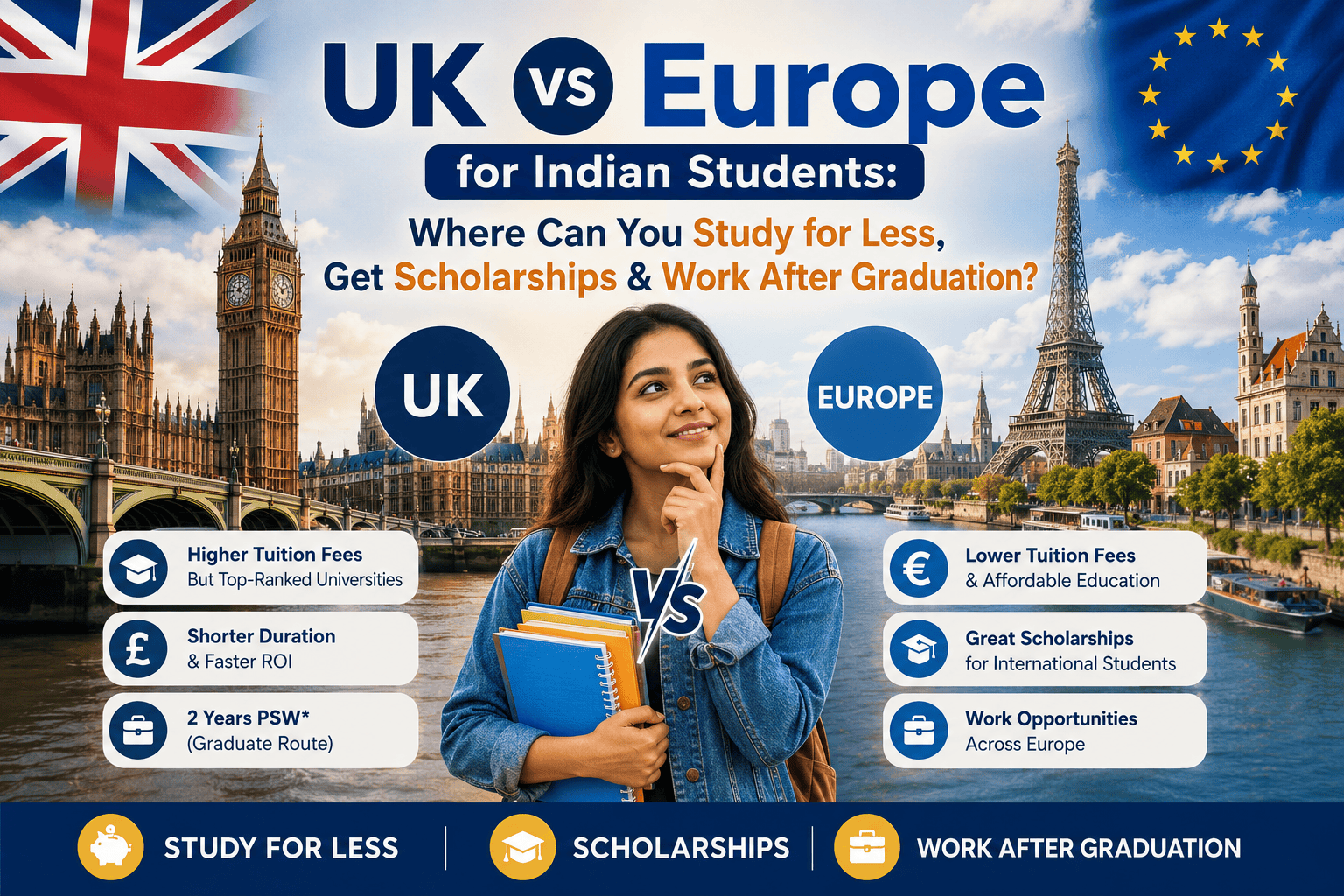
            Choose the UK if you want shorter master’s degrees, a large selection of English-taught programmes and a well-established international education system.

            Choose Europe if your priority is lower tuition fees, public universities, scholarships and exploring affordable study destinations such as Germany, France, Italy and Finland.

            For many Indian students, Germany, France, Italy and Finland can offer a lower overall study cost than the UK, but the exact cost depends on the university, programme and city.

            💬 Not Sure Whether UK or Europe Is Better for You?

            Get a quick profile-based comparison of tuition fees, scholarships, courses and post-study opportunities from a CIES counsellor.

            💬 Chat With a CIES Counsellor on WhatsApp →

            UK vs Europe: At a Glance

            Factor UK Europe
            Tuition Fees Generally higher Can be significantly lower, especially at public universities
            Master’s Duration Many programmes are 1 year Often 1–2 years depending on country and programme
            Scholarships University and external scholarships available Many university, government and country-specific opportunities
            English-Taught Courses Very widely available Widely available, especially at master’s level
            Part-Time Work Permitted under student visa conditions Rules vary by country
            Post-Study Options Graduate visa route available, subject to current rules Rules vary by country
            Overall Affordability Moderate to expensive Many affordable options

            1. Tuition Fees: UK vs Europe

            Tuition fees are one of the biggest factors Indian students consider when selecting an international destination.

            UK Tuition Fees

            International tuition fees in the UK vary significantly by university, course and level of study. Business, management, engineering, data science, healthcare and other popular programmes can have different fee structures.

            One major advantage of the UK is that many master’s degrees can be completed in just one year, potentially reducing accommodation and living expenses compared with a longer programme.

            European Tuition Fees

            Europe includes many different education systems. Some countries have relatively affordable public universities, while private universities and specialised institutions may charge considerably higher fees.

            Germany is particularly attractive because many public universities do not charge traditional tuition fees for many bachelor’s and master’s programmes, although exceptions and semester contributions apply.

            France also offers comparatively affordable public education for many international students, although tuition depends on the programme, institution and applicable fee category.

            Other popular destinations include Italy, Finland, Ireland, Spain, Poland and Norway, each with different tuition and scholarship structures.

            2. Scholarships: UK vs Europe

            Scholarships can significantly reduce the financial burden of studying abroad.

            UK Scholarships

            Indian students may find university scholarships, merit-based awards and external funding opportunities. However, competition can be high, especially for prestigious scholarships.

            European Scholarships

            Several European countries provide scholarships and tuition-related support through universities, governments and European programmes.

            Countries such as Germany, France, Italy and Finland can be worth researching if your main goal is to reduce tuition costs.

            Important: Scholarship eligibility depends on academic performance, programme, university, intake, nationality and other conditions. Never assume that every student will receive a full scholarship.

            3. Cost of Living: UK vs Europe

            Your total study-abroad budget is not just tuition fees. Accommodation, food, transportation, health insurance, utilities and personal expenses can make a major difference.

            Expense UK Europe
            Accommodation Can be expensive, especially in London Varies significantly by country and city
            Food Moderate to expensive Often more affordable outside major cities
            Transport Good public transport network Generally strong public transport in major cities
            Overall Cost Can be high Ranges from affordable to expensive

            4. Post-Study Work Opportunities

            Post-study work opportunities are one of the most important considerations for Indian students looking at international education as a career investment.

            UK Graduate Route

            The UK’s Graduate visa rules are changing. For applications made on or before 31 December 2026, the Graduate visa generally lasts two years. For applications made on or after 1 January 2027, the standard period becomes 18 months. PhD and doctoral graduates continue to have a three-year period.

            The Graduate route can allow eligible graduates to work, look for work or be self-employed. It cannot normally be extended, but eligible applicants may be able to switch to another immigration route such as the Skilled Worker route.

            Europe Post-Study Work

            Europe does not have one single post-study work policy. Every country has its own immigration rules.

            Germany, France, Finland, Ireland, Italy and other European destinations have their own graduate and employment pathways. Therefore, students should check the latest rules for their specific country before applying.

            5. Germany: A Strong Affordable Alternative

            Germany is one of the most popular European destinations for Indian students looking for affordable higher education.

            • Many public universities offer low-cost or no traditional tuition for many programmes.
            • Strong reputation in engineering, technology, business and research.
            • Many English-taught programmes are available.
            • International students can work under specific student-work rules.
            • Germany offers opportunities to transition from education into employment subject to immigration requirements.

            However, students should carefully check programme requirements, language requirements, blocked-funds/financial requirements and university-specific admission criteria.

            6. France: Affordable Education + Global Exposure

            France is another attractive destination for Indian students interested in business, management, luxury, hospitality, engineering, technology and other fields.

            • Public universities can be more affordable than many UK institutions.
            • Strong global reputation in business and management.
            • Excellent cultural and international exposure.
            • Scholarship opportunities are available.
            • Several English-taught master’s programmes are available.

            7. Italy: Scholarships & Affordable Study Options

            Italy has become increasingly popular among Indian students because of its universities, comparatively affordable education options and regional scholarship opportunities.

            Students should evaluate the exact university, tuition fee, scholarship eligibility, accommodation and living expenses before making a decision.

            8. Finland: Quality Education & Student-Friendly Environment

            Finland is known for its education system, innovation ecosystem and high quality of life.

            While tuition fees apply to many non-EU/EEA students, universities may offer scholarships or tuition-fee waivers to eligible international students.

            Finland can be particularly interesting for students targeting technology, business, sustainability, engineering and other future-focused fields.

            🎯 UK or Europe? Compare Before You Apply!

            Don’t choose a destination only because it is trending. Compare your academic profile, budget, course options, scholarship opportunities and career goals first.

            Our CIES counsellors can help you shortlist suitable countries and universities based on your profile.

            📞 Contact CIES for Study Abroad Guidance →

            9. UK vs Europe: Which Is Better for a Master’s?

            If your priority is completing your master’s quickly, the UK can have a major advantage because many master’s programmes are designed for one year.

            On the other hand, European countries may provide more affordable tuition options and longer programmes that can offer additional time for academic development and international experience.

            Your Priority Potentially Better Option
            One-year master’s UK
            Lower tuition possibilities Europe
            Large choice of English-taught courses Both
            Public university affordability Europe
            Established international student ecosystem UK
            Multiple country choices Europe

            10. UK vs Europe: Which Is Better for Indian Students?

            There is no universal answer.

            The UK may be better for you if:

            • You prefer a one-year master’s programme.
            • You want to study completely in an English-speaking environment.
            • You prefer a large selection of internationally recognised universities.
            • Your budget can accommodate UK tuition and living costs.

            Europe may be better for you if:

            • Your main priority is affordability.
            • You want to explore public universities with lower tuition options.
            • You are open to countries such as Germany, France, Italy or Finland.
            • You want to explore different European career markets.
            • You are comfortable researching country-specific visa and work rules.

            11. How to Choose Between UK and Europe

            Before making your final decision, compare these seven factors:

            1. Total tuition fees
            2. Cost of living
            3. Scholarship availability
            4. Course duration
            5. University ranking and reputation
            6. Post-study work opportunities
            7. Long-term career and immigration options

            Don’t select a country simply because someone on social media says it is “cheap” or “easy”. Your eligibility and future opportunities depend on your individual profile.

            12. Common Mistakes Indian Students Should Avoid

            • Choosing a university only because of its ranking.
            • Ignoring total living costs.
            • Applying without checking admission requirements.
            • Assuming every European country has the same visa rules.
            • Depending entirely on part-time work to fund studies.
            • Applying for scholarships after missing deadlines.
            • Ignoring post-study immigration requirements.
            • Choosing a course without considering future career opportunities.

            Final Verdict: UK or Europe?

            If your priority is a fast, one-year master’s degree and an established English-speaking education environment, the UK can be an excellent choice.

            If your priority is affordability, public university options, scholarships and multiple country choices, Europe deserves serious consideration.

            The best destination is not necessarily the cheapest country or the highest-ranked university. It is the destination that provides the right balance between education quality, affordability, career opportunities and your personal goals.

            🚀 Get Your Personalised UK vs Europe Study Plan

            Not sure which country, university or course is right for your profile?

            Share your details with CIES and get guidance based on your qualification, budget, preferred course and study-abroad goals.

              Frequently Asked Questions (FAQs)

              Is Europe cheaper than the UK for Indian students?

              In many cases, yes. Several European countries offer comparatively affordable tuition options, particularly at public universities. However, costs vary by country, university, programme and city.

              Which is better for a master’s, UK or Europe?

              The UK can be attractive for students who want a one-year master’s, while Europe can be attractive for students prioritising affordability and country choice.

              Which European country is affordable for Indian students?

              Germany, France, Italy and some other European destinations can offer affordable options, but the actual cost depends on the university, course and city.

              Can Indian students work while studying in Europe?

              Many European countries allow international students to work under specific conditions. The permitted hours and rules vary by country, so students should check the latest immigration regulations for their destination.

              Does the UK offer post-study work opportunities?

              Yes. The UK Graduate visa route provides eligible graduates with a period to work or look for work after graduation, subject to the rules applicable when they apply.

              Can CIES help me choose between UK and Europe?

              Yes. CIES can assist students with country selection, university and course selection, applications, documentation, scholarship guidance and study-abroad counselling.

              Which is better for ROI: UK or Europe?

              ROI depends on your tuition fees, living expenses, course duration, employment opportunities, salary potential and long-term career plans. A profile-based comparison is better than choosing a destination based only on tuition fees.

              May 15, 2026

              https://images.openai.com/static-rsc-4/R5hk95UeQg_ZY2TSi3jIzwZzEERATVCS7qD_pxKcJm0zDf4vHxQOYNL1kfAYcKvuwgdSsthJyejGYNIm81w81KGfQ__D5q4QEFU8xCaunQwiOEmHjpKmiHo9JmOpczWcwb4vo-W2Z8xFD2SfUSWMnj84fjobLdrH9FyT0ZQRjCPbBTLqF3nc_Lbc1iVISHcI?purpose=fullsize

              https://images.openai.com/static-rsc-4/8PqapFUWdcPxnm7niRbH4loLhl9u7wRk5vBw99hIoM5zdPkAs1I7I0sldfddUNrRFbOkU0YEsKI7gvaJ_NTNgXivNIfFoa6QBzm0G_jNlF7mlKPQ56BE-ffO_z8yuJ-hiu0HzmiZdEf3ILvv_lSwDSn6Qziov0Yja3ctgZzykgiW3Xu0sPhM59_4w9yMniCa?purpose=fullsize

              NEET UG 2026 Controversy Creates Panic Across India

              The recent controversy surrounding NEET UG 2026 has created massive concern among students, parents, coaching institutes, and the education sector across India. Reports related to paper leak allegations, exam irregularities, and possible cancellation discussions have sparked panic among millions of medical aspirants.

              NEET UG is one of the most competitive entrance exams in India for admission into MBBS, BDS, and other medical courses. Every year, more than 20 lakh students appear for the examination with dreams of becoming doctors.

              Any issue related to the examination directly impacts students’ futures and sparks nationwide discussion.

              Currently, students are searching for questions like:

              • Is NEET UG 2026 cancelled?
              • Will there be a re-exam?
              • What is the latest NEET paper leak update?
              • What should students do now?
              • Is MBBS abroad a better option?
              • Will admissions get delayed?


                What Is the NEET UG 2026 Controversy?

                Paper Leak Allegations

                Soon after the examination, several reports and social media posts claimed that the NEET question paper had been leaked before the exam. Alleged screenshots and viral messages circulated rapidly across Telegram, WhatsApp, and other platforms.

                Students from different states also raised concerns regarding:

                • unfair examination practices
                • OMR sheet issues
                • Inconsistent exam center management
                • time discrepancies
                • lack of proper monitoring

                These allegations raised serious questions about the transparency and fairness of the examination process.


                Students Started Nationwide Protests

                https://images.openai.com/static-rsc-4/xZ-W0GrCqLDMgGGHbItWxFbTDWma6gSjt0pKrlWJuyDcT9qfibo24i8o4vV-PvkHt3zA9mdD8hrpOAAeXAfybu4MuwdQkz5Sf56Jk8LZJDoD8vOalHfEv_yIWk1L-jZNEhAgKhxnsz4JuDptUexNCQ-14gelOslf7thTTXoy40ODqvG9c9QjYdgUJgYrhlOm?purpose=fullsize
                https://images.openai.com/static-rsc-4/dhDn8OSdwsyf1b-aUcr2YUn3E3bqhJm05-82jsmFQ0GoIm_-R0qJsOQOw01KaUzYWPBA-eLuJTep6ItpBy4m1rejxpm7rMVbl1UgDujUWEXZCBG9X2lx9gvlVzXsFN34CVnL48beBV75JbFyr2q_u9yaJWCJoKXX5yWf-an-Jf6ZsZNWrALxcdK3wdlAISeN?purpose=fullsize
                https://images.openai.com/static-rsc-4/oo61iUB-yveOYdk8FmKff_IE8AuXcDANhPH1OTLmri7vc344qy6oQf76VTYoTBjfv6sw4Dr5JYAjqzf_yYq8D5qMoZ7KoAH0YV88AUKTwtAG3e3JA3qIOhmbNJS7ueVFSnfCEFB27JEKiZd3RvWgrsCw_51qfmv98BYZ6useIZG1nEfQl5DEJGmwLl0mVsgz?purpose=fullsize

                Impact on Students

                Mental Stress and Anxiety

                For medical aspirants, NEET is not just an exam; it is a life-changing opportunity.

                Most students spend:

                • 1–2 years preparing
                • lakhs of rupees on coaching
                • long study hours daily

                The uncertainty around exam cancellation or re-exam discussions has caused:

                • stress
                • anxiety
                • emotional pressure
                • fear about the future

                among students and parents.


                Drop-Year Students Are More Affected

                Students who already took a drop year for NEET preparation are facing even greater pressure.

                Another delay or re-exam may affect:

                • confidence
                • motivation
                • future planning
                • academic timelines

                for many aspirants.


                Admission Process May Get Delayed

                If authorities decide to conduct a re-exam, it may lead to:

                • delayed counseling
                • postponed MBBS admissions
                • late academic sessions
                • uncertainty in college schedules

                This could impact both government and private medical colleges.


                What Should Students Do Now?

                Continue Preparation

                The most important advice for students is:

                Do not stop studying.

                If a re-exam is conducted, students who remain consistent with preparation will have an advantage.


                Avoid Fake News

                Many rumors spread quickly on social media. Students should rely only on:

                • official announcements
                • trusted education portals
                • authentic news sources

                for updates.


                Keep Backup Career Options Ready

                Today, medical students have several alternative career opportunities apart from MBBS.

                Students can also explore:

                • BDS
                • BAMS
                • BHMS
                • Nursing
                • Biotechnology
                • Pharmacy
                • Physiotherapy
                • Allied Health Sciences

                Why MBBS Abroad Is Becoming Popular

                https://images.openai.com/static-rsc-4/a3agKAVUTkF2Qu55wsnLOBC5KLaxClWWOq8lL3Etj2gCZanHYbfhHfK6_vTi8nlyW56Ha8s24XUAxTpGbPP_aZRNr3I4H-5iYzUVZdHLoWjZAVRerI5CQrDtgcZoKSDZdIWg1GMTfK0TlaQuKqsgSylpWuUZ1ss9AAMIjYDNjF9AiHwaliiqO3Aq93_SHQtk?purpose=fullsizeAfter the NEET controversy, many students have started exploring MBBS abroad opportunities.

                Students are increasingly searching for:

                • affordable MBBS abroad
                • MBBS without donation
                • study medicine in Russia
                • Kazakhstan medical universities
                • low-cost medical education abroad

                Popular Countries for MBBS Abroad

                Russia

                • affordable tuition fees
                • experienced faculty
                • large Indian student community

                Kazakhstan

                • budget-friendly universities
                • English-medium programs
                • easier admission process

                Georgia

                • modern infrastructure
                • European lifestyle
                • international exposure

                Uzbekistan

                • growing popularity
                • low tuition costs
                • safe environment

                Why MBBS in India Is Becoming More Competitive

                Medical education in India has become increasingly competitive because of:

                • limited government seats
                • high cutoffs
                • expensive private colleges
                • rising competition
                • donation systems in private institutions

                As a result, many students are considering international medical education.


                What Language Are Students Using to Search Online?

                Hinglish Is Dominating Search Trends

                According to current student behavior, most users are searching in Hinglish rather than pure Hindi or pure English.

                Trending searches include:

                • NEET result cancelled news
                • Re NEET kab hoga
                • NEET paper leak update
                • MBBS abroad kaise kare
                • medical admission guidance

                This shows that mixed-language content performs better for Indian student audiences.


                Important Advice for Students and Parents

                Do Not Panic

                One examination does not define your entire future.


                Focus on Smart Planning

                Students should focus on:

                • preparation
                • alternative opportunities
                • mental health
                • career guidance

                simultaneously.


                Seek Expert Guidance

                Wrong information can lead to poor decisions. Proper counseling and career planning are extremely important during uncertain situations.


                FAQs

                Is NEET UG 2026 officially cancelled?

                Authorities are still investigating allegations and reviewing the situation.


                Will there be a re-exam?

                There is a possibility of a re-exam depending on official decisions.


                Is MBBS abroad a good option?

                Yes, many Indian students choose MBBS abroad because of affordability and lower competition.


                Is NEET required for MBBS abroad?

                Indian students generally need an NEET qualification for future medical practice eligibility in India.


                Conclusion

                The NEET UG 2026 controversy has created uncertainty and stress among millions of students across India. However, students should remain calm, continue preparation, and stay updated through trusted sources.

                This situation has also encouraged students to explore alternative opportunities such as MBBS abroad and other healthcare careers. Proper planning and expert guidance can help students make informed decisions about their future.


                Contact Us

                📞 +91-9968239372 / 73
                📧 info@cies.org.in

                Get expert guidance for MBBS Abroad, Medical Admission, Career Counseling, and Study Abroad Support.