September 16, 2026

Choosing the best courses to study abroad in 2027 can help Indian students make informed decisions about their education, career goals, budget and preferred study destination. From Artificial Intelligence and Data Science to Engineering, Business, Healthcare and Sustainability, international universities offer a wide range of career-focused programs for students planning to study overseas.

Quick Answer: Which Are the Best Courses to Study Abroad in 2027?

Some of the most relevant study-abroad programs for 2027 include AI & Machine Learning, Data Science, Computer Science, Cybersecurity, Engineering, Business Analytics, Finance & FinTech, Healthcare, Biotechnology, Renewable Energy, Sustainability, Architecture and Design. The best course for you depends on your academic background, career goals, budget, admission requirements and preferred destination.

Why Choose the Right Course Before Studying Abroad?

Studying overseas is a significant academic and financial investment. Therefore, selecting a course should involve more than simply choosing a popular subject. You should consider the curriculum, university requirements, tuition and living costs, available career pathways, internship opportunities and the rules applicable to international students.

A well-planned course and destination combination can make your international education journey more focused and manageable.

Top Courses to Study Abroad in 2027

1. Artificial Intelligence & Machine Learning

Artificial Intelligence and Machine Learning continue to be important areas of study across technology and business. International universities offer programs covering machine learning, deep learning, natural language processing, computer vision, robotics and AI applications.

Popular study areas: Artificial Intelligence, Machine Learning, Robotics, Applied AI, Computational Intelligence.

2. Data Science & Data Analytics

Data-focused programs combine statistics, programming, analytics and business decision-making. Students may study data visualization, predictive analytics, big data, statistical modelling and machine learning.

Popular study areas: Data Science, Business Analytics, Data Analytics, Big Data and Applied Statistics.

3. Computer Science & Software Engineering

Computer Science remains a broad option for students interested in software development, computing systems, algorithms and emerging technologies. Depending on the university, students can specialize in areas such as cloud computing, software engineering, artificial intelligence and distributed systems.

Popular study areas: Computer Science, Software Engineering, Cloud Computing, Computing and Information Technology.

4. Cybersecurity & Information Security

As organizations increasingly depend on digital infrastructure, cybersecurity has become an important academic specialization. Programs can cover network security, digital forensics, information assurance, ethical security practices and risk management.

5. Engineering

Engineering offers a wide range of international study options. Depending on your previous education and interests, you may consider mechanical, electrical, civil, chemical, environmental, industrial or computer engineering.

Popular specializations: Mechanical Engineering, Electrical Engineering, Civil Engineering, Chemical Engineering, Industrial Engineering and Environmental Engineering.

6. Business Analytics & Management

Business-related programs can be suitable for students interested in management, strategy, entrepreneurship, marketing and data-driven decision-making. Business Analytics can be particularly useful for students who want to combine business knowledge with analytical skills.

7. Finance, Accounting & FinTech

Students with an interest in financial systems can explore Finance, Accounting, Financial Technology and related programs. Depending on the university, programs may include investment management, corporate finance, financial modelling, accounting and digital finance.

8. Healthcare & Health Sciences

Healthcare and health-science programs cover a broad range of academic disciplines. Students can explore public health, healthcare management, biomedical sciences, nursing and other health-related programs, subject to individual university and professional licensing requirements.

9. Biotechnology & Life Sciences

Biotechnology and life-science programs can suit students with backgrounds in biology, chemistry, biotechnology and related subjects. Areas of study may include molecular biology, genetics, biomedical research, bioinformatics and pharmaceutical sciences.

10. Renewable Energy, Sustainability & Environmental Studies

Sustainability and environmental studies bring together science, engineering, policy and business perspectives. International universities offer programs related to renewable energy, climate studies, environmental management, sustainable development and green technologies.

11. Architecture, Design & Creative Industries

Students with creative interests can consider architecture, graphic design, interaction design, product design, animation, fashion and related programs. Portfolio requirements can be an important part of admission for many creative courses.

💡 CIES Tip

Do not choose a course only because it is currently popular. Compare the course curriculum with your previous education, strengths and long-term career objectives before applying.

Top Study Destinations for International Students in 2027

The right destination depends on your preferred course, academic profile, budget, language requirements and future plans. Countries commonly considered by Indian students include the UK, Germany, Ireland, Finland, Denmark, Sweden, the Netherlands, Australia and Canada.

Destination Popular Study Areas What to Research
UK Business, Computing, Engineering, Healthcare University requirements, tuition, visa rules
Germany Engineering, IT, Data, Sciences Program language, tuition structure, admission requirements
Ireland IT, Business, Pharma, Data Course fees, entry requirements, immigration rules
Finland Technology, Business, Engineering Program language, tuition and scholarship options
Denmark Engineering, Business, IT, Sustainability Program requirements, fees and residence rules
Sweden Technology, Engineering, Sustainability University selection, tuition and scholarship availability
Netherlands Business, Engineering, Technology Institution type, tuition and admission criteria
Australia Business, IT, Engineering, Healthcare Course costs, visa conditions and eligibility
Canada IT, Business, Engineering, Healthcare Institution, program eligibility and current immigration rules

Popular Courses Based on Your Academic Background

Academic Background Possible Course Areas
Computer Science / IT AI, Data Science, Cybersecurity, Software Engineering
Engineering Engineering specializations, Technology, Data, Sustainability
Commerce / B.Com Finance, Accounting, Business Analytics, Management
Science Biotechnology, Life Sciences, Data, Environmental Studies
Arts / Humanities Design, Management, Social Sciences, Communication
Architecture / Design Architecture, Product Design, UX/UI, Creative Programs

How to Choose the Right Course to Study Abroad

1. Match the Course With Your Academic Background

Check whether your previous degree or subjects meet the university’s academic prerequisites. Some programs require specific subjects, credits or relevant work experience.

2. Compare the Curriculum

Two courses with similar names can have very different curricula. Review modules, practical projects, internships, research opportunities and specialization options.

3. Check University Admission Requirements

Review academic scores, English-language requirements, standardized tests, portfolios, work experience and other requirements before shortlisting universities.

4. Calculate the Complete Budget

Do not consider tuition alone. Your budget should also account for accommodation, food, transportation, insurance, application costs and other living expenses.

5. Check English-Language Requirements

Universities may accept IELTS, PTE, TOEFL or other approved tests depending on the program and institution. Always verify the exact requirement of your chosen university.

If you are preparing for an English-language test, explore our IELTS Coaching in Noida Sector 18 and IELTS Coaching in Delhi resources.

6. Consider Career-Relevant Skills

Look beyond the course title. Consider what technical, analytical, research, communication or practical skills you can develop through the program.

7. Review Current Visa and Post-Study Rules

Visa, work and post-study policies can change. Before applying, verify the latest rules through official government and university sources for your destination.

🎓 Plan Your Study Abroad Journey With CIES

Not sure which course, university or destination fits your profile? CIES Overseas Education can help you evaluate your academic background, shortlist suitable options and understand the application process.

Get a profile evaluation and discuss your study-abroad options.

🚀 Ready to Choose Your Course for 2027?

Get personalised guidance on courses, universities, destinations, applications and student visa requirements.

📲 WhatsApp CIES📞 Book Free Counselling

2027 Study Abroad Application Timeline

Period Recommended Action
Early Planning Research courses, destinations and universities.
Profile Preparation Prepare English test, academic documents and shortlist.
Application Stage Submit applications and required supporting documents.
Offer Stage Review offers, finances and accommodation options.
Visa Preparation Prepare the student visa application and supporting documents.

Common Mistakes Students Should Avoid

  • Choosing a course only because it is trending.
  • Ignoring university-specific eligibility criteria.
  • Comparing tuition fees without considering living costs.
  • Applying without checking English-language requirements.
  • Selecting a university without researching the actual curriculum.
  • Relying on outdated information about visa or immigration rules.
  • Waiting until the last minute to prepare documents.

How CIES Can Help With Your Study Abroad Plans

Choosing the right international education pathway can involve comparing several universities, countries and courses. CIES Overseas Education provides guidance throughout the study-abroad planning process.

  • Profile evaluation and course selection
  • University and destination shortlisting
  • Application guidance
  • SOP and documentation guidance
  • English-language test preparation
  • Student visa guidance
  • Accommodation and air-ticketing support

Learn more about our Study Abroad Consultants in Noida and explore our Visa Services.

📩 Get Study Abroad Guidance

Fill out the form and our counsellors can help you explore suitable courses and study destinations.

    Frequently Asked Questions

    What are the best courses to study abroad in 2027?

    Popular and career-oriented options include Artificial Intelligence, Data Science, Computer Science, Cybersecurity, Engineering, Business Analytics, Finance, Healthcare, Biotechnology and Sustainability. The right choice depends on your individual profile and goals.

    Which country is best for studying abroad in 2027?

    There is no single destination that is suitable for every student. Your choice should consider the course, university, tuition, living expenses, admission requirements and current visa rules.

    Which courses are suitable for Indian students after 12th?

    Depending on your subjects and interests, options can include Computer Science, Engineering, Business, Data-related programs, Life Sciences, Design, Architecture and other undergraduate disciplines.

    Which courses can students consider after graduation?

    Graduates can consider master’s programs aligned with their previous education, including Data Science, AI, Business Analytics, Engineering, Finance, Management, Healthcare, Biotechnology and other specialized disciplines.

    Do I need IELTS to study abroad?

    Many universities require proof of English proficiency, but accepted tests and exemptions vary by institution and program. Always check the exact requirements of your chosen university.

    How early should I start planning for 2027?

    Starting early gives you more time to research programs, prepare for English-language tests, collect documents, write your SOP and complete applications. Exact deadlines vary by country and institution.

    Final Thoughts

    The best courses to study abroad in 2027 are not necessarily the courses with the most attention online. A strong choice is one that matches your academic background, interests, budget and long-term objectives.

    Research the course curriculum, compare universities and verify the latest admission and visa requirements before making your final decision. If you need help evaluating your options, connect with CIES Overseas Education for personalised study-abroad counselling.

    🎓 Your 2027 Study Abroad Journey Starts With the Right Course

    Talk to CIES Overseas Education for course selection, university shortlisting and study visa guidance.

    📲 WhatsApp: +91-9968239372📞 Contact CIES

    Disclaimer

    Course availability, tuition fees, admission criteria, scholarships, visa regulations and immigration policies can change. Students should verify current requirements with the relevant university and official government sources before applying.


    September 3, 2026

    For Indian students planning to study abroad, the UK and Europe are two of the most popular choices. But which destination offers better value for money, affordable tuition fees, scholarships, post-study work opportunities and long-term career prospects?

    The answer depends on your budget, chosen course, career goals, preferred country and post-study plans.

    Quick Answer: UK vs Europe

    Choose the UK if you want shorter master’s degrees, a large selection of English-taught programmes and a well-established international education system.

    Choose Europe if your priority is lower tuition fees, public universities, scholarships and exploring affordable study destinations such as Germany, France, Italy and Finland.

    For many Indian students, Germany, France, Italy and Finland can offer a lower overall study cost than the UK, but the exact cost depends on the university, programme and city.

    💬 Not Sure Whether UK or Europe Is Better for You?

    Get a quick profile-based comparison of tuition fees, scholarships, courses and post-study opportunities from a CIES counsellor.

    💬 Chat With a CIES Counsellor on WhatsApp →

    UK vs Europe: At a Glance

    Factor UK Europe
    Tuition Fees Generally higher Can be significantly lower, especially at public universities
    Master’s Duration Many programmes are 1 year Often 1–2 years depending on country and programme
    Scholarships University and external scholarships available Many university, government and country-specific opportunities
    English-Taught Courses Very widely available Widely available, especially at master’s level
    Part-Time Work Permitted under student visa conditions Rules vary by country
    Post-Study Options Graduate visa route available, subject to current rules Rules vary by country
    Overall Affordability Moderate to expensive Many affordable options

    1. Tuition Fees: UK vs Europe

    Tuition fees are one of the biggest factors Indian students consider when selecting an international destination.

    UK Tuition Fees

    International tuition fees in the UK vary significantly by university, course and level of study. Business, management, engineering, data science, healthcare and other popular programmes can have different fee structures.

    One major advantage of the UK is that many master’s degrees can be completed in just one year, potentially reducing accommodation and living expenses compared with a longer programme.

    European Tuition Fees

    Europe includes many different education systems. Some countries have relatively affordable public universities, while private universities and specialised institutions may charge considerably higher fees.

    Germany is particularly attractive because many public universities do not charge traditional tuition fees for many bachelor’s and master’s programmes, although exceptions and semester contributions apply.

    France also offers comparatively affordable public education for many international students, although tuition depends on the programme, institution and applicable fee category.

    Other popular destinations include Italy, Finland, Ireland, Spain, Poland and Norway, each with different tuition and scholarship structures.

    2. Scholarships: UK vs Europe

    Scholarships can significantly reduce the financial burden of studying abroad.

    UK Scholarships

    Indian students may find university scholarships, merit-based awards and external funding opportunities. However, competition can be high, especially for prestigious scholarships.

    European Scholarships

    Several European countries provide scholarships and tuition-related support through universities, governments and European programmes.

    Countries such as Germany, France, Italy and Finland can be worth researching if your main goal is to reduce tuition costs.

    Important: Scholarship eligibility depends on academic performance, programme, university, intake, nationality and other conditions. Never assume that every student will receive a full scholarship.

    3. Cost of Living: UK vs Europe

    Your total study-abroad budget is not just tuition fees. Accommodation, food, transportation, health insurance, utilities and personal expenses can make a major difference.

    Expense UK Europe
    Accommodation Can be expensive, especially in London Varies significantly by country and city
    Food Moderate to expensive Often more affordable outside major cities
    Transport Good public transport network Generally strong public transport in major cities
    Overall Cost Can be high Ranges from affordable to expensive

    4. Post-Study Work Opportunities

    Post-study work opportunities are one of the most important considerations for Indian students looking at international education as a career investment.

    UK Graduate Route

    The UK’s Graduate visa rules are changing. For applications made on or before 31 December 2026, the Graduate visa generally lasts two years. For applications made on or after 1 January 2027, the standard period becomes 18 months. PhD and doctoral graduates continue to have a three-year period.

    The Graduate route can allow eligible graduates to work, look for work or be self-employed. It cannot normally be extended, but eligible applicants may be able to switch to another immigration route such as the Skilled Worker route.

    Europe Post-Study Work

    Europe does not have one single post-study work policy. Every country has its own immigration rules.

    Germany, France, Finland, Ireland, Italy and other European destinations have their own graduate and employment pathways. Therefore, students should check the latest rules for their specific country before applying.

    5. Germany: A Strong Affordable Alternative

    Germany is one of the most popular European destinations for Indian students looking for affordable higher education.

    • Many public universities offer low-cost or no traditional tuition for many programmes.
    • Strong reputation in engineering, technology, business and research.
    • Many English-taught programmes are available.
    • International students can work under specific student-work rules.
    • Germany offers opportunities to transition from education into employment subject to immigration requirements.

    However, students should carefully check programme requirements, language requirements, blocked-funds/financial requirements and university-specific admission criteria.

    6. France: Affordable Education + Global Exposure

    France is another attractive destination for Indian students interested in business, management, luxury, hospitality, engineering, technology and other fields.

    • Public universities can be more affordable than many UK institutions.
    • Strong global reputation in business and management.
    • Excellent cultural and international exposure.
    • Scholarship opportunities are available.
    • Several English-taught master’s programmes are available.

    7. Italy: Scholarships & Affordable Study Options

    Italy has become increasingly popular among Indian students because of its universities, comparatively affordable education options and regional scholarship opportunities.

    Students should evaluate the exact university, tuition fee, scholarship eligibility, accommodation and living expenses before making a decision.

    8. Finland: Quality Education & Student-Friendly Environment

    Finland is known for its education system, innovation ecosystem and high quality of life.

    While tuition fees apply to many non-EU/EEA students, universities may offer scholarships or tuition-fee waivers to eligible international students.

    Finland can be particularly interesting for students targeting technology, business, sustainability, engineering and other future-focused fields.

    🎯 UK or Europe? Compare Before You Apply!

    Don’t choose a destination only because it is trending. Compare your academic profile, budget, course options, scholarship opportunities and career goals first.

    Our CIES counsellors can help you shortlist suitable countries and universities based on your profile.

    📞 Contact CIES for Study Abroad Guidance →

    9. UK vs Europe: Which Is Better for a Master’s?

    If your priority is completing your master’s quickly, the UK can have a major advantage because many master’s programmes are designed for one year.

    On the other hand, European countries may provide more affordable tuition options and longer programmes that can offer additional time for academic development and international experience.

    Your Priority Potentially Better Option
    One-year master’s UK
    Lower tuition possibilities Europe
    Large choice of English-taught courses Both
    Public university affordability Europe
    Established international student ecosystem UK
    Multiple country choices Europe

    10. UK vs Europe: Which Is Better for Indian Students?

    There is no universal answer.

    The UK may be better for you if:

    • You prefer a one-year master’s programme.
    • You want to study completely in an English-speaking environment.
    • You prefer a large selection of internationally recognised universities.
    • Your budget can accommodate UK tuition and living costs.

    Europe may be better for you if:

    • Your main priority is affordability.
    • You want to explore public universities with lower tuition options.
    • You are open to countries such as Germany, France, Italy or Finland.
    • You want to explore different European career markets.
    • You are comfortable researching country-specific visa and work rules.

    11. How to Choose Between UK and Europe

    Before making your final decision, compare these seven factors:

    1. Total tuition fees
    2. Cost of living
    3. Scholarship availability
    4. Course duration
    5. University ranking and reputation
    6. Post-study work opportunities
    7. Long-term career and immigration options

    Don’t select a country simply because someone on social media says it is “cheap” or “easy”. Your eligibility and future opportunities depend on your individual profile.

    12. Common Mistakes Indian Students Should Avoid

    • Choosing a university only because of its ranking.
    • Ignoring total living costs.
    • Applying without checking admission requirements.
    • Assuming every European country has the same visa rules.
    • Depending entirely on part-time work to fund studies.
    • Applying for scholarships after missing deadlines.
    • Ignoring post-study immigration requirements.
    • Choosing a course without considering future career opportunities.

    Final Verdict: UK or Europe?

    If your priority is a fast, one-year master’s degree and an established English-speaking education environment, the UK can be an excellent choice.

    If your priority is affordability, public university options, scholarships and multiple country choices, Europe deserves serious consideration.

    The best destination is not necessarily the cheapest country or the highest-ranked university. It is the destination that provides the right balance between education quality, affordability, career opportunities and your personal goals.

    🚀 Get Your Personalised UK vs Europe Study Plan

    Not sure which country, university or course is right for your profile?

    Share your details with CIES and get guidance based on your qualification, budget, preferred course and study-abroad goals.

      Frequently Asked Questions (FAQs)

      Is Europe cheaper than the UK for Indian students?

      In many cases, yes. Several European countries offer comparatively affordable tuition options, particularly at public universities. However, costs vary by country, university, programme and city.

      Which is better for a master’s, UK or Europe?

      The UK can be attractive for students who want a one-year master’s, while Europe can be attractive for students prioritising affordability and country choice.

      Which European country is affordable for Indian students?

      Germany, France, Italy and some other European destinations can offer affordable options, but the actual cost depends on the university, course and city.

      Can Indian students work while studying in Europe?

      Many European countries allow international students to work under specific conditions. The permitted hours and rules vary by country, so students should check the latest immigration regulations for their destination.

      Does the UK offer post-study work opportunities?

      Yes. The UK Graduate visa route provides eligible graduates with a period to work or look for work after graduation, subject to the rules applicable when they apply.

      Can CIES help me choose between UK and Europe?

      Yes. CIES can assist students with country selection, university and course selection, applications, documentation, scholarship guidance and study-abroad counselling.

      Which is better for ROI: UK or Europe?

      ROI depends on your tuition fees, living expenses, course duration, employment opportunities, salary potential and long-term career plans. A profile-based comparison is better than choosing a destination based only on tuition fees.

      August 17, 2026

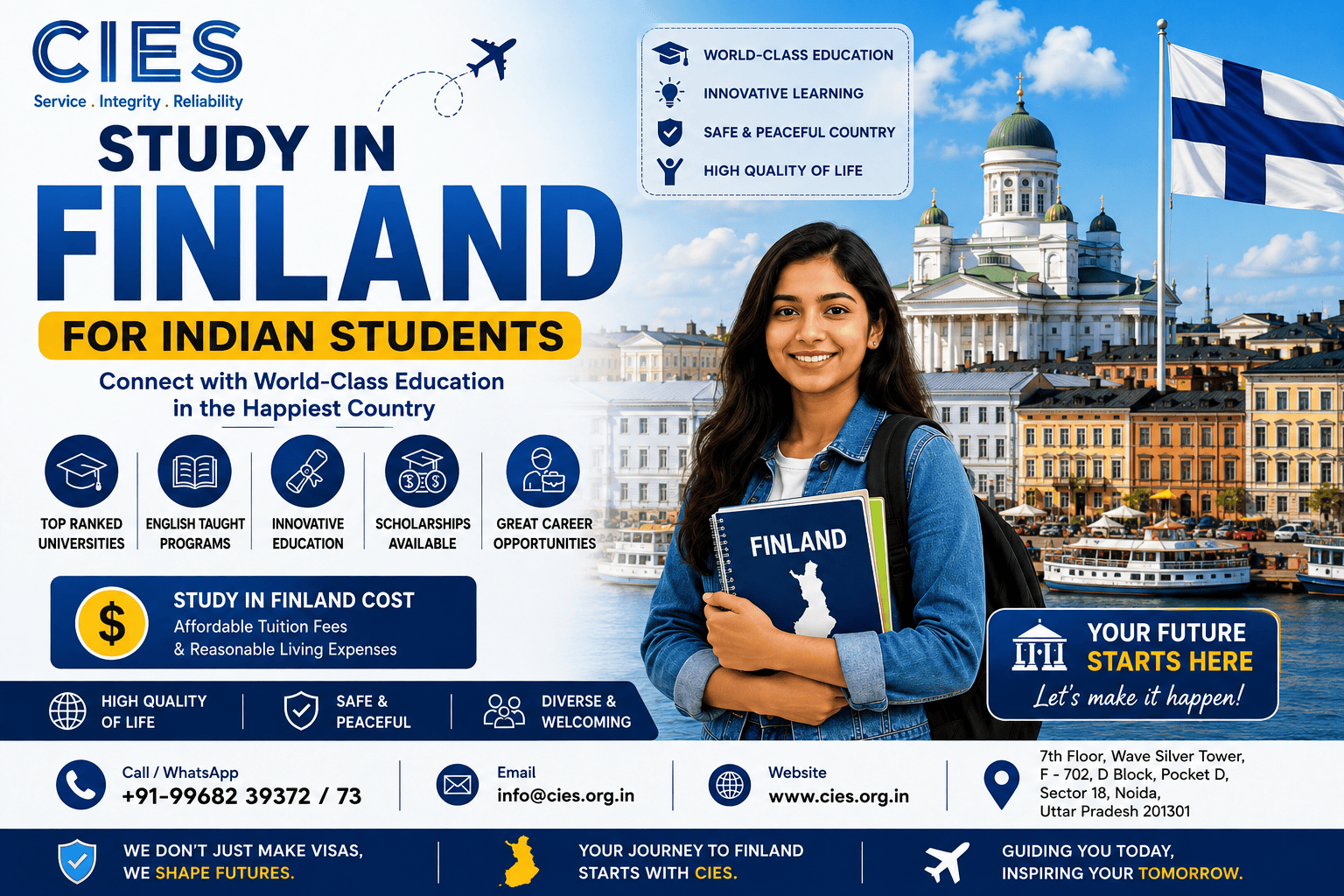
      For Indian students looking beyond traditional study-abroad destinations, Finland is becoming an increasingly attractive option in 2026.

      Known for its high-quality education system, technology-driven economy, safe environment and innovative teaching methods, Finland offers international students an opportunity to earn a globally recognised degree while experiencing life in a Nordic country.

      The demand for English-taught higher education is significant. In Finland’s first joint application round in 2026, around 21,800 applicants applied for approximately 9,000 places across about 440 programmes, with applicants representing 137 countries. Indian applicants accounted for around 5% of those accepted in that round.

      For Indian students considering a master’s, bachelor’s or other higher-education pathway abroad, Finland deserves serious consideration.

      Get Free Counselling to Study in Finland

      Planning to study in Finland? Fill out the form below. Our education counsellor can help you understand courses, universities, scholarships, fees and visa requirements.

        Quick Answer: Why Study in Finland in 2026?

        Indian students are choosing Finland because it combines high-quality education, English-taught programmes, innovative learning, scholarship opportunities, a strong technology ecosystem and post-study work options.

        Students can also work part-time during their studies under the conditions of their residence permit and may apply for a residence permit to look for work or start a business after graduation.

        However, Finland is not a “free education” destination for most Indian students. Students from outside the EU/EEA/Switzerland generally pay tuition fees for English-taught degree programmes, although universities may offer scholarships or tuition-fee waivers.


        10 Reasons Indian Students Are Choosing Finland in 2026

        1. High-Quality Education System

        Finland has built a strong international reputation for education.

        Instead of focusing only on memorisation, Finnish higher education places emphasis on:

        • Critical thinking
        • Problem-solving
        • Independent learning
        • Practical skills
        • Research
        • Innovation
        • Collaboration

        This approach can be particularly valuable for students who want their international education to prepare them for professional careers rather than simply provide a qualification.


        2. Many English-Taught Programmes

        One of the biggest advantages for Indian students is the availability of English-taught bachelor’s and master’s programmes.

        Students do not necessarily need to become fluent in Finnish before starting an English-language degree.

        In the 2026 spring joint application, approximately 440 English-taught study options were available across Finnish universities and universities of applied sciences.

        Popular areas include:

        • Business and Management
        • Computer Science
        • Information Technology
        • Artificial Intelligence
        • Data Science
        • Engineering
        • Renewable Energy
        • Sustainability
        • Biotechnology
        • Health Sciences
        • International Business
        • Design
        • Tourism and Hospitality

        This gives Indian students considerable flexibility when selecting a programme.


        3. Strong Focus on Technology and Innovation

        Finland is particularly attractive for students interested in technology and innovation.

        The country has a strong ecosystem around areas such as:

        • Information technology
        • Software development
        • Artificial intelligence
        • Telecommunications
        • Gaming
        • Clean technology
        • Engineering
        • Digitalisation
        • Research and development

        For students planning careers in STEM and technology-related fields, studying in Finland can provide exposure to an innovation-focused environment.


        4. Universities and Universities of Applied Sciences

        Finland offers two major types of higher education institutions:

        Universities

        Universities generally focus more heavily on:

        • Academic research
        • Theoretical knowledge
        • Research-based education
        • Master’s and doctoral studies

        Universities of Applied Sciences

        • Practical learning
        • Industry connections
        • Professional skills
        • Work-oriented education

        This distinction allows students to select an institution according to their career goals.


        5. Scholarships Can Reduce Tuition Costs

        A major reason students consider Finland is the availability of university-specific scholarships and tuition-fee waivers.

        However, students should understand an important point:

        Finland is not automatically tuition-free for Indian students.

        Students from outside the EU/EEA/Switzerland generally have to pay tuition fees for English-taught degree programmes.

        Some universities offer scholarships based on criteria such as:

        • Academic performance
        • Admission results
        • University-specific scholarship policies
        • Early application or programme requirements

        Scholarship conditions vary by institution and programme, so students should always check the official university information before applying.

        Also remember that a tuition scholarship does not necessarily cover living expenses. Finland’s immigration authorities require students to demonstrate sufficient financial resources for living costs when applying for a residence permit.


        6. Students Can Work While Studying

        Another attraction for international students is the possibility of working alongside their studies.

        Under current Finnish Immigration Service rules, students with a residence permit for studies may work in paid employment for an average of up to 30 hours per week, while work related to practical training or diploma work that is part of the degree has different rules.

        Students may find opportunities in areas such as:

        • Hospitality
        • Retail
        • Customer service
        • Warehousing
        • IT
        • Research
        • University projects
        • Internships
        • Part-time professional roles

        However, students should not depend entirely on part-time employment to finance their education.

        You need sufficient funds for your residence permit application, and finding a suitable job can take time.


        7. Post-Study Work Opportunities

        One of the biggest questions for Indian students is:

        “What happens after I graduate in Finland?”

        Finland provides a pathway for graduates who want to remain in the country while looking for employment.

        After completing a degree in Finland, eligible graduates can apply for a residence permit to look for work or start a business. The permit can be granted for a maximum of two years.

        This gives graduates additional time to:

        • Search for employment
        • Build professional experience
        • Network with employers
        • Start a business
        • Transition into a work-based residence permit

        If a graduate already has a suitable job, they may apply for a residence permit based on employment or a degree completed in Finland, depending on their circumstances.


        8. Finland Is Attractive for STEM and Future-Focused Careers

        The global job market is increasingly influenced by technology, sustainability and digital transformation.

        Finland’s education and innovation ecosystem makes it particularly interesting for students pursuing fields such as:

        Technology

        • Computer Science
        • Software Engineering
        • Artificial Intelligence
        • Data Science
        • Cybersecurity

        Engineering

        • Mechanical Engineering
        • Electrical Engineering
        • Automation
        • Electronics

        Sustainability

        • Environmental Engineering
        • Renewable Energy
        • Sustainable Development
        • Circular Economy

        Business

        • International Business
        • Business Analytics
        • Entrepreneurship
        • Digital Marketing

        Students should still research employment demand for their specific occupation, because studying in Finland does not automatically guarantee a job or permanent residence.


        9. Safe, Modern and Student-Friendly Environment

        Finland is known for its high standard of living and modern infrastructure.

        For international students, the country offers:

        • Reliable public transport
        • Digital public services
        • Modern university facilities
        • Safe cities
        • Strong student services
        • Beautiful natural surroundings
        • High environmental standards

        Students can experience a different lifestyle from larger traditional study destinations while still accessing modern European infrastructure.


        10. Finland Can Be a Long-Term Career Destination

        For many Indian students, studying abroad is not only about getting a degree.

        They also want to build:

        Education → Skills → Work Experience → Career

        Finland can support this progression through its higher education system, work opportunities during studies and post-graduation residence options.

        The Finnish National Agency for Education has also highlighted efforts by higher education institutions, cities and employers to encourage international students to remain in Finland and become part of the country’s workforce.

        That does not mean every graduate will automatically find employment. Your degree, skills, Finnish language ability, work experience and the labour-market situation in your field can all influence your prospects.


        Study in Finland Cost for Indian Students

        One of the most important questions is:

        How much does it cost to study in Finland?

        For Indian students, the overall cost normally consists of:

        1. Tuition fees
        2. Living expenses
        3. Residence permit costs
        4. Insurance
        5. Accommodation
        6. Food and transportation
        7. Study materials and other personal expenses

        Tuition fees vary considerably by university and programme.

        Students from outside the EU/EEA/Switzerland are generally subject to tuition fees for English-taught degree programmes.

        Therefore, students should calculate their total annual budget, rather than looking only at tuition fees.

        Important financial point

        When applying for a student residence permit, students need to demonstrate sufficient funds for their living expenses. If tuition has not yet been paid, the required funds may also need to cover the first year’s tuition fee.


        Finland Student Visa / Residence Permit for Indian Students

        Indian students who are accepted into a degree programme generally need a Finnish residence permit for studies when the programme requires them to stay in Finland for longer than a short visit.

        The process generally involves:

        Step 1: Choose a Programme

        Research universities and Universities of Applied Sciences offering your desired course.

        Step 2: Check Eligibility

        Review:

        • Academic qualifications
        • English-language requirements
        • Entrance examination requirements
        • Programme-specific criteria
        • Application deadlines

        Step 3: Apply to the University

        Submit your application and required documents.

        Step 4: Receive Admission

        Once admitted, review the university’s tuition and scholarship conditions.

        Step 5: Arrange Finances and Insurance

        Prepare the financial documentation and other requirements for your residence permit.

        Step 6: Apply for the Residence Permit

        Submit the residence permit application through the Finnish Immigration Service process.

        Step 7: Travel to Finland

        After receiving the required approval and completing the remaining formalities, you can prepare for your journey.


        Can Indian Students Work Part-Time in Finland?

        Yes.

        Under current rules, a student residence permit allows paid employment for an average of 30 hours per week. Some study-related practical training and diploma work can have different working-hour rules.

        However, students should treat part-time employment as an additional source of income rather than their primary financial plan.

        Why?

        Because:

        • Jobs are not guaranteed.
        • Availability varies by city and industry.
        • Finnish language skills can improve employability.
        • Your studies should remain your primary responsibility.
        • Your residence permit application requires financial planning.

        Do Indian Students Need to Learn Finnish?

        Not necessarily for admission to an English-taught programme.

        However, learning Finnish or Swedish can be highly beneficial for students who want to build a long-term career in Finland.

        Language skills can help with:

        • Communication
        • Networking
        • Customer-facing jobs
        • Internships
        • Local workplace culture
        • Employment opportunities

        So while English may be enough to begin your academic journey, learning the local language can strengthen your long-term career prospects.


        Popular Study Areas in Finland for Indian Students

        Indian students can explore a wide range of programmes.

        💻 Computer Science & IT

        Ideal for students interested in:

        • Software
        • AI
        • Data
        • Cybersecurity
        • Cloud computing

        ⚙️ Engineering

        Popular options include:

        • Mechanical Engineering
        • Electrical Engineering
        • Automation
        • Electronics
        • Energy Engineering

        📊 Business & Management

        Students can consider:

        • International Business
        • Business Analytics
        • Finance
        • Entrepreneurship
        • Marketing

        🌱 Sustainability & Environmental Studies

        Finland’s focus on sustainability makes it interesting for students considering:

        • Renewable Energy
        • Environmental Engineering
        • Sustainable Development
        • Circular Economy

        Finland vs Traditional Study Abroad Destinations

        Indian students traditionally consider countries such as:

        🇨🇦 Canada
        🇺🇸 USA
        🇬🇧 UK
        🇦🇺 Australia

        Finland provides a different proposition.

        Instead of choosing a destination purely based on popularity, students should compare:

        Factor Finland
        English-taught programmes ✅ Available
        High-quality education
        Technology & innovation
        Scholarships ✅ University-specific
        Part-time work ✅ Subject to permit rules
        Post-study job-search option ✅ Up to 2 years for eligible graduates
        Safe environment
        EU location
        Automatic PR after study ❌ No
        Guaranteed job after graduation ❌ No

        The key takeaway is that Finland can be an excellent option, but students should choose it based on their academic profile, budget, career field and long-term goals.


        Is Finland Good for Indian Students in 2026?

        Yes, Finland can be an excellent choice for Indian students who want high-quality education, international exposure and access to a technology-driven European environment.

        It can be especially attractive for students interested in:

        • Technology
        • Engineering
        • Business
        • Sustainability
        • Research
        • Innovation
        • Future-oriented careers

        The 2026 admissions data also shows that Indian students are among the international applicant groups participating in Finland’s English-taught higher education admissions.

        But Finland should not be marketed as a guaranteed pathway to employment or permanent residency.


        Who Should Consider Studying in Finland?

        Finland may be a strong choice if you:

        ✅ Want an English-taught degree in Europe
        ✅ Prefer practical and research-oriented learning
        ✅ Are interested in technology or innovation
        ✅ Want access to a European career environment
        ✅ Have a realistic financial plan
        ✅ Are willing to adapt to a Nordic lifestyle
        ✅ Are prepared to develop your skills and potentially learn Finnish
        ✅ Want to explore post-study employment opportunities


        Who Should Think Twice Before Choosing Finland?

        Finland may not be the ideal destination if you:

        ❌ Expect completely free education
        ❌ Want guaranteed employment after graduation
        ❌ Plan to depend entirely on part-time work
        ❌ Are unwilling to adapt to a different climate and culture
        ❌ Expect automatic permanent residency after studying
        ❌ Have not planned your finances carefully

        A successful Finland study plan requires realistic expectations.


        Frequently Asked Questions

        Is Finland free for Indian students?

        No. Indian students are generally considered non-EU/EEA students and must pay tuition fees for many English-taught degree programmes. Scholarships and tuition-fee waivers may be available depending on the university and programme.

        Is Finland good for Indian students?

        Yes. Finland offers English-taught programmes, a strong education system, technology-focused learning, scholarship opportunities and post-study options that can make it attractive to Indian students.

        Can Indian students work while studying in Finland?

        Yes. Students with a study residence permit can generally work for an average of up to 30 hours per week, subject to the applicable rules.

        Can I stay in Finland after graduation?

        Eligible graduates can apply for a residence permit to look for work or start a business, which can be granted for up to two years.

        Do I need IELTS to study in Finland?

        English-language requirements depend on the university and programme. Some institutions may accept IELTS, while others may accept alternative proof of English proficiency or have their own requirements. Always check the specific programme.

        How much money is required for a Finland student residence permit?

        Students must demonstrate sufficient financial resources for their living costs, and the exact requirements should be checked with the Finnish Immigration Service when applying. If tuition has not been paid, students may also need funds covering the first year’s tuition.

        Is PR guaranteed after studying in Finland?

        No. Studying in Finland does not automatically guarantee permanent residence. Graduates must meet the applicable residence and integration requirements for the route they apply under.

        Is Finnish language required for an English-taught course?

        Usually, an English-taught programme does not require you to study in Finnish. However, Finnish or Swedish language skills can be valuable for employment and integration.

        What are the best courses to study in Finland?

        Popular choices include Computer Science, IT, Artificial Intelligence, Data Science, Engineering, Business, Sustainability and other technology-focused programmes. The best course depends on your academic background and career goals.


        Final Verdict: Why Finland Is on the Radar of Indian Students in 2026

        Finland is emerging as a compelling destination for Indian students who want more than a degree.

        With English-taught programmes, innovative education, strong technology and research ecosystems, scholarship opportunities, part-time work rights and post-study job-search options, Finland offers a well-rounded European study experience.

        At the same time, students should approach the decision realistically. Tuition fees, living costs, financial requirements, employment competition and residence rules all need to be considered before applying.

        Thinking About Studying in Finland? 🇫🇮

        Choosing the right university and course can make a big difference to your future.

        CIES Overseas Education – Centre for Immigration & Education Services can help you explore your Finland study options.

        Get guidance on courses, universities, applications, scholarships and visa requirements.

        Book your FREE counselling session for Finland 2026–27.

        Get Free Counselling

        Fill out the form below. Our counsellor will contact you.

          August 10, 2026

          Finland has become an increasingly attractive destination for international students looking for high-quality education, innovative teaching methods, a safe environment, and excellent career opportunities in Europe. For Indian students, Finland offers a modern education system with programmes taught in English across fields such as technology, business, engineering, healthcare, data science, sustainability, and more.

          If you are planning to study in Finland, understanding the universities, admission requirements, tuition fees, living expenses, scholarships, work opportunities, and student residence permit process is essential.

          This complete guide explains studying in Finland for Indian students, including the cost of studying in Finland, scholarships, eligibility requirements, popular courses, and career opportunities.

          Quick Answer: Is Finland Good for Indian Students?

          Yes. Finland can be an excellent study destination for Indian students who are looking for high-quality European education, English-taught programmes, modern teaching methods, research opportunities, and international career exposure. However, students should carefully compare tuition fees, living costs, scholarships, admission requirements, and residence permit rules before applying.

          Why Study in Finland?

          Finland is known for its high-quality education system and strong focus on practical learning, innovation, research, and student development.

          Here are some major reasons Indian students consider Finland for higher education:

          • 🎓 High-quality universities and universities of applied sciences
          • 🌍 Internationally recognised degrees
          • 🇫🇮 Many English-taught programmes
          • 💻 Strong technology and innovation ecosystem
          • 🔬 Excellent research opportunities
          • 💼 Opportunities for international work experience
          • 🛡️ Safe and student-friendly environment
          • 🌲 High quality of life
          • 🌍 Exposure to European culture and international networks
          • 🎓 Scholarships available at many universities

          For students interested in technology, engineering, business, sustainability, healthcare, and emerging industries, study in Finland can be an excellent choice.

          Study in Finland for Indian Students

          The number of Indian students exploring European education destinations has increased, and Finland is one of the countries attracting attention because of its education quality and English-taught programmes.

          When considering study in Finland for Indian students, students should evaluate four key factors:

          1. Course and university selection
          2. Tuition fees and living expenses
          3. Scholarship opportunities
          4. Residence permit and post-study career options

          The right programme depends on your academic background, career goals, budget, English proficiency, and preferred location.

          Best Courses to Study in Finland

          Finland offers bachelor’s, master’s, doctoral, and other higher education programmes. International students can choose from a wide range of technology, engineering, business, healthcare, sustainability, and research-oriented programmes.

          1. Information Technology & Computer Science

          Finland has a strong technology ecosystem, making IT and computer science popular choices for international students. These programmes can prepare students for careers in software development, artificial intelligence, data analytics, cloud technologies, and cybersecurity.

          Students can explore areas such as:

          • Computer Science
          • Software Engineering
          • Artificial Intelligence
          • Data Science
          • Cybersecurity
          • Cloud Computing
          • Information Systems

          2. Engineering

          Engineering is another popular option for international students planning to study in Finland. Finnish institutions focus strongly on practical learning, innovation, technology, and research.

          Possible specialisations include:

          • Mechanical Engineering
          • Electrical Engineering
          • Electronics
          • Civil Engineering
          • Environmental Engineering
          • Automation
          • Energy Engineering

          3. Business & Management

          Students interested in corporate careers, international business, finance, marketing, or entrepreneurship can explore a variety of business programmes in Finland.

          • International Business
          • Business Administration
          • Finance
          • Marketing
          • Entrepreneurship
          • International Management
          • Business Analytics

          4. Healthcare & Life Sciences

          Finland also offers programmes related to healthcare, health technology, biomedical sciences, and life sciences. Admission requirements can vary significantly, particularly for regulated healthcare professions.

          • Nursing
          • Public Health
          • Biomedical Sciences
          • Biotechnology
          • Health Technology
          • Life Sciences

          5. Sustainability & Environmental Studies

          Finland’s strong focus on sustainability makes it an interesting destination for students interested in environmental protection, renewable energy, climate solutions, and clean technology.

            • Environmental Science
            • Renewable Energy
            • Sustainable Development
            • Circular Economy
            • Climate Studies
            • Clean Technology

          Planning to Study in Finland in 2026?

          Get FREE Study Abroad Counselling

          Top Universities in Finland for Indian Students

          Finland has several internationally recognised universities and universities of applied sciences. The best university for an individual student depends on the chosen programme, academic profile, tuition budget, location preference, and career objectives.

          University Popular Study Areas
          University of Helsinki Research, Business, Science, Technology
          Aalto University Technology, Business, Engineering, Design
          University of Turku Business, Technology, Health, Research
          Tampere University Technology, Engineering, Health, Social Sciences
          University of Oulu Technology, Engineering, Science, Health
          University of Eastern Finland Health, Science, Business, Research
          LUT University Engineering, Technology, Business, Sustainability
          Åbo Akademi University Technology, Business, Science, Research
          Metropolia University of Applied Sciences Technology, Business, Healthcare
          Tampere University of Applied Sciences Engineering, Business, Technology

          Students should always check the specific programme requirements, tuition fees, application deadlines, and admission criteria before applying.

          Study in Finland Cost for Indian Students

          One of the most important questions students ask is:

          How much does it cost to study in Finland?

          The overall cost of studying in Finland depends on your university, programme, city, lifestyle, and whether you receive a scholarship.

          For students from outside the European Union/EEA, tuition fees generally apply to English-taught bachelor’s and master’s degree programmes.

          Estimated Tuition Fees in Finland

          International students may typically find tuition fees in the approximate range of:

          €6,000 – €18,000+ Per Academic Year
          Approximate tuition range for many non-EU/EEA students

          However, fees vary considerably between universities and programmes. Some specialised programmes can cost more, while scholarships may substantially reduce the tuition fee.

          Therefore, students should check the official tuition fee listed for their specific programme before making financial plans.

          Cost of Living in Finland for Indian Students

          In addition to tuition fees, students need to budget for accommodation, food, transportation, insurance, study materials, and other personal expenses.

          A student’s monthly expenses can vary depending on the city and lifestyle. Cities such as Helsinki can generally be more expensive than smaller student cities.

          Approximate Monthly Living Expenses

          Expense Estimated Monthly Cost
          Accommodation €300–€800+
          Food & Groceries €200–€350
          Transportation €30–€70
          Personal Expenses €100–€200
          Study & Miscellaneous €50–€100

          Estimated Monthly Student Budget

          €700 – €1,200+ Per Month

          The actual amount depends on accommodation, city, lifestyle, transportation, food expenses, and other personal costs.

          Students should also account for expenses such as health insurance, residence permit-related costs, study materials, winter clothing, and travel.

          Important: These figures are estimates. Actual costs can change based on accommodation type, city, lifestyle, exchange rates, and university-specific expenses.

          Finland Scholarships for Indian Students

          Scholarships can make studying in Finland more affordable. Many Finnish universities offer scholarships or tuition-fee waivers for international students.

          Scholarship structures vary by university. Depending on the institution and programme, scholarships may provide partial or significant tuition-fee reductions.

          Some universities may also offer incentives based on academic performance or early application.

          How to Improve Your Scholarship Chances

          • Maintain strong academic performance
          • Meet all programme-specific requirements
          • Apply before the scholarship deadline
          • Prepare a strong motivation letter
          • Demonstrate relevant academic or professional experience
          • Meet the required English-language standards
          • Choose programmes where scholarships are available

          Scholarship Alert: Scholarship availability, eligibility, tuition reductions, and deadlines vary by university and intake. Always verify the latest scholarship information directly with the university before applying.

          Why Scholarships Matter for Indian Students

          For Indian students, receiving a tuition-fee scholarship can significantly reduce the overall cost of studying in Finland. However, students should prepare a complete financial plan even when applying for scholarships.

          Scholarships should be treated as financial support rather than the only source of funding for tuition fees and living expenses.

          Eligibility to Study in Finland for Indian Students

          The eligibility requirements to study in Finland depend on whether you are applying for a bachelor’s, master’s, or doctoral programme. Each university and programme may have its own academic, language, entrance examination, and documentation requirements.

          Important: Meeting the general eligibility criteria does not automatically guarantee admission. The final decision is made by the university based on its programme-specific requirements and selection process.

          Bachelor’s Degree Eligibility

          Indian students applying for bachelor’s programmes generally need a recognised secondary or higher-secondary qualification that makes them eligible for higher education.

          Depending on the programme, universities may require:

          • Class 12 qualification or equivalent
          • Required academic subjects
          • Minimum academic performance
          • English-language proficiency
          • Entrance examination or admission test, where applicable
          • Programme-specific documents

          Master’s Degree Eligibility

          Students applying for master’s programmes generally need a relevant bachelor’s degree from a recognised institution.

          Typical requirements may include:

          • Recognised bachelor’s degree
          • Relevant academic background
          • Required academic credits
          • English-language proficiency
          • Academic transcripts
          • CV or resume
          • Motivation letter or Statement of Purpose
          • Letters of recommendation, where required

          Some programmes may also require relevant work experience, entrance assessments, interviews, portfolios, or other additional criteria.

          IELTS Requirement for Finland

          Students applying to English-taught programmes may need to demonstrate their English-language proficiency.

          Depending on the university and programme, accepted English-language tests can include:

          IELTS Academic
          TOEFL
          PTE Academic
          Other Accepted Tests

          The required score varies by institution and programme. Some applicants may qualify for an English-language exemption depending on their previous education, but this is university-specific.

          Therefore, Indian students should check the exact English-language requirements of their selected programme before applying.

          IELTS & PTE Tip for Indian Students

          If you are planning to study in Finland, start preparing for IELTS or PTE well before the application deadline. A valid English-language score can help you complete your university application without last-minute delays.

          Intakes in Finland

          Finnish universities offer admissions according to the specific programme and institution. Many programmes begin in the autumn, while some programmes may have additional application rounds.

          Indian students should always check the official university website for the current application deadline because dates can vary between programmes and intakes.

          When Should You Start Preparing?

          Students should begin the application process well in advance because several steps may require additional preparation.

          • Selecting universities and courses
          • Preparing academic documents
          • Taking IELTS, PTE or another accepted English test
          • Preparing a motivation letter
          • Obtaining recommendation letters, if required
          • Applying for scholarships
          • Arranging finances
          • Completing residence permit formalities

          How to Apply to Study in Finland

          The application process can vary depending on the university and programme. However, Indian students can generally follow these steps:

          Step 1: Choose Your Course

          Identify your preferred field based on your academic background, interests, career goals, and future employment plans.

          Step 2: Shortlist Universities

          Compare universities based on tuition fees, course curriculum, location, scholarships, admission requirements, facilities, and career opportunities.

          Step 3: Check Eligibility

          Review the exact academic, English-language, entrance examination, and documentation requirements of your selected programme.

          Step 4: Prepare Your Documents

          Collect your passport, academic certificates, transcripts, English-language test results, CV, motivation letter, recommendation letters, and other programme-specific documents.

          Step 5: Submit Your Application

          Apply through the appropriate application system or university portal according to the requirements of your selected programme.

          Step 6: Apply for Scholarships

          If your selected university offers scholarships or tuition-fee waivers, check whether the scholarship application is submitted together with the programme application or separately.

          Step 7: Receive Your Admission Decision

          If your application is successful, the university will provide an admission offer or official decision according to its application process.

          Step 8: Apply for a Student Residence Permit

          After receiving admission, eligible students from India generally need to apply for a Finnish residence permit for studies before travelling to Finland.

          Documents Required to Study in Finland

          The exact documents required depend on the university, programme, qualification level, and residence permit process.

          Common University Application Documents

          • Valid passport
          • Class 10 and 12 certificates
          • Academic transcripts
          • Bachelor’s degree, if applying for master’s
          • English proficiency test score
          • CV or resume
          • Motivation letter
          • Statement of Purpose, where required
          • Letters of recommendation, where required
          • Portfolio for relevant programmes
          • Entrance examination documents, where applicable

          Document Preparation Tip

          Make sure your academic documents are accurate and consistent across your application. Some universities may require certified copies, translations, or specific document formats. Always follow the official instructions provided by your selected institution.

          Financial & Residence Permit Documents

          After receiving admission, students may need additional documents for the Finnish residence permit process, including proof of sufficient financial resources, health insurance, passport, admission confirmation, and other documents required by the Finnish authorities.

          Financial requirements and residence permit rules can change. Students should check the latest official requirements before submitting their application.

          Is Finland Good for Indian Students?

          Yes, Finland can be a strong option for Indian students seeking high-quality European education, particularly in areas such as technology, engineering, business, sustainability, healthcare, and research.

          However, students should consider the complete financial picture before making a decision. The study in Finland cost includes tuition fees, accommodation, food, transportation, insurance, residence permit expenses, and other personal costs.

          Students should also compare universities, scholarships, course requirements, career opportunities, and residence permit rules before applying.

          How Much Money Is Required to Study in Finland?

          The total amount required depends on your university, programme, tuition fee, city, lifestyle, and scholarship.

          Your financial planning should include:

          • Tuition fees
          • Accommodation
          • Food and groceries
          • Transportation
          • Health insurance
          • Residence permit-related costs
          • Air tickets
          • Study materials
          • Personal expenses

          As an approximate planning figure, tuition fees for non-EU/EEA students may range from €6,000–€18,000+ per year, while living expenses may be approximately €700–€1,200+ per month, depending on individual circumstances.

          Important: These are indicative figures. Always verify the latest tuition fees, living-cost requirements, and residence permit financial requirements before making financial commitments.

          Frequently Asked Questions About Study in Finland

          1. Can Indian students study in Finland?

          Yes. Indian students can apply for eligible bachelor’s, master’s, and doctoral programmes offered by Finnish higher education institutions, provided they meet the specific admission requirements of their selected programme.

          2. Is IELTS required to study in Finland?

          Many English-taught programmes require proof of English proficiency. Depending on the university and programme, accepted tests may include IELTS Academic, TOEFL, PTE Academic, or other approved qualifications. Requirements vary, so students should check the official programme requirements.

          3. How much does it cost to study in Finland?

          The study in Finland cost varies according to the university and programme. Tuition fees for non-EU/EEA students can commonly range from approximately €6,000 to €18,000+ annually, while living expenses may be around €700–€1,200+ per month.

          4. Are scholarships available for Indian students?

          Yes. Many Finnish universities offer scholarships or tuition-fee waivers for international students. Eligibility, scholarship amounts, and deadlines vary by university and programme.

          5. Can international students work while studying in Finland?

          International students may work subject to the conditions of their residence permit and applicable Finnish regulations. Students should prioritise their studies and should not rely entirely on part-time employment to finance their education.

          6. Is Finland safe for international students?

          Finland is widely regarded as a safe and student-friendly country. International students can benefit from a well-organised education system and supportive university environments. Normal safety precautions should still be followed.

          7. Can I stay in Finland after graduation?

          Graduates may have options to remain in Finland under applicable post-study or employment-based residence rules. The available pathway depends on the current Finnish immigration regulations and the graduate’s individual circumstances.

          8. What are the best courses to study in Finland?

          Popular study areas include Information Technology, Computer Science, Artificial Intelligence, Data Science, Engineering, Business, Sustainability, Renewable Energy, Healthcare, Biotechnology, and Life Sciences.

          Final Thoughts: Should You Study in Finland?

          If you are an Indian student looking for a modern European education system, Finland deserves serious consideration.

          With internationally recognised education, innovative teaching methods, English-taught programmes, scholarship opportunities, a technology-focused economy, and international career exposure, study in Finland for Indian students can be an excellent pathway for students with the right academic and financial planning.

          Before applying, carefully compare universities, tuition fees, scholarships, living expenses, admission requirements, English-language requirements, and residence permit rules.

          The most important step is choosing the right course and university for your profile, rather than simply choosing a country.

          Get Expert Guidance to Study in Finland

          Planning to study in Finland from India?

          CIES Overseas Education can help students with:

          • University and course selection
          • Eligibility assessment
          • Application guidance
          • Scholarship guidance
          • IELTS and PTE preparation
          • Documentation support
          • Student visa and residence permit guidance
          • Pre-departure guidance

          Start Your Finland Study Journey

          📞 Call/WhatsApp: +91-99682 39372 / 73
          🌐 Website: www.cies.org.in
          📧 Email: info@cies.org.in

          Start your Finland study journey with the right guidance and make an informed decision about your international education.

          Get Free Counselling to Study in Finland

          Planning to study in Finland? Fill out the form below and our education counsellor will contact you to discuss universities, courses, scholarships, fees and visa requirements.