
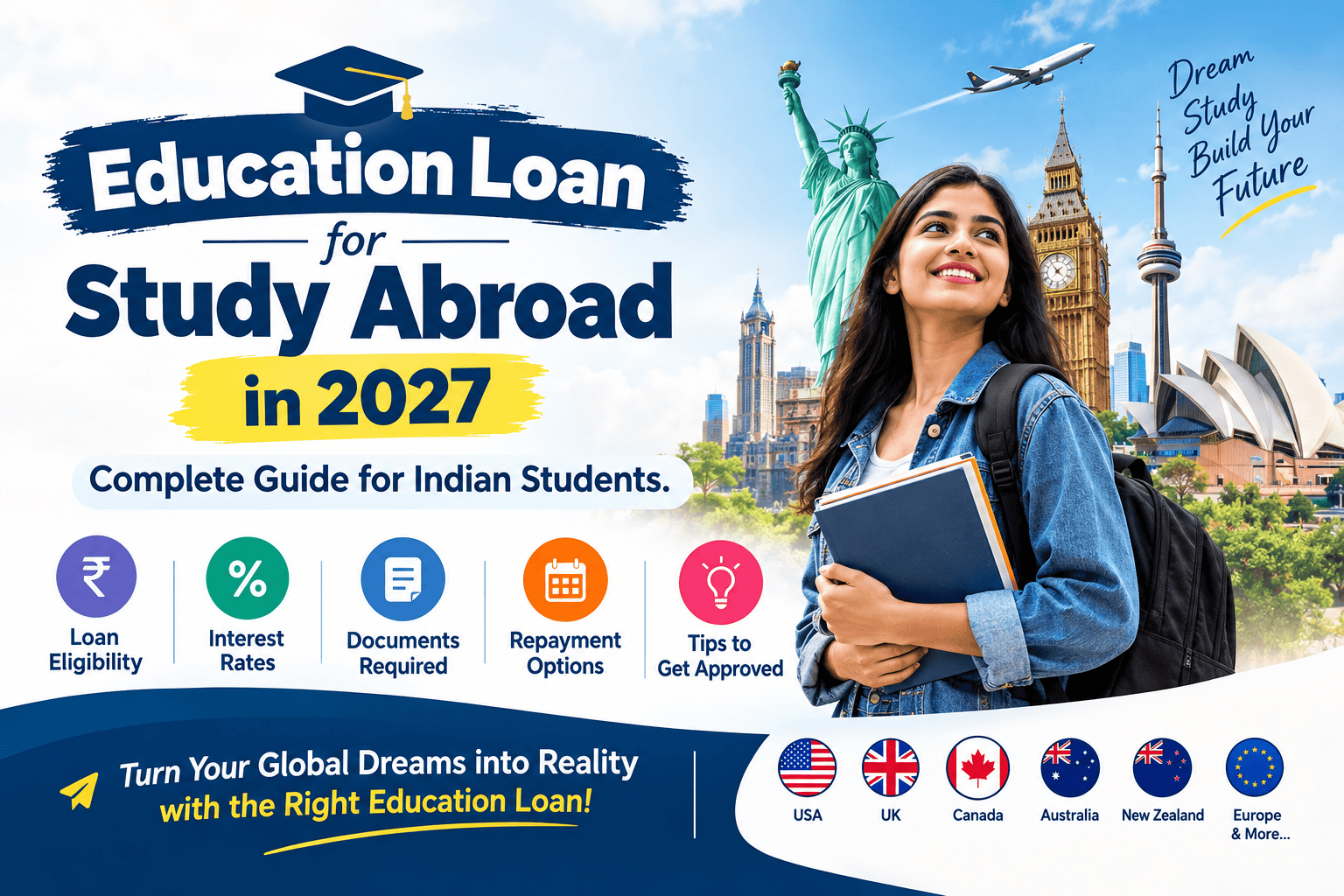
🎓 Planning to Study Abroad in 2027?
Get expert guidance on your university, course, scholarships, visa and education loan planning.
Planning to study abroad in 2027 can be an exciting step toward international education and global career opportunities. However, tuition fees, accommodation, living expenses, insurance, travel and other costs can make overseas education a significant financial commitment.
An education loan for study abroad can help eligible Indian students finance approved education expenses without paying the entire cost upfront. Depending on the lender, university, course, country, loan amount, collateral and co-applicant profile, financing options can vary.
In this complete guide, we explain education loans for studying abroad in 2027, including eligibility, documents, collateral, interest, repayment, margin money, loan amounts and important points to check before applying.
⚡ Quick Answer
Yes, eligible Indian students can apply for education loans to fund approved higher-education programs abroad. The loan amount, interest rate, collateral requirement, repayment period and eligibility depend on the lender and the applicant’s profile.
What Is an Education Loan for Study Abroad?
An education loan for study abroad is a financial facility that can help students fund eligible higher education outside India.
Instead of arranging the complete cost from family savings, a student may borrow an eligible amount and repay it according to the lender’s agreed terms.
CIES Tip: Do not decide your loan amount only on the basis of tuition fees. Prepare a complete budget covering tuition, accommodation, living costs, insurance, travel and other eligible expenses.
Why Consider an Education Loan for Studying Abroad in 2027?
The total cost of international education can include considerably more than tuition fees.
| Expense | What It May Include |
|---|---|
| Tuition Fees | University or college fees |
| Accommodation | University housing or private accommodation |
| Living Costs | Food, utilities and daily expenses |
| Travel | Airfare and eligible travel costs |
| Insurance | Required health or other insurance |
| Study Materials | Books, equipment and supplies |
How Much Education Loan Do You Need for Study Abroad?
There is no single loan amount that applies to every student. Your requirement should be calculated according to your complete education budget.
Total Education Cost = Tuition + Living + Accommodation + Travel + Insurance + Other Eligible Expenses
For example, if your estimated total education cost is ₹35 lakh and your family plans to contribute ₹10 lakh, the potential funding gap could be around ₹25 lakh, subject to lender eligibility, margin requirements and approval.
💰 Don’t Know How Much You Need to Borrow?
Talk to a CIES counsellor and understand your study-abroad budget before making your financial plan.
What Expenses Can an Overseas Education Loan Cover?
1. Tuition Fees
Tuition fees are generally one of the primary components of an overseas education loan. The lender may disburse approved tuition fees according to the agreed schedule.
2. Accommodation
Depending on the loan product, eligible accommodation expenses may be included in the approved financing.
3. Living Expenses
Some education loan products may provide funding for eligible living expenses such as food, local transportation and utilities.
4. Travel Expenses
Certain lenders may include eligible travel expenses. Always check the lender’s current policy before including airfare in your calculations.
5. Books and Study Materials
Approved academic expenses such as books, equipment and, where permitted, a laptop or computer may be included.
Education Loan Eligibility for Study Abroad in 2027
Eligibility varies between lenders. Common factors considered may include:
- Academic performance
- Admission to an eligible institution
- Course and duration
- University and destination
- Student profile
- Co-applicant income
- Credit history
- Repayment capacity
- Collateral, where applicable
Documents Required for an Education Loan
Student Documents
- Passport
- Academic certificates and mark sheets
- University offer/admission letter
- Course details
- Fee structure
- Passport-size photographs
- Relevant test scores, where applicable
Co-Applicant Documents
- PAN card
- Identity and address proof
- Income proof
- Salary slips, where applicable
- Bank statements
- Income-tax documents, where applicable
- Employment or business documents
Collateral Documents
If collateral is required, the lender may request property or other eligible asset documents for valuation and verification.
Secured vs Unsecured Education Loan
| Factor | Secured Loan | Unsecured Loan |
|---|---|---|
| Collateral | Generally required | Generally not required |
| Loan Amount | May support higher amounts | May have product-specific limits |
| Assessment | Includes collateral evaluation | Greater focus on profile and repayment capacity |
| Documentation | Additional asset documents | Usually fewer collateral documents |
Education Loan Interest Rates for Study Abroad in 2027
Education loan interest rates can change and vary according to the lender and loan product.
Before selecting a loan, compare:
- Interest rate
- Fixed or floating rate structure
- Processing fee
- Moratorium period
- Margin requirement
- Collateral requirements
- Prepayment terms
- Repayment period
- Disbursement conditions
Important: Don’t compare education loans only on the advertised interest rate. The total borrowing cost can also depend on processing fees, moratorium interest, insurance, margin and other applicable charges.
What Is the Moratorium Period?
The moratorium period is the period during which regular repayment of principal generally does not begin. Education loans commonly structure repayment around the study period plus an additional moratorium period.
However, the exact terms differ between lenders. Interest may continue to accrue during the study or moratorium period depending on the loan agreement.
What Is Margin Money in an Education Loan?
Margin money refers to the portion of the eligible education cost that may need to be funded by the student or family rather than the lender.
For example, if the eligible education cost is ₹30 lakh and a lender requires a 10% margin, the student’s contribution could be ₹3 lakh and the lender could finance ₹27 lakh, subject to approval and applicable terms.
How to Apply for an Education Loan for Study Abroad
Step 1: Finalize your university and course.
Step 2: Calculate tuition and complete living costs.
Step 3: Calculate your available savings and scholarships.
Step 4: Identify your funding gap.
Step 5: Compare suitable education loan options.
Step 6: Prepare student and co-applicant documents.
Step 7: Submit the loan application.
Step 8: Complete lender assessment and verification.
Step 9: Review the sanction letter carefully.
Step 10: Complete disbursement according to the agreed terms.
Education Loan and Study Abroad Visa
An education loan can form part of your overall financial planning for a student visa. Depending on the destination, students may need to demonstrate sufficient funds for tuition and living expenses.
A loan sanction letter may be accepted as financial evidence in some circumstances, but requirements differ by country and can change.
CIES Tip: Always verify the latest financial and visa requirements for your specific destination before submitting your student visa application.
Education Loan for UK, Australia, Canada, USA & Europe
Your financial planning should be customized according to your destination, university, course duration and city.
| Destination | Key Costs to Plan |
|---|---|
| UK | Tuition, accommodation, living costs and visa-related expenses |
| Australia | Tuition, accommodation, living costs, insurance and travel |
| Canada | Tuition, accommodation, living expenses, insurance and travel |
| USA | Tuition, housing, food, insurance, books and transportation |
| Europe | Tuition, accommodation, living costs, insurance and travel |
🚀 Planning to Study Abroad in 2027?
Don’t wait until your admission is finalized to think about finances.
Let CIES help you understand your course, university, scholarship, visa and overall study-abroad planning.
Common Mistakes Students Make When Taking an Education Loan
- Borrowing without calculating the complete cost
- Looking only at the interest rate
- Ignoring the co-applicant’s financial profile
- Waiting until the last moment to apply
- Assuming an education loan guarantees visa approval
- Accepting a loan without understanding repayment
Education Loan Checklist for Indian Students in 2027
☑ University admission confirmed
☑ Course and duration verified
☑ Complete tuition fee structure available
☑ Accommodation budget prepared
☑ Living-cost estimate prepared
☑ Scholarships checked
☑ Family contribution calculated
☑ Funding gap identified
☑ Suitable lenders compared
☑ Interest and repayment terms understood
☑ Moratorium period checked
☑ Margin requirement checked
☑ Collateral requirement checked
☑ Processing charges checked
☑ Visa financial requirements verified
Frequently Asked Questions
Can I get an education loan for studying abroad in 2027?
Yes. Eligible Indian students can apply for education loans for approved overseas higher-education programs. Approval depends on the lender’s eligibility criteria.
How much education loan can I get for studying abroad?
The amount depends on factors such as education cost, university, course, student profile, co-applicant, collateral and lender policies.
Can I get an education loan without collateral?
Some lenders offer unsecured education loans for qualifying applicants. Eligibility depends on the lender and applicant profile.
Can an education loan cover living expenses?
Some education loan products can cover eligible living expenses. The amount and conditions depend on the lender.
Is an education loan required for a student visa?
Not necessarily. Visa financial requirements vary by destination and individual circumstances. An education loan can be one possible source of education funding where accepted.
When does education loan repayment start?
Repayment generally begins after the applicable study and moratorium period according to the lender’s loan agreement.
Can I repay my education loan early?
Early repayment may be possible, but the applicable conditions depend on the lender and loan agreement.
Can I combine a scholarship with an education loan?
A scholarship can reduce your overall funding requirement in many situations. Inform the lender about any scholarship because it may affect the financing calculation.
Why Choose CIES for Your Study Abroad Planning?
CIES Overseas Education provides guidance to students planning international education, from course and university selection to application and visa guidance.
- 🎓 Study Abroad Counselling
- 🌍 University & Course Guidance
- 💰 Scholarship Guidance
- 📄 Application Assistance
- 🛂 Student Visa Guidance
- ✈️ Air Ticketing Assistance
- 📋 Profile Evaluation
- 🎯 Pre-Departure Guidance
Explore our Study Abroad Consultants in Noida service to start planning your international education journey.
🎓 GET READY FOR YOUR 2027 INTAKE
Your university decision, scholarship, visa and financial planning should work together.
Speak with CIES Overseas Education and get your study-abroad plan started.
7th Floor, Wave Silver Tower, F-702, D Block, Pocket D, Sector 18, Noida, Uttar Pradesh 201301
Enquire About Study Abroad – Free Counselling
📌 Tell us about your study-abroad plans and our counsellor can guide you on the next steps.
Disclaimer: Education loan eligibility, interest rates, loan amounts, collateral requirements, margin requirements and repayment terms vary by lender and may change. Loan approval is subject to the lender’s assessment. Students should verify the latest lender and visa requirements before making financial commitments.