
Can Indian students study in the Netherlands without IELTS? Explore MOI-based English proficiency exemptions, eligibility, tuition fees, living costs and 2027 study options.
Quick Answer: Can You Study in the Netherlands Without IELTS?
Yes, in some cases. Students who have completed their previous education in English may be able to explore selected universities and programmes in the Netherlands where an English-language test exemption is available.
However, an MOI (Medium of Instruction) certificate does not automatically guarantee an IELTS exemption. English-language requirements vary by university, programme, qualification and intake.
Always verify the exact programme requirements before applying.
Study in the Netherlands Without IELTS: What Indian Students Need to Know
The Netherlands is one of Europe’s popular destinations for international students, offering a wide range of English-taught bachelor’s, master’s and professional programs.
For Indian students planning to study abroad in 2027, one important question is whether IELTS, TOEFL, PTE or another English proficiency test is compulsory.
The answer is program-specific. Some universities may consider previous English-medium education when assessing English-language eligibility, while other programmes may require a recognized English proficiency test regardless of the language of previous study.
Therefore, students should not rely solely on general claims such as “Netherlands without IELTS” or “MOI accepted in the Netherlands.” The exact admission policy of the selected programme should always be checked.
Important: MOI Does Not Automatically Mean IELTS Exemption
An MOI certificate confirms that your previous education was delivered in a particular language, such as English. However, whether an institution accepts MOI as evidence for an English-language exemption depends on its own admission rules.
Some programmes may accept specific forms of previous English-medium education, while others may have additional conditions or require IELTS, TOEFL, PTE or another approved test.
Always check the official admission requirements for your exact course before making an application decision.
Netherlands Study Options to Explore for 2027
Students interested in studying in the Netherlands can explore different types of institutions, including research universities and universities of applied sciences. The following options are included for students researching potential 2027 pathways.
1. SRH Haarlem University of Applied Sciences
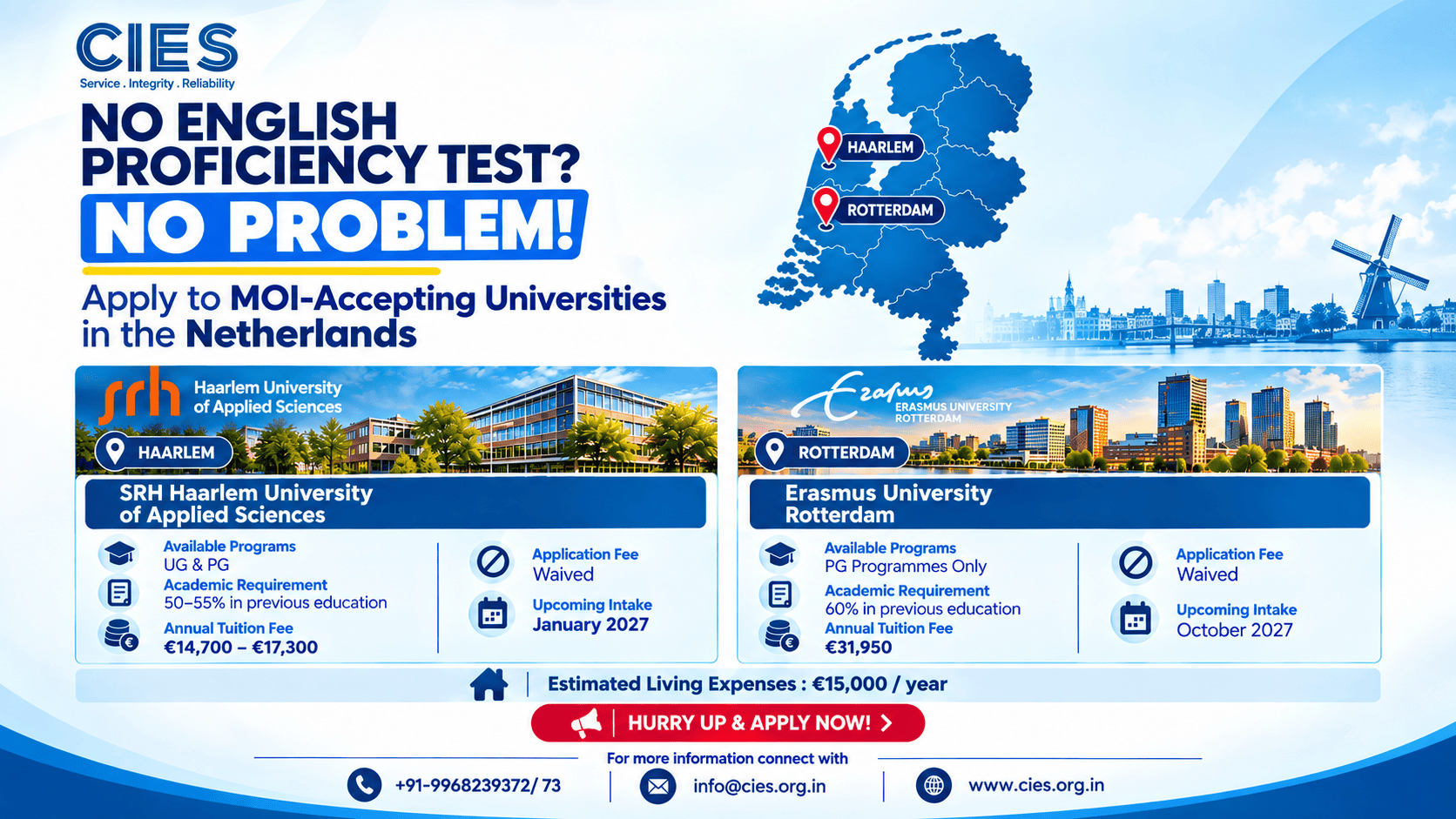
SRH Haarlem University of Applied Sciences is an international higher-education institution in Haarlem offering undergraduate and postgraduate study opportunities.
| Study Detail | Indicative Information |
|---|---|
| Study Level | UG & PG |
| Academic Requirement | Approximately 50–55%* |
| Annual Tuition | Approximately €14,700–€17,300* |
| Application Fee | Waived* |
| Intake | January 2027* |
*Requirements, fees, fee waivers, programmes and intake availability can change. Students should verify the latest programme-specific information before applying.
2. Erasmus University Rotterdam
Erasmus University Rotterdam is a major research university in the Netherlands with a range of international bachelor’s and master’s programmes.
For international applicants, English-language requirements can differ according to the programme. Students should therefore check the specific master’s or other programme admission page before assuming that previous English-medium education qualifies for an exemption.
| Study Detail | Indicative Information |
|---|---|
| Study Level | PG programmes* |
| Academic Requirement | Approximately 60%* |
| Annual Tuition | Approximately €31,950* |
| Application Fee | Waived* |
| Intake | October 2027* |
*Figures are indicative and should be confirmed against the exact programme and intake. Tuition and admission requirements may differ by programme and student category.
Cost of Studying in the Netherlands for Indian Students
When planning to study in the Netherlands, Indian students should calculate both tuition fees and living expenses.
| Expense | Indicative Planning Budget |
|---|---|
| Tuition | Depends on university and programme |
| Living Expenses | Approximately €15,000 per year* |
| Accommodation | Depends on city and housing type |
| Transport & Personal Expenses | Varies by lifestyle |
*€15,000 is a planning estimate and actual living costs can be higher or lower depending on accommodation, location and lifestyle.
Who Can Explore the Netherlands Without an English Test?
Students may consider an English-test exemption pathway if they have:
- Completed a previous qualification where the medium of instruction was English.
- Documentation supporting their English-medium education.
- The academic background required for the selected programme.
- Eligibility under the university’s specific English-language exemption policy.
- All other documents required for admission.
CIES Tip: Check These 5 Things Before Applying
- Does the exact programme allow an English-language exemption?
- Does the university accept your previous English-medium qualification?
- Is an MOI certificate accepted?
- Are there additional English-language conditions?
- Does the requirement apply to your 2027 intake?
Documents Required for Netherlands University Applications
Depending on your university and programme, you may need:
- Valid passport
- Academic transcripts
- Degree or school completion certificate
- Medium of Instruction (MOI) certificate, where applicable
- CV/resume
- Statement of Purpose or motivation letter
- Letters of recommendation, where required
- English proficiency evidence or exemption documentation
- Financial documents, where applicable
- Other programme-specific documents
How to Apply to Study in the Netherlands in 2027
- Evaluate your academic profile:
Review your marks, qualification, study gap and academic background. - Choose your programme:
Shortlist courses that match your academic background and career plans. - Check English requirements:
Determine whether IELTS, TOEFL, PTE or another test is required. - Check MOI eligibility:
If your education was in English, verify whether the selected programme provides an exemption. - Prepare documents:
Collect academic, identity, financial and programme-specific documents. - Submit your application:
Apply according to the university’s official process and deadline. - Plan your visa and finances:
After admission, prepare for the Netherlands student residence/visa process and financial requirements.
Explore More Study Abroad Options with CIES
Planning to study abroad in 2027? Explore CIES resources for:
- Study Abroad Consultants in Noida
- Student Visa & Visa Services
- International Air Ticketing
- Contact CIES Overseas Education
Want to Study in the Netherlands in 2027?
Get your academic profile evaluated before applying.
CIES Overseas Education can help you explore suitable universities, programs, admission requirements, and the student visa process.
Get Your Netherlands Study Profile Evaluated
Fill in your details and our counsellor can help you understand your study options.
Frequently Asked Questions
1. Can I study in the Netherlands without IELTS?
Yes, potentially. Some students may qualify for an English-language exemption depending on their previous education and the requirements of the selected university and programme. IELTS is not automatically waived for every international student.
2. Is MOI accepted for studying in the Netherlands?
MOI may be accepted for certain programmes or under specific exemption conditions, but there is no universal MOI rule covering every Netherlands university. Students should verify the exact programme requirements.
3. Can Indian students study in the Netherlands without IELTS?
Indian students may be eligible for an English-language exemption in selected circumstances. Eligibility depends on the university, programme, previous qualification and applicable exemption rules.
4. How much money is required to study in the Netherlands?
The required budget depends on tuition fees, accommodation, location and personal expenses. As a preliminary planning figure, students can consider around €15,000 per year for living expenses, in addition to tuition and other costs.
5. What is the cost of studying in the Netherlands?
Tuition varies significantly by institution, programme and student category. Some programmes may cost substantially more than others, so students should check the official fee information for their chosen course.
6. Can I use an MOI certificate instead of IELTS?
Not automatically. An MOI certificate can be relevant where a university or programme explicitly accepts previous English-medium education as an exemption. Students should obtain confirmation from the institution before relying on MOI instead of IELTS.
7. Which intake can I target in the Netherlands in 2027?
The available intake depends on the programme. Some institutions offer January intakes, while many programmes have later or annual admission cycles. Always check the official programme calendar.
8. Is the Netherlands good for international students?
The Netherlands offers a broad selection of internationally oriented programmes, including many courses taught in English. Students should compare programmes based on academic fit, tuition, location, career objectives and admission requirements.
Final Answer: Netherlands Without IELTS
Studying in the Netherlands without an English proficiency test may be possible for some students, but it is not a blanket rule.
If you completed your previous education in English, you can explore programmes where an English-language exemption may apply. However, the university’s exact requirements, programme rules and accepted documents should be verified before application.
For the 2027 intake, start with a profile evaluation and programme-specific eligibility check rather than relying on a general “IELTS not required” claim.
Disclaimer: Tuition fees, admission requirements, English-language exemption policies, application fees, intakes and other university conditions may change. Information should be independently verified with the relevant university or programme before application. CIES Overseas Education provides counselling and application guidance but final admission decisions are made by the respective institution.