
September 16, 2026

Choosing the best courses to study abroad in 2027 can help Indian students make informed decisions about their education, career goals, budget and preferred study destination. From Artificial Intelligence and Data Science to Engineering, Business, Healthcare and Sustainability, international universities offer a wide range of career-focused programs for students planning to study overseas.

Quick Answer: Which Are the Best Courses to Study Abroad in 2027?

Some of the most relevant study-abroad programs for 2027 include AI & Machine Learning, Data Science, Computer Science, Cybersecurity, Engineering, Business Analytics, Finance & FinTech, Healthcare, Biotechnology, Renewable Energy, Sustainability, Architecture and Design. The best course for you depends on your academic background, career goals, budget, admission requirements and preferred destination.

Why Choose the Right Course Before Studying Abroad?

Studying overseas is a significant academic and financial investment. Therefore, selecting a course should involve more than simply choosing a popular subject. You should consider the curriculum, university requirements, tuition and living costs, available career pathways, internship opportunities and the rules applicable to international students.

A well-planned course and destination combination can make your international education journey more focused and manageable.

Top Courses to Study Abroad in 2027

1. Artificial Intelligence & Machine Learning

Artificial Intelligence and Machine Learning continue to be important areas of study across technology and business. International universities offer programs covering machine learning, deep learning, natural language processing, computer vision, robotics and AI applications.

Popular study areas: Artificial Intelligence, Machine Learning, Robotics, Applied AI, Computational Intelligence.

2. Data Science & Data Analytics

Data-focused programs combine statistics, programming, analytics and business decision-making. Students may study data visualization, predictive analytics, big data, statistical modelling and machine learning.

Popular study areas: Data Science, Business Analytics, Data Analytics, Big Data and Applied Statistics.

3. Computer Science & Software Engineering

Computer Science remains a broad option for students interested in software development, computing systems, algorithms and emerging technologies. Depending on the university, students can specialize in areas such as cloud computing, software engineering, artificial intelligence and distributed systems.

Popular study areas: Computer Science, Software Engineering, Cloud Computing, Computing and Information Technology.

4. Cybersecurity & Information Security

As organizations increasingly depend on digital infrastructure, cybersecurity has become an important academic specialization. Programs can cover network security, digital forensics, information assurance, ethical security practices and risk management.

5. Engineering

Engineering offers a wide range of international study options. Depending on your previous education and interests, you may consider mechanical, electrical, civil, chemical, environmental, industrial or computer engineering.

Popular specializations: Mechanical Engineering, Electrical Engineering, Civil Engineering, Chemical Engineering, Industrial Engineering and Environmental Engineering.

6. Business Analytics & Management

Business-related programs can be suitable for students interested in management, strategy, entrepreneurship, marketing and data-driven decision-making. Business Analytics can be particularly useful for students who want to combine business knowledge with analytical skills.

7. Finance, Accounting & FinTech

Students with an interest in financial systems can explore Finance, Accounting, Financial Technology and related programs. Depending on the university, programs may include investment management, corporate finance, financial modelling, accounting and digital finance.

8. Healthcare & Health Sciences

Healthcare and health-science programs cover a broad range of academic disciplines. Students can explore public health, healthcare management, biomedical sciences, nursing and other health-related programs, subject to individual university and professional licensing requirements.

9. Biotechnology & Life Sciences

Biotechnology and life-science programs can suit students with backgrounds in biology, chemistry, biotechnology and related subjects. Areas of study may include molecular biology, genetics, biomedical research, bioinformatics and pharmaceutical sciences.

10. Renewable Energy, Sustainability & Environmental Studies

Sustainability and environmental studies bring together science, engineering, policy and business perspectives. International universities offer programs related to renewable energy, climate studies, environmental management, sustainable development and green technologies.

11. Architecture, Design & Creative Industries

Students with creative interests can consider architecture, graphic design, interaction design, product design, animation, fashion and related programs. Portfolio requirements can be an important part of admission for many creative courses.

💡 CIES Tip

Do not choose a course only because it is currently popular. Compare the course curriculum with your previous education, strengths and long-term career objectives before applying.

Top Study Destinations for International Students in 2027

The right destination depends on your preferred course, academic profile, budget, language requirements and future plans. Countries commonly considered by Indian students include the UK, Germany, Ireland, Finland, Denmark, Sweden, the Netherlands, Australia and Canada.

Destination Popular Study Areas What to Research
UK Business, Computing, Engineering, Healthcare University requirements, tuition, visa rules
Germany Engineering, IT, Data, Sciences Program language, tuition structure, admission requirements
Ireland IT, Business, Pharma, Data Course fees, entry requirements, immigration rules
Finland Technology, Business, Engineering Program language, tuition and scholarship options
Denmark Engineering, Business, IT, Sustainability Program requirements, fees and residence rules
Sweden Technology, Engineering, Sustainability University selection, tuition and scholarship availability
Netherlands Business, Engineering, Technology Institution type, tuition and admission criteria
Australia Business, IT, Engineering, Healthcare Course costs, visa conditions and eligibility
Canada IT, Business, Engineering, Healthcare Institution, program eligibility and current immigration rules

Popular Courses Based on Your Academic Background

Academic Background Possible Course Areas
Computer Science / IT AI, Data Science, Cybersecurity, Software Engineering
Engineering Engineering specializations, Technology, Data, Sustainability
Commerce / B.Com Finance, Accounting, Business Analytics, Management
Science Biotechnology, Life Sciences, Data, Environmental Studies
Arts / Humanities Design, Management, Social Sciences, Communication
Architecture / Design Architecture, Product Design, UX/UI, Creative Programs

How to Choose the Right Course to Study Abroad

1. Match the Course With Your Academic Background

Check whether your previous degree or subjects meet the university’s academic prerequisites. Some programs require specific subjects, credits or relevant work experience.

2. Compare the Curriculum

Two courses with similar names can have very different curricula. Review modules, practical projects, internships, research opportunities and specialization options.

3. Check University Admission Requirements

Review academic scores, English-language requirements, standardized tests, portfolios, work experience and other requirements before shortlisting universities.

4. Calculate the Complete Budget

Do not consider tuition alone. Your budget should also account for accommodation, food, transportation, insurance, application costs and other living expenses.

5. Check English-Language Requirements

Universities may accept IELTS, PTE, TOEFL or other approved tests depending on the program and institution. Always verify the exact requirement of your chosen university.

If you are preparing for an English-language test, explore our IELTS Coaching in Noida Sector 18 and IELTS Coaching in Delhi resources.

6. Consider Career-Relevant Skills

Look beyond the course title. Consider what technical, analytical, research, communication or practical skills you can develop through the program.

7. Review Current Visa and Post-Study Rules

Visa, work and post-study policies can change. Before applying, verify the latest rules through official government and university sources for your destination.

🎓 Plan Your Study Abroad Journey With CIES

Not sure which course, university or destination fits your profile? CIES Overseas Education can help you evaluate your academic background, shortlist suitable options and understand the application process.

Get a profile evaluation and discuss your study-abroad options.

🚀 Ready to Choose Your Course for 2027?

Get personalised guidance on courses, universities, destinations, applications and student visa requirements.

📲 WhatsApp CIES📞 Book Free Counselling

2027 Study Abroad Application Timeline

Period Recommended Action
Early Planning Research courses, destinations and universities.
Profile Preparation Prepare English test, academic documents and shortlist.
Application Stage Submit applications and required supporting documents.
Offer Stage Review offers, finances and accommodation options.
Visa Preparation Prepare the student visa application and supporting documents.

Common Mistakes Students Should Avoid

  • Choosing a course only because it is trending.
  • Ignoring university-specific eligibility criteria.
  • Comparing tuition fees without considering living costs.
  • Applying without checking English-language requirements.
  • Selecting a university without researching the actual curriculum.
  • Relying on outdated information about visa or immigration rules.
  • Waiting until the last minute to prepare documents.

How CIES Can Help With Your Study Abroad Plans

Choosing the right international education pathway can involve comparing several universities, countries and courses. CIES Overseas Education provides guidance throughout the study-abroad planning process.

  • Profile evaluation and course selection
  • University and destination shortlisting
  • Application guidance
  • SOP and documentation guidance
  • English-language test preparation
  • Student visa guidance
  • Accommodation and air-ticketing support

Learn more about our Study Abroad Consultants in Noida and explore our Visa Services.

📩 Get Study Abroad Guidance

Fill out the form and our counsellors can help you explore suitable courses and study destinations.

    Frequently Asked Questions

    What are the best courses to study abroad in 2027?

    Popular and career-oriented options include Artificial Intelligence, Data Science, Computer Science, Cybersecurity, Engineering, Business Analytics, Finance, Healthcare, Biotechnology and Sustainability. The right choice depends on your individual profile and goals.

    Which country is best for studying abroad in 2027?

    There is no single destination that is suitable for every student. Your choice should consider the course, university, tuition, living expenses, admission requirements and current visa rules.

    Which courses are suitable for Indian students after 12th?

    Depending on your subjects and interests, options can include Computer Science, Engineering, Business, Data-related programs, Life Sciences, Design, Architecture and other undergraduate disciplines.

    Which courses can students consider after graduation?

    Graduates can consider master’s programs aligned with their previous education, including Data Science, AI, Business Analytics, Engineering, Finance, Management, Healthcare, Biotechnology and other specialized disciplines.

    Do I need IELTS to study abroad?

    Many universities require proof of English proficiency, but accepted tests and exemptions vary by institution and program. Always check the exact requirements of your chosen university.

    How early should I start planning for 2027?

    Starting early gives you more time to research programs, prepare for English-language tests, collect documents, write your SOP and complete applications. Exact deadlines vary by country and institution.

    Final Thoughts

    The best courses to study abroad in 2027 are not necessarily the courses with the most attention online. A strong choice is one that matches your academic background, interests, budget and long-term objectives.

    Research the course curriculum, compare universities and verify the latest admission and visa requirements before making your final decision. If you need help evaluating your options, connect with CIES Overseas Education for personalised study-abroad counselling.

    🎓 Your 2027 Study Abroad Journey Starts With the Right Course

    Talk to CIES Overseas Education for course selection, university shortlisting and study visa guidance.

    📲 WhatsApp: +91-9968239372📞 Contact CIES

    Disclaimer

    Course availability, tuition fees, admission criteria, scholarships, visa regulations and immigration policies can change. Students should verify current requirements with the relevant university and official government sources before applying.
    September 10, 2026

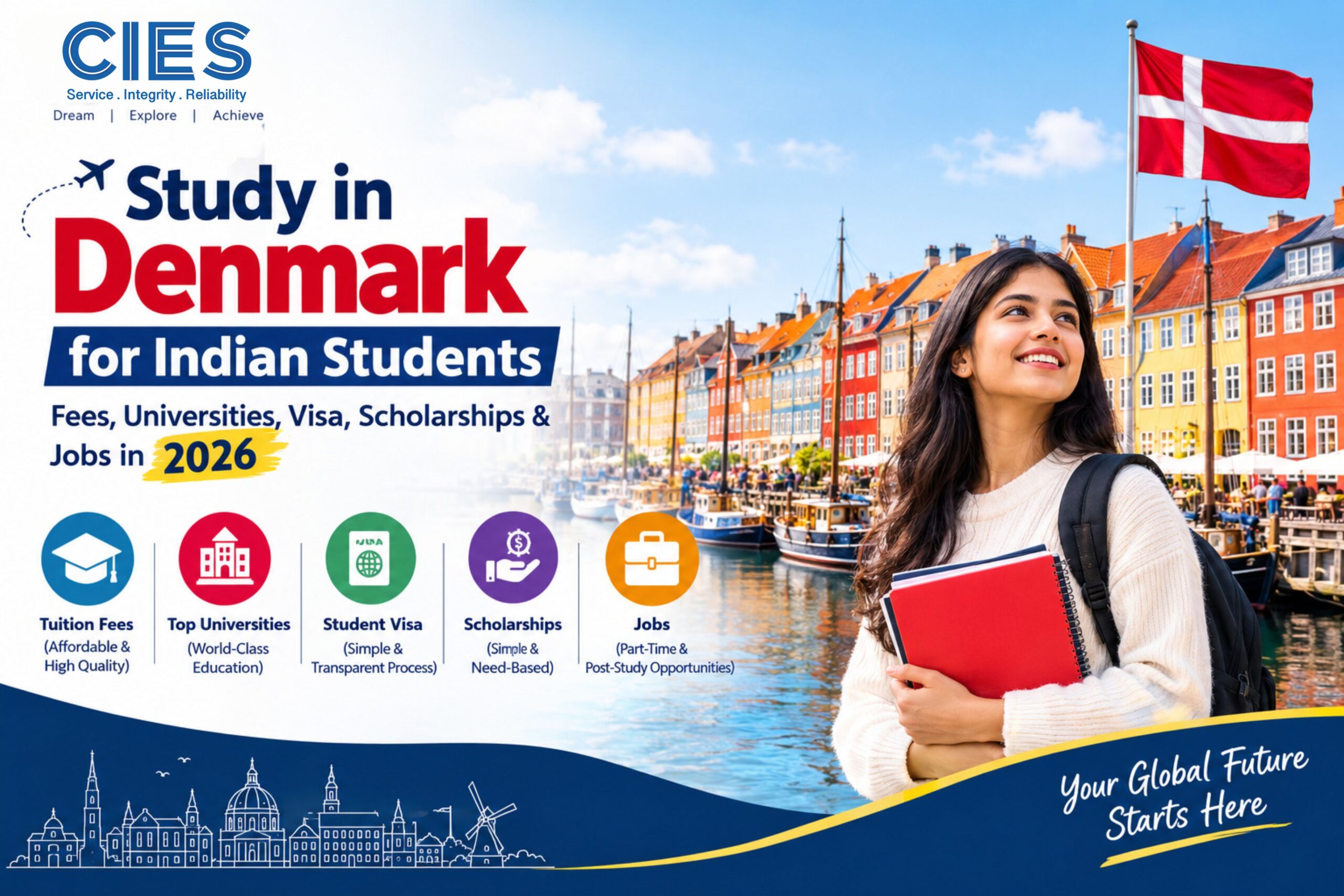
    Thinking about studying in Europe? Denmark is becoming an attractive destination for Indian students looking for internationally recognised education, English-taught programmes, practical learning and opportunities to gain international work experience.

    This complete guide explains how to study in Denmark for Indian students, including Denmark university fees, admission requirements, IELTS requirements, scholarships, student visa and residence permit, living costs, part-time work opportunities and post-study options.

    Quick Answer: Indian students can study a wide range of bachelor’s, professional bachelor’s, master’s and PhD programmes in Denmark, including many programmes taught entirely in English. Non-EU/EEA students generally pay tuition fees, with official guidance listing typical full-degree tuition at around €6,000–€16,000 per year, although the exact fee depends on the university and programme.

    Looking for the right Denmark university or course? Get personalised guidance on university selection, admission requirements, English proficiency, applications and the Denmark student residence process.

    🎓 Talk to a Denmark Study Abroad Counsellor

    Why Study in Denmark?

    Denmark offers an education system that emphasises critical thinking, innovation, collaboration, creativity and practical learning. Students can also benefit from industry-oriented teaching and opportunities to connect academic learning with real-world applications.

    For Indian students, Denmark can be particularly attractive because many higher education programmes are delivered in English, so learning Danish is generally not required for admission to an English-taught programme.

    • 🎓 High-quality European education
    • 🌍 Internationally recognised qualifications
    • 🇩🇰 More than 500 English-taught study programmes
    • 💡 Strong focus on innovation and practical learning
    • 🏢 Industry and business collaboration
    • 🌐 Multicultural international student environment
    • 💼 Opportunities for permitted student work
    • 🚀 Post-study job-seeking options for eligible graduates
    • 🇪🇺 Excellent location for experiencing Europe

    Denmark’s official study portal states that its higher education institutions offer more than 500 English-taught study programmes.

    What Can Indian Students Study in Denmark?

    International students can choose from different types of higher education programmes depending on their academic background and career goals.

    Programme Typical Purpose
    Academy Profession (AP) Practical, career-focused higher education
    Professional Bachelor’s Applied and career-oriented education
    Bachelor’s Degree Undergraduate academic education
    Master’s Degree Advanced specialisation after a bachelor’s degree
    PhD Research and academic careers

    Denmark’s official education portal lists AP, professional bachelor’s, bachelor’s, master’s and PhD programmes among the options available to international students.

    Popular Courses to Study in Denmark for Indian Students

    The best course depends on your previous education, career objectives and eligibility. Popular areas students may explore include:

    • 💻 Computer Science & Information Technology
    • 🤖 Artificial Intelligence & Data Science
    • ⚙️ Engineering
    • 📊 Business & Management
    • 💰 Finance & Economics
    • 🌱 Environmental & Sustainability Studies
    • 🧬 Biotechnology & Life Sciences
    • 🏗️ Architecture & Design
    • 🌍 International Business
    • 🔬 Research & Innovation

    Instead of selecting a course only because it is popular, Indian students should check the curriculum, entry requirements, tuition fee, career outcomes and eligibility for their specific academic profile.

    Top Universities and Higher Education Institutions in Denmark

    Denmark has several internationally recognised universities and higher education institutions. Depending on your course, you may explore institutions such as:

    • University of Copenhagen
    • Technical University of Denmark (DTU)
    • Aarhus University
    • Aalborg University
    • Copenhagen Business School
    • Roskilde University
    • University of Southern Denmark

    Important: University choice should be based on the specific programme rather than rankings alone. Admission criteria, tuition fees, deadlines and English-language requirements can differ between institutions and programmes.

    Denmark University Fees for Indian Students

    For students from India, Denmark generally treats applicants as non-EU/EEA students for tuition purposes. Therefore, most Indian students applying for full-degree programmes should expect to pay tuition fees unless they qualify for an exemption or scholarship.

    Denmark’s official study portal currently lists annual tuition for full-degree students at approximately:

    €6,000 – €16,000 per year

    Approx. DKK 45,000 – 120,000 annually

    Exact tuition varies by institution and programme.

    These figures are official indicative ranges; students should always verify the exact tuition fee directly with their chosen institution before applying.

    Cost of Living in Denmark for Indian Students

    Denmark is known for a relatively high cost of living compared with many destinations. Your actual monthly budget depends on your city, accommodation, lifestyle and transportation choices.

    Major expenses may include:

    • 🏠 Accommodation
    • 🍲 Food and groceries
    • 🚆 Public transportation
    • 📱 Mobile and internet
    • 📚 Books and study materials
    • 🩺 Personal and miscellaneous expenses

    Students should prepare a realistic financial plan before applying because tuition and living costs are separate expenses.

    Denmark Student Visa / Residence Permit for Indian Students

    Indian students generally need a Danish residence permit for study when enrolling in a qualifying higher education programme.

    The process generally involves:

    1. Select an eligible Danish institution and programme.
    2. Meet the academic and language requirements.
    3. Receive your admission/offer.
    4. Prepare the required residence permit documents.
    5. Submit the residence permit application according to the applicable procedure.
    6. Complete any required biometric or identity verification steps.
    7. Wait for the decision before travelling according to the immigration rules applicable to your case.

    Residence permit requirements can change, so students should check the latest requirements with the Danish immigration authorities before submitting an application.

    Denmark Student Visa Requirements for Indian Students

    Depending on your circumstances and programme, documents may include:

    • Valid passport
    • University admission letter
    • Proof of educational qualifications
    • English-language proficiency evidence where required
    • Financial documentation as required
    • Residence permit application documentation
    • Biometric information where applicable
    • Other documents requested by the authorities or institution

    Note: Immigration requirements are case-specific and can change. Always verify the current document list before submitting your application.

    IELTS Requirement for Denmark

    Do you need IELTS to study in Denmark? Many English-taught programmes require proof of English proficiency.

    Denmark’s official study portal states that English-taught undergraduate and postgraduate programmes require a high standard of English. IELTS and TOEFL are among the tests commonly used, but the exact score is decided by the individual institution and programme.

    Indicative English Level Indicative IELTS Score
    English B 6.5
    English A 7.0

    These are indicative benchmarks rather than universal admission requirements. Some programmes may have different requirements, so always check the specific university’s admission page.

    💡 CIES Tip: Don’t prepare only for a generic IELTS score. First shortlist your Denmark programmes and check the exact English requirement for each course.

    Admission Requirements to Study in Denmark

    Admission requirements depend on your programme and institution. In general, students may need to satisfy:

    • Academic qualification requirements
    • Subject-specific requirements
    • Minimum grades/GPA requirements
    • English-language requirements
    • Programme-specific prerequisites
    • Application and documentation requirements

    For undergraduate programmes, Denmark’s official guidance describes general entry requirements, specific programme requirements and language requirements as key parts of the admission process.

    How to Apply to Study in Denmark from India

    Step 1: Choose Your Course

    Identify your preferred subject, degree level, career goal and intake.

    Step 2: Shortlist Universities

    Compare course curriculum, tuition fees, entry requirements and career relevance.

    Step 3: Check Eligibility

    Review academic, subject-specific and English-language requirements.

    Step 4: Prepare Documents

    Prepare academic transcripts, certificates, passport, English test results and other programme-specific documents.

    Step 5: Submit Your Application

    Follow the application method specified by your institution and programme.

    Step 6: Receive Your Admission Decision

    If selected, review your offer carefully and complete the required next steps.

    Step 7: Apply for Your Residence Permit

    Complete the relevant Danish residence permit process for your study programme.

    Step 8: Prepare for Departure

    Arrange accommodation, travel, finances and other pre-departure requirements.

    Denmark Bachelor’s Admission for Indian Students

    Indian students applying for bachelor’s-level study should carefully check whether their Indian school qualification satisfies the Danish general entry requirements for the selected programme.

    Some programmes may also have subject-specific requirements involving particular subjects, grades, or combinations of qualifications.

    For undergraduate admission, Denmark uses a coordinated application system for many programmes, while applications are assessed by the individual institutions.

    Denmark Master’s Admission for Indian Students

    For master’s programmes, students generally need a relevant bachelor’s degree or equivalent qualification. However, the required academic background, ECTS credits, subjects, and grades depend on the programme.

    For example, some programmes may require specific academic credits in subjects related to the master’s field.

    Therefore, Indian students should never assume that having a bachelor’s degree automatically guarantees eligibility. Always check the exact program requirements.

    Scholarships to Study in Denmark

    Scholarships can help reduce the financial burden for eligible international students.

    Denmark offers a limited number of government scholarships for highly qualified non-EU/EEA students enrolled in full-degree higher education programs. These scholarships are administered by individual universities and may include:

    • 🎓 Full or partial tuition fee waivers
    • 💰 Grants towards living expenses

    Availability, eligibility, and selection criteria vary by institution and program.

    Scholarship Strategy: Apply early, maintain strong academic performance, and check each university’s scholarship page separately. Some scholarships are highly competitive and may have separate deadlines.

    Can Indian Students Work While Studying in Denmark?

    Yes, eligible international students can work while studying in Denmark, subject to the conditions of their residence and work permit.

    For students in state-approved higher education programs, the current rules allow work of up to 90 hours per month from September to May and full-time work during June, July and August.

    Students must follow the conditions stated on their residence card/permit. Working beyond the permitted limits can have serious immigration consequences.

    Post-Study Work Opportunities in Denmark

    One of the important questions for international students is what happens after graduation.

    Eligible graduates may receive a residence permit for job seeking after completing certain higher education programs. Current Danish immigration guidance states that graduates of qualifying professional bachelor’s, bachelor’s, master’s, or PhD programs can, in relevant cases, receive a job-seeking residence permit of up to 3 years.

    The exact post-study rights depend on the program, residence permit, and applicable immigration rules.

    If you receive a job offer that requires you to work beyond the limits of a restricted permit, you may need to apply for an appropriate work permit or residence-and-work permit.

    Is Denmark Good for Indian Students?

    Denmark can be a strong study destination for Indian students who want English-taught European education and a practical, innovation-focused learning environment.

    However, Denmark may not be the right choice for every student. Tuition fees, living costs, admission requirements, and program availability should be considered before making a decision.

    Factor What Indian Students Should Consider
    Education High-quality, practical, and innovation-focused
    Language Many English-taught programs
    Tuition Generally applicable to non-EU students
    Work while studying Permitted within applicable work-hour limits
    Career Post-study options may be available to eligible graduates.
    Lifestyle High living costs should be budgeted carefully.

    Denmark vs Other European Study Destinations

    There is no single “best” European country for every student. The right destination depends on your course, budget, academic profile, career goals and preferred lifestyle.

    Denmark can be particularly attractive if you prioritize:

    • English-taught education
    • Practical and collaborative learning
    • Innovation and technology
    • International exposure
    • Industry-oriented education
    • European career opportunities

    Students should compare Denmark with destinations such as Sweden, Finland, Germany, the Netherlands and Ireland based on their individual profile rather than relying only on general country rankings.

    How Much Money Do I Need to Study in Denmark?

    Your total budget should include:

    • 💰 Tuition fees
    • 🏠 Accommodation
    • 🍴 Food and groceries
    • 🚆 Transportation
    • 📱 Communication
    • 📚 Academic expenses
    • 🛂 Residence permit-related costs
    • ✈️ Flight and initial settlement costs
    • 🧾 Emergency/contingency funds

    Because costs vary substantially by city and lifestyle, students should create a personalized budget rather than relying on one universal figure.

    Common Mistakes Indian Students Should Avoid

    1. Choosing a university only because of ranking
    2. Ignoring program-specific eligibility
    3. Assuming IELTS 6.5 works for every program
    4. Underestimating living expenses
    5. Waiting until the last minute to apply
    6. Using outdated visa information
    7. Assuming part-time work will fund the entire education
    8. Ignoring scholarship deadlines
    9. Submitting incomplete documents

    Why Choose CIES for Study in Denmark?

    Choosing the right program and preparing a strong application can make your study-abroad journey much smoother.

    CIES Overseas Education helps students with study-abroad planning, university selection, admission guidance, visa assistance, and English-language preparation.

    • 🎓 Course and university selection
    • 📑 Admission application guidance
    • 📝 IELTS/PTE/CELPIP/TOEFL preparation
    • 🛂 Student visa and immigration guidance
    • 💰 Scholarship guidance
    • 📋 Document preparation support
    • ✈️ Pre-departure assistance
    • 🏠 Accommodation and air-ticketing support

    Ready to explore Denmark for your higher education?

    📞 Book a Free Consultation

    Frequently Asked Questions

    1. Is Denmark good for Indian students?

    Yes. Denmark can be a good option for Indian students seeking high-quality European education, English-taught programmes, practical learning and international exposure. However, students should evaluate tuition, living costs and programme-specific eligibility before applying.

    2. How much does it cost to study in Denmark for Indian students?

    Official Danish guidance currently lists annual full-degree tuition fees for many non-EU/EEA students at approximately €6,000–€16,000, although exact fees vary by institution and programme.

    3. Can I study in Denmark without knowing Danish?

    Yes. Many programmes are taught in English, and students do not generally need to speak Danish to study an English-taught programme. However, the specific programme’s language requirements must be met.

    4. What IELTS score is required for Denmark?

    There is no single IELTS score for all Danish universities. Official guidance gives indicative benchmarks of IELTS 6.5 for English B and 7.0 for English A, but individual institutions and programmes may require different scores.

    5. Can Indian students work while studying in Denmark?

    Eligible students in state-approved higher education programmes can currently work up to 90 hours per month during September–May and full-time during June, July and August, subject to the conditions of their permit.

    6. Is there a scholarship for Indian students in Denmark?

    Limited Danish government scholarships are available through universities for highly qualified non-EU/EEA students. Scholarships may include full or partial tuition waivers and/or grants towards living costs.

    7. Can I stay in Denmark after graduation?

    Eligible graduates may qualify for a post-study job-seeking residence permit. Current rules provide up to three years in relevant cases for graduates of qualifying professional bachelor’s, bachelor’s, master’s or PhD programmes.

    8. Is IELTS mandatory for every Denmark university?

    No. The exact English-language evidence accepted depends on the institution and programme. IELTS, TOEFL and other recognised qualifications may be accepted depending on the programme.

    9. What are the popular courses in Denmark for Indian students?

    Popular areas include IT, computer science, engineering, business, management, finance, sustainability, biotechnology, data science and other technology-related disciplines. The best option depends on your academic background and career goals.

    10. When should I start applying to Denmark universities?

    Students should start researching universities and preparing documents well before the relevant programme deadline. Deadlines differ by institution and programme, so always check the official application schedule.

    Final Verdict: Should You Study in Denmark?

    Study in Denmark can be an excellent option for Indian students looking for an innovative, internationally oriented European education. With a wide range of English-taught programmes, practical learning and potential post-study opportunities for eligible graduates, Denmark deserves consideration as part of your European study-abroad plan.

    But the right decision depends on your academic profile, course preference, budget, English score and long-term career plans.

    Don’t choose a country first and a course later. Choose the right course, university and career pathway first.

    🇩🇰 Plan Your Study in Denmark Journey with CIES

    🎓 Get Expert Guidance for Study in Denmark

    Tell us about your study-abroad plans and our counsellor can help you understand suitable courses, universities, eligibility and application requirements.