June 18, 2026

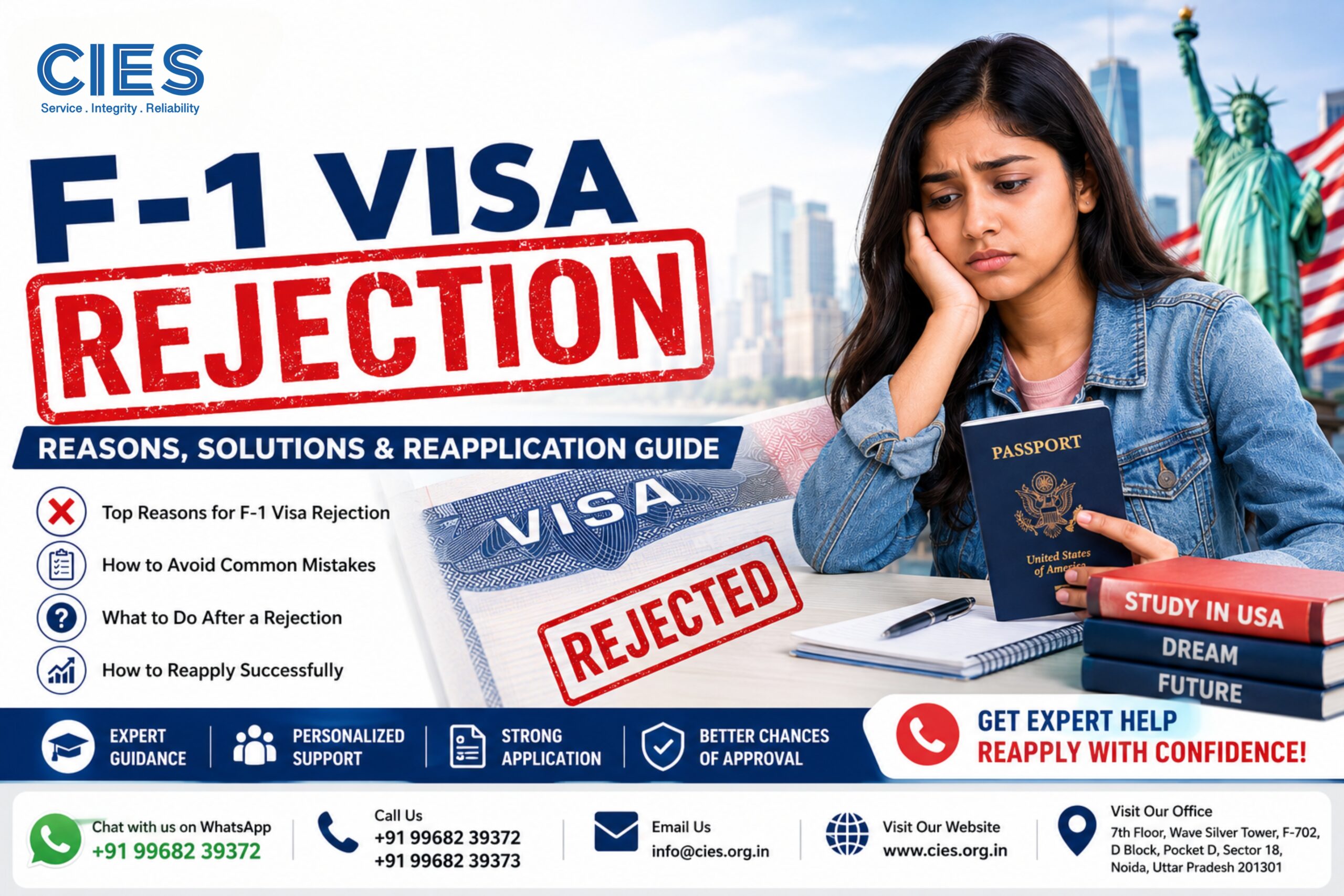
F-1 visa rejection can be disappointing, but it doesn’t necessarily mean your dream of studying in the United States is over. Every year, many international students, including Indian applicants, face F-1 visa refusals for reasons such as insufficient financial evidence, weak interview performance, or failure to demonstrate strong ties to their home country.

Understanding the common causes of an F-1 visa rejection and preparing a stronger application can significantly improve your chances of approval on your next application. This guide explains why F-1 visas are refused, how to avoid common mistakes, and what steps to take after a rejection.

What Is an F-1 Visa Rejection?

An F-1 visa rejection occurs when a U.S. consular officer determines that an applicant does not meet the eligibility requirements for a student visa under U.S. immigration law.

A refusal does not permanently prevent you from applying again. Many students receive approval after addressing the issues that led to their initial refusal.

Top F-1 Visa Rejection Reasons

1. Insufficient Financial Proof

Applicants must demonstrate that they have enough funds to cover tuition, living expenses, and other educational costs.

Common financial issues include:

  • Low bank balance
  • Unverified source of funds
  • Incomplete financial documents
  • Weak sponsorship evidence

How to Avoid It

  • Provide recent bank statements.
  • Include education loan sanction letters.
  • Submit scholarship documents.
  • Clearly explain your funding source.

2. Poor Visa Interview Performance

The visa interview is one of the most important stages of the application process.

Mistakes include:

  • Nervousness
  • Inconsistent answers
  • Memorized responses
  • Lack of confidence

Tips to Improve

  • Practice common interview questions.
  • Speak naturally and confidently.
  • Keep answers concise and relevant.

3. Lack of Genuine Student Intent

Visa officers must be satisfied that your primary purpose is education.

Possible Red Flags:

  • Limited knowledge of your course
  • Unclear career goals
  • No valid reason for selecting the university

Be Prepared to Explain:

  • Why this university?
  • Why this course?
  • How does it support your career?

4. Failure to Demonstrate Strong Home Country Ties

Applicants should demonstrate that they intend to comply with the terms of their visa and depart the United States after completing their studies unless they later become eligible for another lawful immigration pathway.

Examples of Strong Ties:

  • Family relationships
  • Future employment opportunities
  • Property ownership
  • Business interests
  • Career plans in your home country

5. Incomplete or Incorrect Documents

Missing or inaccurate documents can negatively affect your application.

Always verify that you have:

  • Valid Passport
  • Form I-20
  • DS-160 Confirmation
  • SEVIS Fee Receipt
  • Academic Transcripts
  • Financial Documents

6. Inconsistent Information

Any mismatch between your documents and interview responses can create concerns.

Examples:

  • Different sponsor names
  • Incorrect educational history
  • Conflicting financial information

Consistency is essential.

7. Weak Academic Profile

Low grades alone do not automatically result in a refusal, but you should be prepared to explain:

  • Study gaps
  • Backlogs
  • Academic challenges
  • Course changes

Provide honest explanations supported by evidence whenever possible.

What Happens After an F-1 Visa Rejection?

After a refusal:

  • Your passport is usually returned.
  • You receive a refusal notice.
  • The officer may indicate the applicable section of U.S. immigration law.
  • You may submit a new application if you address the previous concerns.

Can You Reapply After an F-1 Visa Rejection?

Yes.

There is generally no mandatory waiting period before reapplying. However, reapplying without addressing the reasons for refusal is unlikely to produce a different outcome.

Before submitting a new application:

  • Review the refusal reason.
  • Strengthen your financial evidence.
  • Improve interview preparation.
  • Update any changed information.
  • Submit accurate documentation.

How to Increase Your Chances of Approval

Choose the Right University

Understand:

  • Course curriculum
  • University rankings
  • Career outcomes
  • Program duration

Prepare Strong Financial Documents

  • Bank Statements
  • Fixed Deposits
  • Education Loan Approval
  • Sponsor Income Proof
  • Scholarship Letters

Practice Interview Questions

  • Why do you want to study in the USA?
  • Why this university?
  • Who is sponsoring your education?
  • What are your future career plans?
  • Why not study in your home country?

Be Honest

Never submit fake documents or misleading information.

Honest answers build credibility.

Organize Your Documents

Carry documents in a logical order to make it easier for the officer to request additional information.

Common Myths About F-1 Visa Rejection

Myth: One rejection means permanent refusal.
Fact: Many students receive approval after improving their applications.

Myth: Hiring an agent guarantees approval.
Fact: Only a U.S. consular officer can approve or refuse a visa.

Myth: Memorized answers improve your chances.
Fact: Honest and natural responses are generally more effective.

F-1 Visa Rejection Checklist

✅ Valid Passport
✅ Form I-20
✅ DS-160 Confirmation
✅ SEVIS Receipt
✅ Appointment Confirmation
✅ Financial Documents
✅ Academic Records
✅ Admission Letter
✅ Clear Study Plan
✅ Confidence & Honesty

Frequently Asked Questions (FAQs)

Why is an F-1 visa rejected?

Common reasons include insufficient financial proof, weak interview performance, inconsistent information, or failure to establish eligibility.

Can I apply again after an F-1 visa rejection?

Yes. You may submit a new application after addressing the issues that led to the previous refusal.

Is there a waiting period?

There is generally no mandatory waiting period, but it is advisable to reapply only after strengthening your application.

Will a previous rejection affect future applications?

No. Each visa application is assessed independently based on its own merits.

Does an education loan improve approval chances?

An approved education loan can strengthen your financial evidence, but visa approval depends on your overall eligibility and interview performance.

Final Thoughts

An F-1 visa rejection can be discouraging, but it is often an opportunity to build a stronger application. By understanding the reasons for refusal, improving your financial documentation, preparing thoroughly for the interview, and presenting a clear academic plan, you can significantly improve your chances of success.

Preparation, honesty, confidence, and consistency remain the keys to a successful F-1 visa application.

FAQ

Q1. What is the most common reason for an F-1 visa rejection?
Insufficient financial documentation and weak interview performance are among the most common reasons.

Q2. Can I reapply after an F-1 visa rejection?
Yes. You can submit a new application after addressing the issues that led to the previous refusal.

Q3. How can I avoid an F-1 visa rejection?
Prepare accurate documents, demonstrate sufficient financial support, answer interview questions honestly, and clearly explain your study plans.

Q4. Does a previous F-1 visa rejection affect future applications?
No. A previous refusal does not automatically result in future refusals, as each application is evaluated independently.

🎓 Rejected F-1 Visa? Don’t Give Up—Your USA Dream Is Still Possible!

An F-1 Visa rejection is not the end of your study abroad journey. Many students receive approval on their second attempt with stronger documentation, better interview preparation, and expert guidance.

🚀 How CIES Overseas Education Helps You Reapply Successfully

✅ One-to-One Visa Counselling
✅ Detailed F-1 Visa Rejection Analysis
✅ University & Course Selection Guidance
✅ Financial Documentation Review
✅ DS-160 Form Assistance
✅ SOP & Student Profile Evaluation
✅ Mock Visa Interview Preparation
✅ Complete F-1 Visa Reapplication Support

🎁 Book Your FREE F-1 Visa Assessment

Our experienced counsellors will help you:

  • 🎯 Identify why your F-1 visa was refused
  • 📄 Strengthen your financial documentation
  • 🗣 Prepare confident visa interview answers
  • 📚 Build a stronger student profile
  • 📈 Improve your chances of visa approval
  • 🛂 Create a personalized visa reapplication strategy

⭐ Why Students Trust CIES Overseas Education

✔ Experienced USA Education Counsellors
✔ Personalized Visa Reapplication Strategy
✔ End-to-End Admission & Visa Assistance
✔ Expert Mock Interview Sessions
✔ Scholarship & Education Loan Guidance
✔ Trusted by Thousands of Study Abroad Aspirants

⏳ Don’t Let One Rejection Stop Your Future!

Many students receive their U.S. student visa after improving their application. Let our experts help you turn your F-1 visa rejection into a successful approval.

🎓 Book Your FREE Visa Assessment Now

    June 17, 2026

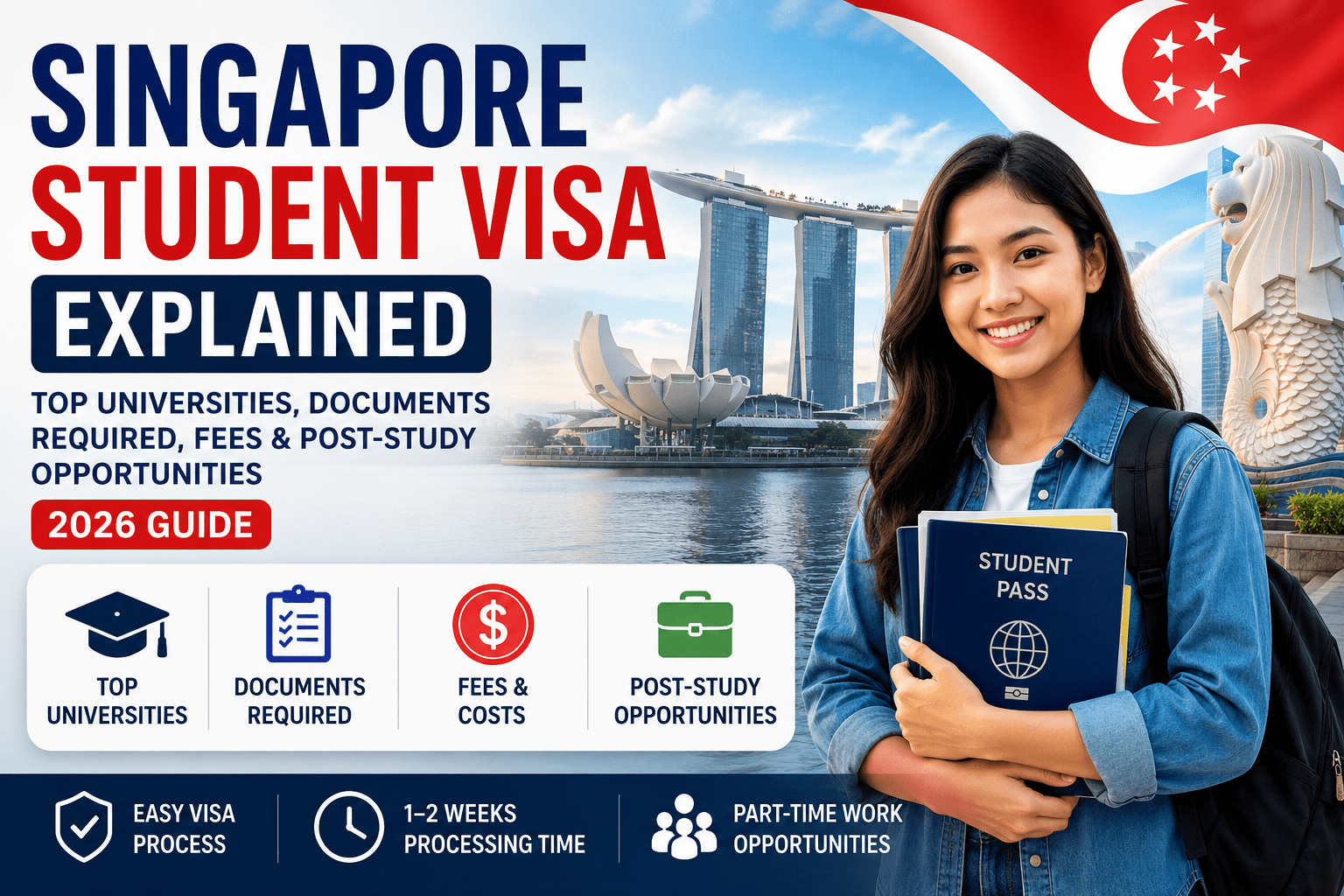
    Singapore Student Visa requirements are an essential consideration for international students planning to study in one of Asia’s leading education hubs. Singapore offers world-class universities, globally recognized degrees, excellent career opportunities, and a safe multicultural environment. This guide explains everything about the Singapore Student Visa (Student Pass), including eligibility, required documents, application fees, processing times, top universities, and post-study work opportunities in 2026.

    Quick Facts About Singapore Student Visa (2026)

    Category Details
    Visa Type Student Pass
    Issuing Authority Immigration & Checkpoints Authority (ICA)
    Application Mode Online via SOLAR System
    Processing Fee SGD 45
    Student Pass Issuance Fee SGD 60
    Entry Visa Fee (If Applicable) SGD 30
    Processing Time 1–2 Weeks
    Work Rights Limited Part-Time Work (Eligible Students)
    Post-Study Options Employment Pass, S Pass

    What Is a Singapore Student Visa?

    A Singapore Student Visa, officially called a Student Pass, is a permit issued by Singapore’s Immigration & Checkpoints Authority (ICA) that allows international students to study full-time at approved educational institutions in Singapore.

    Any international student enrolling in a full-time academic program generally requires a Student Pass before commencing studies.

    Why Study in Singapore?

    Globally Ranked Universities

    Singapore is home to some of Asia’s highest-ranked universities, recognized worldwide for academic excellence and research innovation.

    International Career Opportunities

    As a global financial and technology hub, Singapore provides graduates with access to multinational companies and diverse employment opportunities.

    Safe and Modern Environment

    Singapore consistently ranks among the safest countries in the world, making it an attractive destination for students and families.

    Multicultural Society

    Students experience a diverse international environment with strong Asian and global cultural influences.

    Industry-Focused Education

    Singapore universities emphasize practical learning, internships, innovation, and entrepreneurship.

    Top Universities in Singapore for International Students

    National University of Singapore (NUS)

    • Engineering
    • Computer Science
    • Medicine
    • Business
    • Law
    • Data Science

    Nanyang Technological University (NTU)

    • Engineering
    • Artificial Intelligence
    • Robotics
    • Business Management
    • Environmental Sciences

    Singapore Management University (SMU)

    • Business Administration
    • Economics
    • Finance
    • Accounting
    • Information Systems

    Singapore Institute of Technology (SIT)

    Known for applied learning and strong industry partnerships.

    Singapore University of Technology and Design (SUTD)

    • Design Innovation
    • Engineering
    • Technology
    • Artificial Intelligence

    Singapore University of Social Sciences (SUSS)

    • Social Sciences
    • Human Resources
    • Business Studies
    • Public Administration

    Singapore Student Visa Eligibility Requirements

    • Receive admission from an approved institution.
    • Enroll in a full-time course.
    • Possess a valid passport.
    • Demonstrate sufficient financial resources.
    • Submit required supporting documents.
    • Meet immigration and health requirements.

    Documents Required for Singapore Student Visa

    Students should prepare the following documents:

    Personal Documents

    • Valid Passport
    • Passport Biodata Page
    • Recent Passport-Sized Photograph
    • Birth Certificate (if required)

    Academic Documents

    • Educational Certificates
    • Academic Transcripts
    • Graduation Certificates
    • English Language Test Scores (if required)

    Admission Documents

    • Offer Letter
    • Admission Confirmation
    • Registration Acknowledgement

    Financial Documents

    • Bank Statements
    • Sponsor Documents (if applicable)
    • Proof of Financial Support

    Additional Documents

    • Medical Reports (if requested)
    • Identity Verification Documents
    • Family Information Documents

    How to Apply for a Singapore Student Visa

    Step 1: Obtain Admission

    Apply and receive an offer from a recognized Singapore institution.

    Step 2: Access the SOLAR System

    The institution will register your details in Singapore’s Student’s Pass Online Application & Registration (SOLAR) system.

    Step 3: Submit Student Pass Application

    Complete the online Student Pass application.

    Step 4: Pay Visa Fees

    Submit the applicable processing fee.

    Step 5: Receive In-Principle Approval (IPA)

    Approved students receive an IPA letter.

    Step 6: Travel to Singapore

    Use the IPA letter for entry into Singapore.

    Step 7: Complete Student Pass Issuance

    Complete the final verification process and receive your Student Pass.

    Singapore Student Visa Fees (2026)

    The estimated government fees are:

    Fee Type Amount
    Application Fee SGD 45
    Student Pass Issuance Fee SGD 60
    Entry Visa Fee SGD 30
    Total Estimated Fees SGD 105–135

    Additional institution-specific administrative fees may apply.

    Singapore Student Visa Processing Time

    Most Student Pass applications are processed within:

    • 1 Week for many applicants
    • Up to 2 Weeks for visa-required nationals
    • Longer for complex cases requiring additional verification

    Students should ideally apply at least 2 months before course commencement.

    Cost of Studying in Singapore

    Tuition Fees

    Program Type Annual Tuition Fee
    Diploma Programs SGD 10,000–20,000
    Bachelor’s Degrees SGD 15,000–50,000
    Master’s Degrees SGD 20,000–60,000

    Living Expenses

    • Accommodation: SGD 500–1,500/month
    • Food: SGD 300–600/month
    • Transportation: SGD 80–150/month
    • Miscellaneous Expenses: SGD 200–500/month

    Average annual living expenses range from SGD 10,000–20,000.

    Can International Students Work While Studying in Singapore?

    Yes. Eligible international students studying at approved institutions may work part-time during academic sessions and full-time during approved vacation periods, subject to Singapore regulations and university policies.

    Students should verify eligibility with their institution before accepting employment.

    Post-Study Work Opportunities in Singapore

    Employment Pass (EP)

    Suitable for highly skilled professionals meeting salary and qualification requirements.

    S Pass

    Designed for mid-skilled professionals employed by Singapore-based organizations.

    Popular Employment Sectors

    • Information Technology
    • Artificial Intelligence
    • Data Analytics
    • Finance & Banking
    • Engineering
    • Healthcare
    • Logistics
    • Business Consulting

    Frequently Asked Questions (FAQs)

    Is Singapore good for international students?

    Yes. Singapore offers globally recognized education, high safety standards, excellent infrastructure, and strong employment opportunities.

    How much does a Singapore Student Visa cost?

    The government fees typically range between SGD 105 and SGD 135, depending on individual circumstances.

    How long does Singapore Student Visa processing take?

    Most applications are processed within 1–2 weeks.

    Can Indian students work while studying in Singapore?

    Eligible students enrolled in approved institutions may work part-time according to Singapore regulations.

    Is IELTS required for a Singapore Student Visa?

    IELTS requirements depend on the university and course. Some institutions may accept alternative English proficiency qualifications.

    Can students stay in Singapore after graduation?

    Graduates can remain in Singapore if they secure employment and qualify for an Employment Pass or S Pass.

    Conclusion

    Singapore continues to be a premier destination for international education in 2026. With top-ranked universities, industry-oriented programs, strong career prospects, and a streamlined Student Pass process, Singapore offers an ideal environment for academic and professional growth.

    Students planning to study in Singapore should begin preparing early, ensure all documents are complete, and explore available scholarship and career opportunities to maximize their educational journey.

    Study in Singapore with CIES Overseas Education

    Planning to pursue higher education in Singapore? CIES Overseas Education provides:

    • ✅ University Admissions Guidance
    • ✅ Singapore Student Visa Assistance
    • ✅ SOP & Documentation Support
    • ✅ Scholarship Counseling
    • ✅ Education Loan Assistance
    • ✅ Pre-Departure Support

    Office Address:
    7th Floor, Wave Silver Tower, F-702, Sector 18, Noida, Uttar Pradesh 201301
    Phone: +91-9968239372 / 73
    Email: info@cies.org.in
    Website: www.cies.org.in

    Book Your Free Counseling Session

    Whether you’re planning for a bachelor’s, master’s, diploma, or professional program in Singapore, our experienced advisors are here to guide you every step of the way.

    🚀 Start Your Singapore Study Journey Today with CIES Overseas Education!