September 21, 2026

Looking for the best courses to study in UK for Indian students in 2027? The UK offers a wide range of undergraduate and postgraduate programmes in areas such as Artificial Intelligence, Computer Science, Data Science, Business Analytics, Finance, Engineering, Healthcare, Cyber Security, Biotechnology, Sustainability and Supply Chain Management.

For Indian students, choosing the right UK course should involve more than looking at university rankings or current popularity. Your academic background, career objective, tuition budget, location preference, course curriculum, practical experience and future employment plans should all be considered before applying.

This guide explains the best courses to study in the UK in 2027 for Indian students, potential career options, job-related skills, factors to consider when selecting a course, the current Graduate visa position and how to plan your UK study application.

Quick Answer: What Are the Best Courses to Study in the UK in 2027?

There is no single best UK course for every Indian student. The most relevant areas to research for 2027 include:

  • Computer Science & Artificial Intelligence – technology and software careers
  • Data Science & Business Analytics – data and analytical careers
  • Business & Management – management, consulting and business careers
  • Finance, Accounting & FinTech – finance and financial technology
  • Engineering – technical, infrastructure and engineering careers
  • Healthcare & Health Sciences – healthcare, research and management
  • Biotechnology & Life Sciences – pharmaceutical and research careers
  • Cyber Security – information and digital security
  • Renewable Energy & Sustainability – environmental and energy careers
  • Supply Chain & Logistics – procurement and operations
  • Construction & Project Management – infrastructure and project careers
  • Sports Management – sports business, events and marketing

The right course depends on your academic profile, career goals, budget and eligibility.

Why Study in the UK in 2027?

The UK is a popular destination for Indian students because it provides access to internationally recognised universities, specialised programmes and a wide variety of academic disciplines.

Depending on the university and course, students can find programmes with practical projects, industry exposure, placements, research opportunities and career support.

  • Globally recognised UK qualifications
  • Wide choice of undergraduate and postgraduate courses
  • Specialised master’s programmes
  • Industry-focused modules and projects
  • International learning environment
  • Opportunities to develop professional skills
  • Potential post-study work options for eligible graduates

Important: UK immigration rules can change. Students should check the latest official UK Government guidance before making decisions about study, work or immigration.

Popular courses to study in the UK for Indian students in 2027Best Courses to Study in UK for Indian Students in 2027
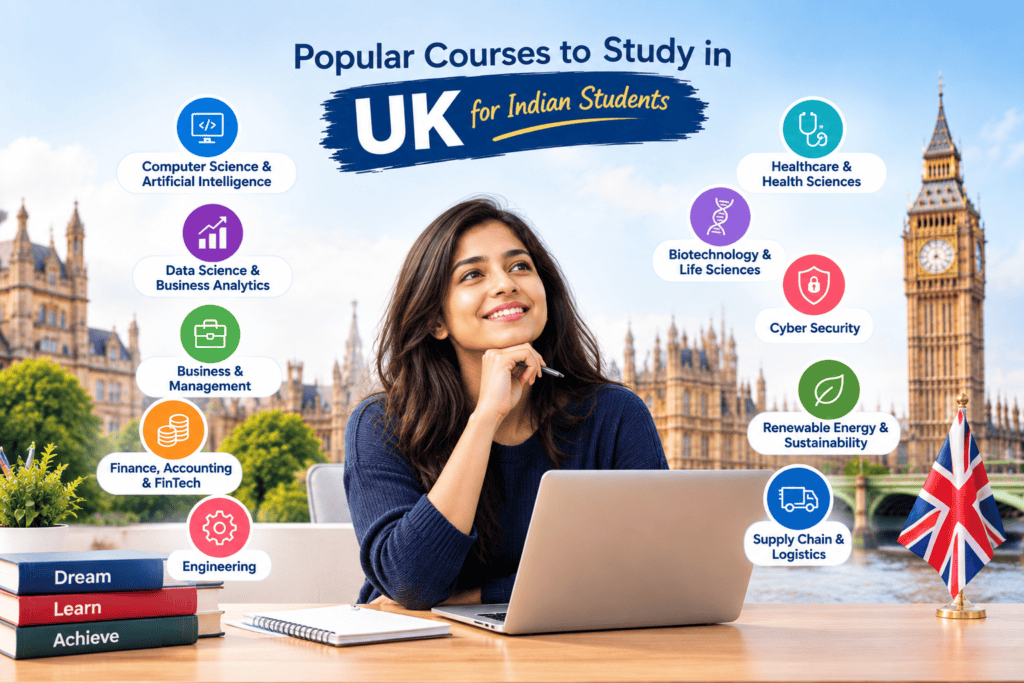
The following course areas can be considered by Indian students depending on their educational background and career objectives.

1. Computer Science & Artificial Intelligence

Computer Science and Artificial Intelligence are popular study areas for students interested in software, technology, machine learning, automation and digital products.

Popular UK Courses

  • MSc Computer Science
  • MSc Artificial Intelligence
  • MSc Machine Learning
  • MSc Software Engineering
  • MSc Cloud Computing
  • MSc Artificial Intelligence & Data Science

Potential Career Options

  • Software Engineer
  • Software Developer
  • AI Engineer
  • Machine Learning Engineer
  • Cloud Engineer
  • Technology Consultant

Useful skills: Python, SQL, cloud technologies, machine learning, software development and data analytics.

2. Data Science & Business Analytics

Data Science and Business Analytics courses can suit students who enjoy mathematics, statistics, technology and business decision-making.

Popular Courses

  • MSc Data Science
  • MSc Business Analytics
  • MSc Data Analytics
  • MSc Business Intelligence
  • MSc Financial Data Science
  • MSc AI & Data Science

Potential Career Options

  • Data Analyst
  • Data Scientist
  • Business Analyst
  • Business Intelligence Analyst
  • Analytics Consultant
  • Risk Analyst

3. Business & Management

Business and management courses can be considered by students interested in leadership, consulting, marketing, entrepreneurship, operations and international business.

Popular Courses

  • MSc Management
  • MSc International Business
  • MSc Marketing
  • MSc International Marketing
  • MSc Entrepreneurship
  • MBA
  • MSc Operations Management

Potential Career Options

  • Business Analyst
  • Management Consultant
  • Marketing Professional
  • Business Development Professional
  • Project Manager
  • Operations Professional

4. Finance, Accounting & FinTech

Students interested in financial markets, accounting, investment, banking and financial technology can explore specialised finance courses in the UK.

Popular Courses

  • MSc Finance
  • MSc Accounting & Finance
  • MSc Investment Management
  • MSc Financial Technology
  • MSc Banking
  • MSc Financial Risk Management

Potential Career Options

  • Financial Analyst
  • Investment Analyst
  • Risk Analyst
  • FinTech Analyst
  • Finance Associate
  • Accounting Professional

5. Engineering

Engineering remains a broad field with opportunities to specialise in mechanical, civil, electrical, electronic, aerospace, automotive, chemical and renewable-energy disciplines.

Popular Engineering Courses

  • Mechanical Engineering
  • Civil Engineering
  • Electrical Engineering
  • Electronic Engineering
  • Aerospace Engineering
  • Automotive Engineering
  • Chemical Engineering
  • Renewable Energy Engineering
  • Engineering Management

Potential Career Areas

  • Engineering
  • Manufacturing
  • Infrastructure
  • Energy
  • Automotive
  • Aerospace
  • Project Management

6. Healthcare & Health Sciences

Indian students interested in healthcare, research, health policy and healthcare management can explore a range of health-related programmes.

Popular Courses

  • Public Health
  • Healthcare Management
  • Biomedical Sciences
  • Clinical Research
  • Health Data Science
  • Nursing
  • Physiotherapy

Important: Some UK healthcare professions are regulated. Check the relevant professional registration requirements before choosing a course.

7. Biotechnology & Life Sciences

Biotechnology and life sciences can be relevant for students with backgrounds in biology, biotechnology, pharmacy, biomedical science and related disciplines.

  • MSc Biotechnology
  • MSc Biomedical Science
  • MSc Molecular Biology
  • MSc Bioinformatics
  • MSc Pharmaceutical Science
  • MSc Clinical Research
  • MSc Genetics

Potential Career Areas

  • Biotechnology
  • Pharmaceutical Research
  • Clinical Research
  • Laboratory Science
  • Bioinformatics
  • Life Sciences Research

8. Cyber Security

Cyber security is an important area for students interested in protecting networks, systems, applications and digital information.

Popular Courses

  • MSc Cyber Security
  • MSc Information Security
  • MSc Network Security
  • MSc Digital Forensics
  • MSc Cyber Security Management

Potential Career Options

  • Cyber Security Analyst
  • Security Consultant
  • Security Engineer
  • Information Security Analyst
  • Digital Forensics Analyst
  • SOC Analyst

9. Renewable Energy & Sustainability

Students interested in climate, clean energy, environmental management and sustainable development can explore programmes connected with sustainability and renewable energy.

  • Renewable Energy Engineering
  • Sustainability Management
  • Environmental Management
  • Environmental Science
  • Energy Systems
  • Sustainable Development
  • Environmental Engineering

Potential Career Options

  • Sustainability Consultant
  • Environmental Consultant
  • Energy Analyst
  • Renewable Energy Professional
  • ESG Professional
  • Environmental Project Manager

10. Supply Chain & Logistics

Supply chain and logistics programmes can suit students interested in international trade, procurement, transportation, operations and business management.

  • MSc Supply Chain Management
  • MSc Logistics Management
  • MSc Procurement & Supply
  • MSc Operations Management
  • MSc International Logistics

Potential Career Options

  • Supply Chain Analyst
  • Procurement Analyst
  • Logistics Manager
  • Operations Analyst
  • Demand Planner
  • Supply Chain Consultant

11. Construction & Project Management

Students with backgrounds in civil engineering, architecture, construction or business can consider specialised programmes in construction and project management.

  • MSc Construction Management
  • MSc Project Management
  • MSc Quantity Surveying
  • MSc Civil Engineering
  • MSc Infrastructure Management

Potential Career Options

  • Project Manager
  • Construction Manager
  • Quantity Surveyor
  • Project Coordinator
  • Construction Consultant

12. Sports Management

Sports management combines sports with business, marketing, events, sponsorship, operations and analytics.

  • MSc Sports Management
  • Sports Business
  • Sports Marketing
  • Sports Analytics
  • International Sports Management

Potential Career Options

  • Sports Marketing
  • Sports Operations
  • Sports Event Management
  • Sponsorship
  • Sports Business Development
  • Sports Analytics

UK Courses & Career Opportunities: Quick Comparison

Study Area Popular Courses Potential Career Areas
Technology Computer Science, AI, Software Engineering Software, AI, Cloud
Data Data Science, Business Analytics Data & Analytics
Business Management, International Business Management, Consulting
Finance Finance, Accounting, FinTech Finance, Banking, Risk
Engineering Civil, Mechanical, Electrical Engineering, Infrastructure
Healthcare Public Health, Health Sciences Healthcare, Research
Life Sciences Biotechnology, Biomedical Science Pharma, Research
Cyber Security Cyber Security, Information Security Security, Risk
Sustainability Renewable Energy, Sustainability Energy, ESG
Supply Chain Supply Chain, Logistics Procurement, Operations

How to Choose the Right Course to Study in the UK in 2027

Choosing the right UK course should be a structured decision. Use the following factors before submitting your university application.

1. Match the Course With Your Academic Background

Check whether your previous degree and subjects meet the university’s academic requirements. Some courses may require specific subjects, grades, work experience or prerequisite knowledge.

2. Define Your Career Goal

Think about the type of role or industry you want to enter after graduation. Then compare courses based on the skills and knowledge they provide.

3. Compare Course Modules

Two courses with similar names can have very different modules. Read the curriculum carefully and identify whether it includes practical projects, specialist modules, research or industry exposure.

4. Check University Location

Location can influence accommodation costs, transport, lifestyle and access to local employers. Consider the overall cost of studying in the city rather than looking only at tuition fees.

5. Research Practical Experience

  • Internships
  • Industry projects
  • Placement opportunities
  • Employer events
  • Career services
  • Professional certifications

6. Check Current Immigration Rules

If your plans include working in the UK after graduation, understand the current Student visa and Graduate route requirements before choosing your programme.

Job Opportunities After Studying in the UK

The career opportunities available after graduation depend on your course, skills, experience, employer requirements and the wider UK labour market.

Students can improve their employability by combining their academic qualification with practical experience and relevant technical or professional skills.

Skills That Can Support Employability

Technology: Programming, cloud computing, software development, and AI.

Data: Python, SQL, statistics, data visualization, and analytics.

Business: Excel, communication, analytics, and project management.

Finance: Financial modelling, Excel, analytics, and accounting knowledge.

Marketing: Digital marketing, SEO, analytics, and content.

Cyber Security: Networking, cloud security, security operations, and risk management.

UK Graduate Visa 2027: What Indian Students Need to Know

The UK Graduate route is an important consideration for international students who plan to work or look for work after completing an eligible UK course.

Current Graduate Route Position

  • Eligible bachelor’s and master’s graduates applying from 1 January 2027 will generally receive 18 months.
  • Eligible PhD and doctoral graduates can receive 3 years.
  • The Graduate route is unsponsored.
  • Eligible graduates can work or look for work.
  • The Graduate route itself is not a settlement route.

Always verify the latest rules on GOV.UK before making an immigration decision. Visa policies and requirements may change.

How to Apply to Study in the UK in 2027

Step 1: Choose Your Course

Identify suitable programmes based on your academic background, career objectives, budget and preferred location.

Step 2: Shortlist UK Universities

Compare course content, entry requirements, tuition fees, facilities, location, practical experience and career support.

Step 3: Prepare Your Documents

  • Passport
  • Academic transcripts
  • Degree certificate
  • English-language test result, where required
  • CV
  • Statement of Purpose
  • Letters of Recommendation, where required
  • Work experience documents, where applicable

Step 4: Submit University Applications

Submit your applications according to the requirements and deadlines of your selected universities.

Step 5: Meet Offer Conditions

If your offer is conditional, complete the required conditions before proceeding with the next stage.

Step 6: Apply for Your Student Visa

Once you have the required university documentation, check the latest UK Student visa requirements and prepare your visa application.

🎓 Need Help Choosing Your UK Course?

Get a personalised profile evaluation and guidance on suitable UK courses and universities.

Get FREE Study Abroad Counselling

Frequently Asked Questions

What are the best courses to study in UK for Indian students in 2027?

Popular areas to research include Computer Science, Artificial Intelligence, Data Science, Business Analytics, Finance, Engineering, Healthcare, Cyber Security, Biotechnology, Sustainability and Supply Chain Management. The right course depends on your academic background and career goals.

Which course is best for a job in the UK?

There is no course that guarantees a job. Career outcomes depend on the course, your skills, practical experience, employer requirements and labour-market conditions. Students should research their target occupation before selecting a degree.

What are the best master’s courses in the UK for Indian students?

Students can explore master’s programmes in areas such as Artificial Intelligence, Computer Science, Data Science, Business Analytics, Finance, Engineering, Cyber Security, Public Health, Biotechnology, Supply Chain Management and Sustainability, depending on their previous qualification.

Can Indian students work in the UK after studying?

Eligible international graduates may apply for the UK Graduate route after completing an eligible course. Current rules should be checked before applying because immigration requirements can change.

How long is the UK Graduate Visa for students graduating in 2027?

Under the current rules, eligible bachelor’s and master’s graduates applying for the Graduate route from 1 January 2027 generally receive 18 months. Eligible doctoral graduates can receive three years.

Is IELTS required to study in the UK?

English-language requirements vary by university and course. Some institutions may accept IELTS, while others may accept alternative English-language tests or specific previous-study qualifications. Always check the requirements of your chosen university.

How much does it cost to study in the UK?

The total cost depends on your university, course, city, accommodation and lifestyle. Compare tuition fees and estimated living costs for each university before making your final decision.

When should Indian students apply for the UK 2027 intake?

Students should begin researching courses and universities well before their intended intake. Application deadlines vary by university and course, and some popular programmes can have earlier or limited application windows.

💡 CIES Tip for Indian Students

Don’t choose a UK course only because it is trending. Compare your academic profile, career goal, course curriculum, university, tuition fee, location, practical experience, employability skills and current immigration rules before making your decision.

Conclusion: Choosing the Right UK Course for 2027

For Indian students planning to study in the UK in 2027, selecting the right course should be based on a combination of academic suitability, career objectives, skills development, university choice, budget and future plans.

Courses in technology, AI, data science, business analytics, finance, engineering, healthcare, cyber security, life sciences, sustainability, and supply chain management can provide different academic and professional pathways.

There is no universally best UK course. The best-fit programme is the one that matches your profile, interests and realistic career objectives.

🇬🇧 Planning to Study in the UK in 2027?

Get personalised guidance on UK courses, universities, eligibility, applications, scholarships and student visa requirements.

Book FREE counselling with CIES Overseas Education.

Book FREE Counselling

Related Study Abroad Resources

🎓 Get FREE UK Study Counselling

Share your academic profile and get guidance on suitable UK courses and universities.
    September 15, 2026

    Planning to study a Master’s in UK in 2027? 🇬🇧 The UK continues to be a popular destination for Indian students looking for globally recognised universities, specialised postgraduate courses, international exposure and career-focused education.

    From Computer Science, Artificial Intelligence and Data Science to Business, Finance, Engineering, Healthcare, Law and Sustainability, UK universities offer a wide range of Master’s programmes for international students.

    But choosing the right Master’s programme involves more than looking at university rankings. Indian students should compare tuition fees, living costs, course duration, entry requirements, scholarships, university location, career opportunities and UK Student Visa requirements before making a decision.

    Quick Answer: A Master’s in the UK can be an attractive option for Indian students because many taught Master’s programmes can be completed in around one year. Tuition fees vary significantly by university and course, while living costs are generally higher in London. For the 2027 intake, students should also plan according to the latest UK Student Visa and Graduate Visa rules.

    🎓 Planning Your Master’s in the UK?

    Get personalised guidance on UK universities, Master’s courses, scholarships, applications and Student Visa planning for the 2027 intake.

    📞 Book FREE Counselling 💬 WhatsApp CIES

    🇬🇧 Why Study a Master’s in the UK?

    The UK has a long-established higher education system and offers postgraduate programmes across a wide range of academic and professional fields. For Indian students, the combination of internationally recognised universities, specialised courses and a multicultural environment makes the UK an important study-abroad destination.

    • 🎓 Globally recognised universities and qualifications
    • ⏱️ Many taught Master’s programmes can be completed in around one year
    • 📚 Wide choice of specialised postgraduate courses
    • 🌍 International and multicultural learning environment
    • 💼 Opportunities to develop industry-relevant skills
    • 🔬 Strong research and innovation ecosystem
    • 🇮🇳 Large Indian student community in many UK cities

    🎓 Popular Master’s Courses in the UK for Indian Students

    Indian students can choose from hundreds of postgraduate specialisations. The right course depends on your previous degree, career goals, academic profile and long-term plans.

    Course Area Popular Master’s Courses
    💻 Technology MSc Computer Science, Artificial Intelligence, Data Science, Cyber Security, Software Engineering
    📊 Business MSc Management, International Business, Finance, Marketing, Business Analytics
    ⚙️ Engineering Mechanical Engineering, Civil Engineering, Electrical Engineering, Electronics, Renewable Energy
    🏥 Healthcare Public Health, Healthcare Management, Health Sciences, Biomedical Sciences
    📈 Economics & Finance Economics, Financial Economics, Banking, Investment and Finance
    ⚖️ Law LLM International Law, Commercial Law, Corporate Law, Human Rights Law
    🎨 Creative Fields Design, Fashion, Media, Film, Architecture and Creative Industries
    🌱 Sustainability Environmental Management, Sustainability, Climate Change and Renewable Energy

    🏆 Top Universities in the UK for Master’s 2027

    The UK has several internationally recognised universities. However, the best university for you depends on your chosen subject, academic background, budget and career objectives.

    When shortlisting universities, don’t look only at overall rankings. Compare the specific course, modules, faculty, research strengths, industry connections, location, tuition fees and graduate career opportunities.

    University Popular Study Areas
    University of Oxford Business, Economics, Computer Science, Engineering, Social Sciences and Law
    University of Cambridge Engineering, Computer Science, Management, Natural Sciences and Economics
    Imperial College London Engineering, Computing, AI, Business, Science and Healthcare
    UCL Business, Computer Science, Architecture, Engineering, Education and Health
    University of Edinburgh Computer Science, Data Science, Business, Engineering and Medicine
    King’s College London Law, Business, International Relations, Health and Social Sciences
    University of Manchester Engineering, Business, Computer Science, Management and Life Sciences
    University of Bristol Engineering, Computer Science, Business, Data Science and Science
    London School of Economics and Political Science Economics, Finance, Management, Politics and Social Sciences
    University of Warwick Business, Management, Economics, Engineering and Computer Science
    💡 CIES Tip: Don’t choose a university only because it appears high in a global ranking. A course with strong modules, relevant skills, industry exposure and career alignment can be a better choice for your individual profile.

    💰 Master’s in UK Fees for Indian Students 2027

    The cost of studying a Master’s in the UK depends on the university, course, location and duration. International tuition fees can vary considerably, so students should always check the official fee for their specific 2027 programme.

    Expense Planning Range / Requirement What Affects the Cost?
    🎓 Tuition Fees Often around £15,000–£40,000+ for international Master’s programmes University, subject and programme
    🏠 Accommodation Varies by city and accommodation type London vs other cities, location and room type
    🍽️ Food & Daily Living Varies by lifestyle Personal spending and city
    🚆 Transport Varies City and commuting requirements
    🛂 Student Visa £558 under the current published fee UK government fee at the time of application
    🏥 Immigration Health Surcharge Additional charge applies Visa duration and applicable government rate

    Important: The tuition figures above are broad planning estimates, not fixed UK-wide fees. Individual universities can charge substantially different amounts for different Master’s programmes.

    💷 UK Student Visa Financial Requirement for 2027

    Students applying for a UK Student Visa generally need to demonstrate that they have enough money to pay the relevant course fees and support themselves in the UK, unless they qualify for an applicable exemption.

    For applications covered by the new rules taking effect on 30 November 2026, the maintenance requirement is scheduled to increase to:

    • £1,570 per month for study in London, for up to 9 months.
    • £1,203 per month for study outside London, for up to 9 months.

    The UK government published these changes in September 2026, with the new figures scheduled to take effect on 30 November 2026.

    ⚠️ Important for 2027 applicants: Visa financial requirements can change. Before submitting your Student Visa application, always verify the latest maintenance requirement and evidence rules on GOV.UK.

    🎓 Entry Requirements for Master’s in UK

    Entry requirements vary by university and course, but Indian students commonly need to meet academic, English-language and documentation requirements.

    1. Academic Qualification

    Most Master’s programmes require a relevant bachelor’s degree or an equivalent qualification. The required percentage, CGPA or grade depends on the university and specific programme.

    2. English Language Requirement

    Universities may accept English-language tests such as IELTS Academic, PTE Academic or TOEFL iBT, depending on their policies.

    • IELTS Academic
    • PTE Academic
    • TOEFL iBT
    • Other accepted English-language evidence, depending on the university

    Required scores vary by programme. Some Master’s courses may require higher overall scores or minimum scores in individual sections.

    Need help preparing for IELTS? Explore our IELTS Coaching options.

    3. Work Experience

    Work experience is not mandatory for every Master’s programme. However, certain professional programmes, including some MBA courses, may prefer or require relevant professional experience.

    4. Statement of Purpose

    A strong Statement of Purpose should explain your academic background, motivation for the selected course, reasons for choosing the university and your future career objectives.

    5. Supporting Documents

    • Academic transcripts and certificates
    • Valid passport
    • English-language test score, where required
    • CV/resume, where required
    • Statement of Purpose
    • Letters of recommendation, where required
    • Work experience documents, where applicable

    📩 Not Sure Which UK University Is Right for You?

    CIES can help you evaluate your academic profile, career goals and budget to shortlist suitable UK universities and Master’s courses.

    Book FREE Counselling WhatsApp Now

    📋 Application Process for UK Master’s 2027

    1. Choose your preferred course and specialisation.
    2. Shortlist suitable UK universities.
    3. Check academic and English-language requirements.
    4. Prepare your SOP, CV and supporting documents.
    5. Submit university applications.
    6. Receive and evaluate offers.
    7. Meet any conditions attached to your offer.
    8. Pay the required deposit, if applicable.
    9. Receive your CAS.
    10. Prepare your Student Visa application.
    11. Arrange accommodation and travel.

    🛂 UK Student Visa for Master’s Students 2027

    International students coming to the UK for an eligible Master’s programme generally apply through the UK Student Visa route.

    The current published Student Visa application fee for applications from outside the UK is £558. Applicants also need to pay the applicable Immigration Health Surcharge as part of the visa process.

    Documents Commonly Required

    • Valid passport
    • CAS (Confirmation of Acceptance for Studies)
    • Financial evidence, where required
    • English-language evidence, where required
    • TB test certificate, where required
    • ATAS certificate, where applicable
    • Academic documents
    • Other documents requested by UKVI

    Students studying at Master’s level or above may need an Academic Technology Approval Scheme (ATAS) certificate depending on the course and circumstances.

    👨‍👩‍👧 Can Master’s Students Bring Dependants to the UK?

    Current UK rules restrict dependants for many international students. Eligibility can depend on the type of postgraduate programme and the student’s circumstances.

    Students should not assume that every Master’s programme allows a spouse or children to accompany them. Always check the latest GOV.UK rules for the exact course and visa category before making family plans.

    ⚠️ Don’t rely on old information: Some older websites still describe previous UK dependant rules. Check the current UKVI requirements before applying.

    💼 Graduate Visa After a UK Master’s

    The UK Graduate route allows eligible international students to stay in the UK after successfully completing an eligible course.

    For students planning the 2027 intake, an important change is the reduction in the Graduate Visa period for applications made from 1 January 2027.

    • Applications made on or before 31 December 2026: generally 2 years for eligible Bachelor’s/Master’s graduates.
    • Applications made on or after 1 January 2027: generally 18 months for eligible Bachelor’s/Master’s graduates.
    • Eligible PhD or other doctoral graduates: generally 3 years.

    The current GOV.UK guidance confirms that the Graduate Visa lasts 18 months for applications made on or after 1 January 2027 and 3 years for eligible doctoral graduates.

    The Graduate Visa cannot be extended. However, eligible graduates may be able to switch to another immigration route, such as the Skilled Worker route, if they meet the relevant requirements.

    🔎 Important: The Graduate Visa is not a guaranteed pathway to permanent residence. Students should understand the eligibility requirements and explore future visa options based on their individual circumstances.

    💰 Scholarships for Indian Students in the UK

    Scholarships can help reduce the overall cost of studying in the UK. Availability, eligibility and deadlines vary by university, course and scholarship provider.

    • 🏫 University-specific scholarships
    • 🎓 Merit-based scholarships
    • 🌍 International student scholarships
    • 📚 Department-specific awards
    • 💼 Business school scholarships
    • 🇬🇧 UK government or external scholarship opportunities

    Start researching scholarships early. Some awards have separate application deadlines and may require additional documents.

    📅 When Should Indian Students Apply for the UK 2027 Intake?

    For a September 2027 intake, students should ideally begin preparation well in advance. Starting early gives you more time to prepare for English tests, shortlist universities, write your SOP and arrange financial documents.

    Period Recommended Action
    2026 Research courses, universities, fees and career objectives.
    Late 2026 Prepare IELTS/PTE, SOP, CV and academic documents.
    Late 2026–Early 2027 Shortlist universities and submit applications.
    Early–Mid 2027 Review offers, scholarships and financial planning.
    After CAS Prepare Student Visa documents and application.
    Before departure Arrange accommodation, travel and essential documents.

    Exact application deadlines vary by university and course. Some programmes can be highly competitive or have limited places, so applying early can be beneficial.

    🏙️ Best UK Cities for Indian Master’s Students

    London

    London offers a large choice of universities, industries, networking opportunities and professional services. However, students should plan carefully because living costs can be significantly higher than in many other UK cities.

    Manchester

    Manchester is a major student city with options across business, technology, engineering, healthcare and other disciplines.

    Birmingham

    Birmingham has a large student population and provides access to a major UK business and employment centre.

    Edinburgh

    Edinburgh can be an attractive option for students interested in technology, business, finance, data and research.

    Leeds

    Leeds is a major UK centre for business, finance, healthcare and professional services and has a strong student community.

    Bristol

    Bristol has strengths across engineering, technology, aerospace and creative industries, making it worth considering for relevant Master’s programmes.

    💡 CIES Tip: The cheapest city is not automatically the best city. Compare university quality, course content, living costs, transport, employment opportunities and your personal preferences.

    📊 What Should Indian Students Consider Before Choosing a UK Master’s?

    • 🎓 Does the course match your academic background?
    • 🏫 Is the university strong in your chosen subject?
    • 💰 Can you comfortably manage tuition and living costs?
    • 📚 Does the course offer the modules and skills you need?
    • 💼 What are the career opportunities after graduation?
    • 📍 Is the city suitable for your budget and lifestyle?
    • 🛂 Do you understand the latest UK visa rules?
    • 🎓 Are scholarships available for your profile?

    🚫 Common Mistakes Indian Students Should Avoid

    • ❌ Choosing a university only because of its overall ranking
    • ❌ Selecting a course without checking its modules
    • ❌ Ignoring the total cost of living
    • ❌ Applying too late
    • ❌ Using the same generic SOP for every university
    • ❌ Ignoring scholarship deadlines
    • ❌ Assuming every Master’s student can bring dependants
    • ❌ Using outdated Student Visa or Graduate Visa information
    • ❌ Ignoring ATAS requirements where applicable
    • ❌ Selecting a course that does not support your long-term career goals

    🎯 How CIES Helps Indian Students Study in the UK

    Choosing a UK Master’s programme involves several decisions, from course and university selection to applications, documentation, visa preparation and pre-departure planning.

    CIES Overseas Education provides study-abroad guidance for students planning international education and can help you understand your available study options.

    • 🎓 Course and university shortlisting
    • 📋 Profile evaluation
    • 📝 Application guidance
    • ✍️ SOP and documentation guidance
    • 💰 Scholarship guidance
    • 🛂 Student Visa guidance
    • 🏠 Pre-departure support
    • ✈️ Air ticketing assistance

    Explore our Study Abroad Consultants in Noida service or speak to a counsellor about your UK study plans.

    🇬🇧 Your UK Master’s Journey Starts With the Right Plan!

    Not sure which course or university matches your profile? Let CIES evaluate your academic background, goals and budget.

    Get personalised guidance for the UK 2027 intake.

    💬 WhatsApp: +91-9968239372 📞 Book FREE Counselling

    📝 UK Master’s Enquiry Form

    Planning to study Master’s in the UK in 2027? Fill out the form below and our counsellors can help you explore suitable study options.

      ❓ Frequently Asked Questions

      1. How much does a Master’s in the UK cost for Indian students?

      International Master’s tuition fees vary by university and course. As a broad planning range, many programmes can fall around £15,000–£40,000+ per year, but students should always check the exact 2027 tuition fee published by their chosen university.

      2. Is a one-year Master’s available in the UK?

      Yes. Many UK taught Master’s programmes are designed to be completed in approximately one year, although the duration varies by programme and university.

      3. Which are the best universities in the UK for Master’s?

      Leading universities include Oxford, Cambridge, Imperial College London, UCL, Edinburgh, King’s College London, Manchester, Bristol, LSE and Warwick. The best choice depends on your subject, academic profile, budget and career objectives.

      4. What IELTS score is required for a UK Master’s?

      Requirements vary by university and course. Many programmes may ask for an IELTS Academic score around 6.5 or higher, but some courses can require higher scores or specific minimum scores in individual sections.

      5. Can I study a Master’s in the UK without IELTS?

      Some universities may accept alternative evidence of English proficiency or previous education in English, depending on their policies. Students should check the exact requirements of their chosen university.

      6. What is the UK Student Visa fee for 2027?

      The current published Student Visa application fee for applications from outside the UK is £558. Students should also budget for the applicable Immigration Health Surcharge and other study-related costs.

      7. How much money do I need for a UK Student Visa in 2027?

      For applications covered by the new rules from 30 November 2026, the scheduled maintenance requirement is £1,570 per month for study in London and £1,203 per month for study outside London, for up to 9 months. Students should verify the latest rules before applying.

      8. Can I bring my spouse to the UK while studying for a Master’s?

      Not automatically. Current UK rules restrict dependants for many international students. Eligibility depends on the type of postgraduate course and other circumstances, so students should check the latest GOV.UK requirements.

      9. How long is the Graduate Visa after a Master’s in 2027?

      Under the current rules, eligible Bachelor’s and Master’s graduates who apply for the Graduate Visa on or after 1 January 2027 can generally receive an 18-month Graduate Visa. Eligible doctoral graduates can receive three years.

      10. When should I start applying for the UK 2027 intake?

      Ideally, start preparing several months before your intended intake. Early preparation gives you more time for English tests, university shortlisting, SOP preparation, applications, scholarships and financial planning.

      📌 Final Verdict: Is a Master’s in the UK Worth It for Indian Students?

      Yes, a UK Master’s can be an excellent option for Indian students who choose the right course and university and plan their finances, applications and visa requirements carefully.

      The UK offers internationally recognised universities, specialised postgraduate programmes and an international learning environment. However, students should not make their decision based only on rankings or advertisements.

      For the 2027 intake, focus on:

      • 🎓 Course relevance
      • 🏫 University quality
      • 💰 Total tuition and living costs
      • 🎓 Scholarship opportunities
      • 📚 Entry requirements
      • 🛂 Current UK Student Visa rules
      • 💼 Career and employability prospects
      • 🇬🇧 Current post-study immigration options

      The right Master’s course can be a major investment in your international career—so choose strategically.

      🚀 Ready to Study a Master’s in the UK?

      Get your profile evaluated by CIES Overseas Education.

      We’ll help you explore suitable UK universities, Master’s courses, application requirements and visa planning for the 2027 intake.

      📞 Book FREE Counselling 💬 WhatsApp +91-9968239372

      📝 UK Master’s 2027 Enquiry Form

      Planning to study a Master’s in the UK? Fill out the form below and our counsellors will help you explore suitable universities and courses based on your academic profile, career goals and budget.

      🇬🇧 Get FREE UK Study Counselling

      Tell us about your study plans and our team will guide you through the next steps.

        April 27, 2026

        Study in UK for Indian students has become one of the most popular choices for those seeking world-class education, global exposure, and excellent career opportunities. With top-ranked universities, shorter course durations, and strong post-study work options, the UK offers everything Indian students need to build a successful international career.


        Why Study in the UK?

        The United Kingdom is home to some of the world’s best universities, including University of Oxford, University of Cambridge, and Imperial College London.

        Key Benefits:

        • 🎓 Globally recognized degrees
        • ⏳ Shorter course duration (3 years UG, 1 year PG)
        • 🌍 Multicultural environment
        • 💼 Post-study work visa (Graduate Route – 2 years)
        • 📚 Wide range of courses

        Top Universities in the UK for Indian Students

        Here are some of the best universities in the UK:

        These universities offer excellent programs in business, engineering, medicine, and humanities.


        Popular Courses to Study in UK

        Indian students prefer the following courses:

        • Business & Management (MBA)
        • Engineering & Technology
        • Computer Science & Data Analytics
        • Medicine & Healthcare
        • Law & International Relations

        Cost of Studying in the UK

        Tuition Fees:

        • Undergraduate: £10,000 – £20,000 per year
        • Postgraduate: £12,000 – £25,000 per year

        Living Expenses:

        • £10,000 – £15,000 per year (depending on city)

        Cities like London are more expensive compared to Manchester or Birmingham.


        Scholarships for Indian Students

        Many scholarships are available to reduce the financial burden:

        • Chevening Scholarships
        • Commonwealth Scholarships
        • University-specific scholarships

        These scholarships can cover tuition fees, living expenses, and travel costs.


        UK Student Visa Requirements

        To study in the UK, Indian students need a Student Visa (Tier 4).

        Requirements:

        • Offer letter from a UK university
        • Confirmation of Acceptance for Studies (CAS)
        • Proof of funds
        • English proficiency test like IELTS
        • Valid passport

        Post-Study Work Opportunities

        The UK offers a Graduate Route Visa, allowing students to stay:

        • 2 years after graduation
        • 3 years for PhD students

        This helps students gain international work experience and explore career opportunities.


        Intakes in the UK

        There are mainly three intakes:

        • September (Major intake)
        • January (Secondary intake)
        • May (Limited courses)

        How to Apply to UK Universities?

        Follow these steps:

        1. Choose your course and university
        2. Prepare documents (SOP, LORs, transcripts)
        3. Take English test like IELTS
        4. Apply via UCAS or directly
        5. Receive offer letter
        6. Apply for visa

        Documents Required

        • Academic transcripts
        • Statement of Purpose (SOP)
        • Letters of Recommendation (LORs)
        • Resume/CV
        • Passport copy
        • English test scores

        Final Thoughts

        Studying in the UK is a life-changing opportunity for Indian students. With high-quality education, global recognition, and excellent career prospects, the UK continues to be a top destination for higher studies.

        If you are planning to study abroad, proper guidance and expert consultation can make your journey smoother and more successful.