September 18, 2026

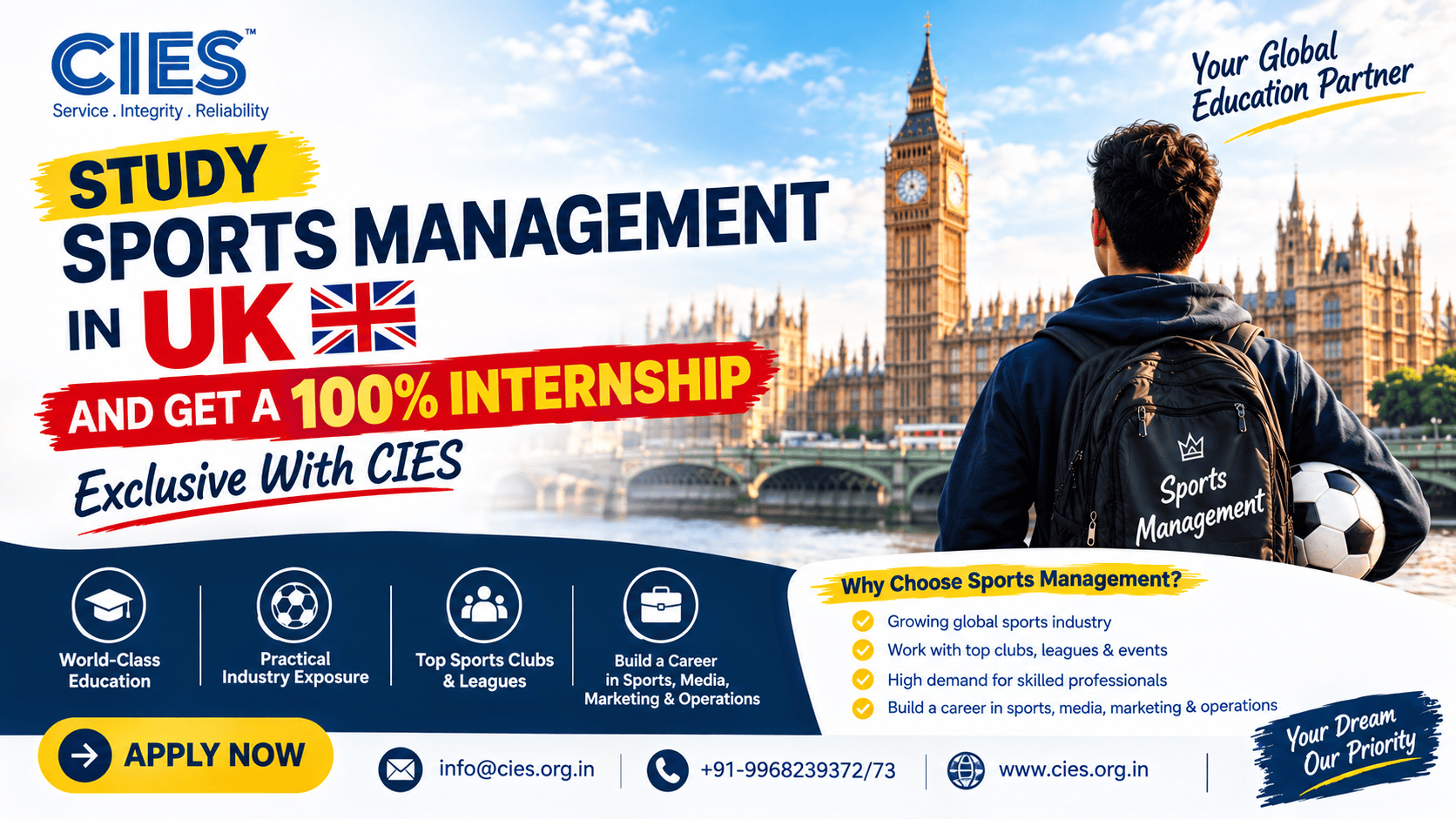
Study Sports Management in the UK and build practical experience through internship-focused programmes designed to connect classroom learning with the sports industry. For Indian students interested in sports business, event management, sports marketing, athlete management and the commercial side of sport, the UK offers a wide range of specialised study options.

At CIES Overseas Education, we help students explore suitable UK universities and courses, understand entry requirements, prepare their applications and plan their student visa journey. If your goal is to study Sports Management in the UK with an internship opportunity, our counsellors can help you identify programmes where internship or work-placement components are included in the course structure.

Quick Answer: Studying Sports Management in the UK can give international students access to specialised sports-business education and practical industry exposure. Some programmes include internships, placements or work-based learning as part of their structure. Always check the exact university course details and placement terms before applying.

Why Study Sports Management in the UK?

The UK has a long-established sports ecosystem covering professional clubs, sporting events, fitness businesses, media, sponsorship, marketing, sports technology and athlete development. This makes the country an attractive destination for students who want to study the business and management side of sport.

A UK Sports Management degree can combine management theory with areas such as sports marketing, finance, event management, leadership, sponsorship, sports law, operations and strategy.

Key Benefits of Studying Sports Management in the UK

  • Specialized sports management and Sports Business programmes
  • Opportunities for practical and industry-focused learning
  • Exposure to the UK’s professional and commercial sports ecosystem
  • Potential internship, placement or work-based learning opportunities on selected courses
  • International classroom environment
  • Career-focused modules covering sports marketing, events and management
  • Opportunities to build professional networks during your studies

What Is Sports Management?

Sports Management is the study of how sports organizations, clubs, events, facilities, athletes and commercial sports businesses are managed. It combines principles from business management with the specific needs of the sports industry.

Depending on the university and programme, students may study sports marketing, sponsorship, event management, sports finance, leadership, operations, media, strategy, governance and athlete management.

What Will You Study in a UK Sports Management Course?

The exact curriculum varies by university, but common subjects can include:

Module Area What You May Learn
Sports Marketing Branding, promotions, fan engagement and marketing strategy
Sports Events Planning, operations, logistics and event delivery
Sports Finance Budgeting, financial planning and commercial decision-making
Sponsorship Commercial partnerships, sponsorship activation and relationship management
Sports Leadership Leadership, teamwork and organisational management
Sports Strategy Strategic planning and business development in sports

What Does “100% Internship” Mean?

If you are searching for Sports Management in the UK with 100% internship, it is important to understand what the offer actually includes. Universities may describe practical experience differently — for example, as an internship, work placement, professional placement, industry project or work-based learning.

Therefore, rather than assuming that every Sports Management course automatically guarantees an internship, students should check whether the selected programme has a formal placement component and what eligibility, availability and employer requirements apply.

CIES Tip: Before accepting an offer, ask the university whether the internship is compulsory or optional, whether it is integrated into the course, how long it lasts, and whether students need to secure the placement themselves.

Sports Management Courses in the UK with Internship Opportunities

Students can find different types of UK programmes related to Sports Management and Sports Business. Depending on your academic background and career goals, you may consider:

  • BA Sports Management
  • BSc Sports Management
  • BA Sports Business Management
  • MSc Sports Management
  • MSc International Sports Management
  • MSc Sports Business
  • Sports Marketing programmes
  • Sports Events Management programmes

Some programmes may offer placement years or industry-based learning, while others may focus more heavily on academic research. Your choice should depend on your previous education, budget, career goals and preferred area of the sports industry.

Who Can Study Sports Management in the UK?

Sports Management can be suitable for students from different academic backgrounds. Depending on the course, universities may accept students who have completed school, undergraduate studies or a relevant degree.

For Undergraduate Students

Students who have completed Class 12 or an equivalent qualification can explore undergraduate Sports Management, Sports Business and related programmes. Specific academic requirements vary between universities.

For Graduates

Graduates can explore postgraduate options such as MSc Sports Management, MSc Sports Business or related programmes. Some universities may accept applicants from business, management, sports, marketing or other academic backgrounds.

English Language Requirements

Most UK universities require international students to demonstrate English-language proficiency. Depending on the institution and program, accepted tests may include IELTS, PTE, TOEFL, or other recognized English-language qualifications.

The required score varies by university and course. Some institutions may also consider previous education in English or other accepted evidence, subject to their own policies.

Need IELTS Preparation?

Prepare for your UK study journey with CIES IELTS coaching, including structured preparation, mock tests and personalised feedback.

Explore IELTS Coaching →

Career Opportunities After Sports Management in the UK

A Sports Management qualification can help students develop skills relevant to different areas of the sports and entertainment ecosystem. Depending on their skills and experience, graduates may explore roles such as:

  • Sports Marketing Executive
  • Sports Event Coordinator
  • Sports Business Development Executive
  • Sports Operations Coordinator
  • Sports Sponsorship Executive
  • Sports Club Administrator
  • Sports Partnership Executive
  • Sports Communications Executive
  • Sports Facility Manager
  • Sports Business Analyst

Actual career opportunities depend on the individual’s qualifications, experience, skills, employer requirements and the relevant immigration and employment rules applicable at the time.

How Much Does It Cost to Study Sports Management in the UK?

The cost of studying sports management in the UK depends on the university, degree level, course duration and location. International students should consider both tuition fees and living expenses when preparing their budget.

Expense What to Consider
Tuition Fees Varies by university and programme
Accommodation Depends on city and accommodation type
Food & Transport Depends on lifestyle and location
Visa & Other Costs Includes applicable visa, health and application-related costs

Because fees and immigration charges can change, students should verify the latest figures with their chosen university and official UK sources before making financial decisions.

How CIES Helps You Study Sports Management in the UK

Choosing the right Sports Management course involves more than simply selecting a university. You need to match your academic profile, budget, career interests and preferred location with the right programme.

CIES Overseas Education provides guidance throughout the study-abroad process, including:

  • Profile evaluation
  • UK university and course selection
  • Course and entry requirement guidance
  • Application assistance
  • SOP and documentation guidance
  • Scholarship guidance where applicable
  • Student visa guidance
  • Pre-departure support
  • Accommodation and air-ticketing support

Want to Study Sports Management in the UK?

Get your profile evaluated and explore UK Sports Management programmes with internship or placement opportunities.

BOOK FREE COUNSELLING

Frequently Asked Questions

1. Can I study Sports Management in the UK with an internship?

Yes. Some UK Sports Management programmes include internships, placements or other forms of practical industry experience. However, the structure differs between universities, so students should verify the specific course details before applying.

2. Is a 100% internship guaranteed with every Sports Management course?

No. An internship or placement is not automatically guaranteed for every course. Students should check whether the programme formally includes a placement and understand its eligibility, availability and employer requirements.

3. What can I do after studying Sports Management in the UK?

Graduates may explore opportunities in sports marketing, event management, sponsorship, sports operations, business development, communications, sports facilities and other sports-business functions.

4. Do I need IELTS to study Sports Management in the UK?

Many UK universities require international students to demonstrate English-language proficiency. IELTS is one commonly accepted test, but requirements vary by institution and course.

5. Can Indian students study Sports Management in the UK?

Yes. Indian students can apply to eligible UK Sports Management programmes if they meet the university’s academic, English-language and other admission requirements and satisfy the applicable student visa requirements.

6. How can CIES help me choose a Sports Management course in the UK?

CIES can evaluate your academic profile and help you explore suitable UK universities and Sports Management programmes based on your education, budget, preferred location and career goals.

CIES Quick Tip for Students

If your main priority is an internship, don’t select a university based only on the phrase “100% internship.” Ask for the exact placement structure, duration, eligibility criteria, location, assessment method and whether the university or student is responsible for securing the placement.

Ready to Start Your UK Sports Management Journey?

If you want to study Sports Management in the UK and are specifically looking for programmes with internship or placement opportunities, CIES Overseas Education can help you explore suitable options.

Get your profile evaluated, explore suitable universities and start your UK study journey with CIES.

Book Your Free Counselling

Fill in the enquiry form below and our study-abroad counsellors can help you explore suitable UK Sports Management courses.

    Disclaimer: Course availability, tuition fees, internship/placement structures, admission requirements, scholarships and visa rules may change. “100% Internship” should be understood only where a specific university/course formally confirms a guaranteed or integrated placement arrangement under its stated terms. Students should verify the latest information with the university and relevant official authorities before applying.

    September 16, 2026

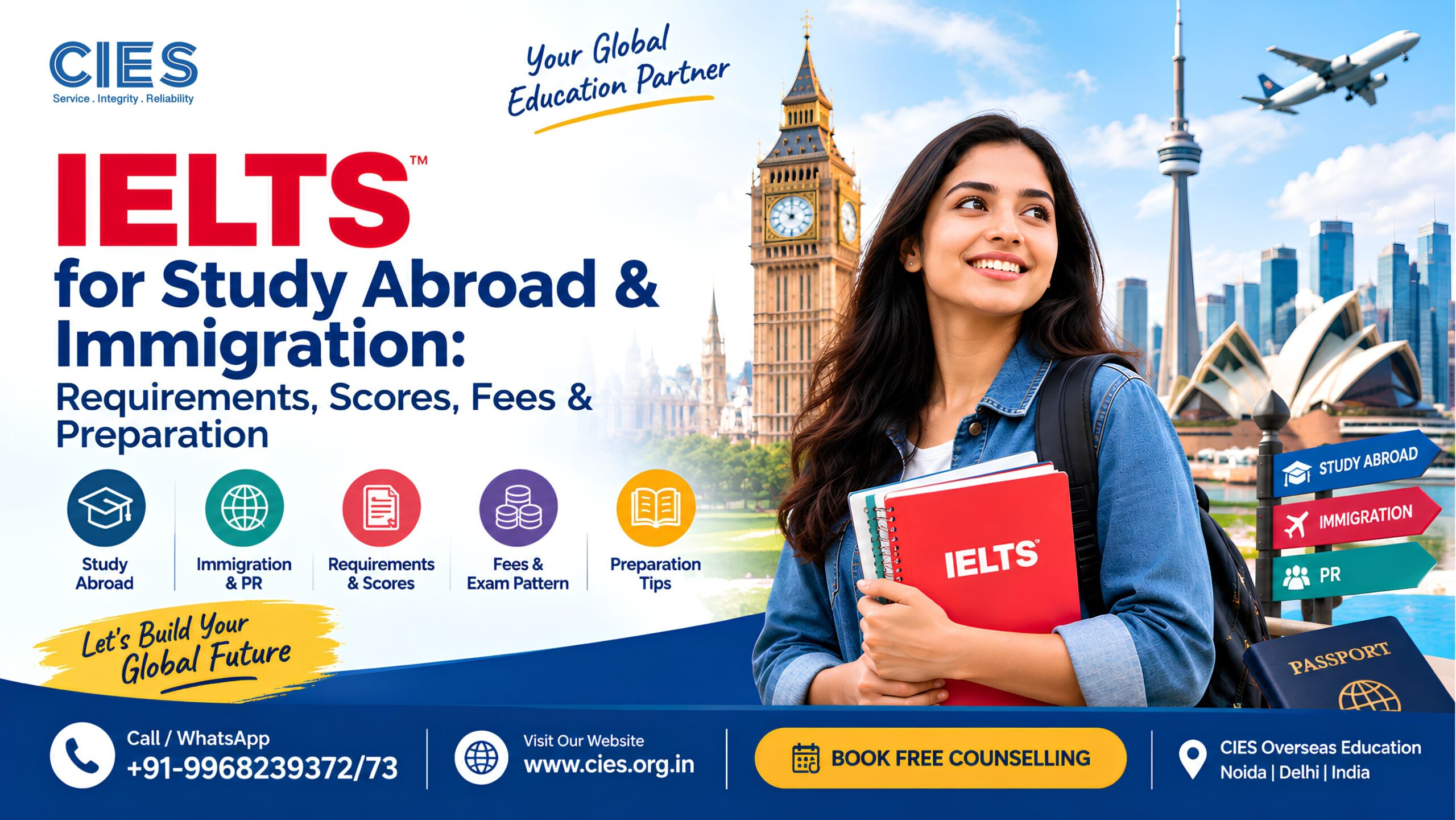
    IELTS for study abroad and immigration is one of the most widely recognised English-language tests for students and professionals planning to study, work or migrate overseas. Depending on your destination and pathway, your IELTS score may be required for university admission, immigration, professional registration or other purposes.

    If you are planning to take IELTS, this complete guide explains IELTS requirements, band scores, exam pattern, fees, Academic vs General Training, immigration requirements and preparation strategies to help you plan your next step.

    Quick Answer: The IELTS score you need depends on your university, course, destination country, immigration program and individual pathway. Many study-abroad applicants target an overall 6.5 or higher, while some programs require higher scores or minimum scores in individual sections. Immigration requirements can be different from university admission requirements.

    What Is IELTS?

    IELTS stands for International English Language Testing System. It evaluates your English proficiency across four skills:

    • 🎧 Listening
    • 📖 Reading
    • ✍️ Writing
    • 🗣️ Speaking

    IELTS is used internationally for education, migration, employment and professional-registration purposes. However, the specific test version and score requirement depend on the organisation or pathway you are applying to.

    Why Is IELTS Important for Study Abroad & Immigration?

    IELTS can provide evidence of your English-language ability when applying to universities, immigration programs or certain professional organisations.

    Purpose How IELTS May Be Used
    Study Abroad English-language admission requirement for universities and colleges
    Student Visa May be relevant depending on destination, course, institution and visa category
    Immigration Proof of English proficiency for certain immigration pathways
    Professional Registration Some regulated professions may require an approved English-language test
    Work Abroad May be required by employers, licensing authorities or visa pathways

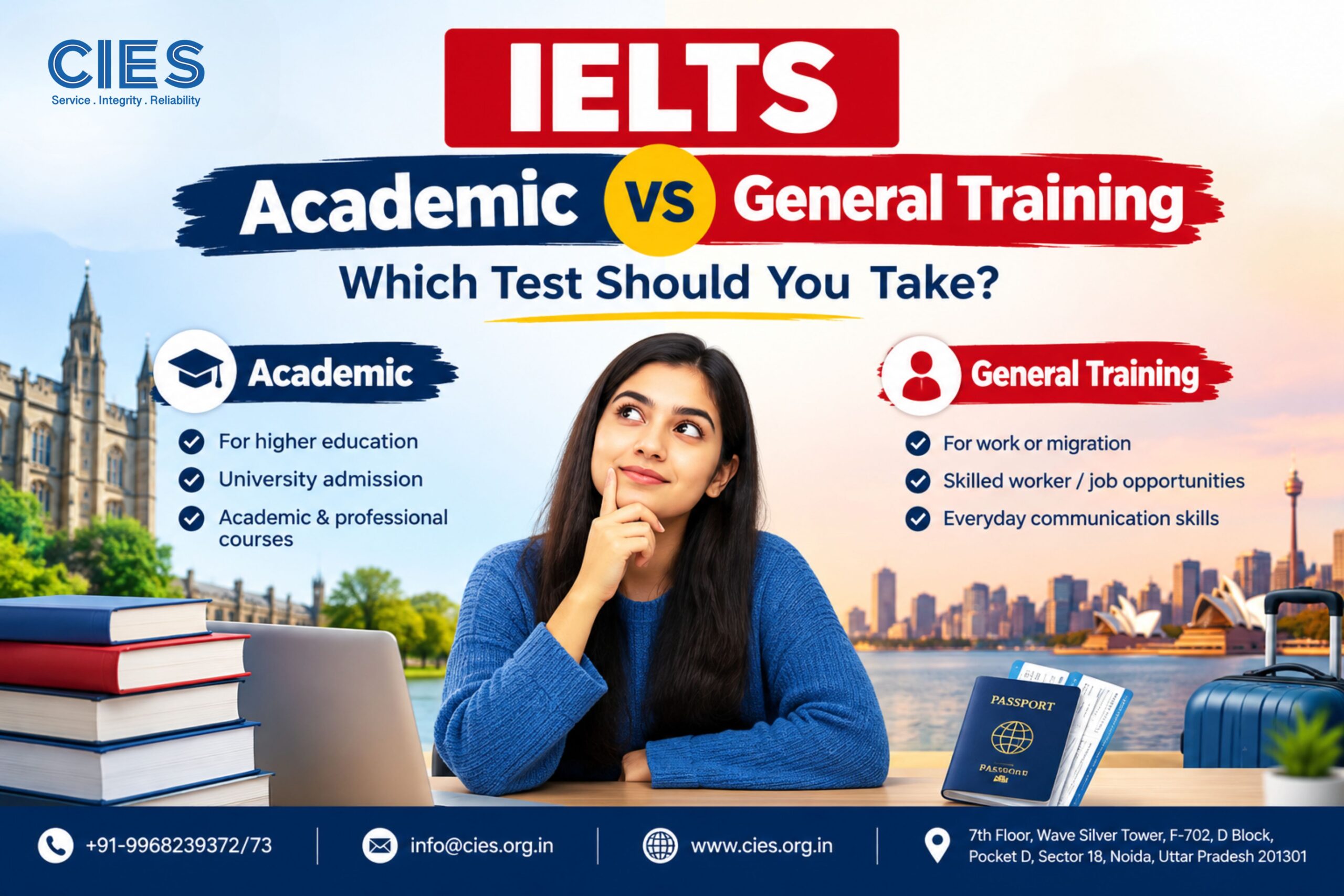
    IELTS Academic vs IELTS General Training

    Choosing the correct IELTS test is important. IELTS Academic is commonly used for higher education and some professional-registration purposes, while IELTS General Training is commonly used for migration, employment and general training contexts.

    Feature IELTS Academic IELTS General Training
    Common Purpose Higher education and professional contexts Migration, work and general training contexts
    Reading Academic-style texts Everyday and workplace-related texts
    Writing Academic writing tasks General-purpose writing tasks

    Important: Always check the current requirement of your university, immigration authority, professional body or visa pathway before booking IELTS. Do not select Academic or General Training based only on general advice.

    IELTS Band Score System

    IELTS uses a 0–9 band scale. You receive an individual score for Listening, Reading, Writing and Speaking, as well as an overall band score.

    Band General Description
    9 Expert user
    8 Very good user
    7 Good user
    6 Competent user
    5 Modest user
    4 Limited user

    What IELTS Score Do You Need for Study Abroad?

    There is no single IELTS score that applies to every university. Requirements can vary according to the country, university, course, degree level and department.

    Study Level Common Planning Range*
    Bachelor’s Around 6.0–6.5
    Master’s Around 6.5–7.0
    Competitive / Specific Programs May require 7.0+ or minimum section scores

    *These are general planning ranges, not universal admission requirements. Always verify the exact requirement for your chosen course and institution.

    IELTS Requirements for Popular Study Destinations

    IELTS for the UK

    UK universities set their own English-language requirements. Many degree programs accept IELTS, but the required score can vary by institution and course. Visa-related requirements should be checked separately.

    IELTS for Canada

    Canadian universities and colleges establish their own admission requirements. For immigration, the accepted IELTS version and required language level depend on the specific immigration program.

    IELTS for Australia

    Australian education providers may have different English-language requirements depending on the course and institution. Immigration and professional-registration requirements may also differ.

    IELTS for New Zealand

    IELTS requirements can vary according to the education provider, course, visa category and immigration pathway. Applicants should check the current requirements for their specific situation.

    IELTS for Europe

    Many European universities offer English-taught programs and may accept IELTS as proof of English proficiency. The required score depends on the institution and specific program.

    🎓 Planning to Study Abroad?

    Get guidance on IELTS, university selection, applications, scholarships and student visa planning.

    📞 Call / WhatsApp: +91-9968239372/73

    BOOK FREE COUNSELLING

    IELTS for Immigration & Permanent Residency

    IELTS may also be accepted as proof of English proficiency for certain immigration and permanent-residence pathways. However, the required score is determined by the specific immigration program, not by IELTS itself.

    Immigration systems may assess English proficiency through language levels, points, eligibility thresholds or occupation-specific requirements. Some pathways require minimum scores in each individual skill.

    Why Individual IELTS Bands Matter

    A candidate may achieve a strong overall band but still fail to meet a particular requirement because one section is below the required minimum.

    For example: If an immigration pathway requires a minimum score in all four skills, a lower Writing or Speaking score may prevent you from meeting that particular requirement even when your overall band is higher.

    IELTS Exam Pattern

    Section Approx. Duration Focus
    Listening About 30 minutes Understanding spoken English
    Reading 60 minutes Reading comprehension
    Writing 60 minutes Written communication
    Speaking 11–14 minutes Speaking assessment

    IELTS Fees in India

    The IELTS exam fee in India depends on the test type and the current fee structure. Additional charges may apply for certain services, including test-date changes, cancellations or other administrative requests.

    Because IELTS fees can change, candidates should check the latest fee shown by the official IELTS test provider before completing their booking.

    How to Prepare for IELTS

    Effective IELTS preparation involves more than simply solving practice papers. You need to understand the exam format, identify weaknesses, improve your English skills and practise under realistic time limits.

    1. Take a Diagnostic Test

    Begin with a full-length assessment to understand your current level. Analyse Listening, Reading, Writing and Speaking separately.

    2. Set a Target Band

    Your target score should be based on your actual university, course, immigration pathway or professional requirement. If you need minimum scores in each section, your preparation should account for all four skills.

    3. Improve Vocabulary in Context

    Instead of memorising long lists of words, learn vocabulary through reading, listening, writing and speaking. Focus on synonyms, collocations, grammar and appropriate usage.

    4. Practise Listening Regularly

    Listen to English conversations, interviews, lectures and other suitable content. Practise identifying keywords, spelling, numbers, names and changes in information.

    5. Build Reading Speed

    Practise skimming, scanning, identifying keywords and locating supporting information. Time management is essential because the Reading section must be completed within the allotted time.

    6. Practise Writing with Feedback

    Writing improvement becomes more effective when you receive feedback on grammar, coherence, vocabulary, task achievement and organisation.

    7. Practise Speaking Every Day

    Record yourself speaking on different topics. Work on fluency, pronunciation, grammar and vocabulary. Focus on communicating naturally rather than memorising complete answers.

    8. Take Full-Length Mock Tests

    Mock tests help you understand your timing, stamina and recurring mistakes. Analyse each mock test carefully instead of focusing only on the final score.

    💡 CIES Tip: If your target is 7+ bands, do not prepare only for the test format. Build a personalised plan around the sections where you are losing the most marks.

    How Long Does IELTS Preparation Take?

    The preparation time depends on your starting English level, target band, daily study time and previous experience with English.

    Starting Level Suggested Approach
    Strong English Foundation Focus on exam strategy, timing and targeted practice
    Intermediate Combine English improvement with IELTS-specific preparation
    Needs Significant Improvement Build grammar, vocabulary, comprehension and communication skills alongside IELTS preparation

    IELTS Preparation with CIES Overseas Education

    CIES Overseas Education provides IELTS preparation support for students and professionals planning to study, work or explore opportunities overseas.

    • 🎯 Target-focused IELTS preparation
    • 📚 Updated study material and practice resources
    • 📝 Regular mock tests
    • 👨‍🏫 Experienced trainers
    • 💬 Speaking practice and feedback
    • ✍️ Writing evaluation and improvement guidance
    • 👥 Small-batch and personalised learning options
    • 💻 Online and offline IELTS classes

    Explore our IELTS Coaching and learn more about IELTS Coaching in Noida Sector 18.

    🚀 Ready to Start Your IELTS Journey?

    Get your profile assessed and understand the IELTS score you should target for your study-abroad or immigration plan.

    📞 Call / WhatsApp: +91-9968239372/73

    BOOK FREE COUNSELLING

    IELTS Enquiry Form

    Planning to take IELTS for study abroad, immigration, work or permanent residency? Fill out the form below and connect with the CIES team for guidance on your target score, preparation plan and overseas goals.

    🎯 Get Your IELTS Preparation Guidance

    • ✅ Discuss your required IELTS band score
    • ✅ Get guidance for Academic or General Training
    • ✅ Understand your preparation options
    • ✅ Explore online and offline IELTS classes
    • ✅ Get study-abroad and immigration guidance

      📞 Prefer to Talk to a Counsellor?

      Call or WhatsApp CIES Overseas Education for IELTS counselling and preparation guidance.

      CONTACT CIES

      Frequently Asked Questions

      What IELTS score is required for studying abroad?

      The required IELTS score depends on the university, course and destination. Many programs accept scores around 6.0–6.5, while some programs require higher scores or minimum section bands.

      Is IELTS required for every study-abroad application?

      No. Requirements vary by university, program and applicant profile. Some institutions may accept alternative English tests or provide exemptions under specific conditions.

      Which IELTS test should I take for immigration?

      The correct IELTS version depends on the immigration program and destination country. Always verify the current official requirements before booking.

      Can IELTS help with Canada PR?

      IELTS can be used as proof of English proficiency for certain Canadian immigration pathways. The required test type and language level depend on the specific program.

      Is IELTS Academic or General better?

      Neither is universally better. IELTS Academic is commonly associated with higher education, while IELTS General Training is commonly used for migration and work-related purposes. Your specific institution or immigration pathway determines which test you need.

      How can I improve my IELTS band score?

      Identify your weakest sections, practise consistently, analyse mistakes, complete timed mock tests and obtain feedback on Writing and Speaking.

      How long should I prepare for IELTS?

      Preparation time varies according to your current English level and target score. A diagnostic assessment can help determine a realistic preparation plan.

      Final Thoughts

      Whether your goal is study abroad, work overseas or immigration, IELTS preparation should begin with a clear understanding of the score you actually need. Do not choose a target band based only on general averages. Check the exact requirements of your university, course, immigration program or professional body.

      With the right preparation strategy, regular practice and expert feedback, you can work towards your required IELTS score and take the next step towards your international education or immigration goals.

      🎓 Planning to Study or Settle Abroad?

      Talk to CIES Overseas Education for IELTS preparation, study-abroad counselling, university applications and visa guidance.

      👉 Contact CIES for FREE Counselling

      September 15, 2026

      A strong Statement of Purpose (SOP) explains who you are, why you chose your course and university, how your academic or professional background prepares you for the programme, and what you plan to achieve after graduation.

      For international students, a Statement of Purpose for study abroad can be one of the most important parts of a university application. Your academic transcripts show your grades, your CV shows your experience, and your test scores show your language proficiency. Your SOP gives the admissions committee an opportunity to understand the person behind those documents.

      Whether you are planning to study in Europe, UK, Canada, Australia, New Zealand, USA, or another international destination, a well-written SOP should be specific, authentic, structured and directly connected to your chosen programme.

      Quick Answer: To write an SOP that strengthens your study-abroad application, explain your academic background, relevant experiences, motivation for the chosen course, reasons for selecting the university and country, career goals, and the value you expect from the programme. Avoid generic statements, copied content, excessive storytelling and unsupported claims. Your SOP should sound personal, logical and relevant to the programme you are applying for.

      What Is a Statement of Purpose (SOP)?

      A Statement of Purpose (SOP) is an application essay in which a student explains their academic background, interests, motivation, relevant experience, reasons for choosing a particular programme and institution, and future career goals.

      Universities use SOPs to understand whether an applicant is a suitable fit for the programme. A good SOP connects the student’s past experiences with their present academic choice and future professional plans.

      In simple terms, your SOP should answer five important questions:

      1. Who are you academically or professionally?
      2. What have you studied or experienced so far?
      3. Why do you want to study this particular course?
      4. Why did you choose this university and study destination?
      5. What do you want to achieve after completing the programme?
      💡 CIES Tip: Do not treat your SOP as a second CV. Your CV lists your achievements; your SOP should explain the motivation, reasoning and story behind those achievements.

      Why Is an SOP Important for Study Abroad?

      An SOP can help an admissions committee understand aspects of your application that cannot be fully explained through marksheets, test scores or a résumé.

      A strong SOP can demonstrate:

      • Your motivation for higher education.
      • Your interest in the selected academic field.
      • Your understanding of the chosen programme.
      • The connection between your previous education and future studies.
      • Relevant internships, projects, employment or extracurricular experiences.
      • Your short-term and long-term career objectives.
      • Why you are a suitable candidate for the programme.
      • How the programme fits into your overall career plan.

      For competitive programmes, a clear and well-researched SOP can help admissions teams distinguish between applicants with similar academic qualifications.

      What Should an SOP Include?

      Although requirements vary between universities and programmes, a typical study-abroad SOP can follow this structure:

      Section What to Include
      Introduction Your motivation and academic direction.
      Academic Background Relevant education, subjects, projects and achievements.
      Professional Experience Work experience, internships or industry exposure where relevant.
      Course Choice Why the specific programme matches your interests and goals.
      University Choice Specific academic features that attract you to the institution.
      Country Choice Academic and professional reasons for selecting the destination.
      Career Goals Your realistic short-term and long-term professional plans.
      Conclusion A concise summary of your motivation and programme fit.

      How to Write an SOP Step by Step

      Step 1: Understand the University’s Requirements

      Before writing anything, carefully read the university’s application instructions. Some institutions provide a specific SOP question or personal statement prompt, while others provide a word limit or particular questions that applicants must answer.

      Do not write one generic SOP and submit exactly the same version to every university.

      Instead, create a strong core draft and customise it for each programme.

      Step 2: Research Your Programme

      Read the official programme information carefully. Identify:

      • Core modules.
      • Elective subjects.
      • Specialisations.
      • Research areas.
      • Practical projects.
      • Industry opportunities.
      • Internship or placement options.
      • Unique academic facilities.

      Then identify which features are genuinely relevant to your career plans.

      Step 3: Make a Personal SOP Outline

      Before writing full paragraphs, make a simple timeline of your academic and professional journey.

      For example:

      • Undergraduate degree
      • Important academic subjects
      • Major project
      • Internship
      • First job
      • Professional responsibilities
      • Reason for changing or advancing your career
      • Chosen postgraduate programme
      • Future career objective

      This helps you create a logical narrative rather than a collection of unrelated achievements.

      How to Write a Strong SOP Introduction

      The opening paragraph should immediately establish your academic or professional direction.

      Avoid starting with extremely broad statements such as:

      “Since childhood, I have always dreamed of becoming successful.”

      Such statements are generic and do not tell the admissions committee anything specific about you.

      Instead, begin with a meaningful academic experience, professional exposure, problem, project or interest that naturally connects to your chosen programme.

      Better approach: Start with a specific experience that influenced your academic or professional direction, then connect that experience to the programme you want to study.

      How to Explain Your Academic Background

      Your academic section should focus on experiences that are relevant to your intended programme.

      Do not simply list every subject you studied. Explain how particular subjects, projects or academic experiences prepared you for your next step.

      For example, if you are applying for a Master’s in Data Science, you could discuss relevant coursework such as statistics, programming, mathematics, databases or machine learning, along with projects that demonstrate your interest.

      If your previous degree is not directly related to your chosen course, explain the transition logically.

      💡 CIES Tip: A change of academic field does not automatically make an SOP weak. The important part is explaining why the transition makes sense and how your previous experience provides transferable skills.

      How to Explain Why You Chose the Course

      This is one of the most important sections of your SOP.

      Do not simply write:

      “I chose this course because it is highly ranked and has excellent career opportunities.”

      Instead, explain:

      • What knowledge or skills you want to develop.
      • Which areas of the subject interest you.
      • How the programme addresses your current knowledge gaps.
      • How the curriculum connects to your career objectives.
      • Why this programme is the logical next step in your academic journey.

      The strongest explanation is usually a clear connection between past → present → future.

      Example structure:
      My previous education gave me a foundation in X. During my project/work experience, I developed an interest in Y. To build advanced expertise in Y and prepare for my intended career in Z, I want to pursue this programme.

      How to Explain Why You Chose the University

      Your university paragraph should demonstrate that you have researched the institution.

      Instead of relying only on rankings, mention specific academic factors such as:

      • Relevant modules.
      • Faculty or research areas.
      • Laboratories or academic facilities.
      • Industry-linked projects.
      • Internship opportunities.
      • Teaching approach.
      • Programme structure.
      • Specialised electives.

      Make sure the reasons are connected to your own academic and career objectives.

      How to Explain Why You Chose the Study Destination

      When explaining your country choice, focus on academic and professional factors rather than generic statements.

      Depending on the destination, relevant factors may include:

      • Quality and structure of higher education.
      • Programme specialisations.
      • Research ecosystem.
      • Industry exposure.
      • Innovation and technology environment.
      • International learning environment.
      • Opportunities for practical learning.
      • Relevance of the country’s education system to your field.

      Avoid making unsupported claims such as “this is the best country in the world” or “everyone gets a job after graduation.”

      Your country choice should support the story of your academic and professional development.

      How to Write Your Career Goals in an SOP

      Admissions teams want to understand what you intend to do with your education.

      Your career goals should be realistic and connected to your chosen programme.

      Short-Term Goals

      Explain the type of role, industry or area in which you intend to develop professionally after completing your studies.

      Long-Term Goals

      Explain the broader professional direction you want to pursue over time.

      For example, instead of writing:

      “I want to become a successful manager.”

      you could explain the industry, functional area and expertise you want to develop.

      Strong career-goal formula:
      Programme knowledge → Skills developed → Target role/industry → Long-term professional contribution.

      How to Write an SOP If You Have Work Experience

      If you have professional experience, do not turn your SOP into a detailed employment history.

      Instead, select experiences that demonstrate why further education is now important for your career.

      Explain:

      • Your role and responsibilities.
      • Skills you developed.
      • Challenges you encountered.
      • What you learned.
      • What knowledge gaps you identified.
      • Why the selected programme can help you address those gaps.

      This creates a stronger connection between professional experience and academic motivation.

      How to Write an SOP for Students With Low Academic Scores

      If you have lower grades, academic gaps or another unusual aspect of your profile, do not ignore it if it materially affects your application.

      However, avoid making excuses.

      Where appropriate, briefly explain the circumstances, demonstrate subsequent improvement and highlight evidence of your current preparedness.

      Your SOP should focus on what you learned and how your later experiences demonstrate academic readiness.

      How to Write an SOP for a Study Gap

      A study gap does not necessarily make an application unsuccessful. What matters is how honestly and clearly you explain the period.

      If you worked, completed professional training, prepared for examinations, managed family responsibilities, pursued a project or gained relevant experience, explain the activity and what you learned from it.

      Keep the explanation factual, concise and relevant.

      Should You Mention Extracurricular Activities in an SOP?

      Yes, but only when they add value to your application.

      Relevant extracurricular activities can demonstrate:

      • Leadership.
      • Teamwork.
      • Communication.
      • Problem-solving.
      • Community involvement.
      • Entrepreneurship.
      • Discipline.

      Do not fill your SOP with unrelated achievements simply to make it longer.

      SOP Format and Length

      There is no single universal SOP format because universities and programmes may provide different instructions.

      Always follow the institution’s official requirements first.

      Element Recommended Approach
      Length Follow the university’s stated word limit. If none is provided, keep it focused rather than unnecessarily long.
      Paragraphs Use short, focused paragraphs with clear transitions.
      Tone Professional, authentic and confident.
      Language Clear English with accurate grammar.
      Formatting Follow the university’s submission requirements.
      Personalisation Customise the SOP for each course and institution.

      Common SOP Mistakes to Avoid

      1. Copying an SOP From the Internet

      Online SOP samples can help you understand structure, but copying them can make your application generic and may create serious originality concerns.

      2. Using the Same SOP for Every University

      A programme-specific application should contain programme-specific reasoning.

      3. Writing Only About the University

      Your SOP is about your fit with the programme, not a promotional brochure for the university.

      4. Repeating Your CV

      Use your SOP to explain the significance of your experiences instead of simply listing them.

      5. Making Unrealistic Career Claims

      Avoid exaggerated promises about salaries, jobs or immigration outcomes.

      6. Using Excessive Complex Vocabulary

      Simple, precise language is generally more effective than unnecessarily complicated vocabulary.

      7. Including False Information

      Never invent achievements, projects, internships, responsibilities or career experiences.

      8. Ignoring the University’s Question

      If the university gives you specific questions, answer those questions directly.

      9. Focusing Too Much on Immigration

      Your academic purpose should remain central. Your SOP should explain why you want to study the programme and how it supports your professional development.

      10. Submitting Without Proofreading

      Grammar, spelling, punctuation and formatting errors can make an otherwise strong application look careless.

      What Makes an SOP Stand Out?

      A strong SOP does not stand out because it uses complicated words. It stands out because it is specific, logical, relevant and authentic.

      Admissions officers should be able to understand your academic journey and answer the following question:

      Why does this particular student make sense for this particular programme at this particular stage of their career?

      If your SOP answers that question clearly, you have a strong foundation.

      SOP Checklist Before Submission

      Use this checklist before submitting your study-abroad application:

      • ☐ Did I clearly explain why I want to study this course?
      • ☐ Did I connect my previous education to the programme?
      • ☐ Did I explain relevant projects, internships or work experience?
      • ☐ Did I research the university?
      • ☐ Did I provide specific reasons for choosing the programme?
      • ☐ Did I explain my career goals?
      • ☐ Is my SOP customised for this university?
      • ☐ Is every statement accurate?
      • ☐ Did I avoid generic or copied content?
      • ☐ Did I follow the university’s word limit and instructions?
      • ☐ Have I checked grammar, spelling and formatting?

      🎓 Need Help With Your Study Abroad SOP?

      Not sure how to present your academic background, course choice and career goals effectively?

      Get personalised guidance from CIES Overseas Education.

      💬 WhatsApp CIES
      📞 Contact Us

      Study Abroad Guidance From CIES Overseas Education

      Choosing the right programme is only one part of a successful study-abroad application. Your academic profile, course selection, university choice, SOP, English-language test preparation and visa documentation should work together as a coherent application.

      CIES Overseas Education provides study-abroad counselling and application guidance for students planning to pursue international education.

      Our team can help students understand their profile, shortlist suitable study destinations and programmes, and prepare their applications more effectively.

      Explore our Study Abroad Consultants in Noida service or explore our IELTS Coaching options.

      📚 Start Your Study Abroad Journey

      Get profile-based guidance for your study-abroad plans.

      Call / WhatsApp: +91-9968239372/73

      Book Free Counselling
      Talk to a Counsellor

      Frequently Asked Questions

      What is an SOP for studying abroad?

      An SOP, or Statement of Purpose, is an application essay explaining a student’s academic background, motivation for choosing a programme, reasons for selecting a university and study destination, and future career goals.

      How do I write a good SOP for university admission?

      Start by understanding the university’s requirements, research the programme, outline your academic and professional journey, explain your motivation, connect the programme to your career goals, and customise the final SOP for the university.

      What should I include in an SOP?

      A typical SOP includes your introduction, academic background, relevant experience, motivation for the chosen course, reasons for choosing the university and country, career goals and a concise conclusion.

      How long should a study-abroad SOP be?

      The required length varies by university and programme. Always follow the institution’s official instructions and stated word limit.

      Can I use the same SOP for different universities?

      You can use a common structure, but you should customise the SOP for each university and programme. Your reasons for selecting the course and institution should be specific and relevant.

      Can I use AI to write my SOP?

      AI tools can help with brainstorming, organisation, grammar and editing, but your SOP should accurately reflect your own experiences, motivations and voice. Always verify the final content and comply with the university’s application policies.

      Should an SOP mention career goals?

      Yes. Career goals help explain why the chosen programme is relevant to your professional development. Your goals should be realistic and logically connected to your academic background and intended programme.

      Should I mention a study gap in my SOP?

      If a study gap is relevant to understanding your academic journey, explain it honestly and briefly. Focus on what you did during the period and how the experience contributed to your current goals.

      Can a strong SOP compensate for low academic marks?

      An SOP cannot guarantee admission or replace academic eligibility requirements. However, it can provide context for your academic journey and demonstrate your motivation, preparation and suitability for the programme.

      What is the biggest mistake in an SOP?

      One of the biggest mistakes is submitting generic or copied content that does not clearly explain the applicant’s motivation, programme choice and career direction.

      Final Takeaway

      A successful Statement of Purpose for study abroad is more than an essay. It is a structured explanation of your academic journey, motivation, programme choice and future goals.

      The best SOPs are specific, authentic, programme-focused and logically connected. Instead of trying to impress the admissions committee with complicated vocabulary, focus on demonstrating why your chosen programme is the right next step for you.

      Research the university, understand the programme, use relevant examples from your own experience, explain your goals clearly and proofread your final draft carefully.

      Planning to study abroad from India? Get profile-based guidance from CIES Overseas Education and take the next step toward your international education goals.

      🌍 Your Global Education Journey Starts Here

      CIES Overseas Education | Study Abroad Consultants in Noida

      📞 +91-9968239372/73
      🌐 www.cies.org.in
      📍 7th Floor, Wave Silver Tower, F-702, D Block, Pocket D, Sector 18, Noida, Uttar Pradesh 201301

      WhatsApp Us
      Contact CIES

      Enquire About Study Abroad

        September 10, 2026

        Thinking about studying in Europe? Denmark is becoming an attractive destination for Indian students looking for internationally recognised education, English-taught programmes, practical learning and opportunities to gain international work experience.

        This complete guide explains how to study in Denmark for Indian students, including Denmark university fees, admission requirements, IELTS requirements, scholarships, student visa and residence permit, living costs, part-time work opportunities and post-study options.

        Quick Answer: Indian students can study a wide range of bachelor’s, professional bachelor’s, master’s and PhD programmes in Denmark, including many programmes taught entirely in English. Non-EU/EEA students generally pay tuition fees, with official guidance listing typical full-degree tuition at around €6,000–€16,000 per year, although the exact fee depends on the university and programme.

        Looking for the right Denmark university or course? Get personalised guidance on university selection, admission requirements, English proficiency, applications and the Denmark student residence process.

        🎓 Talk to a Denmark Study Abroad Counsellor

        Why Study in Denmark?

        Denmark offers an education system that emphasises critical thinking, innovation, collaboration, creativity and practical learning. Students can also benefit from industry-oriented teaching and opportunities to connect academic learning with real-world applications.

        For Indian students, Denmark can be particularly attractive because many higher education programmes are delivered in English, so learning Danish is generally not required for admission to an English-taught programme.

        • 🎓 High-quality European education
        • 🌍 Internationally recognised qualifications
        • 🇩🇰 More than 500 English-taught study programmes
        • 💡 Strong focus on innovation and practical learning
        • 🏢 Industry and business collaboration
        • 🌐 Multicultural international student environment
        • 💼 Opportunities for permitted student work
        • 🚀 Post-study job-seeking options for eligible graduates
        • 🇪🇺 Excellent location for experiencing Europe

        Denmark’s official study portal states that its higher education institutions offer more than 500 English-taught study programmes.

        What Can Indian Students Study in Denmark?

        International students can choose from different types of higher education programmes depending on their academic background and career goals.

        Programme Typical Purpose
        Academy Profession (AP) Practical, career-focused higher education
        Professional Bachelor’s Applied and career-oriented education
        Bachelor’s Degree Undergraduate academic education
        Master’s Degree Advanced specialisation after a bachelor’s degree
        PhD Research and academic careers

        Denmark’s official education portal lists AP, professional bachelor’s, bachelor’s, master’s and PhD programmes among the options available to international students.

        Popular Courses to Study in Denmark for Indian Students

        The best course depends on your previous education, career objectives and eligibility. Popular areas students may explore include:

        • 💻 Computer Science & Information Technology
        • 🤖 Artificial Intelligence & Data Science
        • ⚙️ Engineering
        • 📊 Business & Management
        • 💰 Finance & Economics
        • 🌱 Environmental & Sustainability Studies
        • 🧬 Biotechnology & Life Sciences
        • 🏗️ Architecture & Design
        • 🌍 International Business
        • 🔬 Research & Innovation

        Instead of selecting a course only because it is popular, Indian students should check the curriculum, entry requirements, tuition fee, career outcomes and eligibility for their specific academic profile.

        Top Universities and Higher Education Institutions in Denmark

        Denmark has several internationally recognised universities and higher education institutions. Depending on your course, you may explore institutions such as:

        • University of Copenhagen
        • Technical University of Denmark (DTU)
        • Aarhus University
        • Aalborg University
        • Copenhagen Business School
        • Roskilde University
        • University of Southern Denmark

        Important: University choice should be based on the specific programme rather than rankings alone. Admission criteria, tuition fees, deadlines and English-language requirements can differ between institutions and programmes.

        Denmark University Fees for Indian Students

        For students from India, Denmark generally treats applicants as non-EU/EEA students for tuition purposes. Therefore, most Indian students applying for full-degree programmes should expect to pay tuition fees unless they qualify for an exemption or scholarship.

        Denmark’s official study portal currently lists annual tuition for full-degree students at approximately:

        €6,000 – €16,000 per year

        Approx. DKK 45,000 – 120,000 annually

        Exact tuition varies by institution and programme.

        These figures are official indicative ranges; students should always verify the exact tuition fee directly with their chosen institution before applying.

        Cost of Living in Denmark for Indian Students

        Denmark is known for a relatively high cost of living compared with many destinations. Your actual monthly budget depends on your city, accommodation, lifestyle and transportation choices.

        Major expenses may include:

        • 🏠 Accommodation
        • 🍲 Food and groceries
        • 🚆 Public transportation
        • 📱 Mobile and internet
        • 📚 Books and study materials
        • 🩺 Personal and miscellaneous expenses

        Students should prepare a realistic financial plan before applying because tuition and living costs are separate expenses.

        Denmark Student Visa / Residence Permit for Indian Students

        Indian students generally need a Danish residence permit for study when enrolling in a qualifying higher education programme.

        The process generally involves:

        1. Select an eligible Danish institution and programme.
        2. Meet the academic and language requirements.
        3. Receive your admission/offer.
        4. Prepare the required residence permit documents.
        5. Submit the residence permit application according to the applicable procedure.
        6. Complete any required biometric or identity verification steps.
        7. Wait for the decision before travelling according to the immigration rules applicable to your case.

        Residence permit requirements can change, so students should check the latest requirements with the Danish immigration authorities before submitting an application.

        Denmark Student Visa Requirements for Indian Students

        Depending on your circumstances and programme, documents may include:

        • Valid passport
        • University admission letter
        • Proof of educational qualifications
        • English-language proficiency evidence where required
        • Financial documentation as required
        • Residence permit application documentation
        • Biometric information where applicable
        • Other documents requested by the authorities or institution

        Note: Immigration requirements are case-specific and can change. Always verify the current document list before submitting your application.

        IELTS Requirement for Denmark

        Do you need IELTS to study in Denmark? Many English-taught programmes require proof of English proficiency.

        Denmark’s official study portal states that English-taught undergraduate and postgraduate programmes require a high standard of English. IELTS and TOEFL are among the tests commonly used, but the exact score is decided by the individual institution and programme.

        Indicative English Level Indicative IELTS Score
        English B 6.5
        English A 7.0

        These are indicative benchmarks rather than universal admission requirements. Some programmes may have different requirements, so always check the specific university’s admission page.

        💡 CIES Tip: Don’t prepare only for a generic IELTS score. First shortlist your Denmark programmes and check the exact English requirement for each course.

        Admission Requirements to Study in Denmark

        Admission requirements depend on your programme and institution. In general, students may need to satisfy:

        • Academic qualification requirements
        • Subject-specific requirements
        • Minimum grades/GPA requirements
        • English-language requirements
        • Programme-specific prerequisites
        • Application and documentation requirements

        For undergraduate programmes, Denmark’s official guidance describes general entry requirements, specific programme requirements and language requirements as key parts of the admission process.

        How to Apply to Study in Denmark from India

        Step 1: Choose Your Course

        Identify your preferred subject, degree level, career goal and intake.

        Step 2: Shortlist Universities

        Compare course curriculum, tuition fees, entry requirements and career relevance.

        Step 3: Check Eligibility

        Review academic, subject-specific and English-language requirements.

        Step 4: Prepare Documents

        Prepare academic transcripts, certificates, passport, English test results and other programme-specific documents.

        Step 5: Submit Your Application

        Follow the application method specified by your institution and programme.

        Step 6: Receive Your Admission Decision

        If selected, review your offer carefully and complete the required next steps.

        Step 7: Apply for Your Residence Permit

        Complete the relevant Danish residence permit process for your study programme.

        Step 8: Prepare for Departure

        Arrange accommodation, travel, finances and other pre-departure requirements.

        Denmark Bachelor’s Admission for Indian Students

        Indian students applying for bachelor’s-level study should carefully check whether their Indian school qualification satisfies the Danish general entry requirements for the selected programme.

        Some programmes may also have subject-specific requirements involving particular subjects, grades, or combinations of qualifications.

        For undergraduate admission, Denmark uses a coordinated application system for many programmes, while applications are assessed by the individual institutions.

        Denmark Master’s Admission for Indian Students

        For master’s programmes, students generally need a relevant bachelor’s degree or equivalent qualification. However, the required academic background, ECTS credits, subjects, and grades depend on the programme.

        For example, some programmes may require specific academic credits in subjects related to the master’s field.

        Therefore, Indian students should never assume that having a bachelor’s degree automatically guarantees eligibility. Always check the exact program requirements.

        Scholarships to Study in Denmark

        Scholarships can help reduce the financial burden for eligible international students.

        Denmark offers a limited number of government scholarships for highly qualified non-EU/EEA students enrolled in full-degree higher education programs. These scholarships are administered by individual universities and may include:

        • 🎓 Full or partial tuition fee waivers
        • 💰 Grants towards living expenses

        Availability, eligibility, and selection criteria vary by institution and program.

        Scholarship Strategy: Apply early, maintain strong academic performance, and check each university’s scholarship page separately. Some scholarships are highly competitive and may have separate deadlines.

        Can Indian Students Work While Studying in Denmark?

        Yes, eligible international students can work while studying in Denmark, subject to the conditions of their residence and work permit.

        For students in state-approved higher education programs, the current rules allow work of up to 90 hours per month from September to May and full-time work during June, July and August.

        Students must follow the conditions stated on their residence card/permit. Working beyond the permitted limits can have serious immigration consequences.

        Post-Study Work Opportunities in Denmark

        One of the important questions for international students is what happens after graduation.

        Eligible graduates may receive a residence permit for job seeking after completing certain higher education programs. Current Danish immigration guidance states that graduates of qualifying professional bachelor’s, bachelor’s, master’s, or PhD programs can, in relevant cases, receive a job-seeking residence permit of up to 3 years.

        The exact post-study rights depend on the program, residence permit, and applicable immigration rules.

        If you receive a job offer that requires you to work beyond the limits of a restricted permit, you may need to apply for an appropriate work permit or residence-and-work permit.

        Is Denmark Good for Indian Students?

        Denmark can be a strong study destination for Indian students who want English-taught European education and a practical, innovation-focused learning environment.

        However, Denmark may not be the right choice for every student. Tuition fees, living costs, admission requirements, and program availability should be considered before making a decision.

        Factor What Indian Students Should Consider
        Education High-quality, practical, and innovation-focused
        Language Many English-taught programs
        Tuition Generally applicable to non-EU students
        Work while studying Permitted within applicable work-hour limits
        Career Post-study options may be available to eligible graduates.
        Lifestyle High living costs should be budgeted carefully.

        Denmark vs Other European Study Destinations

        There is no single “best” European country for every student. The right destination depends on your course, budget, academic profile, career goals and preferred lifestyle.

        Denmark can be particularly attractive if you prioritize:

        • English-taught education
        • Practical and collaborative learning
        • Innovation and technology
        • International exposure
        • Industry-oriented education
        • European career opportunities

        Students should compare Denmark with destinations such as Sweden, Finland, Germany, the Netherlands and Ireland based on their individual profile rather than relying only on general country rankings.

        How Much Money Do I Need to Study in Denmark?

        Your total budget should include:

        • 💰 Tuition fees
        • 🏠 Accommodation
        • 🍴 Food and groceries
        • 🚆 Transportation
        • 📱 Communication
        • 📚 Academic expenses
        • 🛂 Residence permit-related costs
        • ✈️ Flight and initial settlement costs
        • 🧾 Emergency/contingency funds

        Because costs vary substantially by city and lifestyle, students should create a personalized budget rather than relying on one universal figure.

        Common Mistakes Indian Students Should Avoid

        1. Choosing a university only because of ranking
        2. Ignoring program-specific eligibility
        3. Assuming IELTS 6.5 works for every program
        4. Underestimating living expenses
        5. Waiting until the last minute to apply
        6. Using outdated visa information
        7. Assuming part-time work will fund the entire education
        8. Ignoring scholarship deadlines
        9. Submitting incomplete documents

        Why Choose CIES for Study in Denmark?

        Choosing the right program and preparing a strong application can make your study-abroad journey much smoother.

        CIES Overseas Education helps students with study-abroad planning, university selection, admission guidance, visa assistance, and English-language preparation.

        • 🎓 Course and university selection
        • 📑 Admission application guidance
        • 📝 IELTS/PTE/CELPIP/TOEFL preparation
        • 🛂 Student visa and immigration guidance
        • 💰 Scholarship guidance
        • 📋 Document preparation support
        • ✈️ Pre-departure assistance
        • 🏠 Accommodation and air-ticketing support

        Ready to explore Denmark for your higher education?

        📞 Book a Free Consultation

        Frequently Asked Questions

        1. Is Denmark good for Indian students?

        Yes. Denmark can be a good option for Indian students seeking high-quality European education, English-taught programmes, practical learning and international exposure. However, students should evaluate tuition, living costs and programme-specific eligibility before applying.

        2. How much does it cost to study in Denmark for Indian students?

        Official Danish guidance currently lists annual full-degree tuition fees for many non-EU/EEA students at approximately €6,000–€16,000, although exact fees vary by institution and programme.

        3. Can I study in Denmark without knowing Danish?

        Yes. Many programmes are taught in English, and students do not generally need to speak Danish to study an English-taught programme. However, the specific programme’s language requirements must be met.

        4. What IELTS score is required for Denmark?

        There is no single IELTS score for all Danish universities. Official guidance gives indicative benchmarks of IELTS 6.5 for English B and 7.0 for English A, but individual institutions and programmes may require different scores.

        5. Can Indian students work while studying in Denmark?

        Eligible students in state-approved higher education programmes can currently work up to 90 hours per month during September–May and full-time during June, July and August, subject to the conditions of their permit.

        6. Is there a scholarship for Indian students in Denmark?

        Limited Danish government scholarships are available through universities for highly qualified non-EU/EEA students. Scholarships may include full or partial tuition waivers and/or grants towards living costs.

        7. Can I stay in Denmark after graduation?

        Eligible graduates may qualify for a post-study job-seeking residence permit. Current rules provide up to three years in relevant cases for graduates of qualifying professional bachelor’s, bachelor’s, master’s or PhD programmes.

        8. Is IELTS mandatory for every Denmark university?

        No. The exact English-language evidence accepted depends on the institution and programme. IELTS, TOEFL and other recognised qualifications may be accepted depending on the programme.

        9. What are the popular courses in Denmark for Indian students?

        Popular areas include IT, computer science, engineering, business, management, finance, sustainability, biotechnology, data science and other technology-related disciplines. The best option depends on your academic background and career goals.

        10. When should I start applying to Denmark universities?

        Students should start researching universities and preparing documents well before the relevant programme deadline. Deadlines differ by institution and programme, so always check the official application schedule.

        Final Verdict: Should You Study in Denmark?

        Study in Denmark can be an excellent option for Indian students looking for an innovative, internationally oriented European education. With a wide range of English-taught programmes, practical learning and potential post-study opportunities for eligible graduates, Denmark deserves consideration as part of your European study-abroad plan.

        But the right decision depends on your academic profile, course preference, budget, English score and long-term career plans.

        Don’t choose a country first and a course later. Choose the right course, university and career pathway first.

        🇩🇰 Plan Your Study in Denmark Journey with CIES

        🎓 Get Expert Guidance for Study in Denmark

        Tell us about your study-abroad plans and our counsellor can help you understand suitable courses, universities, eligibility and application requirements.

          August 29, 2026
          August 29, 2026

          Are you searching for the safest countries in the world to study, work, live, travel or build your future? Safety and peacefulness are increasingly important factors when students, professionals and families choose an international destination.

          For Indian students and professionals planning to move abroad, safety is only one part of the decision. You should also consider education quality, tuition fees, cost of living, employment opportunities, visa requirements and long-term immigration options.

          According to the 2026 Global Peace Index (GPI) by the Institute for Economics & Peace (IEP), the five most peaceful countries in the world are:

          • 🇮🇸 Iceland
          • 🇳🇿 New Zealand
          • 🇨🇭 Switzerland
          • 🇸🇮 Slovenia
          • 🇮🇪 Ireland

          ⚡ Quick Answer: What Are the 5 Safest Countries in the World in 2026?

          According to the Global Peace Index 2026, the five most peaceful countries in the world are Iceland, New Zealand, Switzerland, Slovenia and Ireland. Iceland ranks #1, followed by New Zealand, Switzerland, Slovenia and Ireland.

          The Global Peace Index evaluates 163 countries and territories using 23 indicators covering Societal Safety and Security, Ongoing Conflict, and Militarisation.

          🏆 Top 5 Safest Countries in the World 2026

          Rank Country GPI Score Key Highlight
          🥇 1 Iceland 🇮🇸 1.161 World’s most peaceful country
          🥈 2 New Zealand 🇳🇿 1.343 Strong safety and peacefulness
          🥉 3 Switzerland 🇨🇭 1.363 Stability and strong institutions
          4 Slovenia 🇸🇮 1.369 Strong safety and security performance
          5 Ireland 🇮🇪 1.371 Very low ongoing conflict

          Source: Global Peace Index 2026, Institute for Economics & Peace. Lower GPI scores indicate greater peacefulness.

          1. Iceland 🇮🇸 – The Safest Country in the World

          Global Peace Index 2026 Rank: #1 | Score: 1.161

          Iceland remains the world’s most peaceful country in the 2026 Global Peace Index and has held the top position for the 19th consecutive year.

          The country’s strong position reflects its performance across the GPI’s peace and security indicators. For people researching the safest country in the world, Iceland is therefore a natural starting point.

          Why Is Iceland One of the Safest Countries?

          • 🛡️ Strong societal safety
          • 🤝 High social stability
          • ☮️ Very low levels of ongoing conflict
          • 🏛️ Stable institutions
          • 🌍 Low militarisation

          💡 CIES Tip: If you are considering Iceland for education, don’t look at safety alone. Compare tuition fees, available programmes, living expenses, student visa rules and career opportunities before applying.

          2. New Zealand 🇳🇿 – A Safe Destination for International Students

          Global Peace Index 2026 Rank: #2 | Score: 1.343

          New Zealand ranks second in the 2026 Global Peace Index and is the highest-ranked country in the Asia-Pacific region.

          Its peaceful environment, English-speaking society and international education sector make New Zealand an important option for students searching for safe countries to study abroad.

          Why Consider New Zealand?

          • 🎓 Internationally recognised education
          • 🛡️ Strong safety and security indicators
          • 🌿 High-quality natural environment
          • 💼 International career opportunities
          • 🌏 Multicultural environment

          Students can also explore CIES’s broader guide to the best countries to study abroad in 2026 when comparing destinations.

          3. Switzerland 🇨🇭 – Safety, Stability and Quality of Life

          Global Peace Index 2026 Rank: #3 | Score: 1.363

          Switzerland ranks third among the world’s most peaceful countries in 2026. Its reputation for political stability, strong institutions and high living standards makes it an attractive destination for international students and professionals.

          Why Is Switzerland Considered Safe?

          • 🏛️ Stable political institutions
          • 🛡️ Strong safety and security
          • 💼 Strong economy
          • 🏥 High-quality public infrastructure
          • 🌍 International business environment

          💡 CIES Tip: Switzerland can be an expensive destination. Before choosing it for study abroad, prepare a realistic budget covering tuition, accommodation, insurance, food and transportation.

          4. Slovenia 🇸🇮 – One of Europe’s Safest Countries

          Global Peace Index 2026 Rank: #4 | Score: 1.369

          Slovenia ranks fourth globally in the 2026 Global Peace Index. Its strong performance in safety and security helped it move into the top five.

          For students looking beyond the most traditional European destinations, Slovenia can be an option worth researching.

          Why Consider Slovenia?

          • 🛡️ Strong safety environment
          • 🌍 European location
          • 🎓 Higher education opportunities
          • 🏞️ Attractive natural environment
          • 🤝 Peaceful social environment

          5. Ireland 🇮🇪 – A Safe English-Speaking Country in Europe

          Global Peace Index 2026 Rank: #5 | Score: 1.371

          Ireland completes the top five safest and most peaceful countries in the 2026 Global Peace Index. It performs particularly strongly in the Ongoing Conflict dimension.

          For Indian students, Ireland can be particularly interesting because it combines an English-speaking environment with internationally recognised higher education and a strong international business presence.

          Why Is Ireland Popular with International Students?

          • 🎓 Strong higher education ecosystem
          • 🌍 English-speaking environment
          • 💻 Technology and business opportunities
          • 💊 Strong pharmaceutical sector
          • 📈 International career exposure

          If you are considering Ireland, start with CIES’s study abroad counselling and university guidance before selecting a course or institution.

          📊 Safest Countries in the World: Quick Comparison

          Country Rank Best For Key Consideration
          🇮🇸 Iceland #1 Peaceful living Cost and programme availability
          🇳🇿 New Zealand #2 Study & lifestyle Distance from India and living costs
          🇨🇭 Switzerland #3 Education & professional careers High living costs
          🇸🇮 Slovenia #4 European study experience Course and university availability
          🇮🇪 Ireland #5 Study & international careers Housing and living costs

          🛡️ What Makes a Country One of the Safest in the World?

          Safety is not determined by one factor. The Global Peace Index uses 23 indicators grouped into three broad domains: Societal Safety and Security, Ongoing Conflict, and Militarisation.

          1. Strong Safety and Security

          Public safety, social stability and security conditions contribute to a country’s overall peacefulness.

          2. Low Levels of Conflict

          Countries experiencing lower levels of internal and external conflict generally perform better on peace-related rankings.

          3. Stable Institutions

          Strong institutions and political stability can contribute to a predictable environment for residents, students and businesses.

          4. Lower Militarisation

          Militarisation is one of the three major domains measured by the Global Peace Index.

          🎓 What Are the Safest Countries for Indian Students?

          There is no single safest country for every Indian student. The best destination depends on your academic profile, budget, preferred course, career plans and visa eligibility.

          Priority What to Compare
          🎓 Education University rankings, accreditation and course quality
          💰 Budget Tuition fees, rent, food, insurance and transport
          💼 Career Industry demand, internships and graduate opportunities
          🛂 Visa Current eligibility and documentation requirements
          🌍 Long-term plans Post-study options and applicable immigration pathways

          💡 CIES Tip: Don’t Choose a Country Only Because It Is Safe

          A high peace ranking does not automatically mean a country is the best fit for you. Compare course availability, university quality, tuition, living costs, visa rules, employment opportunities and your long-term career goals before making a decision.

          🔗 Explore More Study Abroad Resources

          If you are researching safe countries for your international education journey, these CIES resources can help:

          📚 Official Sources & Further Reading

          ❓ Frequently Asked Questions About the Safest Countries in the World

          What is the safest country in the world in 2026?

          Iceland is ranked the most peaceful country in the 2026 Global Peace Index, with a score of 1.161.

          What are the top 5 safest countries in the world?

          The top five countries in the 2026 Global Peace Index are Iceland, New Zealand, Switzerland, Slovenia and Ireland.

          Which country is safest for Indian students?

          There is no universal answer. New Zealand, Ireland, Switzerland, Slovenia and Iceland all rank highly for peacefulness, but Indian students should also compare tuition fees, courses, living costs, visa requirements and career opportunities.

          Is New Zealand a safe country for international students?

          Yes. New Zealand ranks second in the 2026 Global Peace Index and is the highest-ranked country in the Asia-Pacific region.

          Is Ireland a safe country for Indian students?

          Ireland ranks fifth in the 2026 Global Peace Index. It is also an English-speaking European destination with a strong international education and business ecosystem.

          What is the Global Peace Index?

          The Global Peace Index is an annual peace ranking produced by the Institute for Economics & Peace. The 2026 index covers 163 countries and territories and uses 23 indicators across three broad domains: Societal Safety and Security, Ongoing Conflict and Militarisation.

          Does the safest country automatically mean the best country to immigrate to?

          No. Peacefulness is only one factor. Immigration decisions should also consider eligibility, occupation, finances, language requirements, visa rules, labour-market conditions and applicable permanent residence pathways.

          🌍 Ready to Explore Your Global Opportunities?

          Whether you want to study abroad, work overseas or explore immigration pathways, choosing the right country starts with the right profile assessment.

          🎯 Get personalised guidance for your study abroad and immigration journey.


            Disclaimer: Country rankings can change between editions and should not be interpreted as a guarantee of individual safety, visa approval, employment or immigration outcomes. Immigration and visa rules may change. Always verify current requirements with the relevant government or official authority before making a decision.

            July 16, 2026

            The dream to study in Netherlands is becoming increasingly popular among Indian students due to its world-class universities, English-taught programs, affordable tuition fees compared to other European countries, excellent career opportunities, and high quality of life.

            The Netherlands is home to some of Europe’s leading universities offering innovative education, research-driven learning, and internationally recognized qualifications. Whether you’re planning to pursue a Bachelor’s degree, Master’s degree, MBA, Engineering, Business, Artificial Intelligence, Data Science, Hospitality, Design, or Technology program, studying in the Netherlands can open doors to global career opportunities.

            At CIES Overseas Education, we help students throughout their study abroad journey—from university selection and application support to student visa assistance and pre-departure guidance.

            Quick Overview: Study in Netherlands 2027

            • 🇳🇱 World-ranked Dutch universities
            • 🎓 2,500+ English-taught programs
            • 💼 Excellent post-study work opportunities
            • 🏠 Safe and student-friendly environment
            • 🌍 International classrooms and global exposure
            • 💰 Affordable education compared to many Western countries
            • 🚀 Strong career opportunities after graduation
            • ✈ Gateway to Europe

            Why Study in Netherlands?

            The Netherlands has emerged as one of the most preferred destinations for international students. Its education system focuses on innovation, practical learning, research, and industry collaboration.

            Dutch universities consistently rank among the best institutions globally and attract students from over 160 countries.

            🎓 World-Class Education

            Highly ranked universities with globally recognized degrees and research-focused learning.

            🌎 English-Taught Programs

            More than 2,500 programs are available entirely in English for international students.

            💼 Career Opportunities

            Excellent employment prospects in technology, engineering, finance, logistics, and business sectors.

            🏡 Quality of Life

            Safe cities, modern infrastructure, efficient transportation, and student-friendly communities.

            Top Benefits of Studying in Netherlands

            • World-ranked universities
            • Affordable tuition fees
            • Strong global reputation
            • Multicultural student environment
            • Excellent internship opportunities
            • Research-driven education system
            • Post-study work opportunities
            • Easy access to European countries
            • Industry-focused learning approach
            • High employability after graduation

            💡 Did You Know? The Netherlands is among the top destinations in Europe for international students due to its innovative teaching methods, strong economy, and high graduate employment rate.

            Why Choose the Spring Intake 2027?

            Many Dutch universities offer admissions during the Spring Intake, providing students with additional flexibility and opportunities to begin their academic journey without waiting for the next Fall semester.

            Benefits of Spring Intake 2027

            • Faster admission process
            • Less competition than Fall Intake
            • Better accommodation availability
            • More time for visa processing
            • Flexible course options
            • Earlier graduation compared to delaying admission

            Planning to Study Abroad in 2027?

            Get expert guidance from CIES Overseas Education for university selection, admissions, scholarships, visa assistance, and career planning.

            Best Universities to Study in the Netherlands

            The Netherlands is home to some of Europe’s highest-ranked universities, offering internationally recognised degrees, research-driven education, and strong industry partnerships. Whether you want to pursue Engineering, Business, Artificial Intelligence, or Hospitality Management, Dutch universities provide excellent academic and career opportunities.

            University Popular Courses
            University of Twente Engineering, Robotics, Artificial Intelligence
            Wittenborg University of Applied Sciences Business, MBA, Hospitality
            Tio Business School Business Management, Tourism
            Haarlem University of Applied Sciences International Business
            Webster Leiden Campus MBA, International Relations

            Other Top Universities

            • Delft University of Technology
            • Eindhoven University of Technology
            • Leiden University
            • Utrecht University
            • Erasmus University Rotterdam
            • Maastricht University
            • Tilburg University
            • Radboud University
            • Vrije Universiteit Amsterdam

            Popular Courses to Study in the Netherlands

            Dutch universities focus on innovation, practical learning, research, and industry collaboration. Students graduate with globally recognised qualifications that are highly valued by employers across Europe and around the world.

            💻 Computer Science
            🤖 Artificial Intelligence
            📊 Data Science
            ⚙ Mechanical Engineering
            🏗 Civil Engineering
            ⚡ Electrical Engineering
            💼 MBA
            🌍 International Business
            💰 Finance
            📣 Marketing
            🚚 Supply Chain Management
            🏨 Hospitality Management
            🧠 Psychology
            🏛 Architecture
            🎨 Design
            🧬 Biotechnology
            🌱 Environmental Science
            🚢 Logistics
            🔐 Cyber Security

            Cost of Studying in the Netherlands

            One of the biggest advantages of choosing the Netherlands is its affordable tuition fees compared to countries like the USA, UK, or Australia. The total cost depends on the university, program, and city you choose. Students should also budget for accommodation, food, insurance, and transportation.

            Program Approximate Tuition Fee (Per Year)
            Bachelor’s Degree €6,000 – €15,000
            Master’s Degree €8,000 – €20,000
            MBA €15,000 – €40,000

            Living Cost in the Netherlands

            International students generally spend between €900–€1,500 per month, depending on their lifestyle and the city they live in. Amsterdam is usually more expensive than cities like Enschede, Groningen, or Maastricht.

            🏠 Accommodation
            🍽 Food & Groceries
            🚆 Public Transportation
            🩺 Health Insurance
            📶 Internet & Mobile
            🎓 Study Materials
            🛍 Personal Expenses

            Scholarships to Study in the Netherlands

            Many Dutch universities and the Government of the Netherlands offer scholarships to international students based on academic excellence, merit, and financial need. Scholarships can significantly reduce your overall education expenses.

            🇳🇱 Holland Scholarship

            One of the most popular scholarships for non-European international students pursuing Bachelor’s or Master’s degrees.

            🌷 Orange Tulip Scholarship

            Designed specifically for talented students from selected countries, including India, studying at participating Dutch universities.

            🎓 Erasmus+ Scholarship

            Supports international students pursuing higher education and exchange programs across Europe.

            🏆 University Merit Scholarships

            Many universities offer scholarships based on academic performance, leadership qualities, and extracurricular achievements.

            Netherlands Student Visa for Indian Students

            Indian students planning to study in the Netherlands must obtain a Dutch Student Visa, commonly known as the MVV (Provisional Residence Permit) along with a Residence Permit. In most cases, your university assists with the visa application after you receive your admission offer.

            Documents Required

            🛂 Valid Passport
            🎓 University Offer Letter
            💰 Proof of Financial Support
            📑 Academic Documents
            📝 IELTS / PTE / TOEFL Score
            🏥 Health Insurance
            📸 Passport-size Photographs

            IELTS Requirement for the Netherlands

            Most Dutch universities require proof of English language proficiency. The minimum score varies depending on the university and course you choose.

            English Test Typical Requirement
            IELTS Academic 6.0 – 6.5 Overall Band
            PTE Academic Accepted by many universities
            TOEFL iBT Accepted by most universities

            Some universities may waive the English language requirement if you have completed previous education in English or meet other eligibility criteria.

            Work While Studying in the Netherlands

            International students can work part-time while studying in the Netherlands according to Dutch immigration regulations. Working while studying helps students gain valuable international work experience and manage their living expenses.

            💼 Gain International Work Experience
            💶 Earn Additional Income
            🤝 Build Professional Network
            📈 Improve Career Opportunities
            🌍 Experience Dutch Work Culture
            🚀 Strengthen Your Resume

            Post-Study Work Opportunities in the Netherlands

            After completing their studies, international graduates may apply for the Orientation Year (Zoekjaar) Permit, which allows eligible students to stay in the Netherlands and search for employment. This makes the Netherlands one of the most attractive destinations for students planning an international career.

            Popular Industries Hiring International Graduates

            💻 Information Technology
            🤖 Artificial Intelligence
            📊 Data Analytics
            ⚙ Engineering
            💰 Finance & Banking
            🏥 Healthcare
            🚚 Logistics & Supply Chain
            📣 Marketing & Digital Media
            🏨 Hospitality & Tourism

            Intakes in the Netherlands

            Dutch universities generally offer two major admission intakes each year. Students should begin preparing their applications at least 8–12 months in advance to maximize their chances of admission and scholarship opportunities.

            🌸 Spring Intake

            Ideal for students who missed the Fall intake. Selected universities offer Bachelor’s and Master’s programs during this intake.

            🍂 Fall Intake

            The primary intake with the largest number of universities, programs, scholarships, and student admissions.

            Admission Requirements

            Admission requirements vary depending on the university and program. However, most Dutch universities require the following documents during the application process.

            📑 Academic Transcripts
            🛂 Valid Passport
            📝 IELTS / PTE / TOEFL Score
            ✍ Statement of Purpose (SOP)
            📄 Letters of Recommendation (LOR)
            💼 Resume (For Master’s Programs)
            🎨 Portfolio (Design & Creative Courses)

            Documents Required to Study in the Netherlands

            Before applying to a Dutch university, make sure all your documents are prepared and verified. Having complete documentation helps speed up the admission and student visa process.

            🛂 Valid Passport
            🎓 10th & 12th Marksheet
            📜 Bachelor’s Degree (For Master’s)
            📝 IELTS / PTE / TOEFL Scorecard
            ✍ Statement of Purpose (SOP)
            📄 Letters of Recommendation (LOR)
            💼 Updated Resume / CV
            💳 Financial Documents
            📷 Passport-size Photographs

            Best Student Cities in the Netherlands

            The Netherlands offers vibrant student cities with excellent universities, modern infrastructure, multicultural communities, and outstanding career opportunities.

            🌷 Amsterdam
            🚢 Rotterdam
            💡 Eindhoven
            🏛 Utrecht
            📚 Leiden
            🎓 Groningen
            ⚙ Enschede
            🌍 Maastricht

            Career Opportunities After Graduation

            Graduates from Dutch universities are highly valued by multinational companies because of their practical education, research skills, and international exposure.

            Top Recruiters in the Netherlands

            💡 Philips
            🖥 ASML
            ⛽ Shell
            🏦 ING Bank
            🍺 Heineken
            🏨 Booking.com
            📊 Deloitte
            💼 PwC
            📈 KPMG
            🌍 Accenture

            Why Choose CIES Overseas Education?

            CIES Overseas Education has successfully guided thousands of Indian students toward international education. Our experienced counsellors provide complete support from career counselling to visa approval.

            • ✔ Free Career Counselling
            • ✔ University Selection
            • ✔ Admission Assistance
            • ✔ SOP & LOR Guidance
            • ✔ Scholarship Assistance
            • ✔ Education Loan Support
            • ✔ Student Visa Assistance
            • ✔ IELTS & PTE Coaching
            • ✔ Accommodation Assistance
            • ✔ Pre-Departure Briefing
            • ✔ Travel Support

            Frequently Asked Questions (FAQ)

            Is the Netherlands good for Indian students?

            Yes. The Netherlands offers world-class universities, English-taught programs, affordable tuition fees, excellent career opportunities, and a safe environment.

            Can I study in the Netherlands without IELTS?

            Some universities accept alternative English proficiency tests or may waive IELTS depending on your previous education and eligibility.

            What is the average tuition fee?

            International students generally pay between €6,000 and €20,000 per year, depending on the university and course.

            Can students work while studying?

            Yes. Eligible international students can work part-time while studying according to Dutch regulations.

            Which intake is best?

            Both Spring and Fall intakes are excellent. Students should choose based on course availability and their academic timeline.

            Start Your Study in Netherlands Journey Today!

            Planning to study in the Netherlands in 2027? Let CIES Overseas Education help you with university selection, admission, scholarships, visa guidance, accommodation, and IELTS/PTE coaching.

              June 18, 2026

              F-1 visa rejection can be disappointing, but it doesn’t necessarily mean your dream of studying in the United States is over. Every year, many international students, including Indian applicants, face F-1 visa refusals for reasons such as insufficient financial evidence, weak interview performance, or failure to demonstrate strong ties to their home country.

              Understanding the common causes of an F-1 visa rejection and preparing a stronger application can significantly improve your chances of approval on your next application. This guide explains why F-1 visas are refused, how to avoid common mistakes, and what steps to take after a rejection.

              What Is an F-1 Visa Rejection?

              An F-1 visa rejection occurs when a U.S. consular officer determines that an applicant does not meet the eligibility requirements for a student visa under U.S. immigration law.

              A refusal does not permanently prevent you from applying again. Many students receive approval after addressing the issues that led to their initial refusal.

              Top F-1 Visa Rejection Reasons

              1. Insufficient Financial Proof

              Applicants must demonstrate that they have enough funds to cover tuition, living expenses, and other educational costs.

              Common financial issues include:

              • Low bank balance
              • Unverified source of funds
              • Incomplete financial documents
              • Weak sponsorship evidence

              How to Avoid It

              • Provide recent bank statements.
              • Include education loan sanction letters.
              • Submit scholarship documents.
              • Clearly explain your funding source.

              2. Poor Visa Interview Performance

              The visa interview is one of the most important stages of the application process.

              Mistakes include:

              • Nervousness
              • Inconsistent answers
              • Memorized responses
              • Lack of confidence

              Tips to Improve

              • Practice common interview questions.
              • Speak naturally and confidently.
              • Keep answers concise and relevant.

              3. Lack of Genuine Student Intent

              Visa officers must be satisfied that your primary purpose is education.

              Possible Red Flags:

              • Limited knowledge of your course
              • Unclear career goals
              • No valid reason for selecting the university

              Be Prepared to Explain:

              • Why this university?
              • Why this course?
              • How does it support your career?

              4. Failure to Demonstrate Strong Home Country Ties

              Applicants should demonstrate that they intend to comply with the terms of their visa and depart the United States after completing their studies unless they later become eligible for another lawful immigration pathway.

              Examples of Strong Ties:

              • Family relationships
              • Future employment opportunities
              • Property ownership
              • Business interests
              • Career plans in your home country

              5. Incomplete or Incorrect Documents

              Missing or inaccurate documents can negatively affect your application.

              Always verify that you have:

              • Valid Passport
              • Form I-20
              • DS-160 Confirmation
              • SEVIS Fee Receipt
              • Academic Transcripts
              • Financial Documents

              6. Inconsistent Information

              Any mismatch between your documents and interview responses can create concerns.

              Examples:

              • Different sponsor names
              • Incorrect educational history
              • Conflicting financial information

              Consistency is essential.

              7. Weak Academic Profile

              Low grades alone do not automatically result in a refusal, but you should be prepared to explain:

              • Study gaps
              • Backlogs
              • Academic challenges
              • Course changes

              Provide honest explanations supported by evidence whenever possible.

              What Happens After an F-1 Visa Rejection?

              After a refusal:

              • Your passport is usually returned.
              • You receive a refusal notice.
              • The officer may indicate the applicable section of U.S. immigration law.
              • You may submit a new application if you address the previous concerns.

              Can You Reapply After an F-1 Visa Rejection?

              Yes.

              There is generally no mandatory waiting period before reapplying. However, reapplying without addressing the reasons for refusal is unlikely to produce a different outcome.

              Before submitting a new application:

              • Review the refusal reason.
              • Strengthen your financial evidence.
              • Improve interview preparation.
              • Update any changed information.
              • Submit accurate documentation.

              How to Increase Your Chances of Approval

              Choose the Right University

              Understand:

              • Course curriculum
              • University rankings
              • Career outcomes
              • Program duration

              Prepare Strong Financial Documents

              • Bank Statements
              • Fixed Deposits
              • Education Loan Approval
              • Sponsor Income Proof
              • Scholarship Letters

              Practice Interview Questions

              • Why do you want to study in the USA?
              • Why this university?
              • Who is sponsoring your education?
              • What are your future career plans?
              • Why not study in your home country?

              Be Honest

              Never submit fake documents or misleading information.

              Honest answers build credibility.

              Organize Your Documents

              Carry documents in a logical order to make it easier for the officer to request additional information.

              Common Myths About F-1 Visa Rejection

              Myth: One rejection means permanent refusal.
              Fact: Many students receive approval after improving their applications.

              Myth: Hiring an agent guarantees approval.
              Fact: Only a U.S. consular officer can approve or refuse a visa.

              Myth: Memorized answers improve your chances.
              Fact: Honest and natural responses are generally more effective.

              F-1 Visa Rejection Checklist

              ✅ Valid Passport
              ✅ Form I-20
              ✅ DS-160 Confirmation
              ✅ SEVIS Receipt
              ✅ Appointment Confirmation
              ✅ Financial Documents
              ✅ Academic Records
              ✅ Admission Letter
              ✅ Clear Study Plan
              ✅ Confidence & Honesty

              Frequently Asked Questions (FAQs)

              Why is an F-1 visa rejected?

              Common reasons include insufficient financial proof, weak interview performance, inconsistent information, or failure to establish eligibility.

              Can I apply again after an F-1 visa rejection?

              Yes. You may submit a new application after addressing the issues that led to the previous refusal.

              Is there a waiting period?

              There is generally no mandatory waiting period, but it is advisable to reapply only after strengthening your application.

              Will a previous rejection affect future applications?

              No. Each visa application is assessed independently based on its own merits.

              Does an education loan improve approval chances?

              An approved education loan can strengthen your financial evidence, but visa approval depends on your overall eligibility and interview performance.

              Final Thoughts

              An F-1 visa rejection can be discouraging, but it is often an opportunity to build a stronger application. By understanding the reasons for refusal, improving your financial documentation, preparing thoroughly for the interview, and presenting a clear academic plan, you can significantly improve your chances of success.

              Preparation, honesty, confidence, and consistency remain the keys to a successful F-1 visa application.

              FAQ

              Q1. What is the most common reason for an F-1 visa rejection?
              Insufficient financial documentation and weak interview performance are among the most common reasons.

              Q2. Can I reapply after an F-1 visa rejection?
              Yes. You can submit a new application after addressing the issues that led to the previous refusal.

              Q3. How can I avoid an F-1 visa rejection?
              Prepare accurate documents, demonstrate sufficient financial support, answer interview questions honestly, and clearly explain your study plans.

              Q4. Does a previous F-1 visa rejection affect future applications?
              No. A previous refusal does not automatically result in future refusals, as each application is evaluated independently.

              🎓 Rejected F-1 Visa? Don’t Give Up—Your USA Dream Is Still Possible!

              An F-1 Visa rejection is not the end of your study abroad journey. Many students receive approval on their second attempt with stronger documentation, better interview preparation, and expert guidance.

              🚀 How CIES Overseas Education Helps You Reapply Successfully

              ✅ One-to-One Visa Counselling
              ✅ Detailed F-1 Visa Rejection Analysis
              ✅ University & Course Selection Guidance
              ✅ Financial Documentation Review
              ✅ DS-160 Form Assistance
              ✅ SOP & Student Profile Evaluation
              ✅ Mock Visa Interview Preparation
              ✅ Complete F-1 Visa Reapplication Support

              🎁 Book Your FREE F-1 Visa Assessment

              Our experienced counsellors will help you:

              • 🎯 Identify why your F-1 visa was refused
              • 📄 Strengthen your financial documentation
              • 🗣 Prepare confident visa interview answers
              • 📚 Build a stronger student profile
              • 📈 Improve your chances of visa approval
              • 🛂 Create a personalized visa reapplication strategy

              ⭐ Why Students Trust CIES Overseas Education

              ✔ Experienced USA Education Counsellors
              ✔ Personalized Visa Reapplication Strategy
              ✔ End-to-End Admission & Visa Assistance
              ✔ Expert Mock Interview Sessions
              ✔ Scholarship & Education Loan Guidance
              ✔ Trusted by Thousands of Study Abroad Aspirants

              ⏳ Don’t Let One Rejection Stop Your Future!

              Many students receive their U.S. student visa after improving their application. Let our experts help you turn your F-1 visa rejection into a successful approval.


              🎓 Book Your FREE Visa Assessment Now

                June 18, 2026

                Planning to study in the United States? Obtaining a US F-1 Visa is one of the most important steps for Indian students pursuing higher education in the USA. Whether you’re applying for a bachelor’s, master’s, MBA, or PhD program, understanding the US F-1 Visas process—including eligibility, required documents, fees, interview preparation, and processing time—can help you avoid delays and improve your chances of approval. This complete 2026 guide covers everything you need to know before starting your study abroad journey.

                What is a US F-1 Student Visa?

                A US F-1 Visa is a non-immigrant student visa issued to international students enrolled in full-time academic programs at SEVP-approved institutions in the United States.

                The F-1 visa allows students to:

                • Study full-time
                • Live legally in the USA during their program
                • Work under authorized conditions
                • Apply for Optional Practical Training (OPT)
                • Become eligible for STEM OPT Extension (if applicable)

                For Indian students, the F-1 visa is the standard visa for studying in the United States.

                Why Indian Students Choose the USA

                The United States continues to be one of the world’s leading study destinations because of:

                • Globally ranked universities
                • Flexible education system
                • Research opportunities
                • Industry exposure
                • High graduate employability
                • Strong earning potential
                • International networking
                • Diverse student community

                Popular Study Destinations

                • New York
                • California
                • Texas
                • Illinois
                • Massachusetts
                • Florida
                • Pennsylvania

                Who Can Apply for US F-1 Visas for Indian Students?

                You are eligible if you:

                • Receive admission from a SEVP-approved institution
                • Obtain Form I-20
                • Demonstrate sufficient financial resources
                • Show strong academic intent
                • Prove non-immigrant intent
                • Meet English language requirements (if required)
                • Have a valid passport

                Eligibility Requirements

                1. Admission Letter

                You must receive admission into a recognized US institution.

                Examples include:

                • Universities
                • Colleges
                • Community Colleges
                • Language Institutes
                • Graduate Schools

                2. Form I-20

                Your institution issues Form I-20, which confirms:

                • Admission
                • Program duration
                • Estimated education cost
                • Student information
                • SEVIS ID

                Without a Form I-20, you cannot apply for an F-1 visa.

                3. Financial Capability

                Applicants must demonstrate enough funds to cover:

                • Tuition fees
                • Living expenses
                • Health insurance
                • Accommodation
                • Travel costs

                Financial proof may include:

                • Bank statements
                • Education loan approval
                • Scholarship letters
                • Fixed deposits
                • Sponsor documents
                • Income Tax Returns

                4. Genuine Student Intent

                Visa officers want assurance that applicants genuinely intend to study.

                You should clearly explain:

                • Why this university?
                • Why this course?
                • Future career plans
                • Why not study in India?

                Documents Required for US F-1 Visas for Indian Students

                Mandatory Documents

                • Valid Passport
                • DS-160 Confirmation Page
                • Visa Appointment Confirmation
                • Form I-20
                • SEVIS Fee Receipt
                • Passport-Size Photograph
                • Admission Letter

                Academic Documents

                • Class 10 Mark Sheet
                • Class 12 Mark Sheet
                • Graduation Certificates
                • Academic Transcripts
                • Degree Certificate
                • IELTS/TOEFL/PTE Scores (if applicable)
                • GRE/GMAT Scores (if applicable)

                Financial Documents

                • Bank Statements
                • Fixed Deposits
                • Education Loan Sanction Letter
                • Income Tax Returns
                • Salary Slips
                • Sponsor Affidavit
                • CA Statement (Optional)

                Step-by-Step Application Process

                1. Secure University Admission
                2. Receive Form I-20
                3. Pay the SEVIS I-901 Fee
                4. Complete the DS-160 Application
                5. Pay the MRV Visa Fee
                6. Schedule VAC & Visa Interview Appointments
                7. Attend Biometrics Appointment
                8. Attend the F-1 Visa Interview

                US F-1 Visa Fees (2026)

                Fee Approximate Amount
                SEVIS I-901 Fee USD 350
                Visa Application (MRV) Fee USD 185
                Passport Photos Additional
                Travel Expenses Varies

                Note: Always verify the latest government fees before making a payment.

                US F-1 Visa Processing Time

                Stage Estimated Time
                University Admission 2–8 Weeks
                I-20 Issuance 1–3 Weeks
                Visa Appointment Depends on Availability
                Visa Decision Usually, immediately after the interview
                Passport Delivery 3–10 Working Days

                Common US F-1 Visa Interview Questions

                • Why do you want to study in the USA?
                • Why did you choose this university?
                • Why this course?
                • Who is sponsoring your education?
                • What do your parents do?
                • What are your future plans?
                • Do you intend to work in the USA?
                • Why not study in India?

                Tips to Crack the F-1 Visa Interview

                • Answer confidently.
                • Be honest.
                • Keep responses concise.
                • Maintain eye contact.
                • Know your university and course.
                • Understand your financial documents.
                • Explain your career goals clearly.
                • Carry organized documents.

                Reasons for F-1 Visa Rejection

                • Weak financial documentation
                • Inconsistent answers
                • Poor interview performance
                • Lack of genuine academic intent
                • Inadequate English communication
                • Missing documents
                • Insufficient ties to the home country

                Can Indian Students Work on an F-1 Visa?

                On-Campus Employment

                • Up to 20 hours per week during academic sessions
                • Full-time during official breaks

                Curricular Practical Training (CPT)

                Students may participate in internships that are part of their academic curriculum.

                Optional Practical Training (OPT)

                Eligible graduates can work in their field of study after completing their degree.

                STEM OPT Extension

                Students with qualifying STEM degrees may apply for an extended period of work authorization, subject to current regulations.

                Benefits of US F-1 Visas for Indian Students

                • Access to globally recognized education
                • Exposure to advanced research
                • Networking opportunities
                • Practical work experience
                • Career development
                • International exposure
                • Diverse campus environment
                • Potential pathway to long-term professional opportunities through separate immigration processes

                Expert Tips for Visa Success

                • Apply early.
                • Select the right university.
                • Prepare strong financial documents.
                • Practice interview questions.
                • Review your DS-160 carefully.
                • Keep your answers truthful.
                • Stay calm during the interview.
                • Demonstrate clear academic objectives.

                Frequently Asked Questions (FAQs)

                Is the F-1 visa mandatory for Indian students studying in the USA?

                Yes. Most full-time academic programs require an F-1 student visa.

                How much bank balance is required?

                There is no fixed amount. You should demonstrate sufficient funds to cover tuition and living expenses as listed on your Form I-20.

                Can parents sponsor my education?

                Yes. Parents, guardians, or other eligible sponsors can financially support your education.

                Can I work while studying?

                Yes. F-1 students may work on campus under authorized conditions and may become eligible for CPT or OPT.

                Can my visa be rejected?

                Yes. Incomplete documentation, insufficient financial evidence, or failure to establish eligibility may lead to refusal.

                How early can I apply?

                Students can generally apply for an F-1 visa after receiving their Form I-20 and paying the required fees. Visa issuance and entry timelines are subject to current U.S. regulations.

                Final Thoughts

                Obtaining US F-1 visas for Indian students is a crucial step toward studying in one of the world’s leading education systems. With careful planning, complete documentation, strong financial preparation, and a confident interview, Indian students can significantly improve their chances of visa approval.

                Start your application early, understand every requirement, and prepare thoroughly for your interview. With the right guidance and preparation, your journey to studying in the United States can begin smoothly.

                🎓 Ready to Study in the USA?

                Turn your Study Abroad Dream into reality with CIES Overseas Education. Our experienced counsellors provide personalized guidance to help you secure admission to top U.S. universities and prepare a successful US F-1 Student Visa application.

                🌟 Why Choose CIES Overseas Education?

                ✅ Free Career & University Counselling
                ✅ Personalized Course & University Selection
                ✅ Application & Admission Assistance
                ✅ SOP, LOR & Resume Guidance
                ✅ Scholarship & Education Loan Support
                ✅ Complete US F-1 Visa Documentation
                ✅ Mock Visa Interview Preparation
                ✅ Pre-Departure Briefing & Ongoing Support

                🎁 Book Your FREE 30-Minute Counselling Session

                Get personalized guidance from our experienced study abroad experts and receive:

                • 🎯 Personalized Study Plan
                • 🏛 University Shortlist Based on Your Profile
                • 💰 Tuition Fee & Living Cost Estimates
                • 🎓 Scholarship Opportunities
                • 📄 US F-1 Visa Eligibility Assessment
                • 🛂 Complete Admission & Visa Roadmap

                🏆 Why Students Trust CIES Overseas Education

                ✔ Personalized One-to-One Counselling
                ✔ Experienced Study Abroad Advisors
                ✔ Admission Assistance for Top Global Universities
                ✔ Transparent Admission Process
                ✔ End-to-End Visa Support
                ✔ High Student Satisfaction

                ⏳ Limited FREE Counselling Slots Available!

                Our expert counsellors offer personalized guidance to a limited number of students each week. Reserve your FREE consultation today and begin your journey to studying in the USA with confidence.


                🎓 Book Your FREE Consultation Now


                📍 Contact CIES Overseas Education

                Address:
                7th Floor, Wave Silver Tower, F-702, D Block, Pocket D,
                Sector 18, Noida, Uttar Pradesh 201301

                📞 Phone: +91-9968239372 / +91-9968239373

                  FAQ

                  Q1. What is the US F-1 visa for Indian students?

                  The US F-1 visa is a non-immigrant student visa that allows Indian students to pursue full-time academic studies at SEVP-approved institutions in the United States.

                  Q2. What documents are required for an F-1 visa?

                  Key documents include a valid passport, Form I-20, DS-160 confirmation, SEVIS fee receipt, visa appointment confirmation, academic transcripts, and financial proof.

                  Q3. How much does a US F-1 visa cost in 2026?

                  Applicants generally pay a SEVIS I-901 fee (USD 350) and a non-refundable visa application fee (USD 185), in addition to any incidental costs.

                  Q4. Can Indian students work on an F-1 visa?

                  Yes. Eligible students may work on-campus and, if authorized, participate in CPT or OPT programs.

                  Q5. How long does the F-1 visa process take?

                  Processing times vary based on university timelines, appointment availability, and administrative processing. Applying several months before your course start date is recommended.


                  June 16, 2026

                  In today’s competitive world, effective English communication is one of the most valuable skills you can possess. Whether you’re preparing for interviews, planning to study abroad, aiming for career growth, or simply wanting to communicate confidently, enrolling in Spoken English Classes in Noida can be a life-changing decision.

                  At CIES – Centre for Immigration & Education Services, we provide industry-focused Spoken English training that helps students, professionals, job seekers, and entrepreneurs improve their speaking confidence, pronunciation, grammar, vocabulary, and overall communication skills.

                  If you’re searching for the best Spoken English Classes in Noida, CIES offers practical learning, experienced trainers, and personalized attention to help you achieve fluency faster.


                  Why are Spoken English Skills Important?

                  English is the global language of communication. Strong spoken English skills help you succeed in academics, career, and everyday life.

                  Benefits include:

                  • Better job opportunities
                  • Higher interview success rate
                  • Improved confidence
                  • Better workplace communication
                  • Success in international education
                  • Easier travel abroad
                  • Strong presentation skills
                  • Enhanced personality development
                  • Networking with global professionals

                  Whether you are a beginner or already have basic knowledge, improving your English can significantly impact your personal and professional growth.


                  Why Choose Spoken English Classes in Noida?

                  Noida has become one of India’s fastest-growing educational and corporate hubs. Thousands of students and professionals relocate here every year.

                  Joining Spoken English Classes in Noida gives you access to:

                  • Experienced trainers
                  • Interactive classrooms
                  • Corporate communication techniques
                  • Interview preparation
                  • Group discussions
                  • Practical speaking sessions
                  • Affordable course fees
                  • Flexible class timings

                  At CIES, our programs are designed according to real-world communication needs rather than textbook learning.


                  Why Choose CIES for Spoken English Classes in Noida?

                  CIES has earned a reputation for delivering high-quality English language training with personalized coaching.

                  Experienced Trainers

                  Our certified trainers have years of experience in communication training and personality development.

                  Practical Learning

                  Students learn through:

                  • Daily conversations
                  • Role plays
                  • Group discussions
                  • Presentations
                  • Public speaking
                  • Real-life scenarios

                  Small Batch Size

                  Small classroom sizes ensure every student receives individual attention.

                  Flexible Timings

                  Morning, afternoon, evening, and weekend batches are available for students and working professionals.

                  Affordable Fees

                  Our Spoken English courses provide excellent value without compromising on quality.

                  Career-Oriented Training

                  We focus on communication skills that employers actually look for.


                  Our Spoken English Course Modules

                  Our comprehensive curriculum covers every aspect of English communication.

                  1. Basic English Grammar

                  Students build a strong grammar foundation including:

                  • Parts of Speech
                  • Sentence Formation
                  • Tenses
                  • Active & Passive Voice
                  • Articles
                  • Prepositions
                  • Subject-Verb Agreement

                  2. Vocabulary Development

                  • Daily New Words
                  • Synonyms & Antonyms
                  • Idioms
                  • Phrasal Verbs
                  • Business Vocabulary
                  • Academic Vocabulary

                  3. Pronunciation Training

                  • Correct Pronunciation
                  • Accent Neutralization
                  • Word Stress
                  • Sentence Stress
                  • Intonation
                  • Phonetics Basics

                  4. Spoken English Practice

                  • Daily Speaking Practice
                  • Pair Conversations
                  • Group Activities
                  • Classroom Interaction
                  • Storytelling
                  • Situation-Based Speaking

                  5. Public Speaking

                  • Stage Speaking
                  • Speech Delivery
                  • Presentation Skills
                  • Confidence Building
                  • Audience Interaction

                  6. Personality Development

                  • Body Language
                  • Professional Etiquette
                  • Confidence Enhancement
                  • Positive Attitude
                  • Leadership Communication

                  7. Interview Preparation

                  • HR Interview Questions
                  • Self Introduction
                  • Resume Discussion
                  • Mock Interviews
                  • Confidence Building

                  8. Business English

                  • Professional Emails
                  • Business Communication
                  • Meetings
                  • Telephone Etiquette
                  • Corporate Presentations

                  Who Can Join Our Spoken English Classes?

                  • School Students
                  • College Students
                  • Working Professionals
                  • Job Seekers
                  • Homemakers
                  • Entrepreneurs
                  • IELTS Aspirants
                  • Study Abroad Aspirants
                  • Fresh Graduates
                  • Government Exam Aspirants

                  No prior English knowledge is required.


                  Beginner to Advanced Learning

                  Beginner Level

                  • Basic Vocabulary
                  • Grammar
                  • Daily Conversations
                  • Confidence Building

                  Intermediate Level

                  • Conversation Practice
                  • Fluency Improvement
                  • Grammar Correction
                  • Vocabulary Enhancement

                  Advanced Level

                  • Public Speaking
                  • Corporate Communication
                  • Business English
                  • Presentation Skills
                  • Leadership Communication

                  Course Highlights

                  • ✔ Interactive Classrooms
                  • ✔ Daily Speaking Sessions
                  • ✔ Grammar Improvement
                  • ✔ Vocabulary Building
                  • ✔ Pronunciation Correction
                  • ✔ Public Speaking
                  • ✔ Personality Development
                  • ✔ Mock Interviews
                  • ✔ Business Communication
                  • ✔ Flexible Batches
                  • ✔ Affordable Fees
                  • ✔ Certificate on Completion

                  Benefits of Joining Spoken English Classes at CIES

                  • Improved Speaking Confidence
                  • Better Communication Skills
                  • Enhanced Vocabulary
                  • Correct Pronunciation
                  • Better Interview Performance
                  • Improved Public Speaking
                  • Professional Workplace Communication
                  • Higher Social Confidence

                  Career Opportunities After Improving Spoken English

                  • IT Companies
                  • MNCs
                  • Customer Support
                  • BPO
                  • Hospitality
                  • Aviation
                  • Education
                  • Sales & Marketing
                  • Banking
                  • Healthcare
                  • International Business

                  Strong English communication also improves your chances of promotions and leadership roles.


                  Study Abroad Aspirants Benefit Too

                  Our Spoken English program supports preparation for:

                  • IELTS
                  • CELPIP
                  • Duolingo English Test
                  • PTE Academic

                  It builds confidence for visa interviews, university interactions, and life abroad.


                  Classroom Activities

                  • Debate Sessions
                  • Group Discussions
                  • Story Narration
                  • Vocabulary Games
                  • Pronunciation Exercises
                  • Extempore Speaking
                  • Presentation Practice
                  • Mock Interviews
                  • Role Playing

                  Why Students Trust CIES

                  • Experienced Trainers
                  • Practical Teaching Methods
                  • Friendly Classroom Environment
                  • Personalized Mentoring
                  • Career-Focused Curriculum
                  • Excellent Student Support
                  • Flexible Schedules
                  • Affordable Pricing

                  Tips to Improve Spoken English Faster

                  • Speak English Daily.
                  • Read English Newspapers.
                  • Watch English Movies with Subtitles.
                  • Learn Five New Words Every Day.
                  • Practice with Friends.
                  • Record Your Voice.
                  • Think in English.
                  • Join Regular Speaking Sessions.
                  • Avoid Translating from Your Native Language.
                  • Stay Consistent.

                  Frequently Asked Questions (FAQs)

                  Which are the best Spoken English Classes in Noida?

                  CIES offers one of the most practical and career-oriented Spoken English Classes in Noida, focusing on fluency, confidence, grammar, and professional communication.

                  How long does it take to become fluent?

                  Most learners notice significant improvement within 2–4 months with regular practice and attendance.

                  Is the course suitable for beginners?

                  Yes. Our course starts from the basics and gradually progresses to advanced communication skills.

                  Do you provide certificates?

                  Yes. Students receive a course completion certificate after successfully completing the program.

                  Are weekend classes available?

                  Yes. Weekend and weekday batches are available to accommodate students and working professionals.

                  Can working professionals join?

                  Absolutely. We offer flexible schedules that suit professionals with busy work routines.

                  Will this course help with job interviews?

                  Yes. Our curriculum includes mock interviews, self-introduction practice, HR interview questions, and professional communication training.


                  Enroll in the Best Spoken English Classes in Noida Today

                  If you’re ready to improve your confidence, communicate fluently, and unlock better career and educational opportunities, CIES – Centre for Immigration & Education Services is here to help.

                  Our expert trainers, practical learning approach, and supportive environment make us a preferred choice for Spoken English Classes in Noida.

                  Whether you’re a student, professional, or someone looking to improve everyday communication, now is the perfect time to invest in your future.


                    June 6, 2026

                    The United Kingdom is one of the most sought-after study destinations globally, attracting thousands of international students every year. While degree programs remain popular, short term courses in UK are becoming increasingly attractive for students, working professionals, entrepreneurs, and career changers seeking specialized knowledge, international exposure, and industry-relevant skills without committing to a long-term academic program.

                    Whether you’re interested in business management, digital marketing, data analytics, healthcare, hospitality, information technology, artificial intelligence, cybersecurity, finance, or English language training, the UK offers a wide range of short courses designed to enhance employability and professional growth.

                    In this comprehensive guide, you’ll discover everything about short term courses in UK for international students, including top universities, fees, eligibility criteria, visa requirements, scholarships, admission procedures, and career prospects.

                      Why Choose Short Term Courses in UK?

                      The UK is home to some of the world’s most prestigious universities and training institutions. Short-term programs are designed to provide practical, career-oriented learning in a condensed timeframe.

                      Key Benefits of Studying Short Term Courses in UK

                      • Internationally recognized certification
                      • Shorter duration and lower costs compared to degree programs
                      • Access to world-class faculty and resources
                      • Career-focused curriculum
                      • Industry networking opportunities
                      • Flexible online and on-campus options
                      • Opportunity to experience UK culture and education
                      • Pathway to higher education opportunities
                      • Improved employability and professional development

                      What Are Short Term Courses in UK?

                      Short-term courses are specialized educational programs typically lasting from a few weeks to one year. They focus on developing specific skills, knowledge, and competencies relevant to a particular industry or profession.

                      Duration of Short Courses

                      Course Type Duration
                      Professional Certificates 2 Weeks – 6 Months
                      Executive Education Programs 1 Week – 6 Months
                      Diploma Courses 6 – 12 Months
                      English Language Programs 2 Weeks – 11 Months
                      Technical & Vocational Courses 3 Months – 1 Year

                      These Programs Are Ideal For:

                      • International students
                      • Working professionals
                      • Entrepreneurs
                      • Recent graduates
                      • Career changers
                      • Skilled workers seeking upskilling opportunities

                      Best Short Term Courses in UK for International Students

                      1. Business and Management Courses

                      Business-related courses remain among the most popular short-term study options in the UK.

                      Popular Subjects

                      • Business Management
                      • Leadership Development
                      • Strategic Management
                      • International Business
                      • Entrepreneurship
                      • Project Management
                      • Human Resource Management
                      • Supply Chain Management

                      Career Opportunities

                      • Business Analyst
                      • Project Coordinator
                      • Operations Manager
                      • Team Leader
                      • Entrepreneur

                      Average Fees: £2,000 – £15,000

                      2. Digital Marketing Courses in UK

                      The rapid growth of online business has created strong demand for digital marketing professionals worldwide.

                      Course Topics

                      • Search Engine Optimization (SEO)
                      • Social Media Marketing
                      • Google Ads
                      • Email Marketing
                      • Content Marketing
                      • Marketing Analytics
                      • AI Marketing Tools

                      Career Opportunities

                      • SEO Specialist
                      • Digital Marketing Executive
                      • Social Media Manager
                      • Content Strategist
                      • Marketing Consultant

                      Average Fees: £1,500 – £10,000

                      3. Data Analytics and Data Science Courses

                      Data-driven decision-making has become critical for businesses globally.

                      Skills Covered

                      • Data Analysis
                      • Python Programming
                      • SQL
                      • Power BI
                      • Tableau
                      • Machine Learning
                      • Business Intelligence

                      Career Opportunities

                      • Data Analyst
                      • Business Analyst
                      • Reporting Specialist
                      • Data Consultant

                      Average Fees: £3,000 – £20,000

                      4. Artificial Intelligence (AI) and Machine Learning Courses

                      Artificial Intelligence is one of the fastest-growing fields globally. UK institutions offer cutting-edge short courses that provide practical knowledge and industry-relevant skills in AI technologies.

                      Key Learning Areas

                      • Machine Learning
                      • Deep Learning
                      • Natural Language Processing (NLP)
                      • AI Applications
                      • Predictive Analytics
                      • Neural Networks

                      Career Opportunities

                      • AI Analyst
                      • Machine Learning Engineer
                      • Data Scientist
                      • Automation Specialist
                      • AI Consultant

                      Average Fees: £4,000 – £20,000

                      5. Cybersecurity Courses

                      With increasing cyber threats worldwide, cybersecurity professionals are in high demand across industries.

                      Topics Covered

                      • Network Security
                      • Ethical Hacking
                      • Digital Forensics
                      • Cyber Risk Management
                      • Cloud Security
                      • Information Security

                      Career Opportunities

                      • Cybersecurity Analyst
                      • Information Security Officer
                      • Security Consultant
                      • Risk Analyst
                      • Ethical Hacker

                      Average Fees: £4,000 – £20,000

                      6. Healthcare and Public Health Courses

                      The UK healthcare sector offers numerous short-term programs for healthcare professionals and students interested in public health management.

                      Popular Programs

                      • Public Health
                      • Healthcare Management
                      • Clinical Research
                      • Nursing Leadership
                      • Health Administration

                      Career Opportunities

                      • Healthcare Administrator
                      • Clinical Coordinator
                      • Public Health Officer
                      • Healthcare Consultant

                      Average Fees: £2,500 – £15,000

                      7. Finance and FinTech Courses

                      Financial technology and modern finance programs help students develop skills required in banking, investment, and digital finance sectors.

                      Areas of Study

                      • Financial Analysis
                      • Investment Management
                      • Risk Management
                      • FinTech Innovation
                      • Blockchain Fundamentals

                      Career Opportunities

                      • Financial Analyst
                      • Investment Associate
                      • Risk Consultant
                      • FinTech Specialist

                      Average Fees: £3,000 – £18,000

                      8. Hospitality and Tourism Management

                      The UK’s tourism and hospitality industry offers excellent training opportunities through specialized short-term courses.

                      Subjects Include

                      • Hotel Management
                      • Tourism Operations
                      • Event Management
                      • Customer Experience Management
                      • Hospitality Leadership

                      Career Opportunities

                      • Hotel Manager
                      • Tourism Executive
                      • Event Coordinator
                      • Hospitality Supervisor

                      Average Fees: £2,000 – £12,000

                      9. Information Technology (IT) Courses

                      Technology professionals continue to be highly sought after globally, making IT courses one of the most popular choices.

                      Popular IT Courses

                      • Software Development
                      • Cloud Computing
                      • Web Development
                      • Networking
                      • Database Management
                      • DevOps Fundamentals

                      Career Opportunities

                      • Software Developer
                      • Cloud Engineer
                      • Systems Administrator
                      • IT Support Specialist

                      Average Fees: £3,000 – £18,000

                      10. English Language Courses in UK

                      English language programs are among the most popular short courses for international students looking to improve communication skills and meet university admission requirements.

                      Types of Courses

                      • General English
                      • Academic English
                      • IELTS Preparation
                      • Business English
                      • English for Professionals

                      Benefits

                      • Improved Communication Skills
                      • Better University Admission Prospects
                      • Enhanced Career Opportunities
                      • Increased Confidence in English

                      Top Universities and Institutions Offering Short Term Courses in UK

                      Many prestigious UK universities and institutions offer internationally recognized short-term programs.

                      • University of Oxford
                      • University of Cambridge
                      • Imperial College London
                      • London School of Economics and Political Science (LSE)
                      • King’s College London
                      • University College London (UCL)
                      • University of Manchester
                      • University of Edinburgh

                      These institutions offer both online and on-campus short courses for international students.

                      Eligibility Requirements for Short Term Courses in UK

                      Academic Requirements

                      Certificate Courses

                      • Completion of Class 12th or equivalent qualification

                      Advanced Professional Programs

                      • Bachelor’s Degree
                      • Relevant Work Experience (if required)

                      English Language Requirements

                      Most institutions accept:

                      • IELTS
                      • PTE Academic
                      • TOEFL iBT
                      • Duolingo English Test (selected institutions)

                      Typical IELTS Requirement: Overall Band Score 5.5 – 6.5

                      Cost of Short Term Courses in UK

                      The overall cost of studying short term courses in the UK depends on the institution, course duration, specialization, and location.

                      Average Tuition Fees

                      Course Category Estimated Cost
                      English Language Courses £500 – £5,000
                      Business Courses £2,000 – £15,000
                      Digital Marketing £1,500 – £10,000
                      Data Analytics £3,000 – £20,000
                      AI & Cybersecurity £4,000 – £20,000
                      Executive Education £5,000 – £25,000

                      Living Expenses in UK

                      International students should budget for accommodation, food, transportation, and personal expenses while studying in the UK.

                      Expense Approximate Monthly Cost
                      Accommodation £600 – £1,500
                      Food £200 – £400
                      Transportation £50 – £200
                      Miscellaneous £100 – £300

                      Total Estimated Monthly Living Cost: Approximately £950 – £2,400

                      Visa Requirements for Short Term Courses in UK

                      International students pursuing short-term studies in the UK may require a visitor or study visa depending on the course duration.

                      Standard Visitor Visa

                      Suitable for students enrolling in courses lasting up to 6 months.

                      Required Documents

                      • Valid Passport
                      • Admission Letter
                      • Proof of Sufficient Funds
                      • Travel Itinerary
                      • Accommodation Details

                      Short-Term Study Visa

                      Applicable for English language courses lasting between 6 and 11 months.

                      Students should always verify the latest UK immigration requirements before applying.

                      Scholarships for Short Term Courses in UK

                      Although scholarship opportunities for short courses are limited compared to full degree programs, many institutions offer financial assistance.

                      Popular Scholarship Options

                      • Merit-Based Scholarships
                      • Early-Bird Discounts
                      • Professional Development Grants
                      • Employer-Sponsored Funding
                      • University-Specific Financial Aid

                      Students are encouraged to check directly with institutions regarding available scholarships and discounts.

                      Career Benefits of Short Term Courses in UK

                      Short-term courses can significantly improve employability and career growth by providing industry-relevant skills and international exposure.

                      Enhanced Employability

                      Employers highly value internationally recognized certifications and specialized skills acquired through UK education.

                      Professional Networking

                      Students gain opportunities to connect with industry experts, professors, and professionals from around the world.

                      Skill Development

                      Courses focus on practical learning and current industry requirements, making graduates job-ready.

                      Career Advancement

                      Professionals can improve promotion prospects, salary potential, and leadership opportunities.

                      Academic Progression

                      Many short-term courses can serve as pathways to undergraduate and postgraduate degree programs.

                      Admission Process for Short Term Courses in UK

                      Step 1: Choose a Course

                      Identify a course that aligns with your academic background and future career goals.

                      Step 2: Select an Institution

                      Research universities and training providers that offer the desired course.

                      Step 3: Prepare Documents

                      Common documents include:

                      • Academic Transcripts
                      • Valid Passport
                      • English Proficiency Test Scores
                      • CV / Resume
                      • Statement of Purpose (if required)

                      Step 4: Submit Application

                      Apply directly through the institution’s official application portal.

                      Step 5: Receive Offer Letter

                      Successful applicants receive admission confirmation from the institution.

                      Step 6: Apply for Visa

                      Submit the required visa application and supporting documents.

                      Step 7: Travel to UK

                      Arrange accommodation, health insurance, and travel plans before departure.

                      Why Choose CIES Overseas Education for UK Admissions?

                      CIES Overseas Education is a trusted study abroad consultant helping students achieve their international education goals through expert guidance, university admissions support, visa assistance, and test preparation services.

                      Whether you are planning to pursue a short-term certification, diploma, professional training program, or English language course in the UK, our experienced counselors provide end-to-end assistance throughout your study abroad journey.

                      Our Services

                      Our goal is to help students choose the right course, institution, and career pathway based on their academic profile, budget, and long-term objectives.

                      Contact CIES Overseas Education

                      📍 Office Address:
                      7th Floor, Wave Silver Tower, F-702, D Block, Pocket D,
                      Sector 18, Noida, Uttar Pradesh 201301

                      📞 Phone:
                      +91-9968239372
                      +91-9968239373

                      📧 Email:
                      info@cies.org.in

                      🌐 Website:
                      www.cies.org.in

                      Frequently Asked Questions (FAQs)

                      Which short term course is best in the UK?

                      Some of the most popular short-term courses in the UK include Digital Marketing, Data Analytics, Artificial Intelligence, Cybersecurity, Business Management, Healthcare Management, Project Management, Finance, and Hospitality Management.

                      Can international students study short courses in the UK?

                      Yes. International students can enroll in a wide range of short-term courses offered by UK universities, colleges, and professional training institutions.

                      How much do short term courses cost in the UK?

                      Short-term course fees generally range between £500 and £25,000 depending on the institution, specialization, and duration of the program.

                      Do I need IELTS for short term courses in UK?

                      Many institutions require proof of English language proficiency through IELTS, PTE Academic, TOEFL iBT, or equivalent examinations. Some courses may offer exemptions based on previous education.

                      Can short courses help me get a job?

                      Yes. Industry-recognized certifications and practical skills gained through short-term courses can improve employability, enhance professional credibility, and support career advancement.

                      Can I work while studying a short-term course in the UK?

                      Work rights depend on the type of visa and course duration. Students should check the latest UK immigration regulations before making plans to work during their studies.

                      How long do short term courses in the UK last?

                      Short-term courses can range from a few weeks to one year depending on the program type, institution, and specialization.

                      Conclusion

                      Short Term Courses in UK provide an excellent opportunity for international students, graduates, and working professionals to gain specialized knowledge, international exposure, and globally recognized certifications within a short period. With flexible study options, career-focused curricula, and access to world-class institutions, these programs help learners stay competitive in today’s rapidly evolving job market.

                      Whether your goal is to upgrade professional skills, switch careers, enhance employability, or prepare for higher education, the UK offers a wide range of short-term courses tailored to modern industry demands.

                      By choosing the right institution, understanding visa requirements, and planning your finances carefully, you can maximize the benefits of studying in the UK and accelerate your personal and professional growth.

                      With expert support from CIES Overseas Education, you can confidently navigate the admission process and take the next step toward a successful international education journey.

                      🎓 Start Your UK Study Journey Today

                      Get expert guidance for UK admissions, short-term courses, IELTS/PTE preparation, scholarships, SOP assistance, and student visa support.

                      📞 Book Your FREE Counseling Session Now