August 10, 2026

Finland has become an increasingly attractive destination for international students looking for high-quality education, innovative teaching methods, a safe environment, and excellent career opportunities in Europe. For Indian students, Finland offers a modern education system with programmes taught in English across fields such as technology, business, engineering, healthcare, data science, sustainability, and more.

If you are planning to study in Finland, understanding the universities, admission requirements, tuition fees, living expenses, scholarships, work opportunities, and student residence permit process is essential.

This complete guide explains studying in Finland for Indian students, including the cost of studying in Finland, scholarships, eligibility requirements, popular courses, and career opportunities.

Quick Answer: Is Finland Good for Indian Students?

Yes. Finland can be an excellent study destination for Indian students who are looking for high-quality European education, English-taught programmes, modern teaching methods, research opportunities, and international career exposure. However, students should carefully compare tuition fees, living costs, scholarships, admission requirements, and residence permit rules before applying.

Why Study in Finland?

Finland is known for its high-quality education system and strong focus on practical learning, innovation, research, and student development.

Here are some major reasons Indian students consider Finland for higher education:

  • 🎓 High-quality universities and universities of applied sciences
  • 🌍 Internationally recognised degrees
  • 🇫🇮 Many English-taught programmes
  • 💻 Strong technology and innovation ecosystem
  • 🔬 Excellent research opportunities
  • 💼 Opportunities for international work experience
  • 🛡️ Safe and student-friendly environment
  • 🌲 High quality of life
  • 🌍 Exposure to European culture and international networks
  • 🎓 Scholarships available at many universities

For students interested in technology, engineering, business, sustainability, healthcare, and emerging industries, study in Finland can be an excellent choice.

Study in Finland for Indian Students

The number of Indian students exploring European education destinations has increased, and Finland is one of the countries attracting attention because of its education quality and English-taught programmes.

When considering study in Finland for Indian students, students should evaluate four key factors:

  1. Course and university selection
  2. Tuition fees and living expenses
  3. Scholarship opportunities
  4. Residence permit and post-study career options

The right programme depends on your academic background, career goals, budget, English proficiency, and preferred location.

Best Courses to Study in Finland

Finland offers bachelor’s, master’s, doctoral, and other higher education programmes. International students can choose from a wide range of technology, engineering, business, healthcare, sustainability, and research-oriented programmes.

1. Information Technology & Computer Science

Finland has a strong technology ecosystem, making IT and computer science popular choices for international students. These programmes can prepare students for careers in software development, artificial intelligence, data analytics, cloud technologies, and cybersecurity.

Students can explore areas such as:

  • Computer Science
  • Software Engineering
  • Artificial Intelligence
  • Data Science
  • Cybersecurity
  • Cloud Computing
  • Information Systems

2. Engineering

Engineering is another popular option for international students planning to study in Finland. Finnish institutions focus strongly on practical learning, innovation, technology, and research.

Possible specialisations include:

  • Mechanical Engineering
  • Electrical Engineering
  • Electronics
  • Civil Engineering
  • Environmental Engineering
  • Automation
  • Energy Engineering

3. Business & Management

Students interested in corporate careers, international business, finance, marketing, or entrepreneurship can explore a variety of business programmes in Finland.

  • International Business
  • Business Administration
  • Finance
  • Marketing
  • Entrepreneurship
  • International Management
  • Business Analytics

4. Healthcare & Life Sciences

Finland also offers programmes related to healthcare, health technology, biomedical sciences, and life sciences. Admission requirements can vary significantly, particularly for regulated healthcare professions.

  • Nursing
  • Public Health
  • Biomedical Sciences
  • Biotechnology
  • Health Technology
  • Life Sciences

5. Sustainability & Environmental Studies

Finland’s strong focus on sustainability makes it an interesting destination for students interested in environmental protection, renewable energy, climate solutions, and clean technology.

    • Environmental Science
    • Renewable Energy
    • Sustainable Development
    • Circular Economy
    • Climate Studies
    • Clean Technology

Planning to Study in Finland in 2026?

Get FREE Study Abroad Counselling

Top Universities in Finland for Indian Students

Finland has several internationally recognised universities and universities of applied sciences. The best university for an individual student depends on the chosen programme, academic profile, tuition budget, location preference, and career objectives.

University Popular Study Areas
University of Helsinki Research, Business, Science, Technology
Aalto University Technology, Business, Engineering, Design
University of Turku Business, Technology, Health, Research
Tampere University Technology, Engineering, Health, Social Sciences
University of Oulu Technology, Engineering, Science, Health
University of Eastern Finland Health, Science, Business, Research
LUT University Engineering, Technology, Business, Sustainability
Åbo Akademi University Technology, Business, Science, Research
Metropolia University of Applied Sciences Technology, Business, Healthcare
Tampere University of Applied Sciences Engineering, Business, Technology

Students should always check the specific programme requirements, tuition fees, application deadlines, and admission criteria before applying.

Study in Finland Cost for Indian Students

One of the most important questions students ask is:

How much does it cost to study in Finland?

The overall cost of studying in Finland depends on your university, programme, city, lifestyle, and whether you receive a scholarship.

For students from outside the European Union/EEA, tuition fees generally apply to English-taught bachelor’s and master’s degree programmes.

Estimated Tuition Fees in Finland

International students may typically find tuition fees in the approximate range of:

€6,000 – €18,000+ Per Academic Year
Approximate tuition range for many non-EU/EEA students

However, fees vary considerably between universities and programmes. Some specialised programmes can cost more, while scholarships may substantially reduce the tuition fee.

Therefore, students should check the official tuition fee listed for their specific programme before making financial plans.

Cost of Living in Finland for Indian Students

In addition to tuition fees, students need to budget for accommodation, food, transportation, insurance, study materials, and other personal expenses.

A student’s monthly expenses can vary depending on the city and lifestyle. Cities such as Helsinki can generally be more expensive than smaller student cities.

Approximate Monthly Living Expenses

Expense Estimated Monthly Cost
Accommodation €300–€800+
Food & Groceries €200–€350
Transportation €30–€70
Personal Expenses €100–€200
Study & Miscellaneous €50–€100

Estimated Monthly Student Budget

€700 – €1,200+ Per Month

The actual amount depends on accommodation, city, lifestyle, transportation, food expenses, and other personal costs.

Students should also account for expenses such as health insurance, residence permit-related costs, study materials, winter clothing, and travel.

Important: These figures are estimates. Actual costs can change based on accommodation type, city, lifestyle, exchange rates, and university-specific expenses.

Finland Scholarships for Indian Students

Scholarships can make studying in Finland more affordable. Many Finnish universities offer scholarships or tuition-fee waivers for international students.

Scholarship structures vary by university. Depending on the institution and programme, scholarships may provide partial or significant tuition-fee reductions.

Some universities may also offer incentives based on academic performance or early application.

How to Improve Your Scholarship Chances

  • Maintain strong academic performance
  • Meet all programme-specific requirements
  • Apply before the scholarship deadline
  • Prepare a strong motivation letter
  • Demonstrate relevant academic or professional experience
  • Meet the required English-language standards
  • Choose programmes where scholarships are available

Scholarship Alert: Scholarship availability, eligibility, tuition reductions, and deadlines vary by university and intake. Always verify the latest scholarship information directly with the university before applying.

Why Scholarships Matter for Indian Students

For Indian students, receiving a tuition-fee scholarship can significantly reduce the overall cost of studying in Finland. However, students should prepare a complete financial plan even when applying for scholarships.

Scholarships should be treated as financial support rather than the only source of funding for tuition fees and living expenses.

Eligibility to Study in Finland for Indian Students

The eligibility requirements to study in Finland depend on whether you are applying for a bachelor’s, master’s, or doctoral programme. Each university and programme may have its own academic, language, entrance examination, and documentation requirements.

Important: Meeting the general eligibility criteria does not automatically guarantee admission. The final decision is made by the university based on its programme-specific requirements and selection process.

Bachelor’s Degree Eligibility

Indian students applying for bachelor’s programmes generally need a recognised secondary or higher-secondary qualification that makes them eligible for higher education.

Depending on the programme, universities may require:

  • Class 12 qualification or equivalent
  • Required academic subjects
  • Minimum academic performance
  • English-language proficiency
  • Entrance examination or admission test, where applicable
  • Programme-specific documents

Master’s Degree Eligibility

Students applying for master’s programmes generally need a relevant bachelor’s degree from a recognised institution.

Typical requirements may include:

  • Recognised bachelor’s degree
  • Relevant academic background
  • Required academic credits
  • English-language proficiency
  • Academic transcripts
  • CV or resume
  • Motivation letter or Statement of Purpose
  • Letters of recommendation, where required

Some programmes may also require relevant work experience, entrance assessments, interviews, portfolios, or other additional criteria.

IELTS Requirement for Finland

Students applying to English-taught programmes may need to demonstrate their English-language proficiency.

Depending on the university and programme, accepted English-language tests can include:

IELTS Academic
TOEFL
PTE Academic
Other Accepted Tests

The required score varies by institution and programme. Some applicants may qualify for an English-language exemption depending on their previous education, but this is university-specific.

Therefore, Indian students should check the exact English-language requirements of their selected programme before applying.

IELTS & PTE Tip for Indian Students

If you are planning to study in Finland, start preparing for IELTS or PTE well before the application deadline. A valid English-language score can help you complete your university application without last-minute delays.

Intakes in Finland

Finnish universities offer admissions according to the specific programme and institution. Many programmes begin in the autumn, while some programmes may have additional application rounds.

Indian students should always check the official university website for the current application deadline because dates can vary between programmes and intakes.

When Should You Start Preparing?

Students should begin the application process well in advance because several steps may require additional preparation.

  • Selecting universities and courses
  • Preparing academic documents
  • Taking IELTS, PTE or another accepted English test
  • Preparing a motivation letter
  • Obtaining recommendation letters, if required
  • Applying for scholarships
  • Arranging finances
  • Completing residence permit formalities

How to Apply to Study in Finland

The application process can vary depending on the university and programme. However, Indian students can generally follow these steps:

Step 1: Choose Your Course

Identify your preferred field based on your academic background, interests, career goals, and future employment plans.

Step 2: Shortlist Universities

Compare universities based on tuition fees, course curriculum, location, scholarships, admission requirements, facilities, and career opportunities.

Step 3: Check Eligibility

Review the exact academic, English-language, entrance examination, and documentation requirements of your selected programme.

Step 4: Prepare Your Documents

Collect your passport, academic certificates, transcripts, English-language test results, CV, motivation letter, recommendation letters, and other programme-specific documents.

Step 5: Submit Your Application

Apply through the appropriate application system or university portal according to the requirements of your selected programme.

Step 6: Apply for Scholarships

If your selected university offers scholarships or tuition-fee waivers, check whether the scholarship application is submitted together with the programme application or separately.

Step 7: Receive Your Admission Decision

If your application is successful, the university will provide an admission offer or official decision according to its application process.

Step 8: Apply for a Student Residence Permit

After receiving admission, eligible students from India generally need to apply for a Finnish residence permit for studies before travelling to Finland.

Documents Required to Study in Finland

The exact documents required depend on the university, programme, qualification level, and residence permit process.

Common University Application Documents

  • Valid passport
  • Class 10 and 12 certificates
  • Academic transcripts
  • Bachelor’s degree, if applying for master’s
  • English proficiency test score
  • CV or resume
  • Motivation letter
  • Statement of Purpose, where required
  • Letters of recommendation, where required
  • Portfolio for relevant programmes
  • Entrance examination documents, where applicable

Document Preparation Tip

Make sure your academic documents are accurate and consistent across your application. Some universities may require certified copies, translations, or specific document formats. Always follow the official instructions provided by your selected institution.

Financial & Residence Permit Documents

After receiving admission, students may need additional documents for the Finnish residence permit process, including proof of sufficient financial resources, health insurance, passport, admission confirmation, and other documents required by the Finnish authorities.

Financial requirements and residence permit rules can change. Students should check the latest official requirements before submitting their application.

Is Finland Good for Indian Students?

Yes, Finland can be a strong option for Indian students seeking high-quality European education, particularly in areas such as technology, engineering, business, sustainability, healthcare, and research.

However, students should consider the complete financial picture before making a decision. The study in Finland cost includes tuition fees, accommodation, food, transportation, insurance, residence permit expenses, and other personal costs.

Students should also compare universities, scholarships, course requirements, career opportunities, and residence permit rules before applying.

How Much Money Is Required to Study in Finland?

The total amount required depends on your university, programme, tuition fee, city, lifestyle, and scholarship.

Your financial planning should include:

  • Tuition fees
  • Accommodation
  • Food and groceries
  • Transportation
  • Health insurance
  • Residence permit-related costs
  • Air tickets
  • Study materials
  • Personal expenses

As an approximate planning figure, tuition fees for non-EU/EEA students may range from €6,000–€18,000+ per year, while living expenses may be approximately €700–€1,200+ per month, depending on individual circumstances.

Important: These are indicative figures. Always verify the latest tuition fees, living-cost requirements, and residence permit financial requirements before making financial commitments.

Frequently Asked Questions About Study in Finland

1. Can Indian students study in Finland?

Yes. Indian students can apply for eligible bachelor’s, master’s, and doctoral programmes offered by Finnish higher education institutions, provided they meet the specific admission requirements of their selected programme.

2. Is IELTS required to study in Finland?

Many English-taught programmes require proof of English proficiency. Depending on the university and programme, accepted tests may include IELTS Academic, TOEFL, PTE Academic, or other approved qualifications. Requirements vary, so students should check the official programme requirements.

3. How much does it cost to study in Finland?

The study in Finland cost varies according to the university and programme. Tuition fees for non-EU/EEA students can commonly range from approximately €6,000 to €18,000+ annually, while living expenses may be around €700–€1,200+ per month.

4. Are scholarships available for Indian students?

Yes. Many Finnish universities offer scholarships or tuition-fee waivers for international students. Eligibility, scholarship amounts, and deadlines vary by university and programme.

5. Can international students work while studying in Finland?

International students may work subject to the conditions of their residence permit and applicable Finnish regulations. Students should prioritise their studies and should not rely entirely on part-time employment to finance their education.

6. Is Finland safe for international students?

Finland is widely regarded as a safe and student-friendly country. International students can benefit from a well-organised education system and supportive university environments. Normal safety precautions should still be followed.

7. Can I stay in Finland after graduation?

Graduates may have options to remain in Finland under applicable post-study or employment-based residence rules. The available pathway depends on the current Finnish immigration regulations and the graduate’s individual circumstances.

8. What are the best courses to study in Finland?

Popular study areas include Information Technology, Computer Science, Artificial Intelligence, Data Science, Engineering, Business, Sustainability, Renewable Energy, Healthcare, Biotechnology, and Life Sciences.

Final Thoughts: Should You Study in Finland?

If you are an Indian student looking for a modern European education system, Finland deserves serious consideration.

With internationally recognised education, innovative teaching methods, English-taught programmes, scholarship opportunities, a technology-focused economy, and international career exposure, study in Finland for Indian students can be an excellent pathway for students with the right academic and financial planning.

Before applying, carefully compare universities, tuition fees, scholarships, living expenses, admission requirements, English-language requirements, and residence permit rules.

The most important step is choosing the right course and university for your profile, rather than simply choosing a country.

Get Expert Guidance to Study in Finland

Planning to study in Finland from India?

CIES Overseas Education can help students with:

  • University and course selection
  • Eligibility assessment
  • Application guidance
  • Scholarship guidance
  • IELTS and PTE preparation
  • Documentation support
  • Student visa and residence permit guidance
  • Pre-departure guidance

Start Your Finland Study Journey

📞 Call/WhatsApp: +91-99682 39372 / 73
🌐 Website: www.cies.org.in
📧 Email: info@cies.org.in

Start your Finland study journey with the right guidance and make an informed decision about your international education.

Get Free Counselling to Study in Finland

Planning to study in Finland? Fill out the form below and our education counsellor will contact you to discuss universities, courses, scholarships, fees and visa requirements.

    August 4, 2026

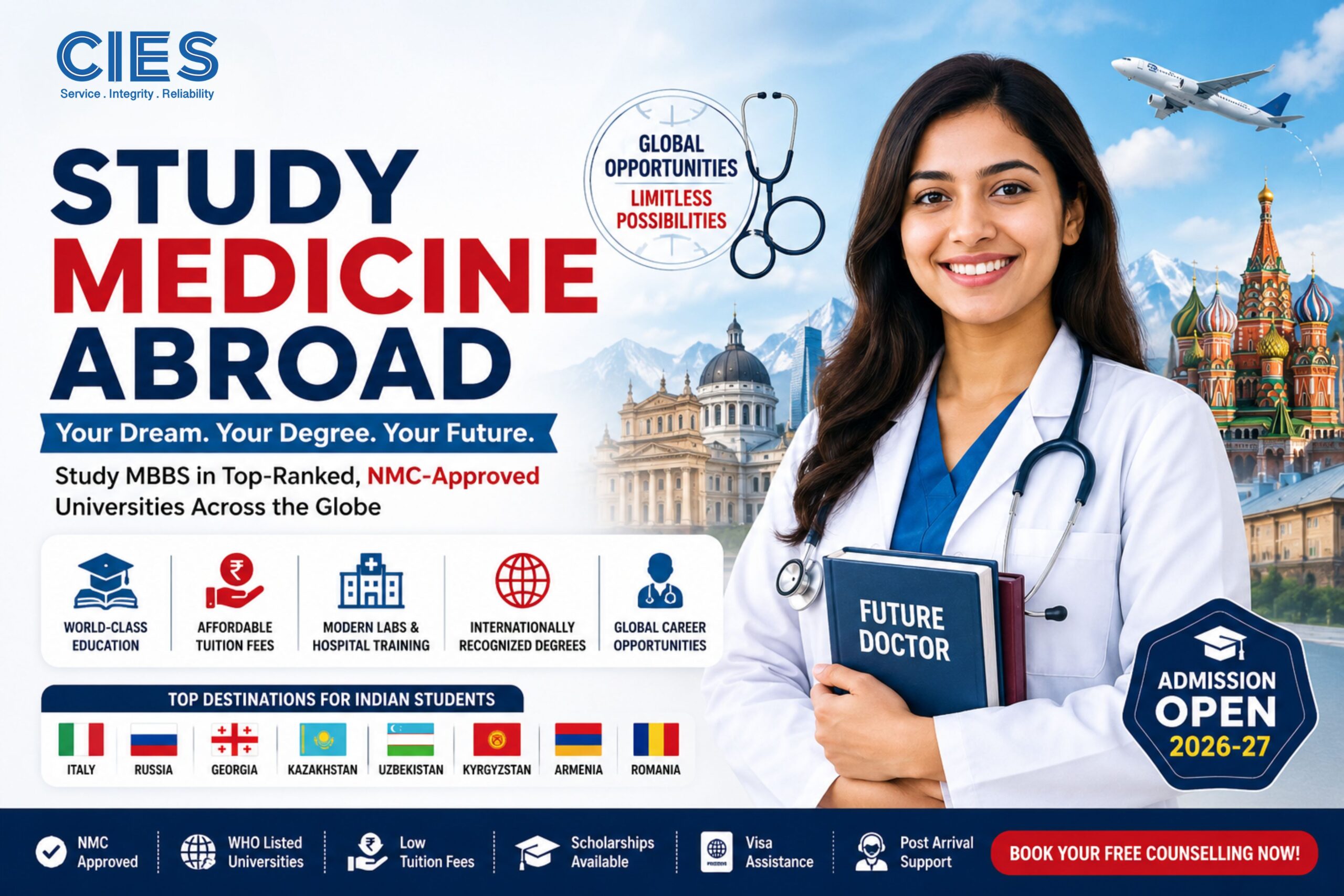
    Dreaming of becoming a doctor but worried about the high tuition fees and limited medical seats in India? Study Medicine Abroad has become one of the most preferred options for Indian students seeking globally recognized medical education at an affordable cost.

    Thousands of students every year choose internationally recognized medical universities offering modern infrastructure, experienced faculty, advanced clinical training, English-medium programs, and globally accepted medical degrees.

    Whether you’re planning to study in Italy, Russia, Georgia, Kazakhstan, Uzbekistan, Kyrgyzstan, Armenia, Romania or other popular destinations, this comprehensive guide covers everything you need to know before starting your medical journey abroad.

    Quick Answer

    Studying medicine abroad offers Indian students access to affordable tuition fees, internationally recognized medical universities, English-medium education, modern hospitals, global clinical exposure, and internationally accepted degrees. Students intending to practice medicine in India should always verify the latest National Medical Commission (NMC) regulations before applying.

    Why Study Medicine Abroad?

    Medical education overseas provides several advantages compared to many private medical colleges in India. Students benefit from quality education, international exposure, practical learning, and opportunities to build a successful global medical career.

    💰 Affordable Tuition Fees

    Many international medical universities offer significantly lower tuition fees than private medical colleges in India, making quality medical education more accessible.

    🌍 Globally Recognized Universities

    Students can study at internationally recognized universities with modern infrastructure, experienced professors, and research-based medical education.

    🏥 Advanced Clinical Training

    Medical universities abroad provide hands-on clinical exposure through affiliated teaching hospitals and practical learning opportunities.

    🌐 International Career Opportunities

    Graduates gain valuable international exposure that can support future career opportunities in healthcare, research, public health, and postgraduate medical education.

    Why Indian Students Choose Medicine Abroad

    Every year, thousands of Indian students qualify NEET but are unable to secure a government medical seat because of intense competition. Studying medicine abroad has become a practical option for students looking for quality education at an affordable cost.

    • ✔ Affordable medical education
    • ✔ Transparent admission process
    • ✔ No donation or capitation fees at many universities
    • ✔ Modern laboratories and teaching hospitals
    • ✔ English-medium medical programs
    • ✔ Practical clinical exposure
    • ✔ International student environment
    • ✔ Globally accepted medical degrees
    • ✔ Better student-teacher ratio
    • ✔ Opportunity to build a global medical career

    Important Note

    Students planning to return to India after completing their medical education abroad should verify the latest eligibility, internship, licensing, and registration requirements issued by the National Medical Commission (NMC) before selecting any university.

    🌍 Top Countries to Study Medicine Abroad

    Choosing the right country is one of the most important decisions when planning your medical education abroad. Every destination offers unique advantages in terms of tuition fees, university rankings, clinical exposure, scholarships, career opportunities, and student lifestyle.

    🇮🇹 Study Medicine in Italy

    Italy is one of the most preferred destinations for Indian students because of its affordable tuition fees, government-funded scholarships, globally ranked universities, and English-medium medical programs.

    Highlights

    • ✔ Public medical universities
    • ✔ IMAT entrance examination
    • ✔ English-taught MBBS programs
    • ✔ Government scholarships available
    • ✔ European Union-recognized degree
    • ✔ Excellent research facilities

    Popular Universities

    • University of Milan
    • Sapienza University of Rome
    • University of Bologna
    • University of Padua

    Study in Italy →

    🇷🇺 Study Medicine in Russia

    Russia has remained one of the most popular destinations for Indian students seeking affordable medical education with internationally recognized universities and experienced faculty.

    Advantages

    • ✔ Affordable tuition fees
    • ✔ Experienced professors
    • ✔ Modern teaching hospitals
    • ✔ English-medium programs
    • ✔ Large Indian student community
    • ✔ Practical clinical training

    Study in Russia →

    🇬🇪 Study Medicine in Georgia

    Georgia has rapidly become a preferred destination for international students because of its quality education, safe environment, and English-medium medical programs.

    Benefits

    • ✔ Easy admission process
    • ✔ English-medium education
    • ✔ International learning environment
    • ✔ Safe and student-friendly country
    • ✔ Clinical exposure
    • ✔ Modern infrastructure

    Study in Georgia →

    🇰🇿 Study Medicine in Kazakhstan

    Kazakhstan offers internationally recognized medical education with affordable tuition fees, quality infrastructure, and excellent clinical learning opportunities.

    Features

    • ✔ Affordable tuition fees
    • ✔ Modern classrooms
    • ✔ Clinical exposure
    • ✔ International recognition
    • ✔ Student-friendly campuses
    • ✔ Experienced faculty

    🌏 More Popular Countries to Study Medicine Abroad

    Apart from Italy, Russia, Georgia, and Kazakhstan, several other countries also provide affordable, English-medium medical education for Indian students. Choosing the right destination depends on your budget, career goals, preferred learning environment, and university recognition.

    🇺🇿 Study Medicine in Uzbekistan

    Uzbekistan has become an increasingly popular destination among Indian students because of its affordable tuition fees, modern universities, English-medium medical programs, and comfortable student lifestyle.

    Why Choose Uzbekistan?

    • ✔ Affordable tuition fees
    • ✔ English-medium MBBS programs
    • ✔ Modern medical universities
    • ✔ Indian food availability
    • ✔ Safe student environment
    • ✔ Practical clinical training

    🇰🇬 Study Medicine in Kyrgyzstan

    Kyrgyzstan is well known for offering budget-friendly medical education while maintaining quality teaching standards and internationally recognized universities.

    Benefits

    • ✔ Budget-friendly tuition fees
    • ✔ English-medium programs
    • ✔ International student community
    • ✔ Affordable cost of living
    • ✔ Experienced medical faculty
    • ✔ Clinical exposure through teaching hospitals

    🎓 Eligibility to Study Medicine Abroad

    Admission requirements vary by university and country, but most international medical universities require applicants to meet the following eligibility criteria.

    • ✔ 10+2 with Physics, Chemistry & Biology
    • ✔ Minimum qualifying percentage (varies by university)
    • ✔ Valid NEET qualification for Indian students intending to practice in India
    • ✔ Valid Passport
    • ✔ Medical Fitness Certificate
    • ✔ Student Visa Approval

    📄 Documents Required

    Prepare all required documents before starting your admission process to avoid unnecessary delays.

    • ✔ 10th Marksheet
    • ✔ 12th Marksheet
    • ✔ NEET Scorecard
    • ✔ Passport
    • ✔ Passport-size Photographs
    • ✔ Birth Certificate
    • ✔ Medical Certificate
    • ✔ Police Clearance (if required)
    • ✔ Admission Letter
    • ✔ Visa Documents

    📝 Medicine Abroad Admission Process

    The admission process for studying medicine abroad is simple and transparent when guided by experienced overseas education consultants.

    Step 2

    University Selection

    Step 3

    Eligibility Assessment

    Step 4

    Application Submission

    Step 5

    Admission Letter

    Step 6

    Fee Payment

    💰 Cost of Studying Medicine Abroad

    The overall cost of studying medicine abroad varies depending on the country, university, accommodation, lifestyle, and exchange rates. Many international medical universities offer affordable tuition fees compared to private medical colleges in India, making overseas education an attractive option for aspiring doctors.

    Expense Typical Cost Component
    🎓 Tuition Fees Varies by country & university
    🏠 Hostel Accommodation University hostel or private accommodation
    🍽 Food & Living Expenses Depends on lifestyle and location
    🩺 Health Insurance Mandatory in many countries
    🛂 Student Visa Visa processing charges
    ✈ Airfare One-time travel cost
    📚 Books & Study Materials Depends on university requirements

    Scholarships & Financial Assistance

    Several universities and governments provide scholarships, tuition fee waivers, and financial aid for eligible international students. Scholarship availability varies depending on the destination country, university, and academic profile.

    📘 Is NEET Mandatory for Studying Medicine Abroad?

    Yes. Indian students who plan to return to India and practice medicine are generally required to qualify NEET (National Eligibility cum Entrance Test) before taking admission to an undergraduate medical program abroad, as per the applicable regulations of the National Medical Commission (NMC).

    Important

    Admission policies and licensing regulations may change over time. Students should always verify the latest guidelines issued by the National Medical Commission (NMC) before applying to any medical university abroad.

    🩺 Can I Practice in India After Studying Medicine Abroad?

    Yes. Graduates from recognized medical universities abroad may become eligible to practice medicine in India after fulfilling the applicable requirements prescribed by the National Medical Commission, including licensing, internship, and other regulations in force at the time.

    Students should carefully verify university recognition, curriculum structure, internship provisions, and compliance with current NMC regulations before taking admission.

    💼 Career Opportunities After Studying Medicine Abroad

    An internationally recognized medical degree can open doors to a wide range of healthcare careers across different countries, subject to local licensing requirements.

    🏥 Clinical Practice

    Work in hospitals, clinics, healthcare centers, and specialized medical institutions after meeting licensing requirements.

    🔬 Medical Research

    Contribute to clinical research, biomedical sciences, pharmaceutical development, and healthcare innovation.

    🌍 Public Health

    Support national and international healthcare organizations working in disease prevention and community health.

    🎓 Higher Medical Education

    Pursue postgraduate medical education, specialization, fellowships, or academic careers in medicine.

    🎓 Ready to Start Your Study Abroad Journey?

    Get expert guidance from CIES Overseas Education for Medicine Abroad, MBBS Abroad, Student Visas, University Selection and IELTS Coaching.

    Frequently Asked Questions (FAQ)

    Which country is best to study medicine abroad?

    Italy, Russia, Georgia, Kazakhstan, Uzbekistan, and Kyrgyzstan are among the most preferred destinations for Indian students. The ideal country depends on your academic profile, budget, career goals, preferred language of instruction, and university recognition.

    Is studying medicine abroad affordable?

    Yes. Many internationally recognized medical universities offer affordable tuition fees compared to private medical colleges in India. Students should also consider accommodation, food, insurance, travel, and other living expenses while planning their budget.

    Is NEET mandatory for studying medicine abroad?

    Indian students who intend to return and practice medicine in India generally need to qualify NEET before pursuing an undergraduate medical program abroad, subject to the latest National Medical Commission (NMC) regulations.

    Which countries offer English-medium medical programs?

    Several universities in Italy, Russia, Georgia, Kazakhstan, Uzbekistan, Kyrgyzstan, Armenia, and other European countries offer English-medium medical programs for international students. Always verify the language of instruction before applying.

    Can I get scholarships to study medicine abroad?

    Yes. Scholarship opportunities vary depending on the university and destination country. Italy is particularly known for government-funded scholarships, while many universities also offer merit-based financial assistance to eligible international students.

    Is studying medicine abroad safe?

    Yes. Reputed medical universities provide secure campuses, hostel facilities, international student support services, and dedicated assistance to help overseas students adapt to their new environment.


    Conclusion

    Studying medicine abroad is an excellent option for Indian students seeking globally recognized medical education, affordable tuition fees, modern infrastructure, and international career opportunities. With proper university selection, guidance, and preparation, you can build a successful medical career while gaining valuable global exposure.

    Whether you’re planning to study in Italy, Russia, Georgia, Kazakhstan, Uzbekistan, Kyrgyzstan, or other leading destinations, choosing the right university based on recognition, curriculum, and career prospects is essential for long-term success.


    Ready to Study Medicine Abroad?

    Get a FREE Counselling Session with CIES Overseas Education and receive expert guidance on university selection, eligibility, admission, scholarships, documentation, visa processing, and your complete study abroad journey.

    📞 Call: +91-9968239372 / +91-9968239373

    Apply for MBBS Abroad 2026–2027

    Get FREE Expert Counselling for MBBS Abroad. Our experienced counsellors will help you choose the right country, compare universities, understand eligibility, estimate fees, explore scholarships, and guide you through the complete admission and student visa process.


      medicine abroad, study medicine abroad, MBBS abroad, study medicine overseas, medical universities abroad, NMC approved medical universities, study medicine in Italy, study medicine in Russia, study medicine in Georgia, study medicine in Kazakhstan, study medicine in Uzbekistan, medical education abroad, affordable MBBS abroad, MBBS for Indian students, overseas medical education, medical scholarships abroad, study abroad consultant, CIES Overseas Education
      July 16, 2026

      The dream to study in Netherlands is becoming increasingly popular among Indian students due to its world-class universities, English-taught programs, affordable tuition fees compared to other European countries, excellent career opportunities, and high quality of life.

      The Netherlands is home to some of Europe’s leading universities offering innovative education, research-driven learning, and internationally recognized qualifications. Whether you’re planning to pursue a Bachelor’s degree, Master’s degree, MBA, Engineering, Business, Artificial Intelligence, Data Science, Hospitality, Design, or Technology program, studying in the Netherlands can open doors to global career opportunities.

      At CIES Overseas Education, we help students throughout their study abroad journey—from university selection and application support to student visa assistance and pre-departure guidance.

      Quick Overview: Study in Netherlands 2027

      • 🇳🇱 World-ranked Dutch universities
      • 🎓 2,500+ English-taught programs
      • 💼 Excellent post-study work opportunities
      • 🏠 Safe and student-friendly environment
      • 🌍 International classrooms and global exposure
      • 💰 Affordable education compared to many Western countries
      • 🚀 Strong career opportunities after graduation
      • ✈ Gateway to Europe

      Why Study in Netherlands?

      The Netherlands has emerged as one of the most preferred destinations for international students. Its education system focuses on innovation, practical learning, research, and industry collaboration.

      Dutch universities consistently rank among the best institutions globally and attract students from over 160 countries.

      🎓 World-Class Education

      Highly ranked universities with globally recognized degrees and research-focused learning.

      🌎 English-Taught Programs

      More than 2,500 programs are available entirely in English for international students.

      💼 Career Opportunities

      Excellent employment prospects in technology, engineering, finance, logistics, and business sectors.

      🏡 Quality of Life

      Safe cities, modern infrastructure, efficient transportation, and student-friendly communities.

      Top Benefits of Studying in Netherlands

      • World-ranked universities
      • Affordable tuition fees
      • Strong global reputation
      • Multicultural student environment
      • Excellent internship opportunities
      • Research-driven education system
      • Post-study work opportunities
      • Easy access to European countries
      • Industry-focused learning approach
      • High employability after graduation

      💡 Did You Know? The Netherlands is among the top destinations in Europe for international students due to its innovative teaching methods, strong economy, and high graduate employment rate.

      Why Choose the Spring Intake 2027?

      Many Dutch universities offer admissions during the Spring Intake, providing students with additional flexibility and opportunities to begin their academic journey without waiting for the next Fall semester.

      Benefits of Spring Intake 2027

      • Faster admission process
      • Less competition than Fall Intake
      • Better accommodation availability
      • More time for visa processing
      • Flexible course options
      • Earlier graduation compared to delaying admission

      Planning to Study Abroad in 2027?

      Get expert guidance from CIES Overseas Education for university selection, admissions, scholarships, visa assistance, and career planning.

      Best Universities to Study in the Netherlands

      The Netherlands is home to some of Europe’s highest-ranked universities, offering internationally recognised degrees, research-driven education, and strong industry partnerships. Whether you want to pursue Engineering, Business, Artificial Intelligence, or Hospitality Management, Dutch universities provide excellent academic and career opportunities.

      University Popular Courses
      University of Twente Engineering, Robotics, Artificial Intelligence
      Wittenborg University of Applied Sciences Business, MBA, Hospitality
      Tio Business School Business Management, Tourism
      Haarlem University of Applied Sciences International Business
      Webster Leiden Campus MBA, International Relations

      Other Top Universities

      • Delft University of Technology
      • Eindhoven University of Technology
      • Leiden University
      • Utrecht University
      • Erasmus University Rotterdam
      • Maastricht University
      • Tilburg University
      • Radboud University
      • Vrije Universiteit Amsterdam

      Popular Courses to Study in the Netherlands

      Dutch universities focus on innovation, practical learning, research, and industry collaboration. Students graduate with globally recognised qualifications that are highly valued by employers across Europe and around the world.

      💻 Computer Science
      🤖 Artificial Intelligence
      📊 Data Science
      ⚙ Mechanical Engineering
      🏗 Civil Engineering
      ⚡ Electrical Engineering
      💼 MBA
      🌍 International Business
      💰 Finance
      📣 Marketing
      🚚 Supply Chain Management
      🏨 Hospitality Management
      🧠 Psychology
      🏛 Architecture
      🎨 Design
      🧬 Biotechnology
      🌱 Environmental Science
      🚢 Logistics
      🔐 Cyber Security

      Cost of Studying in the Netherlands

      One of the biggest advantages of choosing the Netherlands is its affordable tuition fees compared to countries like the USA, UK, or Australia. The total cost depends on the university, program, and city you choose. Students should also budget for accommodation, food, insurance, and transportation.

      Program Approximate Tuition Fee (Per Year)
      Bachelor’s Degree €6,000 – €15,000
      Master’s Degree €8,000 – €20,000
      MBA €15,000 – €40,000

      Living Cost in the Netherlands

      International students generally spend between €900–€1,500 per month, depending on their lifestyle and the city they live in. Amsterdam is usually more expensive than cities like Enschede, Groningen, or Maastricht.

      🏠 Accommodation
      🍽 Food & Groceries
      🚆 Public Transportation
      🩺 Health Insurance
      📶 Internet & Mobile
      🎓 Study Materials
      🛍 Personal Expenses

      Scholarships to Study in the Netherlands

      Many Dutch universities and the Government of the Netherlands offer scholarships to international students based on academic excellence, merit, and financial need. Scholarships can significantly reduce your overall education expenses.

      🇳🇱 Holland Scholarship

      One of the most popular scholarships for non-European international students pursuing Bachelor’s or Master’s degrees.

      🌷 Orange Tulip Scholarship

      Designed specifically for talented students from selected countries, including India, studying at participating Dutch universities.

      🎓 Erasmus+ Scholarship

      Supports international students pursuing higher education and exchange programs across Europe.

      🏆 University Merit Scholarships

      Many universities offer scholarships based on academic performance, leadership qualities, and extracurricular achievements.

      Netherlands Student Visa for Indian Students

      Indian students planning to study in the Netherlands must obtain a Dutch Student Visa, commonly known as the MVV (Provisional Residence Permit) along with a Residence Permit. In most cases, your university assists with the visa application after you receive your admission offer.

      Documents Required

      🛂 Valid Passport
      🎓 University Offer Letter
      💰 Proof of Financial Support
      📑 Academic Documents
      📝 IELTS / PTE / TOEFL Score
      🏥 Health Insurance
      📸 Passport-size Photographs

      IELTS Requirement for the Netherlands

      Most Dutch universities require proof of English language proficiency. The minimum score varies depending on the university and course you choose.

      English Test Typical Requirement
      IELTS Academic 6.0 – 6.5 Overall Band
      PTE Academic Accepted by many universities
      TOEFL iBT Accepted by most universities

      Some universities may waive the English language requirement if you have completed previous education in English or meet other eligibility criteria.

      Work While Studying in the Netherlands

      International students can work part-time while studying in the Netherlands according to Dutch immigration regulations. Working while studying helps students gain valuable international work experience and manage their living expenses.

      💼 Gain International Work Experience
      💶 Earn Additional Income
      🤝 Build Professional Network
      📈 Improve Career Opportunities
      🌍 Experience Dutch Work Culture
      🚀 Strengthen Your Resume

      Post-Study Work Opportunities in the Netherlands

      After completing their studies, international graduates may apply for the Orientation Year (Zoekjaar) Permit, which allows eligible students to stay in the Netherlands and search for employment. This makes the Netherlands one of the most attractive destinations for students planning an international career.

      Popular Industries Hiring International Graduates

      💻 Information Technology
      🤖 Artificial Intelligence
      📊 Data Analytics
      ⚙ Engineering
      💰 Finance & Banking
      🏥 Healthcare
      🚚 Logistics & Supply Chain
      📣 Marketing & Digital Media
      🏨 Hospitality & Tourism

      Intakes in the Netherlands

      Dutch universities generally offer two major admission intakes each year. Students should begin preparing their applications at least 8–12 months in advance to maximize their chances of admission and scholarship opportunities.

      🌸 Spring Intake

      Ideal for students who missed the Fall intake. Selected universities offer Bachelor’s and Master’s programs during this intake.

      🍂 Fall Intake

      The primary intake with the largest number of universities, programs, scholarships, and student admissions.

      Admission Requirements

      Admission requirements vary depending on the university and program. However, most Dutch universities require the following documents during the application process.

      📑 Academic Transcripts
      🛂 Valid Passport
      📝 IELTS / PTE / TOEFL Score
      ✍ Statement of Purpose (SOP)
      📄 Letters of Recommendation (LOR)
      💼 Resume (For Master’s Programs)
      🎨 Portfolio (Design & Creative Courses)

      Documents Required to Study in the Netherlands

      Before applying to a Dutch university, make sure all your documents are prepared and verified. Having complete documentation helps speed up the admission and student visa process.

      🛂 Valid Passport
      🎓 10th & 12th Marksheet
      📜 Bachelor’s Degree (For Master’s)
      📝 IELTS / PTE / TOEFL Scorecard
      ✍ Statement of Purpose (SOP)
      📄 Letters of Recommendation (LOR)
      💼 Updated Resume / CV
      💳 Financial Documents
      📷 Passport-size Photographs

      Best Student Cities in the Netherlands

      The Netherlands offers vibrant student cities with excellent universities, modern infrastructure, multicultural communities, and outstanding career opportunities.

      🌷 Amsterdam
      🚢 Rotterdam
      💡 Eindhoven
      🏛 Utrecht
      📚 Leiden
      🎓 Groningen
      ⚙ Enschede
      🌍 Maastricht

      Career Opportunities After Graduation

      Graduates from Dutch universities are highly valued by multinational companies because of their practical education, research skills, and international exposure.

      Top Recruiters in the Netherlands

      💡 Philips
      🖥 ASML
      ⛽ Shell
      🏦 ING Bank
      🍺 Heineken
      🏨 Booking.com
      📊 Deloitte
      💼 PwC
      📈 KPMG
      🌍 Accenture

      Why Choose CIES Overseas Education?

      CIES Overseas Education has successfully guided thousands of Indian students toward international education. Our experienced counsellors provide complete support from career counselling to visa approval.

      • ✔ Free Career Counselling
      • ✔ University Selection
      • ✔ Admission Assistance
      • ✔ SOP & LOR Guidance
      • ✔ Scholarship Assistance
      • ✔ Education Loan Support
      • ✔ Student Visa Assistance
      • ✔ IELTS & PTE Coaching
      • ✔ Accommodation Assistance
      • ✔ Pre-Departure Briefing
      • ✔ Travel Support

      Frequently Asked Questions (FAQ)

      Is the Netherlands good for Indian students?

      Yes. The Netherlands offers world-class universities, English-taught programs, affordable tuition fees, excellent career opportunities, and a safe environment.

      Can I study in the Netherlands without IELTS?

      Some universities accept alternative English proficiency tests or may waive IELTS depending on your previous education and eligibility.

      What is the average tuition fee?

      International students generally pay between €6,000 and €20,000 per year, depending on the university and course.

      Can students work while studying?

      Yes. Eligible international students can work part-time while studying according to Dutch regulations.

      Which intake is best?

      Both Spring and Fall intakes are excellent. Students should choose based on course availability and their academic timeline.

      Start Your Study in Netherlands Journey Today!

      Planning to study in the Netherlands in 2027? Let CIES Overseas Education help you with university selection, admission, scholarships, visa guidance, accommodation, and IELTS/PTE coaching.

        July 13, 2026

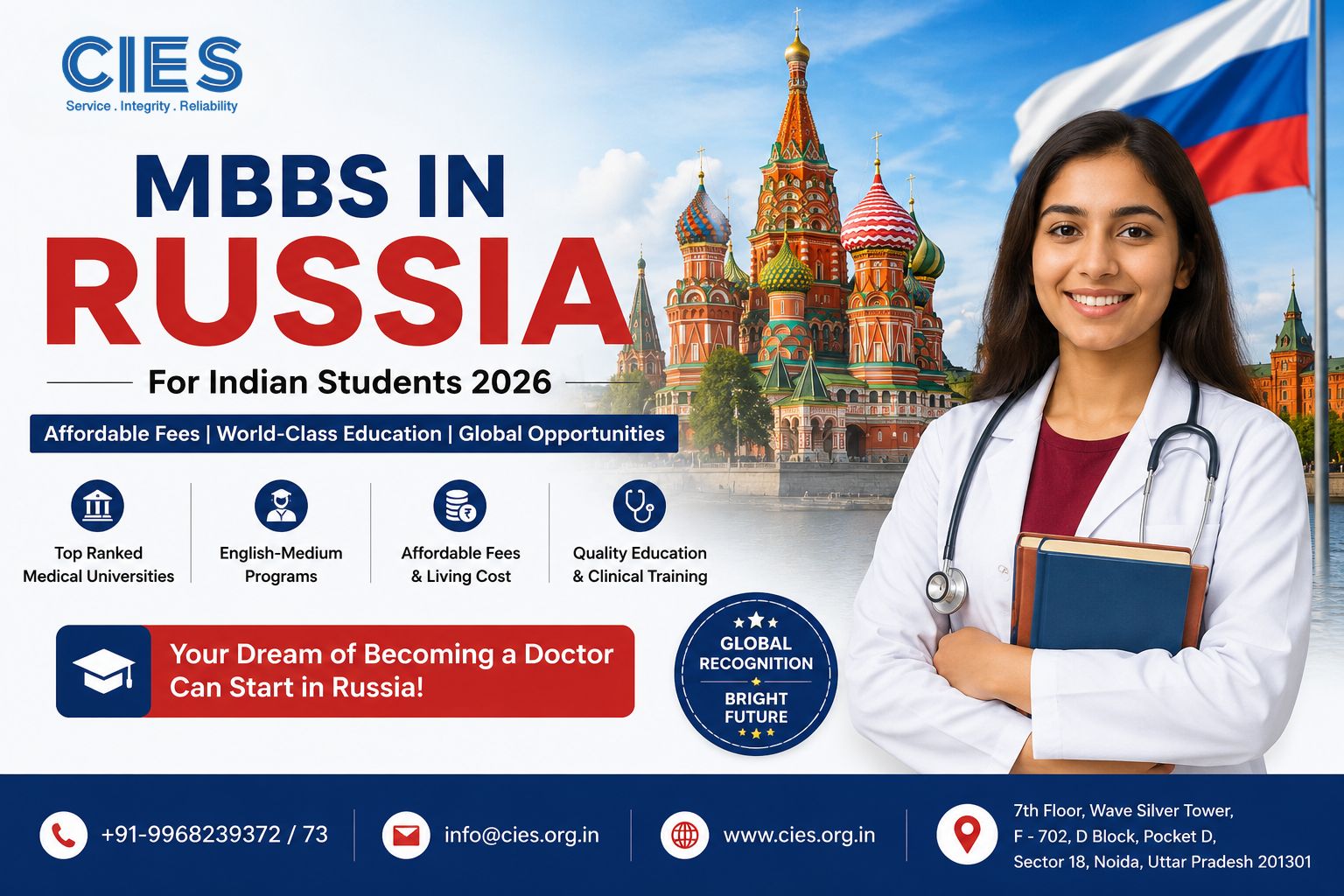
        MBBS in Russia is one of the most popular options for Indian students who want to study medicine abroad at an affordable cost. Russian medical universities offer globally recognized medical programs, modern infrastructure, experienced faculty, and comparatively lower tuition fees than many private medical colleges in India.

        For Indian students planning to study medicine abroad in 2026, Russia can be an attractive destination. However, students should carefully verify university recognition, English-medium availability, clinical exposure, licensing requirements, and the latest National Medical Commission (NMC) rules before taking admission.

        This comprehensive guide covers MBBS in Russia for Indian students, including fees, eligibility, admission requirements, course duration, NEET requirements, top medical universities, living costs, scholarships, advantages, disadvantages, and career opportunities after graduation.

        Quick Answer: Is MBBS in Russia Good for Indian Students?

        Yes, MBBS in Russia can be a good option for Indian students who choose an appropriately recognized university and understand the licensing requirements for practising medicine in India.

        Russia is known for its established medical education system, relatively affordable tuition fees, and international student community. However, choosing the right university is essential.

        Indian students should confirm that the medical program complies with applicable NMC requirements and provides the necessary clinical training, internship structure, and medium of instruction.

        MBBS in Russia 2026: Quick Overview

        Particular Details
        Course General Medicine / Medical Degree
        Popular Search Term MBBS in Russia
        Typical Duration Approximately 6 years
        Medium of Instruction English or bilingual, depending on the university
        NEET Required for Indian students seeking eligibility to practise in India
        Entrance Exam Usually university-specific or based on academic eligibility
        Typical Tuition Fee Approximately ₹2.5 lakh to ₹8 lakh per year
        Estimated Total Budget Approximately ₹20 lakh to ₹50 lakh or more
        Popular Intake Usually September
        Recognition Must be verified individually for each university and program
        Major Requirement 10+2 with Physics, Chemistry and Biology

        Important: Fees, exchange rates, admission rules, program structures, and regulatory requirements can change. Students should verify current information directly with the university and relevant authorities before applying.

        Why Study MBBS in Russia?

        Thousands of international students consider studying MBBS in Russia because of the country’s long-established medical universities and relatively affordable tuition.

        1. Affordable Medical Education

        The cost of studying medicine in Russia can be lower than the cost of an MBBS degree at many private medical colleges in India. Tuition fees vary significantly depending on the university and city.

        2. Established Medical Universities

        Russia has several universities with a long history of medical education, research, and clinical training.

        3. English-Medium Programs

        Some Russian universities offer medical programs taught wholly or substantially in English for international students. Students should verify the exact language of instruction for the complete course, including clinical years.

        4. International Student Environment

        Russian universities attract students from India and other countries, creating a multicultural academic environment.

        5. Clinical Exposure

        Depending on the university and affiliated hospitals, students may receive practical and clinical exposure during their medical studies.

        6. No Donation at Many Universities

        Many universities admit eligible international students without the high capitation or donation fees commonly associated with some private medical admissions. However, official university fees and other expenses still apply.

        MBBS in Russia Eligibility for Indian Students

        The eligibility criteria for MBBS in Russia for Indian students may vary by university. Common requirements generally include:

        • Completion of Class 12 or equivalent education.
        • Physics, Chemistry and Biology as core subjects.
        • Meeting the university’s minimum academic requirements.
        • Qualifying NEET where required under Indian regulations.
        • Meeting the minimum age requirement applicable to the university and regulations.
        • Holding a valid passport.
        • Meeting medical fitness and visa requirements.

        Eligibility Note: Students from reserved categories or different education boards should verify the exact eligibility criteria before applying.

        Is NEET Required for MBBS in Russia?

        For Indian students who intend to pursue a medical qualification abroad and later seek registration or eligibility to practise medicine in India, NEET qualification is an important regulatory requirement under applicable Indian rules.

        Students should check the latest regulations issued by the National Medical Commission and other relevant authorities before enrolling in a foreign medical program.

        Important: NEET qualification alone does not guarantee admission to every Russian medical university. Universities may have their own academic and documentation requirements.

        MBBS in Russia Course Duration

        The medical program commonly pursued by international students in Russia generally lasts around six years, although the exact structure can vary by university and program.

        The curriculum may include:

        • Basic medical sciences
        • Anatomy and physiology
        • Biochemistry
        • Pathology
        • Pharmacology
        • Microbiology
        • Internal medicine
        • Surgery
        • Paediatrics
        • Obstetrics and gynaecology
        • Clinical rotations and practical training

        Important: Students should verify whether the program’s duration, internship, clinical training, and licensing eligibility satisfy the regulations applicable in the country where they plan to practise.

        MBBS in Russia Fees for Indian Students

        The cost of MBBS in Russia depends on the university, location, accommodation, exchange rate, and personal lifestyle.

        Estimated Cost of Studying MBBS in Russia

        Expense Estimated Cost
        Tuition Fee ₹2.5 lakh–₹8 lakh per year
        Hostel ₹30,000–₹1.5 lakh per year
        Food & Personal Expenses ₹1.5 lakh–₹3 lakh per year
        Insurance & Medical Check-ups Varies
        Visa & Documentation Varies
        Travel Depends on airfare
        Total Estimated Budget ₹20 lakh–₹50 lakh+

        These figures are indicative only. Actual expenses may be higher or lower depending on the university, city, currency exchange rate, and personal spending.

        Top Medical Universities in Russia for Indian Students

        Students frequently research several Russian universities when considering medical education. The best choice depends on the current program structure, recognition status, medium of instruction, clinical exposure, tuition fees, and regulatory compliance.

        Popular names often researched by international students include:

        University Location
        Sechenov University Moscow
        Pirogov Russian National Research Medical University Moscow
        Kazan Federal University Kazan
        RUDN University Moscow
        Bashkir State Medical University Ufa
        Orenburg State Medical University Orenburg
        Kursk State Medical University Kursk
        Volgograd State Medical University Volgograd
        Siberian State Medical University Tomsk
        Far Eastern Federal University Vladivostok

        Important: Inclusion in this list is not a recommendation or guarantee of eligibility to practise in India. Recognition, curriculum, language of instruction, internship arrangements, and regulatory compliance should be independently verified for the specific program and admission year.

        How to Choose the Best Medical University in Russia

        Do not select a university based only on low fees or promotional rankings. Before applying for MBBS in Russia, check:

        • Current recognition and accreditation status.
        • Compliance with applicable NMC regulations.
        • Medium of instruction for the entire program.
        • Course duration and internship structure.
        • Availability of clinical training.
        • Affiliated teaching hospitals.
        • Total tuition and living costs.
        • Hostel and student support facilities.
        • Local language requirements during clinical training.
        • Graduate licensing pathways in India and other countries.

        MBBS in Russia Admission Process 2026

        The general admission process may involve the following steps:

        Step 1: Check Eligibility

        Review your Class 12 subjects, marks, NEET status, age, passport validity, and the university’s admission criteria.

        Step 2: Shortlist Suitable Universities

        Compare universities based on fees, curriculum, clinical training, location, language of instruction, and regulatory compatibility.

        Step 3: Submit the Application

        Apply with the required academic and personal documents.

        Step 4: Receive an Admission or Offer Letter

        If your application is accepted, the university may issue an admission confirmation or offer letter.

        Step 5: Complete University Formalities

        Pay applicable official fees and complete the university’s admission requirements.

        Step 6: Obtain the Required Invitation Documents

        Depending on the process, students may need an official invitation or supporting documentation for the student visa.

        Step 7: Apply for a Student Visa

        Submit the required documents to the relevant Russian visa authorities.

        Step 8: Travel and Complete University Registration

        After visa approval, students can travel to Russia and complete enrolment, migration registration, medical checks, and other university formalities.

        Documents Required for MBBS in Russia

        Commonly required documents may include:

        • Valid passport
        • Passport-size photographs
        • Class 10 marksheet and certificate
        • Class 12 marksheet and certificate
        • NEET scorecard or qualification proof, where applicable
        • University application form
        • Admission or invitation letter
        • Medical fitness certificate
        • HIV test report, where required
        • Birth certificate, if requested
        • Visa application documents
        • Translated, notarised, apostilled, or legalised documents where applicable

        Document requirements can vary by university and visa rules.

        MBBS in Russia Without NEET: Is It Possible?

        A Russian university may have its own admission criteria, but Indian students must separately consider Indian regulatory requirements.

        If your goal is to return to India and pursue medical registration, taking admission abroad without meeting applicable Indian eligibility requirements may create serious difficulties later.

        Important: Students should verify the latest applicable rules and eligibility requirements before enrolling in any foreign medical university.

        Medium of Instruction for MBBS in Russia

        Many international students search for English-medium MBBS in Russia. Some universities offer programs in English, while others may use Russian or a combination of English and Russian.

        Even when academic teaching is in English, learning Russian can be important for communicating with patients during clinical training.

        Before admission, obtain written confirmation regarding:

        • Language of classroom teaching
        • Language of examinations
        • Language used during clinical training
        • Whether the entire program is available in English
        • Whether Russian-language proficiency is mandatory at any stage

        Cost of Living in Russia for Indian Students

        Living expenses vary significantly between cities. Moscow and other major metropolitan areas may be more expensive than smaller cities.

        Students should budget for:

        • Hostel or accommodation
        • Food and groceries
        • Local transportation
        • Mobile and internet expenses
        • Health insurance
        • Winter clothing
        • Books and study materials
        • Personal expenses

        A realistic budget should account for inflation and currency exchange-rate fluctuations.

        Advantages of Studying MBBS in Russia

        The potential benefits of MBBS in Russia for Indian students include:

        • Comparatively affordable tuition fees at some universities.
        • Established medical education institutions.
        • Availability of international student programs.
        • English-taught options at selected universities.
        • Exposure to an international academic environment.
        • Potential clinical training opportunities.
        • No donation or capitation fee at many institutions.
        • Access to university hostel facilities at many campuses.

        Disadvantages and Challenges of MBBS in Russia

        Students should also understand the possible challenges:

        • Russian language may be necessary for patient interaction.
        • Extremely cold weather in some regions.
        • Quality and clinical exposure can differ between universities.
        • Licensing exams may be required after graduation.
        • Rules for foreign medical graduates can change.
        • Cultural and academic adjustment may take time.
        • Currency fluctuations can affect the total cost.
        • English-medium claims should be independently verified.

        Remember: A lower fee should never be the only reason for selecting a medical university.

        Is an MBBS Degree from Russia Valid in India?

        A foreign medical qualification is not automatically sufficient to practise medicine in India.

        Indian students must comply with the regulations applicable to foreign medical graduates, including eligibility conditions, course and internship requirements, and the applicable licensing or screening pathway in force at the time.

        Because regulations can change, students should check the latest official requirements before admission rather than relying solely on university agents or older online information.

        Career Options After MBBS in Russia

        After completing a medical degree in Russia, graduates may explore different pathways depending on licensing and regulatory requirements.

        Possible options include:

        • Returning to India and completing the applicable licensing pathway.
        • Pursuing postgraduate medical education.
        • Exploring medical licensing pathways in other countries.
        • Working in research or healthcare-related fields.
        • Pursuing public health or healthcare management programs.

        Every country has its own medical registration requirements.

        MBBS in Russia vs MBBS in India

        Factor Russia India
        Admission University eligibility + applicable requirements Primarily NEET-based
        Cost Can be comparatively affordable Varies greatly between government and private colleges
        Language English, Russian, or bilingual Primarily English with regional patient interaction
        Clinical Environment Depends on university and hospital Depends on medical college
        Licensing in India Foreign graduate requirements apply Domestic registration pathway applies
        Cultural Adjustment Required Generally lower for Indian students

        The better option depends on your NEET performance, budget, career goals, and willingness to study abroad.

        MBBS in Russia vs Other Study Abroad Destinations

        Russia is often compared with countries such as Georgia, Kazakhstan, Uzbekistan, Kyrgyzstan, and other destinations offering medical education to international students.

        Students should compare destinations based on:

        • Total cost of education
        • University recognition
        • Course duration
        • Internship structure
        • Medium of instruction
        • Clinical exposure
        • Safety and living conditions
        • Licensing outcomes
        • Regulatory compliance

        Important: The cheapest destination is not always the best choice for a medical career. Students should consider education quality, clinical training, recognition, and future licensing requirements before making a decision.

        Who Should Consider MBBS in Russia?

        MBBS in Russia may be suitable for students who:

        • Want to study medicine abroad.
        • Meet the required academic and NEET criteria.
        • Have a realistic budget for the complete program.
        • Are prepared to adapt to a different climate and culture.
        • Are willing to learn basic Russian for clinical communication.
        • Understand the licensing pathway after graduation.
        • Have carefully verified the university and program.

        Frequently Asked Questions About MBBS in Russia

        Is MBBS in Russia good for Indian students?

        MBBS in Russia can be a suitable option for Indian students if they select a properly recognized university, verify the program structure, and understand the licensing requirements for practising medicine in India.

        How much does MBBS in Russia cost?

        The total cost can vary considerably. Tuition fees may range approximately from ₹2.5 lakh to ₹8 lakh per year, while the overall budget may range from around ₹20 lakh to ₹50 lakh or more depending on the university and lifestyle.

        Is NEET compulsory for MBBS in Russia?

        Indian students planning to study medicine abroad and later pursue medical registration in India should meet the applicable NEET and regulatory requirements. Always verify the latest official rules.

        What is the duration of MBBS in Russia?

        Medical programs in Russia commonly take approximately six years, although the exact duration and training structure can vary by university.

        Is MBBS in Russia taught in English?

        Some universities offer English-medium medical programs, while others may use Russian or a bilingual model. Students should verify the language of instruction for the complete course before admission.

        Can I practise in India after MBBS in Russia?

        Graduates must satisfy the applicable eligibility, registration, internship, and licensing requirements for foreign medical graduates in India.

        Is Russia expensive for Indian students?

        The cost depends on the city and lifestyle. Major cities can be more expensive, while university hostels may help reduce accommodation costs.

        Which is the best medical university in Russia?

        There is no single best university for every student. The right choice depends on recognition, regulatory compliance, course structure, medium of instruction, clinical exposure, fees, and career goals.

        Can I get admission to MBBS in Russia without donation?

        Many Russian universities do not follow the high donation or capitation-fee model associated with some private medical admissions. Students must still pay official tuition and other applicable charges.

        When should I apply for MBBS in Russia 2026?

        Students should begin researching and preparing documents several months before the university’s intake deadline. Exact application timelines vary by institution.

        Final Thoughts: Is MBBS in Russia Worth It in 2026?

        MBBS in Russia can be a cost-effective pathway to medical education for Indian students, but the decision requires careful research.

        Before paying any fees, verify the university’s current accreditation, complete course structure, medium of instruction, internship arrangements, clinical training, total cost, and compliance with the regulations applicable to foreign medical graduates.

        A well-informed university selection can make a significant difference to your education and future medical career.

        Get Expert Guidance for MBBS in Russia

        Planning to study MBBS in Russia in 2026? Get personalised guidance for university selection, eligibility assessment, application support, documentation, and the student visa process.

        CIES Overseas Education – Centre for Immigration & Education Services

        📍 7th Floor, Wave Silver Tower, F-702, D Block, Pocket D, Sector 18, Noida, Uttar Pradesh 201301
        📞 +91 99682 39372 / +91 99682 39373
        📧 info@cies.org.in
        🌐 www.cies.org.in

        Start your MBBS abroad journey with informed and transparent guidance.

          June 30, 2026

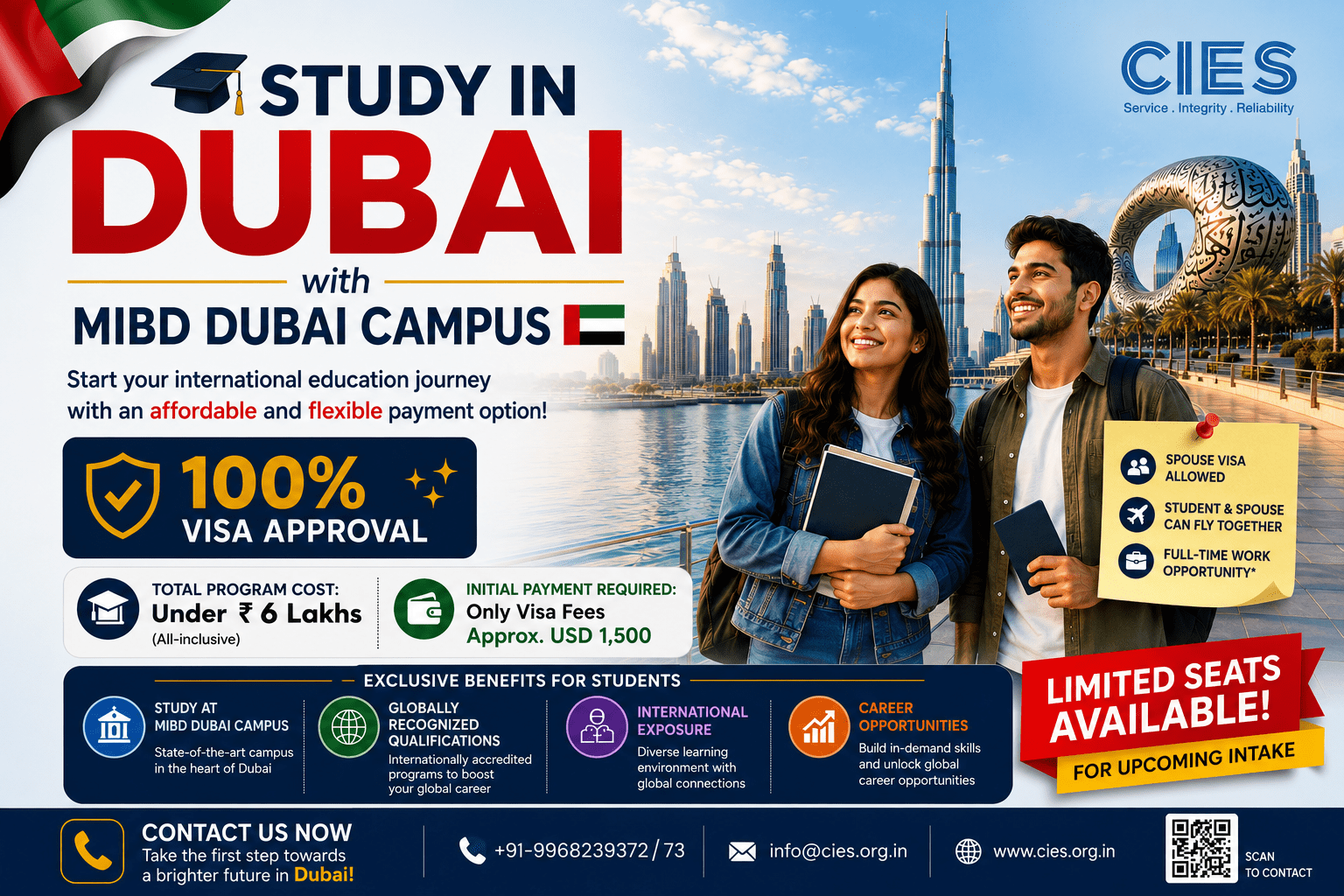
          Dreaming of studying abroad without spending a fortune? Study in Dubai with MIBD Dubai Campus offers an affordable pathway to international education with flexible payment options, globally recognized qualifications, and exciting career opportunities.

          Dubai has become one of the fastest-growing education destinations for Indian students because of its world-class infrastructure, multicultural environment, safety, and proximity to India. If you’re planning to study abroad in 2026, MIBD Dubai Campus can be the perfect choice.

          🌍 Why Choose Dubai for Higher Education?

          Dubai has rapidly emerged as one of the world’s leading international education hubs, attracting thousands of students from across the globe every year.

          Benefits of Studying in Dubai

          • ✅ Internationally Recognized Universities
          • ✅ Modern Learning Environment
          • ✅ Safe & Student-Friendly City
          • ✅ Tax-Free Economy
          • ✅ Excellent Career Opportunities
          • ✅ Global Networking Opportunities
          • ✅ Short Travel Distance from India
          • ✅ Multicultural Lifestyle

          Students gain valuable international exposure while living in one of the world’s fastest-growing business and innovation hubs.

          🎓 Why Study at MIBD Dubai Campus?

          MIBD Dubai Campus delivers quality education designed to prepare students for today’s competitive global job market through practical learning and industry-oriented programs.

          💰 Affordable Education

          Quality international education at an affordable cost.

          💳 Flexible Payments

          Student-friendly payment options for easier admissions.

          🌍 Global Recognition

          Internationally recognized qualifications valued by employers.

          🏢 Industry Curriculum

          Career-focused programs designed with practical learning.

          👨‍🏫 International Faculty

          Experienced faculty members with global teaching expertise.

          🚀 Career Guidance

          Dedicated career support to help students build successful careers.

          💵 Affordable Program Cost

          One of the biggest advantages of choosing MIBD Dubai Campus is its highly affordable fee structure, making international education accessible for Indian students.

          Program Details Information
          Total Program Cost Approx. ₹5.4 Lakhs
          Initial Payment Approx. ₹1.25 Lakhs (Visa-related expenses)

          💡 Why Students Love This Payment Structure

          • ✔ Budget-friendly international education
          • ✔ Lower upfront financial burden
          • ✔ Flexible payment options
          • ✔ Easier planning for families
          • ✔ Affordable pathway to study in Dubai

          💼 Full-Time Work Opportunity While Studying

          One of the biggest advantages of studying at MIBD Dubai Campus is the opportunity to gain valuable professional experience while pursuing your education. Dubai’s rapidly growing economy offers students exposure to an international workplace and helps them build practical skills for future careers.

          Benefits of Working While Studying

          • ✅ Earn while studying
          • ✅ Gain international work experience
          • ✅ Develop professional skills
          • ✅ Improve communication & leadership abilities
          • ✅ Build a strong international network
          • ✅ Enhance your resume for future employers

          Working alongside your studies helps students become financially independent while gaining real-world industry exposure that employers highly value.

          👨‍👩‍👧 Student & Spouse Can Fly Together

          MIBD Dubai Campus also offers an attractive opportunity for eligible married students. Subject to applicable UAE visa regulations, students may be able to relocate with their spouse, making the transition to studying abroad more comfortable and family-friendly.

          ❤️ Family Support

          Stay together with your spouse while pursuing your education in Dubai.

          🏡 Comfortable Relocation

          Enjoy a smoother transition to your new life abroad with your family.

          🌍 Better Lifestyle

          Experience a balanced student and family life in one of the world’s safest cities.

          🌍 Globally Recognized Qualifications

          Graduating from MIBD Dubai Campus equips students with internationally recognized qualifications that open doors to exciting career opportunities across the UAE, GCC countries, and other international markets.

          Benefits After Graduation

          • ✔ Internationally recognized qualification
          • ✔ Better employment opportunities
          • ✔ Higher earning potential
          • ✔ Strong global professional network
          • ✔ Career advancement opportunities
          • ✔ Industry-relevant practical skills

          📈 Career Opportunities After Graduation

          Dubai’s booming economy provides graduates with career opportunities across multiple high-growth industries. Students benefit from exposure to multinational companies and international business environments.

          💼 Business Management
          💰 Finance & Banking
          🏨 Hospitality Management
          📢 Marketing
          👥 Human Resources
          🚚 Logistics & Supply Chain
          💻 Information Technology
          📱 Digital Marketing
          🏥 Healthcare Administration

          Graduates can also explore employment opportunities across GCC countries and other international destinations, making Dubai an excellent launchpad for a global career.

          🎯 Who Should Apply?

          This program is suitable for students from diverse educational and professional backgrounds who wish to pursue internationally recognized qualifications in Dubai.

          • 🎓 Students after Class 12
          • 🎓 Undergraduate graduates
          • 💼 Working professionals
          • 🔄 Career changers
          • 🌍 Students seeking international exposure
          • 💰 Students looking for affordable study abroad options

          📝 Admission Process

          Starting your study-abroad journey at MIBD Dubai Campus is simple. Follow these easy steps to begin your admission process.

          Step 1

          Contact CIES Overseas Education for free expert counselling.

          Step 2

          Discuss your academic profile and choose the right program.

          Step 3

          Submit your required academic and personal documents.

          Step 4

          Receive your admission confirmation from MIBD Dubai Campus.

          Step 5

          Complete your student visa application process.

          Step 6

          Fly to Dubai and begin your exciting international education journey.

          📄 Documents Required

          To apply for admission at MIBD Dubai Campus, students are generally required to submit the following documents. Additional documents may be requested depending on the chosen program and visa requirements.

          Required Documents

          • 📘 Valid Passport
          • 🎓 Academic Transcripts & Certificates
          • 🖼 Passport-size Photographs
          • 📑 English Proficiency Documents (if applicable)
          • 📝 Statement of Purpose (if required)
          • 📋 Any Additional Supporting Documents

          Our experienced counsellors will help you prepare and verify every document before submission, ensuring a smooth admission and visa application process.

          🤝 Why Choose CIES Overseas Education?

          CIES Overseas Education has successfully guided thousands of students toward achieving their dream of studying abroad. Our dedicated team provides end-to-end support from counselling to post-arrival assistance.

          🎯 Free Career Counselling
          🏫 University Selection Assistance
          📄 Admission & Documentation Support
          🛂 Complete Visa Assistance
          💰 Scholarship & Education Loan Guidance
          ✈ Pre-Departure & Post-Arrival Support

          ❓ Frequently Asked Questions (FAQs)

          Is Dubai a good destination for Indian students?

          Yes. Dubai offers quality education, international exposure, excellent career opportunities, world-class infrastructure, and a safe environment, making it one of the preferred destinations for Indian students.


          What is the approximate program cost?

          The total program cost is approximately ₹5.4 Lakhs, making it one of the most affordable international education options.


          How much initial payment is required?

          Students generally pay approximately ₹1.25 Lakhs towards visa-related expenses to begin the admission process.


          Can married students travel together?

          Eligible students and their spouses may travel together, subject to applicable UAE visa regulations and program requirements.


          Can students work while studying?

          Students may have opportunities to work while studying, depending on applicable UAE regulations, visa conditions, and employer requirements.


          Why choose MIBD Dubai Campus?

          MIBD Dubai Campus offers affordable education, globally recognized qualifications, flexible payment options, practical learning, and excellent career opportunities.

          📌 Final Thoughts

          Choosing to study at MIBD Dubai Campus is an excellent investment in your future. With affordable tuition fees, flexible payment plans, globally recognized qualifications, career-focused education, and opportunities to gain international work experience, students can build successful global careers while enjoying life in one of the world’s most dynamic cities.

          Whether you are beginning your first international degree or planning to enhance your career prospects, Dubai offers a practical, affordable, and rewarding pathway toward achieving your academic and professional goals.

          🎓 Ready to Start Your Study Abroad Journey in Dubai?

          Take the first step toward an international career with MIBD Dubai Campus. CIES Overseas Education will guide you through every stage—from career counselling and admissions to visa processing and pre-departure support.


            June 25, 2026

            How to start a career as a nurse abroad is one of the most searched questions among nursing graduates and healthcare professionals seeking international opportunities. With increasing demand for qualified nurses in countries such as the UK, Canada, Australia, Ireland, and New Zealand, pursuing a nursing career abroad can provide higher salaries, better career growth, global exposure, and long-term immigration opportunities. This guide explains how to start a career as a nurse abroad step by step in 2026.

            Why Choose a Nursing Career Abroad?

            Working as a nurse overseas offers numerous benefits:

            • Competitive salaries and benefits
            • Global career exposure
            • Access to advanced healthcare systems
            • Better professional development opportunities
            • Permanent residency pathways in many countries
            • Improved quality of life
            • International work experience

            Many countries include nursing among their priority occupation lists, making immigration and work permits more accessible for qualified professionals.

            Who Can Apply for Nursing Jobs Abroad?

            You may be eligible to work as a nurse abroad if you have:

            • Bachelor of Science in Nursing (B.Sc Nursing)
            • General Nursing and Midwifery (GNM) qualification
            • Registered Nurse (RN) certification
            • Relevant clinical experience
            • Good English language proficiency

            Requirements vary by country and healthcare regulator.

            Step-by-Step Guide to Start a Career as a Nurse Abroad

            Step 1: Complete Your Nursing Education

            The first step is obtaining a recognized nursing qualification.

            Common qualifications include:

            • B.Sc Nursing – Preferred by most international employers.
            • GNM (General Nursing and Midwifery) – Accepted in some countries with additional assessments.

            Ensure your qualification is recognized by the nursing regulatory authority of your target country.

            Step 2: Register as a Licensed Nurse

            Before applying overseas, you should be registered with the relevant nursing council in your home country.

            For Indian nurses:

            • Registration with the State Nursing Council
            • Registration with the Indian Nursing Council (INC)

            Step 3: Gain Clinical Experience

            Most countries prefer candidates with professional nursing experience.

            • 1–2 years minimum experience recommended
            • Hospital-based experience preferred
            • ICU, Emergency, Surgical, Pediatric, and Critical Care experience highly valued

            Step 4: Meet English Language Requirements

            English language proficiency is mandatory for most nursing destinations.

            IELTS Academic

            • Overall Score: 7.0
            • Speaking: 7.0
            • Listening: 7.0
            • Reading: 6.5–7.0
            • Writing: 6.5–7.0

            OET (Occupational English Test)

            Many nursing regulators prefer OET because it assesses healthcare-specific communication skills.

            Step 5: Pass Licensing and Registration Exams

            United Kingdom

            • IELTS or OET
            • CBT (Computer-Based Test)
            • OSCE (Objective Structured Clinical Examination)

            Canada

            • Credential Evaluation
            • NCLEX-RN Examination
            • Provincial Registration

            Australia

            • Qualification Assessment
            • English Proficiency
            • AHPRA Registration

            New Zealand

            • Credential Assessment
            • English Proficiency
            • Nursing Registration Process

            Ireland

            • Qualification Recognition
            • Nursing Registration
            • English Language Scores

            Step 6: Prepare Required Documents

            • Passport
            • Nursing Degree Certificates
            • Academic Transcripts
            • Nursing Registration Certificate
            • Work Experience Certificates
            • Updated Resume/CV
            • IELTS or OET Score Report
            • Police Clearance Certificate
            • Medical Examination Reports

            Step 7: Apply for Nursing Jobs

            Common healthcare employers include:

            • Government Hospitals
            • Private Hospitals
            • Aged Care Facilities
            • Community Healthcare Centers
            • Rehabilitation Facilities
            • Specialty Clinics

            Step 8: Obtain a Work Visa

            After receiving a job offer, you may apply for:

            • Skilled Worker Visa
            • Healthcare Worker Visa
            • Employer-Sponsored Visa
            • Permanent Residency Pathways

            Best Countries for Nurses in 2026

            Country Average Salary
            United Kingdom £28,000 – £45,000
            Canada CAD 65,000 – CAD 110,000
            Australia AUD 75,000 – AUD 120,000
            New Zealand NZD 65,000 – NZD 100,000
            Ireland €35,000 – €60,000

            Skills Required for an International Nursing Career

            Successful international nurses possess a combination of clinical knowledge, communication abilities, and professional competencies that help them excel in global healthcare environments.

            • Clinical expertise
            • Patient care skills
            • Critical thinking abilities
            • Communication skills
            • Team collaboration
            • Adaptability
            • Cultural awareness
            • Leadership qualities

            Continuous professional development is essential for long-term success and career advancement in international healthcare systems.

            Challenges Nurses May Face Abroad

            While international nursing offers tremendous opportunities, candidates should be prepared for several challenges during the transition process.

            • Licensing examinations
            • Credential verification
            • Cultural adaptation
            • Healthcare system differences
            • Relocation expenses
            • Language requirements

            Proper planning, professional guidance, and thorough preparation can make the transition smoother and more successful.

            Career Growth Opportunities for Nurses Abroad

            International nursing careers can lead to a variety of advanced and specialized healthcare roles.

            • Clinical Nurse Specialist
            • Nurse Practitioner
            • Nurse Educator
            • Healthcare Manager
            • Research Nurse
            • Critical Care Specialist
            • Public Health Nurse

            Many countries also provide pathways to permanent residency and citizenship, making nursing one of the most attractive professions for long-term international career growth.

            Frequently Asked Questions (FAQs)

            How can I start a nursing career abroad?

            Complete a recognized nursing qualification, gain experience, meet language requirements, pass licensing exams, secure a job offer, and obtain a work visa.

            Which country is best for nurses from India?

            The UK, Canada, Australia, New Zealand, and Ireland are among the most popular destinations.

            Is IELTS mandatory for nurses abroad?

            Most countries require IELTS Academic or OET scores.

            Can fresh nursing graduates work abroad?

            Some countries accept fresh graduates, but 1–2 years of clinical experience improve opportunities.

            What is the salary of nurses abroad?

            Salaries vary by country, specialization, and experience but are generally highly competitive.

            Final Thoughts

            Starting a career as a nurse abroad can be one of the most rewarding professional decisions for healthcare professionals seeking international opportunities. With growing global demand, attractive salaries, and clear immigration pathways, qualified nurses have excellent prospects worldwide.


            🩺 Ready to Start Your Nursing Career Abroad?

            Get expert guidance from CIES Overseas Education and take the first step toward an international nursing career.

            📍 Address:
            7th Floor, Wave Silver Tower, F-702, Sector 18, Noida, Uttar Pradesh 201301

            📞 Phone: +91 85953 67553
            🌐 Website: www.cies.org.in

            June 18, 2026

            F-1 visa rejection can be disappointing, but it doesn’t necessarily mean your dream of studying in the United States is over. Every year, many international students, including Indian applicants, face F-1 visa refusals for reasons such as insufficient financial evidence, weak interview performance, or failure to demonstrate strong ties to their home country.

            Understanding the common causes of an F-1 visa rejection and preparing a stronger application can significantly improve your chances of approval on your next application. This guide explains why F-1 visas are refused, how to avoid common mistakes, and what steps to take after a rejection.

            What Is an F-1 Visa Rejection?

            An F-1 visa rejection occurs when a U.S. consular officer determines that an applicant does not meet the eligibility requirements for a student visa under U.S. immigration law.

            A refusal does not permanently prevent you from applying again. Many students receive approval after addressing the issues that led to their initial refusal.

            Top F-1 Visa Rejection Reasons

            1. Insufficient Financial Proof

            Applicants must demonstrate that they have enough funds to cover tuition, living expenses, and other educational costs.

            Common financial issues include:

            • Low bank balance
            • Unverified source of funds
            • Incomplete financial documents
            • Weak sponsorship evidence

            How to Avoid It

            • Provide recent bank statements.
            • Include education loan sanction letters.
            • Submit scholarship documents.
            • Clearly explain your funding source.

            2. Poor Visa Interview Performance

            The visa interview is one of the most important stages of the application process.

            Mistakes include:

            • Nervousness
            • Inconsistent answers
            • Memorized responses
            • Lack of confidence

            Tips to Improve

            • Practice common interview questions.
            • Speak naturally and confidently.
            • Keep answers concise and relevant.

            3. Lack of Genuine Student Intent

            Visa officers must be satisfied that your primary purpose is education.

            Possible Red Flags:

            • Limited knowledge of your course
            • Unclear career goals
            • No valid reason for selecting the university

            Be Prepared to Explain:

            • Why this university?
            • Why this course?
            • How does it support your career?

            4. Failure to Demonstrate Strong Home Country Ties

            Applicants should demonstrate that they intend to comply with the terms of their visa and depart the United States after completing their studies unless they later become eligible for another lawful immigration pathway.

            Examples of Strong Ties:

            • Family relationships
            • Future employment opportunities
            • Property ownership
            • Business interests
            • Career plans in your home country

            5. Incomplete or Incorrect Documents

            Missing or inaccurate documents can negatively affect your application.

            Always verify that you have:

            • Valid Passport
            • Form I-20
            • DS-160 Confirmation
            • SEVIS Fee Receipt
            • Academic Transcripts
            • Financial Documents

            6. Inconsistent Information

            Any mismatch between your documents and interview responses can create concerns.

            Examples:

            • Different sponsor names
            • Incorrect educational history
            • Conflicting financial information

            Consistency is essential.

            7. Weak Academic Profile

            Low grades alone do not automatically result in a refusal, but you should be prepared to explain:

            • Study gaps
            • Backlogs
            • Academic challenges
            • Course changes

            Provide honest explanations supported by evidence whenever possible.

            What Happens After an F-1 Visa Rejection?

            After a refusal:

            • Your passport is usually returned.
            • You receive a refusal notice.
            • The officer may indicate the applicable section of U.S. immigration law.
            • You may submit a new application if you address the previous concerns.

            Can You Reapply After an F-1 Visa Rejection?

            Yes.

            There is generally no mandatory waiting period before reapplying. However, reapplying without addressing the reasons for refusal is unlikely to produce a different outcome.

            Before submitting a new application:

            • Review the refusal reason.
            • Strengthen your financial evidence.
            • Improve interview preparation.
            • Update any changed information.
            • Submit accurate documentation.

            How to Increase Your Chances of Approval

            Choose the Right University

            Understand:

            • Course curriculum
            • University rankings
            • Career outcomes
            • Program duration

            Prepare Strong Financial Documents

            • Bank Statements
            • Fixed Deposits
            • Education Loan Approval
            • Sponsor Income Proof
            • Scholarship Letters

            Practice Interview Questions

            • Why do you want to study in the USA?
            • Why this university?
            • Who is sponsoring your education?
            • What are your future career plans?
            • Why not study in your home country?

            Be Honest

            Never submit fake documents or misleading information.

            Honest answers build credibility.

            Organize Your Documents

            Carry documents in a logical order to make it easier for the officer to request additional information.

            Common Myths About F-1 Visa Rejection

            Myth: One rejection means permanent refusal.
            Fact: Many students receive approval after improving their applications.

            Myth: Hiring an agent guarantees approval.
            Fact: Only a U.S. consular officer can approve or refuse a visa.

            Myth: Memorized answers improve your chances.
            Fact: Honest and natural responses are generally more effective.

            F-1 Visa Rejection Checklist

            ✅ Valid Passport
            ✅ Form I-20
            ✅ DS-160 Confirmation
            ✅ SEVIS Receipt
            ✅ Appointment Confirmation
            ✅ Financial Documents
            ✅ Academic Records
            ✅ Admission Letter
            ✅ Clear Study Plan
            ✅ Confidence & Honesty

            Frequently Asked Questions (FAQs)

            Why is an F-1 visa rejected?

            Common reasons include insufficient financial proof, weak interview performance, inconsistent information, or failure to establish eligibility.

            Can I apply again after an F-1 visa rejection?

            Yes. You may submit a new application after addressing the issues that led to the previous refusal.

            Is there a waiting period?

            There is generally no mandatory waiting period, but it is advisable to reapply only after strengthening your application.

            Will a previous rejection affect future applications?

            No. Each visa application is assessed independently based on its own merits.

            Does an education loan improve approval chances?

            An approved education loan can strengthen your financial evidence, but visa approval depends on your overall eligibility and interview performance.

            Final Thoughts

            An F-1 visa rejection can be discouraging, but it is often an opportunity to build a stronger application. By understanding the reasons for refusal, improving your financial documentation, preparing thoroughly for the interview, and presenting a clear academic plan, you can significantly improve your chances of success.

            Preparation, honesty, confidence, and consistency remain the keys to a successful F-1 visa application.

            FAQ

            Q1. What is the most common reason for an F-1 visa rejection?
            Insufficient financial documentation and weak interview performance are among the most common reasons.

            Q2. Can I reapply after an F-1 visa rejection?
            Yes. You can submit a new application after addressing the issues that led to the previous refusal.

            Q3. How can I avoid an F-1 visa rejection?
            Prepare accurate documents, demonstrate sufficient financial support, answer interview questions honestly, and clearly explain your study plans.

            Q4. Does a previous F-1 visa rejection affect future applications?
            No. A previous refusal does not automatically result in future refusals, as each application is evaluated independently.

            🎓 Rejected F-1 Visa? Don’t Give Up—Your USA Dream Is Still Possible!

            An F-1 Visa rejection is not the end of your study abroad journey. Many students receive approval on their second attempt with stronger documentation, better interview preparation, and expert guidance.

            🚀 How CIES Overseas Education Helps You Reapply Successfully

            ✅ One-to-One Visa Counselling
            ✅ Detailed F-1 Visa Rejection Analysis
            ✅ University & Course Selection Guidance
            ✅ Financial Documentation Review
            ✅ DS-160 Form Assistance
            ✅ SOP & Student Profile Evaluation
            ✅ Mock Visa Interview Preparation
            ✅ Complete F-1 Visa Reapplication Support

            🎁 Book Your FREE F-1 Visa Assessment

            Our experienced counsellors will help you:

            • 🎯 Identify why your F-1 visa was refused
            • 📄 Strengthen your financial documentation
            • 🗣 Prepare confident visa interview answers
            • 📚 Build a stronger student profile
            • 📈 Improve your chances of visa approval
            • 🛂 Create a personalized visa reapplication strategy

            ⭐ Why Students Trust CIES Overseas Education

            ✔ Experienced USA Education Counsellors
            ✔ Personalized Visa Reapplication Strategy
            ✔ End-to-End Admission & Visa Assistance
            ✔ Expert Mock Interview Sessions
            ✔ Scholarship & Education Loan Guidance
            ✔ Trusted by Thousands of Study Abroad Aspirants

            ⏳ Don’t Let One Rejection Stop Your Future!

            Many students receive their U.S. student visa after improving their application. Let our experts help you turn your F-1 visa rejection into a successful approval.


            🎓 Book Your FREE Visa Assessment Now

              June 18, 2026

              Planning to study in the United States? Obtaining a US F-1 Visa is one of the most important steps for Indian students pursuing higher education in the USA. Whether you’re applying for a bachelor’s, master’s, MBA, or PhD program, understanding the US F-1 Visas process—including eligibility, required documents, fees, interview preparation, and processing time—can help you avoid delays and improve your chances of approval. This complete 2026 guide covers everything you need to know before starting your study abroad journey.

              What is a US F-1 Student Visa?

              A US F-1 Visa is a non-immigrant student visa issued to international students enrolled in full-time academic programs at SEVP-approved institutions in the United States.

              The F-1 visa allows students to:

              • Study full-time
              • Live legally in the USA during their program
              • Work under authorized conditions
              • Apply for Optional Practical Training (OPT)
              • Become eligible for STEM OPT Extension (if applicable)

              For Indian students, the F-1 visa is the standard visa for studying in the United States.

              Why Indian Students Choose the USA

              The United States continues to be one of the world’s leading study destinations because of:

              • Globally ranked universities
              • Flexible education system
              • Research opportunities
              • Industry exposure
              • High graduate employability
              • Strong earning potential
              • International networking
              • Diverse student community

              Popular Study Destinations

              • New York
              • California
              • Texas
              • Illinois
              • Massachusetts
              • Florida
              • Pennsylvania

              Who Can Apply for US F-1 Visas for Indian Students?

              You are eligible if you:

              • Receive admission from a SEVP-approved institution
              • Obtain Form I-20
              • Demonstrate sufficient financial resources
              • Show strong academic intent
              • Prove non-immigrant intent
              • Meet English language requirements (if required)
              • Have a valid passport

              Eligibility Requirements

              1. Admission Letter

              You must receive admission into a recognized US institution.

              Examples include:

              • Universities
              • Colleges
              • Community Colleges
              • Language Institutes
              • Graduate Schools

              2. Form I-20

              Your institution issues Form I-20, which confirms:

              • Admission
              • Program duration
              • Estimated education cost
              • Student information
              • SEVIS ID

              Without a Form I-20, you cannot apply for an F-1 visa.

              3. Financial Capability

              Applicants must demonstrate enough funds to cover:

              • Tuition fees
              • Living expenses
              • Health insurance
              • Accommodation
              • Travel costs

              Financial proof may include:

              • Bank statements
              • Education loan approval
              • Scholarship letters
              • Fixed deposits
              • Sponsor documents
              • Income Tax Returns

              4. Genuine Student Intent

              Visa officers want assurance that applicants genuinely intend to study.

              You should clearly explain:

              • Why this university?
              • Why this course?
              • Future career plans
              • Why not study in India?

              Documents Required for US F-1 Visas for Indian Students

              Mandatory Documents

              • Valid Passport
              • DS-160 Confirmation Page
              • Visa Appointment Confirmation
              • Form I-20
              • SEVIS Fee Receipt
              • Passport-Size Photograph
              • Admission Letter

              Academic Documents

              • Class 10 Mark Sheet
              • Class 12 Mark Sheet
              • Graduation Certificates
              • Academic Transcripts
              • Degree Certificate
              • IELTS/TOEFL/PTE Scores (if applicable)
              • GRE/GMAT Scores (if applicable)

              Financial Documents

              • Bank Statements
              • Fixed Deposits
              • Education Loan Sanction Letter
              • Income Tax Returns
              • Salary Slips
              • Sponsor Affidavit
              • CA Statement (Optional)

              Step-by-Step Application Process

              1. Secure University Admission
              2. Receive Form I-20
              3. Pay the SEVIS I-901 Fee
              4. Complete the DS-160 Application
              5. Pay the MRV Visa Fee
              6. Schedule VAC & Visa Interview Appointments
              7. Attend Biometrics Appointment
              8. Attend the F-1 Visa Interview

              US F-1 Visa Fees (2026)

              Fee Approximate Amount
              SEVIS I-901 Fee USD 350
              Visa Application (MRV) Fee USD 185
              Passport Photos Additional
              Travel Expenses Varies

              Note: Always verify the latest government fees before making a payment.

              US F-1 Visa Processing Time

              Stage Estimated Time
              University Admission 2–8 Weeks
              I-20 Issuance 1–3 Weeks
              Visa Appointment Depends on Availability
              Visa Decision Usually, immediately after the interview
              Passport Delivery 3–10 Working Days

              Common US F-1 Visa Interview Questions

              • Why do you want to study in the USA?
              • Why did you choose this university?
              • Why this course?
              • Who is sponsoring your education?
              • What do your parents do?
              • What are your future plans?
              • Do you intend to work in the USA?
              • Why not study in India?

              Tips to Crack the F-1 Visa Interview

              • Answer confidently.
              • Be honest.
              • Keep responses concise.
              • Maintain eye contact.
              • Know your university and course.
              • Understand your financial documents.
              • Explain your career goals clearly.
              • Carry organized documents.

              Reasons for F-1 Visa Rejection

              • Weak financial documentation
              • Inconsistent answers
              • Poor interview performance
              • Lack of genuine academic intent
              • Inadequate English communication
              • Missing documents
              • Insufficient ties to the home country

              Can Indian Students Work on an F-1 Visa?

              On-Campus Employment

              • Up to 20 hours per week during academic sessions
              • Full-time during official breaks

              Curricular Practical Training (CPT)

              Students may participate in internships that are part of their academic curriculum.

              Optional Practical Training (OPT)

              Eligible graduates can work in their field of study after completing their degree.

              STEM OPT Extension

              Students with qualifying STEM degrees may apply for an extended period of work authorization, subject to current regulations.

              Benefits of US F-1 Visas for Indian Students

              • Access to globally recognized education
              • Exposure to advanced research
              • Networking opportunities
              • Practical work experience
              • Career development
              • International exposure
              • Diverse campus environment
              • Potential pathway to long-term professional opportunities through separate immigration processes

              Expert Tips for Visa Success

              • Apply early.
              • Select the right university.
              • Prepare strong financial documents.
              • Practice interview questions.
              • Review your DS-160 carefully.
              • Keep your answers truthful.
              • Stay calm during the interview.
              • Demonstrate clear academic objectives.

              Frequently Asked Questions (FAQs)

              Is the F-1 visa mandatory for Indian students studying in the USA?

              Yes. Most full-time academic programs require an F-1 student visa.

              How much bank balance is required?

              There is no fixed amount. You should demonstrate sufficient funds to cover tuition and living expenses as listed on your Form I-20.

              Can parents sponsor my education?

              Yes. Parents, guardians, or other eligible sponsors can financially support your education.

              Can I work while studying?

              Yes. F-1 students may work on campus under authorized conditions and may become eligible for CPT or OPT.

              Can my visa be rejected?

              Yes. Incomplete documentation, insufficient financial evidence, or failure to establish eligibility may lead to refusal.

              How early can I apply?

              Students can generally apply for an F-1 visa after receiving their Form I-20 and paying the required fees. Visa issuance and entry timelines are subject to current U.S. regulations.

              Final Thoughts

              Obtaining US F-1 visas for Indian students is a crucial step toward studying in one of the world’s leading education systems. With careful planning, complete documentation, strong financial preparation, and a confident interview, Indian students can significantly improve their chances of visa approval.

              Start your application early, understand every requirement, and prepare thoroughly for your interview. With the right guidance and preparation, your journey to studying in the United States can begin smoothly.

              🎓 Ready to Study in the USA?

              Turn your Study Abroad Dream into reality with CIES Overseas Education. Our experienced counsellors provide personalized guidance to help you secure admission to top U.S. universities and prepare a successful US F-1 Student Visa application.

              🌟 Why Choose CIES Overseas Education?

              ✅ Free Career & University Counselling
              ✅ Personalized Course & University Selection
              ✅ Application & Admission Assistance
              ✅ SOP, LOR & Resume Guidance
              ✅ Scholarship & Education Loan Support
              ✅ Complete US F-1 Visa Documentation
              ✅ Mock Visa Interview Preparation
              ✅ Pre-Departure Briefing & Ongoing Support

              🎁 Book Your FREE 30-Minute Counselling Session

              Get personalized guidance from our experienced study abroad experts and receive:

              • 🎯 Personalized Study Plan
              • 🏛 University Shortlist Based on Your Profile
              • 💰 Tuition Fee & Living Cost Estimates
              • 🎓 Scholarship Opportunities
              • 📄 US F-1 Visa Eligibility Assessment
              • 🛂 Complete Admission & Visa Roadmap

              🏆 Why Students Trust CIES Overseas Education

              ✔ Personalized One-to-One Counselling
              ✔ Experienced Study Abroad Advisors
              ✔ Admission Assistance for Top Global Universities
              ✔ Transparent Admission Process
              ✔ End-to-End Visa Support
              ✔ High Student Satisfaction

              ⏳ Limited FREE Counselling Slots Available!

              Our expert counsellors offer personalized guidance to a limited number of students each week. Reserve your FREE consultation today and begin your journey to studying in the USA with confidence.


              🎓 Book Your FREE Consultation Now


              📍 Contact CIES Overseas Education

              Address:
              7th Floor, Wave Silver Tower, F-702, D Block, Pocket D,
              Sector 18, Noida, Uttar Pradesh 201301

              📞 Phone: +91-9968239372 / +91-9968239373

                FAQ

                Q1. What is the US F-1 visa for Indian students?

                The US F-1 visa is a non-immigrant student visa that allows Indian students to pursue full-time academic studies at SEVP-approved institutions in the United States.

                Q2. What documents are required for an F-1 visa?

                Key documents include a valid passport, Form I-20, DS-160 confirmation, SEVIS fee receipt, visa appointment confirmation, academic transcripts, and financial proof.

                Q3. How much does a US F-1 visa cost in 2026?

                Applicants generally pay a SEVIS I-901 fee (USD 350) and a non-refundable visa application fee (USD 185), in addition to any incidental costs.

                Q4. Can Indian students work on an F-1 visa?

                Yes. Eligible students may work on-campus and, if authorized, participate in CPT or OPT programs.

                Q5. How long does the F-1 visa process take?

                Processing times vary based on university timelines, appointment availability, and administrative processing. Applying several months before your course start date is recommended.


                June 17, 2026

                ECR and ECNR on Indian passports are among the most important distinctions that Indian travelers, students, and overseas job seekers should understand before planning international travel. Knowing the difference between ECR and ECNR passport categories can help you avoid immigration issues, understand emigration requirements, and ensure a smooth visa application process. In this guide, we explain everything about ECR vs ECNR passport status, eligibility criteria, benefits, and how to check your passport category.

                What is ECR on an Indian Passport?

                ECR (Emigration Check Required) is a passport category introduced by the Government of India to protect Indian citizens with lower educational qualifications from exploitation while seeking employment in certain foreign countries.

                Passport holders classified under ECR must obtain emigration clearance from the Protector of Emigrants (POE) before traveling to designated countries for employment purposes.

                Purpose of ECR

                The ECR system helps:

                • Protect migrant workers from fraudulent recruitment agencies
                • Prevent human trafficking and labor exploitation
                • Ensure workers receive legal employment contracts
                • Safeguard the rights of Indian workers abroad

                What is ECNR on an Indian Passport?

                ECNR (Emigration Check Not Required) means the passport holder does not need emigration clearance before traveling abroad for employment or other purposes.

                Individuals with higher educational qualifications or who meet specific eligibility criteria are generally granted ECNR status.

                Benefits of ECNR Status

                • No requirement for emigration clearance
                • Faster immigration processing
                • Greater flexibility for overseas travel
                • Simplified employment opportunities abroad
                • Convenient international mobility

                ECR vs ECNR on Indian Passport: Key Differences

                Feature ECR Passport ECNR Passport
                Full Form Emigration Check Required Emigration Check Not Required
                Emigration Clearance Mandatory for certain employment travel Not required
                Eligible Individuals Generally, below a Class 10 qualification Class 10 pass and above, or eligible categories
                Travel Restrictions Additional clearance for specific countries No such restrictions
                Immigration Process More documentation may be required Simplified process
                Overseas Employment Subject to POE clearance Direct employment travel permitted

                How to Check Whether Your Passport is ECR and ECNR on Indian passports?

                ECNR Passport

                If there is no ECR stamp or endorsement on your passport, it is generally considered ECNR.

                ECR Passport

                Older passports may contain a stamp stating:

                “Emigration Check Required“

                Newer passports may specifically indicate ECR status in the observation section.

                Who Qualifies for ECNR Status?

                Educational Qualification

                Individuals who have passed:

                • Class 10 (Matriculation) or higher
                • Senior Secondary (12th)
                • Diploma programs
                • Undergraduate degrees
                • Postgraduate degrees

                Income Tax Payers

                • Individuals who pay income tax
                • Individuals who paid income tax in previous assessment years

                Professional Categories

                • Doctors
                • Engineers
                • Chartered Accountants
                • Scientists
                • Teachers
                • Lawyers
                • Journalists

                Government Employees

                • Central Government employees
                • State Government employees
                • Public Sector Undertaking employees

                Senior Citizens

                Individuals aged 50 years or above generally qualify for ECNR.

                Children

                Children below 18 years are usually issued ECNR passports.

                Spouses and Dependents

                Spouses and dependent children of ECNR holders may also qualify.

                Which Countries Require Emigration Clearance for ECR Passport Holders?

                • United Arab Emirates (UAE)
                • Saudi Arabia
                • Qatar
                • Oman
                • Kuwait
                • Bahrain
                • Malaysia

                Government policies may change, so travelers should verify current requirements before departure.

                Can ECR Passport Holders Travel Abroad for Tourism?

                Yes.

                ECR passport holders can travel internationally for:

                • Tourism
                • Family visits
                • Business meetings
                • Higher education
                • Medical treatment

                Emigration clearance is generally required only when traveling for employment to notified countries.

                How to Convert an ECR Passport to ECNR?

                Required Documents

                • Class 10 certificate
                • Higher education certificates
                • Degree certificates
                • Income tax records
                • Professional qualification certificates
                • Government employment proof

                Application Process

                1. Apply for a passport reissue.
                2. Select the option for updating personal particulars.
                3. Submit ECNR eligibility documents.
                4. Attend verification if required.
                5. Receive an updated passport with ECNR status.

                Importance of ECR and ECNR for Students Planning to Study Abroad

                Students pursuing international education generally benefit from ECNR status.

                Popular study destinations include:

                Frequently Asked Questions (FAQs)

                Is a Class 10 qualification sufficient for ECNR?

                Yes. Individuals who have passed Class 10 (Matriculation) are generally eligible for ECNR status.

                Can ECR passport holders get a student visa?

                Yes. ECR status does not prevent obtaining a student visa.

                Is ECNR mentioned on the passport?

                In most modern passports, ECNR may not be explicitly printed. Absence of an ECR endorsement generally indicates ECNR status.

                Can I work abroad with an ECR passport?

                Yes, but emigration clearance may be required when traveling for employment to notified countries.

                Can ECR status be removed?

                Yes. Eligible individuals can apply for a passport reissue and submit supporting documents for ECNR conversion.

                Conclusion

                Understanding the distinction between ECR and ECNR on Indian passports is crucial for anyone considering international travel, employment, or higher education abroad. ECNR status offers greater travel flexibility, while ECR serves as a protective mechanism for certain categories of workers seeking overseas employment.

                Before applying for a visa or planning international travel, always verify your passport category and update it if you meet ECNR eligibility requirements.

                Ready to Study Abroad? Let CIES Overseas Education Guide You!

                Whether you’re planning to study in Canada, Australia, the UK, France, Germany, Ireland, New Zealand, or other top destinations, understanding your passport status is just one step in your international education journey.

                At CIES Overseas Education, our experienced counselors help students with:

                • ✅ University & College Admissions
                • ✅ Student Visa Assistance
                • ✅ SOP & LOR Guidance
                • ✅ Scholarship Support
                • ✅ Education Loan Assistance
                • ✅ Career Counseling & Course Selection
                • ✅ Pre-Departure Guidance

                Don’t let documentation or visa procedures delay your dream of studying abroad. Get expert support from a trusted study abroad consultancy.

                Contact CIES Overseas Education Today

                📍 Address:
                7th Floor, Wave Silver Tower, F-702, D Block, Pocket D, Sector 18, Noida, Uttar Pradesh 201301
                📞 Phone: +91-9968239372 / +91-9968239373
                🌐 Website:
                www.cies.org.in

                📧 Email:
                info@cies.org.in

                Book Your Free Study Abroad Consultation Now!

                Take the first step toward your global education journey with expert guidance from CIES Overseas Education. Contact our team today and discover the best universities, courses, scholarships, and visa options tailored to your goals.

                ✈️ Study Abroad with Confidence | 🎓 Achieve Your Academic Goals | 🌍 Build a Global Future


                  June 11, 2026

                  Studying abroad is a dream for many students seeking quality education, international exposure, and better career opportunities. Study in Cyprus has become one of the fastest-growing choices among international students due to its affordable tuition fees, globally recognized universities, English-taught programs, and welcoming multicultural environment.

                  Located at the crossroads of Europe, Asia, and Africa, Cyprus offers a unique blend of academic excellence, Mediterranean lifestyle, and career-focused education. Whether you want to pursue undergraduate, postgraduate, or doctoral studies, Cyprus provides a wide range of programs designed to meet international standards.

                  This comprehensive guide covers everything you need to know about studying in Cyprus, including universities, admission requirements, costs, scholarships, visa processes, and career opportunities.

                    Why Study in Cyprus?

                    There are several reasons why thousands of international students choose Cyprus every year.

                    1. Affordable Tuition Fees

                    Compared to other European countries, Cyprus offers relatively low tuition fees without compromising educational quality.

                    • Bachelor’s Programs: €3,500 – €8,000 per year
                    • Master’s Programs: €5,000 – €12,000 per year
                    • PhD Programs: Often funded or partially funded

                    2. English-Taught Programs

                    Most universities in Cyprus offer programs entirely in English, eliminating language barriers for international students.

                    3. Internationally Recognized Degrees

                    Universities in Cyprus follow the European Higher Education Area (EHEA) standards, ensuring global recognition of qualifications.

                    4. Safe and Student-Friendly Environment

                    Cyprus is considered one of Europe’s safest destinations, making it an attractive choice for international students.

                    5. Diverse Career Opportunities

                    Students gain access to internships, networking opportunities, and pathways into European and international job markets.

                    Top Reasons to Study in Cyprus in 2026

                    High-Quality Education System

                    Cyprus has invested significantly in higher education, attracting students from over 100 countries worldwide.

                    Lower Cost of Living

                    Living expenses in Cyprus are generally more affordable compared to many Western European destinations.

                    Expense Category Estimated Monthly Cost
                    Accommodation €250 – €600
                    Food €150 – €250
                    Transportation €30 – €60
                    Miscellaneous Expenses €100 – €200

                    Total Monthly Living Expenses: Approximately €500 – €1,000.

                    Multicultural Learning Environment

                    International students benefit from exposure to diverse cultures, perspectives, and global networking opportunities.

                    Best Universities to Study in Cyprus

                    University of Nicosia

                    Popular for programs in:

                    • Medicine
                    • Business Administration
                    • Computer Science
                    • International Relations

                    European University Cyprus

                    Well-known for:

                    • Health Sciences
                    • Dentistry
                    • Hospitality Management
                    • Engineering

                    Cyprus International University

                    Offers strong academic programs in:

                    • Architecture
                    • Pharmacy
                    • Law
                    • Education

                    Near East University

                    Recognized for excellence in:

                    • Medical Studies
                    • Engineering
                    • Arts and Sciences

                    Frederick University

                    Specializes in:

                    • Maritime Studies
                    • Business
                    • Engineering

                    Popular Courses to Study in Cyprus

                    Business and Management

                    Cyprus offers excellent opportunities for students interested in entrepreneurship, international business, and leadership.

                    Medicine and Healthcare

                    Medical programs attract international students seeking European-standard healthcare education.

                    Engineering

                    Engineering degrees provide practical learning experiences aligned with global industry requirements.

                    Hospitality and Tourism Management

                    Given Cyprus’s thriving tourism sector, graduates often enjoy excellent employment prospects.

                    Information Technology and Computer Science

                    Technology-focused programs equip students with skills required in today’s digital economy.

                    Eligibility Criteria to Study in Cyprus

                    Undergraduate Programs

                    • Completion of secondary education
                    • Academic transcripts
                    • Valid passport
                    • English proficiency proof (if applicable)

                    Postgraduate Programs

                    • Recognized bachelor’s degree
                    • Academic transcripts
                    • Updated CV/Resume
                    • Statement of Purpose (SOP)
                    • Letters of Recommendation (if required)

                    English Language Requirements

                    Many universities accept:

                    • IELTS
                    • TOEFL
                    • PTE Academic
                    • Medium of Instruction Certificates

                    Minimum score requirements vary by institution and program.

                    Cyprus Student Visa Requirements

                    International students must obtain a student visa after receiving an admission offer.

                    Commonly required documents include:

                    • University acceptance letter
                    • Valid passport
                    • Passport-sized photographs
                    • Educational certificates
                    • Financial proof
                    • Medical examination reports
                    • Police clearance certificate

                    Students are encouraged to apply early to avoid processing delays.

                    Cost of Studying in Cyprus

                    Tuition Fees

                    Program Level Average Annual Tuition Fees
                    Bachelor’s Degree €3,500 – €8,000
                    Master’s Degree €5,000 – €12,000
                    Doctoral Degree Varies by institution

                    Living Expenses

                    Students generally spend between €6,000 and €12,000 annually on accommodation and daily living expenses.

                    Scholarships for International Students in Cyprus

                    Many universities offer scholarships based on:

                    • Academic merit
                    • Sports achievements
                    • Financial need
                    • Early application discounts

                    Scholarships can significantly reduce the overall cost of education.

                    Can International Students Work While Studying in Cyprus?

                    Yes. International students may be permitted to work part-time according to visa regulations.

                    Common sectors include:

                    • Hospitality
                    • Retail
                    • Administrative Support
                    • Customer Service

                    Students should always verify the latest employment policies before accepting part-time work.

                    Career Opportunities After Studying in Cyprus

                    Graduates from Cypriot universities pursue careers across a wide range of industries worldwide. The combination of internationally recognized qualifications, practical learning experiences, and multicultural exposure equips students with the skills needed to thrive in today’s competitive job market.

                    Some of the most promising career sectors for international graduates include:

                    • Healthcare – Opportunities in hospitals, clinics, healthcare administration, and research institutions.
                    • Information Technology – Careers in software development, cybersecurity, data analytics, and IT consulting.
                    • Engineering – Roles in civil, mechanical, electrical, and environmental engineering sectors.
                    • Business Management – Positions in marketing, finance, human resources, operations, and entrepreneurship.
                    • Tourism and Hospitality – Employment opportunities in hotels, resorts, travel agencies, and event management companies.
                    • Education – Careers in teaching, academic administration, training, and educational consulting.

                    The international exposure gained while studying in Cyprus often enhances employability by helping students develop cross-cultural communication skills, adaptability, and a global professional network.

                    How to Apply to Study in Cyprus

                    Applying to universities in Cyprus is a straightforward process when approached systematically. Follow these essential steps to begin your study abroad journey.

                    Step 1: Choose Your Program

                    Research universities and identify programs that align with your academic background, career aspirations, and personal interests.

                    Step 2: Prepare Required Documents

                    Gather all necessary documentation, including:

                    • Academic transcripts and certificates
                    • Valid passport copy
                    • English language proficiency certificates (if applicable)
                    • Statement of Purpose (SOP)
                    • Updated CV or resume (for postgraduate programs)
                    • Letters of Recommendation (if required)

                    Step 3: Submit Your Application

                    Complete the university’s online application form and upload the required supporting documents before the specified deadline.

                    Step 4: Receive Offer Letter

                    Successful applicants will receive an admission offer outlining the program details, tuition fees, and enrollment procedures.

                    Step 5: Apply for Student Visa

                    Begin the student visa application process immediately after receiving confirmation of admission. Ensure that all visa requirements are fulfilled accurately and on time.

                    Step 6: Arrange Accommodation and Travel

                    Secure suitable accommodation, organize health insurance if required, and make travel arrangements before departing for Cyprus.

                    Frequently Asked Questions (FAQs)

                    Is Cyprus a good destination for international students?

                    Yes. Cyprus offers affordable tuition fees, English-taught programs, internationally recognized degrees, a multicultural environment, and a high standard of living, making it an excellent choice for international students.

                    How much does it cost to study in Cyprus?

                    Tuition fees generally range from €3,500 to €12,000 per year, depending on the university and level of study. Living expenses typically range from €500 to €1,000 per month.

                    Can students work while studying in Cyprus?

                    Yes. International students may be permitted to work part-time, subject to the regulations associated with their student visa. Students should always verify the latest employment guidelines before accepting work.

                    Are degrees from Cyprus recognized internationally?

                    Most accredited universities in Cyprus offer qualifications recognized across Europe and in many countries around the world, enhancing graduates’ global career prospects.

                    Do I need IELTS to study in Cyprus?

                    Some universities require IELTS, TOEFL, or PTE Academic scores, while others may accept alternative evidence of English proficiency, such as a Medium of Instruction certificate.

                    Conclusion

                    Choosing to study in Cyprus can open doors to high-quality education, international exposure, and rewarding career opportunities. With affordable tuition fees, English-medium instruction, globally recognized degrees, and a welcoming environment, Cyprus has emerged as an increasingly popular destination for students seeking a European education experience.

                    Whether you aspire to pursue studies in business, healthcare, engineering, hospitality, or technology, Cyprus offers a diverse range of programs designed to support your academic and professional ambitions. By planning early, understanding the admission requirements, and seeking expert guidance, you can take confident steps toward achieving your study abroad goals in 2026.

                    Start Your Study Abroad Journey with CIES

                    Ready to explore educational opportunities in Cyprus? Let the experienced counselors at CIES Overseas Education guide you through every stage of the admission process.

                    • ✓ University & Course Selection
                    • ✓ Application Assistance
                    • ✓ SOP & Documentation Support
                    • ✓ Scholarship Guidance
                    • ✓ Student Visa Assistance
                    • ✓ Pre-Departure Support

                    Book your free counseling session today and take the first step toward a successful international future.

                    CIES Overseas Education
                    📍 7th Floor, Wave Silver Tower, F-702, D Block, Pocket D, Sector 18, Noida, Uttar Pradesh 201301
                    📞 +91-9968239372 / +91-9968239373
                    📧 info@cies.org.in
                    🌐 www.cies.org.in