
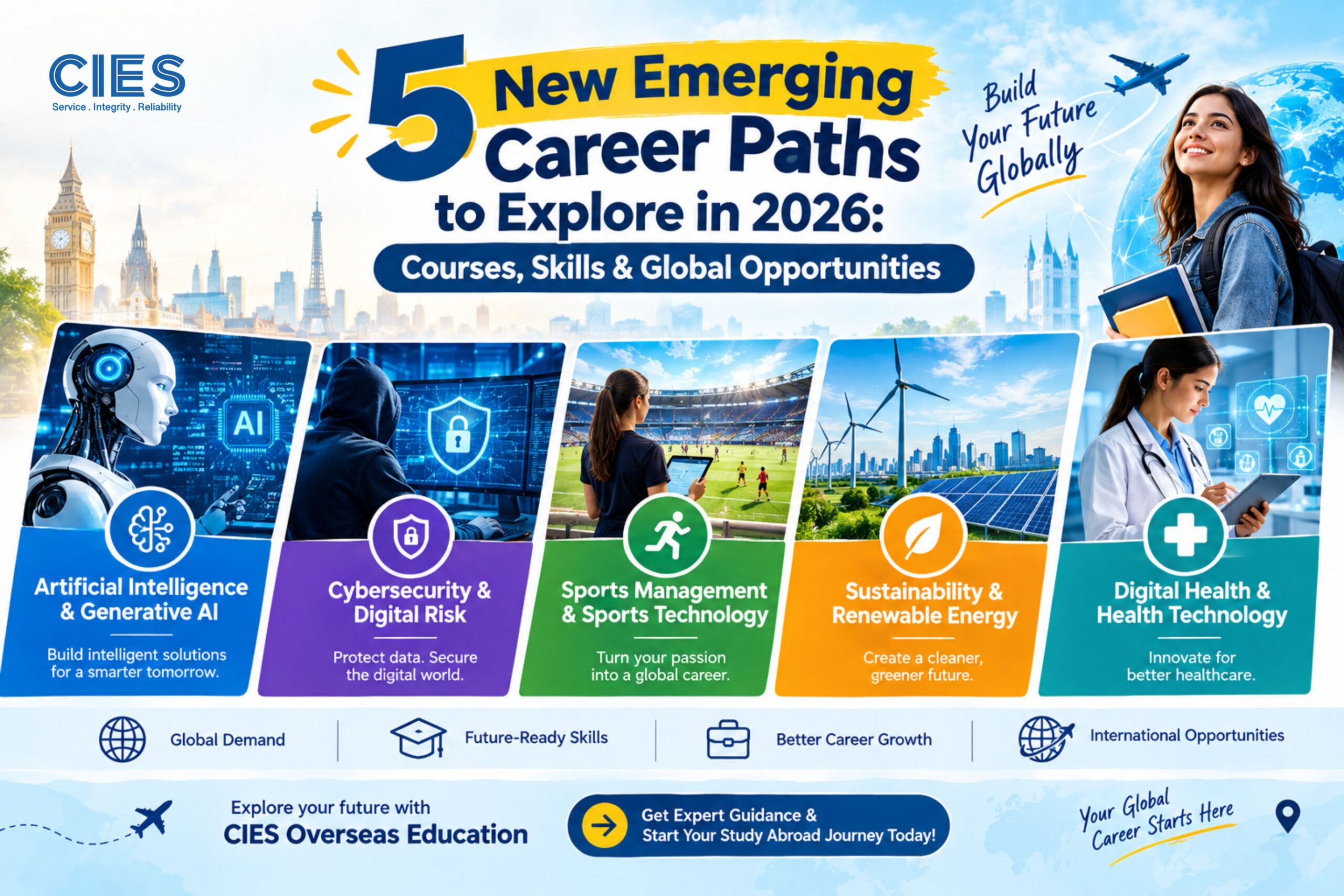
The world of work is changing rapidly, and new emerging career paths in 2026 are creating exciting opportunities for students and young professionals. Advances in artificial intelligence, digital technology, sustainability, healthcare, sports, and global business are changing the skills employers need.
If you are planning to study abroad in 2026, choosing a future-focused course can help you build relevant skills while gaining international academic and professional exposure. From AI and cybersecurity to sports management and sustainability, several fields are expanding beyond traditional career choices.
Quick Answer: Five emerging career paths worth exploring in 2026 include Artificial Intelligence & Generative AI, Cybersecurity & Digital Risk, Sports Management & Sports Technology, Sustainability & Renewable Energy, and Digital Health & Health Technology. Each field combines specialized education with skills that can be applied across international markets.
Why Explore Emerging Career Paths in 2026?
Traditional career choices are no longer the only route to professional growth. Technology, changing consumer behaviour, environmental priorities, and the internationalization of industries are creating new roles across multiple sectors.
For students, this means it is important to look beyond a course title and understand the skills, career opportunities, practical exposure, internships, and international demand connected with a programme.
Studying abroad can also provide access to international classrooms, industry projects, internships, research facilities, and multicultural professional networks.
5 New Emerging Career Paths to Explore in 2026
| Career Path | Key Areas | Important Skills |
|---|---|---|
| AI & Generative AI | AI, Machine Learning, Automation, GenAI | Python, data analysis, AI tools, problem-solving |
| Cybersecurity & Digital Risk | Cloud security, cyber defence, risk management | Networking, security, analytical thinking |
| Sports Management & Sports Technology | Sports business, analytics, marketing, events | Leadership, marketing, analytics, communication |
| Sustainability & Renewable Energy | Clean energy, ESG, climate solutions | Research, data, environmental knowledge |
| Digital Health & Health Technology | Health data, digital healthcare, medical technology | Data analysis, technology, healthcare knowledge |
1. Artificial Intelligence & Generative AI
Artificial Intelligence (AI) is one of the most visible areas of technological change. Generative AI is also expanding the way organisations create content, analyse information, automate processes, develop software, and support customers.
Students interested in mathematics, computing, programming, data, or technology can explore AI-related degrees and specialisations.
Courses to Consider
- Bachelor’s or Master’s in Artificial Intelligence
- Computer Science with AI specialisation
- Machine Learning
- Data Science
- Robotics and Intelligent Systems
- AI and Business Analytics
Skills to Build
- Python and programming fundamentals
- Machine learning concepts
- Data analysis
- Prompting and responsible use of generative AI tools
- Problem-solving and critical thinking
- Statistics and analytical reasoning
Potential Career Areas
Graduates can explore roles such as AI specialist, machine learning engineer, data scientist, AI product professional, automation specialist, AI consultant, or research professional, depending on their qualification and experience.
CIES Tip: Don’t choose an AI programme only because the field is popular. Check the curriculum, practical projects, programming requirements, internship opportunities, and progression options before applying.
2. Cybersecurity & Digital Risk
As organisations become increasingly dependent on digital systems, protecting data, networks, applications, and cloud infrastructure has become a major business priority. This has created opportunities in cybersecurity and digital risk management.
Courses to Consider
- Cybersecurity
- Information Security
- Computer Science
- Cloud Computing
- Digital Forensics
- Cyber Risk Management
Skills to Build
- Networking fundamentals
- Cloud security
- Threat detection
- Risk assessment
- Security frameworks
- Analytical and problem-solving skills
Potential Career Areas
Career options can include cybersecurity analyst, information security specialist, security consultant, cloud security professional, digital forensics professional, and risk analyst.
3. Sports Management & Sports Technology
Sports is no longer only about athletes and competitions. The modern sports industry combines business, marketing, technology, analytics, media, sponsorship, events, fitness, and fan engagement.
This makes sports management an interesting emerging career path for students who enjoy sports but want to build a career on the business or management side of the industry.
Courses to Consider
- Sports Management
- Sports Business
- Sports Marketing
- Sports Analytics
- International Sports Management
- Event Management
Skills to Build
- Sports marketing
- Event planning
- Business management
- Data and performance analytics
- Sponsorship management
- Communication and networking
Potential Career Areas
Depending on their education and experience, graduates can explore sports marketing, sports operations, event management, sponsorship, athlete management, sports analytics, fan engagement, sports media, and commercial partnerships.
Explore More: If you are interested in this field, read our guide on Study Sports Management in the UK and explore courses, internships and international study opportunities.
4. Sustainability & Renewable Energy
The transition towards cleaner energy, resource efficiency, sustainable infrastructure, and responsible business practices is creating new educational and professional opportunities.
Students interested in engineering, environmental science, energy, business, or climate-related subjects can explore careers connected with sustainability and renewable energy.
Courses to Consider
- Renewable Energy Engineering
- Environmental Science
- Sustainable Engineering
- Energy Management
- Sustainability Management
- Environmental Management
Skills to Build
- Environmental analysis
- Energy systems knowledge
- Data interpretation
- Project management
- Sustainability reporting
- Research and problem-solving
Potential Career Areas
Possible career areas include renewable energy, sustainability consulting, environmental management, ESG-related roles, energy management, sustainable construction, and climate-focused projects.
5. Digital Health & Health Technology
Healthcare is increasingly connected with digital technology. Electronic health records, health data, remote healthcare services, medical devices, healthcare analytics, and digital platforms are changing how healthcare organisations operate.
This creates opportunities for students who want to combine healthcare with technology, data, business, or innovation.
Courses to Consider
- Health Informatics
- Digital Health
- Biomedical Engineering
- Healthcare Management
- Health Data Science
- Medical Technology
Skills to Build
- Data analysis
- Healthcare technology
- Research skills
- Digital systems knowledge
- Project management
- Communication and collaboration
Potential Career Areas
Career areas may include health informatics, healthcare analytics, digital health operations, healthcare technology, medical technology, health data, and healthcare management.
Emerging Career Paths: What Should You Study?
There is no single course that is right for every student. Your choice should depend on your academic background, interests, strengths, budget, preferred destination, career goals, and long-term plans.
| If You Enjoy… | Explore… |
|---|---|
| Coding, mathematics & technology | AI, Data Science, Cybersecurity |
| Sports, business & events | Sports Management & Sports Business |
| Environment & engineering | Renewable Energy & Sustainability |
| Healthcare & technology | Digital Health & Health Informatics |
| Business + technology | AI Business, Digital Transformation & Analytics |
Why Study an Emerging Career Course Abroad?
International universities offer students opportunities to study specialised subjects, work on practical projects, interact with students from different countries, and gain exposure to international industries.
Depending on the destination and programme, students may also find opportunities for internships, industry placements, research projects, career services, and post-study professional pathways.
Before selecting a university, compare the course curriculum, tuition fees, living costs, scholarships, internship or placement structure, entry requirements, English-language requirements, visa rules, and post-study options.
Skills That Can Help Across Emerging Careers
Regardless of the career path you select, developing transferable skills can strengthen your academic and professional profile.
- Digital literacy: Comfort with modern digital tools and platforms.
- Data skills: Ability to understand, analyse and communicate information.
- Communication: Clear written, verbal and presentation skills.
- Problem-solving: Ability to approach complex situations logically.
- Adaptability: Willingness to learn new technologies and methods.
- Teamwork: Ability to collaborate across cultures and disciplines.
- English proficiency: Strong English can be important for international education and many global workplaces.
How to Choose the Right Emerging Career Path
1. Start With Your Interests
Think about the subjects, activities and problems you genuinely enjoy working on.
2. Check Your Academic Background
Some programmes may require mathematics, science, programming, healthcare or other specific academic prerequisites.
3. Compare Course Modules
Two courses with similar names can have very different curricula. Look at the modules, projects, assessment methods and practical components.
4. Research the Destination
Consider tuition fees, living expenses, scholarships, employment rules, visa requirements and the overall student experience before selecting a country.
5. Think Beyond Your First Job
Consider how the qualification can support your career development over several years rather than selecting a programme based only on its current popularity.
Planning to Study Abroad in 2026?
Choosing the right course and country can be challenging. CIES Overseas Education can help you explore study-abroad destinations, courses, university options, scholarships, admission requirements and visa guidance based on your profile.
Get personalised guidance before you apply.
Frequently Asked Questions
What are the emerging career paths in 2026?
Some emerging career areas include artificial intelligence and generative AI, cybersecurity, sports management and sports technology, sustainability and renewable energy, and digital health.
Which emerging career is best for the future?
There is no universally best emerging career. The right choice depends on your academic background, interests, skills, preferred industry, budget, destination and long-term career goals.
Can I study emerging career courses abroad?
Yes. Universities in many international study destinations offer specialised programmes in areas such as AI, cybersecurity, sustainability, sports management, digital health, data science and related disciplines.
What skills should students develop for emerging careers?
Technical knowledge, digital literacy, data skills, communication, critical thinking, problem-solving, adaptability and teamwork can be useful across many emerging career fields.
Should I choose a new career path just because it is trending?
Not necessarily. A trending field should still match your interests, abilities and long-term goals. Research the course curriculum, entry requirements, career pathways and professional opportunities before making a decision.
Can CIES help me choose a course and study destination?
Yes. CIES Overseas Education provides study-abroad counselling and can help students explore course and destination options, university applications, scholarships, admission requirements and visa-related guidance.
Final Thoughts
The 5 new emerging career paths to explore in 2026 highlighted in this guide show how education and employment are evolving across technology, sports, sustainability and healthcare. The right career decision should be based on more than a trend—it should connect your interests and abilities with a course that provides relevant knowledge and practical opportunities.
If you are considering studying abroad in 2026, start by identifying your preferred career direction, then compare countries, universities, courses, costs, scholarships and entry requirements.
Ready to Explore Your Study Abroad Options?
Get profile-based guidance from CIES Overseas Education.
Explore courses, countries, universities, scholarships and admission pathways with our counsellors.