
June 23, 2026

Planning a European holiday, business trip, family visit, or short-term study? A Schengen Visa is your gateway to exploring multiple European countries with a single visa. This comprehensive guide explains everything Indian applicants need to know about Schengen Visa eligibility, required documents, processing time, fees, application steps, and expert tips to maximize approval chances.

At CIES – Centre for Immigration & Education Services (CIES), we assist individuals, families, students, and professionals with complete Schengen Visa documentation and application support.


What is a Schengen Visa?

A Schengen Visa is a short-stay visa that allows non-European Union citizens to travel freely within the Schengen Area for up to 90 days within 180 days.

Instead of applying for separate visas for each country, a single Schengen Visa allows you to visit multiple participating countries during one trip.

This visa is commonly issued for:

  • Tourism
  • Business Meetings
  • Family Visits
  • Medical Treatment
  • Conferences
  • Cultural Events
  • Sports Competitions
  • Short-Term Educational Programs

Quick Facts About the Schengen Visa

Feature Details
Visa Type Short Stay Visa
Maximum Stay 90 Days
Validity Rule 180-Day Rolling Period
Number of Countries 29 Schengen Countries
Biometrics Required Yes
Travel Insurance Mandatory
Processing Time Usually 15 Working Days

What is the Schengen Area?

The Schengen Area is a group of European countries that have removed internal border checks, making travel between member states seamless.

Popular destinations include:

  • France
  • Germany
  • Italy
  • Spain
  • Switzerland
  • Netherlands
  • Belgium
  • Austria
  • Portugal
  • Greece
  • Norway
  • Sweden
  • Finland
  • Denmark
  • Czech Republic
  • Poland
  • Hungary
  • Iceland
  • Luxembourg

Types of Schengen Visas

Tourist Visa

  • Holidays
  • Europe Tours
  • Vacations
  • Honeymoon Trips
  • Backpacking

Business Visa

  • Corporate Meetings
  • Client Visits
  • Trade Fairs
  • Business Conferences
  • Exhibitions

Family Visit Visa

Issued for individuals visiting relatives or friends residing in Schengen countries.

Medical Visa

Designed for patients seeking medical treatment in Europe.

Airport Transit Visa

Required for travelers transiting through certain Schengen airports before reaching another destination.


Who Can Apply for a Schengen Visa?

Indian citizens planning short-term travel to Schengen countries generally require a Schengen Visa.

Applicants should:

  • Possess a valid passport
  • Have sufficient financial resources
  • Demonstrate a genuine travel purpose
  • Maintain a clean travel history
  • Intend to return to India before visa expiry

Schengen Visa Eligibility Criteria

  • Passport valid for at least three months beyond departure.
  • Proof of accommodation.
  • Confirmed or planned travel arrangements.
  • Sufficient financial support.
  • Valid Schengen-compliant travel insurance.
  • Truthful and complete documentation.

Documents Required for a Schengen Visa

Identity Documents

  • Original Passport
  • Previous Passports
  • Passport-size Photographs
  • Visa Application Form
  • Cover Letter

Financial Documents

  • Bank Statements (6 Months)
  • Income Tax Returns
  • Salary Slips
  • Employment Letter
  • Business Registration (Self-employed)
  • CA Report (if applicable)

Travel Documents

  • Flight Reservation
  • Hotel Booking
  • Complete Travel Itinerary
  • Travel Insurance

Supporting Documents

  • Invitation Letter
  • Business Invitation
  • Marriage Certificate
  • Birth Certificate
  • Conference Registration
  • Medical Appointment Letter

Step-by-Step Schengen Visa Application Process

Step 1: Select Your Destination

Apply through the embassy of the country where you will spend the most time.

Step 2: Complete the Application Form

Fill out the Schengen Visa application carefully.

Step 3: Prepare Documentation

Arrange documents according to embassy requirements.

Step 4: Book Your Appointment

Schedule a biometric appointment through the designated Visa Application Centre.

Step 5: Submit Biometrics

Provide fingerprints and photographs.

Step 6: Pay Visa Fees

Pay embassy and service centre charges.

Step 7: Track Your Application

Monitor your application status online.

Step 8: Receive Your Passport

Collect your passport once processed.


Schengen Visa Processing Time

The average processing time is 15 Working Days. It may extend to 30–45 days during peak travel seasons or if additional verification is required.

Experts recommend applying at least one month before your intended travel date.


Schengen Visa Fees (2026)

  • Embassy Visa Fee
  • Visa Application Centre Fee
  • Courier Charges (Optional)
  • SMS Notification Charges (Optional)

Children and certain applicant categories may qualify for reduced fees or exemptions.


Travel Insurance Requirements

  • Medical Emergencies
  • Hospitalization
  • Emergency Evacuation
  • Repatriation
  • Coverage across all Schengen countries

Common Reasons for Schengen Visa Rejection

  • Incomplete documents
  • Insufficient funds
  • Unclear travel plans
  • Fake documentation
  • Poor travel history
  • Invalid travel insurance
  • Lack of proof of returning to India
  • Inconsistent information

Tips to Increase Schengen Visa Approval Chances

  • Submit genuine documents.
  • Maintain a healthy bank balance.
  • Write a professional cover letter.
  • Purchase valid travel insurance.
  • Prepare a realistic itinerary.
  • Avoid incomplete applications.
  • Apply early.
  • Show strong ties to your home country.

Why Choose CIES for Your Schengen Visa?

  • Professional Visa Consultation
  • Documentation Review
  • Cover Letter Preparation
  • Travel Itinerary Guidance
  • Visa Application Support
  • Appointment Assistance
  • Pre-submission Verification
  • Dedicated Visa Experts

Our experienced consultants help applicants prepare complete and accurate applications, reducing common mistakes and improving application quality.


Frequently Asked Questions (FAQs)

What is a Schengen Visa?

A Schengen Visa allows eligible travelers to visit multiple Schengen countries for short stays of up to 90 days within a 180-day period.

How many countries can I visit with a Schengen Visa?

You may travel across participating Schengen countries, provided you comply with the conditions of your visa.

Is travel insurance mandatory?

Yes. Travel medical insurance meeting Schengen requirements is generally required.

How long does processing take?

Most applications are processed within approximately 15 working days, though some may take longer.

Can I extend my Schengen Visa?

Extensions are granted only under exceptional circumstances, such as humanitarian reasons or force majeure.

Can CIES help me apply?

Yes. CIES offers professional guidance for documentation, application review, appointment support, and complete Schengen Visa assistance.


Final Thoughts

A Schengen Visa opens the door to exploring some of the world’s most iconic destinations with a single visa. Proper planning, complete documentation, and timely application significantly improve your chances of approval.

Whether you’re traveling for tourism, business, family visits, or short-term education, CIES – Centre for Immigration & Education Services is committed to helping you navigate the Schengen Visa process with confidence.

🌍 Ready to Apply for Your Schengen Visa?

Planning a trip to Europe? Let CIES – Centre for Immigration & Education Services simplify your
Schengen Visa application with expert guidance and end-to-end support.
Our experienced visa consultants help you prepare accurate documentation,
review your application, and guide you through every step of the process to maximize your chances of approval.

✨ Why Choose CIES?

  • ✔ Expert Schengen Visa Consultation
  • ✔ Complete Document Verification
  • ✔ Visa Application Assistance
  • ✔ Travel Itinerary & Cover Letter Support
  • ✔ Appointment Booking Guidance
  • ✔ Transparent Process with Personalized Support

Whether you’re traveling for tourism, business, family visits, or short-term study,
CIES is here to make your Schengen Visa journey smooth, stress-free, and successful.

📞 Contact CIES Today

✈️ Book Your Free Consultation Today!

Take the first step toward exploring Europe with confidence. Contact
CIES – Centre for Immigration & Education Services today for trusted
Schengen Visa guidance and let our experts help turn your travel plans into reality.
    June 23, 2026

    If you’re searching for the best Duolingo coaching in Noida, you’re likely planning to study abroad and need a high score in the Duolingo English Test (DET). The Duolingo English Test has become one of the most accepted English proficiency exams worldwide due to its affordability, convenience, and quick results.

    At CIES – Centre for Immigration & Education Services, we offer professional Duolingo coaching in Noida designed to help students achieve their target scores and secure admission to top universities in Canada, the UK, the USA, Australia, Ireland, New Zealand, Germany, and many other countries.

    Whether you’re taking the test for the first time or looking to improve your previous score, our experienced trainers provide personalized guidance that maximizes your performance.


    Why Choose the Duolingo English Test?

    The Duolingo English Test (DET) has become a preferred choice among international students because it offers several advantages over traditional English language tests.

    Benefits of the Duolingo English Test

    • ✔ Take the test from home
    • ✔ Results within 48 hours
    • ✔ Accepted by thousands of universities worldwide
    • ✔ Affordable exam fee
    • ✔ Adaptive testing system
    • ✔ AI-powered secure assessment
    • ✔ No test center required
    • ✔ Faster university application process

    Why Choose CIES for Duolingo Coaching in Noida?

    CIES is one of the most trusted names for study abroad and English language test preparation. Our expert faculty has successfully guided thousands of students toward achieving excellent Duolingo scores.

    1. Certified Expert Trainers

    Learn from experienced language trainers who understand the Duolingo English Test pattern and scoring system.

    2. Personalized Study Plans

    Every student has different strengths and weaknesses. We create customized preparation plans based on your English proficiency level.

    3. Complete Study Material

    • Grammar Notes
    • Vocabulary Lists
    • Reading Exercises
    • Writing Practice
    • Speaking Activities
    • Listening Exercises
    • Practice Questions

    4. Full-Length Mock Tests

    Practice with real exam-like mock tests to improve:

    • Time Management
    • Confidence
    • Accuracy
    • Adaptive Question Handling

    5. Individual Performance Analysis

    • Score Analysis
    • Mistake Review
    • Weak Area Identification
    • Improvement Strategy

    6. Flexible Online & Offline Classes

    • Classroom Coaching
    • Live Online Classes
    • Weekend Batches
    • Weekday Batches
    • Fast-Track Courses

    What is Covered in Our Duolingo Coaching?

    Reading Skills

    • Reading Comprehension
    • Vocabulary Building
    • Fill-in-the-Blanks
    • Sentence Completion

    Writing Skills

    • Essay Writing
    • Picture Description
    • Grammar
    • Sentence Formation
    • Coherence

    Listening Skills

    • Audio Understanding
    • Listening Practice
    • Spoken English Recognition

    Speaking Skills

    • Speaking Fluency
    • Pronunciation
    • Picture Description
    • Independent Speaking
    • Interactive Speaking Tasks

    Duolingo Test Format Explained

    The Duolingo English Test is an adaptive online examination lasting approximately one hour.

    Introduction & Setup

    • ID Verification
    • Camera Check
    • Microphone Test

    Adaptive Test

    • Read and Complete
    • Read Aloud
    • Listen and Type
    • Write About the Photo
    • Speak About the Photo
    • Interactive Reading
    • Interactive Listening
    • Video Interview

    Video Interview

    Students answer open-ended questions that are shared with universities.

    Writing Sample

    A short essay that universities can review alongside your score.


    Benefits of Joining the Best Duolingo Coaching in Noida

    • ✔ Higher Scores
    • ✔ Better Confidence
    • ✔ Improved Time Management
    • ✔ Updated Exam Strategies
    • ✔ Personalized Feedback
    • ✔ Expert Mentorship

    Who Should Join Our Duolingo Coaching?

    • Students planning to study abroad
    • Working professionals
    • Scholarship applicants
    • University applicants
    • Visa applicants

    Countries Accepting the Duolingo English Test

    🇨🇦 Canada
    🇺🇸 USA
    🇬🇧 United Kingdom
    🇦🇺 Australia
    🇮🇪 Ireland
    🇳🇿 New Zealand
    🇩🇪 Germany
    🇫🇷 France
    🇳🇱 Netherlands
    🇮🇹 Italy
    🇸🇬 Singapore
    🇦🇪 Dubai (UAE)

    Why Students Trust CIES

    • Experienced Faculty
    • Personalized Mentoring
    • Updated Study Material
    • Regular Practice Tests
    • Small Batch Sizes
    • Flexible Timings
    • Study Abroad Counseling
    • University Admission Assistance
    • Student Visa Guidance

    Tips to Score High in the Duolingo English Test

    • Practice English daily.
    • Read newspapers and articles.
    • Improve vocabulary.
    • Speak English regularly.
    • Take multiple mock tests.
    • Focus on grammar.
    • Improve typing speed.
    • Watch English videos and podcasts.
    • Manage your time wisely.
    • Learn from mistakes.

    Why Noida Students Prefer CIES


    Frequently Asked Questions (FAQs)

    Which is the best Duolingo coaching in Noida?

    CIES is one of the leading Duolingo coaching institutes in Noida, offering expert trainers, personalized guidance, mock tests, and complete study abroad support.

    How long is the Duolingo coaching course?

    Most students prepare within 2–6 weeks, depending on their English proficiency and target score.

    Can I prepare for the Duolingo English Test online?

    Yes. CIES offers both online and offline coaching with live interactive classes and mock tests.

    What score is required for studying abroad?

    Most universities require a Duolingo score between 95 and 130, although requirements vary by institution and program.

    Is the Duolingo English Test easier than IELTS?

    The Duolingo English Test is shorter and more convenient, but proper preparation is still essential to achieve a competitive score.


    Enroll in the Best Duolingo Coaching in Noida Today

    If you’re planning to study abroad, choosing the best Duolingo coaching in Noida can make a significant difference in your preparation and final score. At CIES, our expert trainers, structured curriculum, regular mock tests, and personalized mentoring help students achieve their desired Duolingo scores with confidence.

    Whether you’re targeting universities in Canada, the USA, the UK, Australia, Ireland, New Zealand, Germany, or other top study destinations, CIES provides complete guidance—from Duolingo preparation to university admissions and student visa assistance.

      June 18, 2026

      F-1 visa rejection can be disappointing, but it doesn’t necessarily mean your dream of studying in the United States is over. Every year, many international students, including Indian applicants, face F-1 visa refusals for reasons such as insufficient financial evidence, weak interview performance, or failure to demonstrate strong ties to their home country.

      Understanding the common causes of an F-1 visa rejection and preparing a stronger application can significantly improve your chances of approval on your next application. This guide explains why F-1 visas are refused, how to avoid common mistakes, and what steps to take after a rejection.

      What Is an F-1 Visa Rejection?

      An F-1 visa rejection occurs when a U.S. consular officer determines that an applicant does not meet the eligibility requirements for a student visa under U.S. immigration law.

      A refusal does not permanently prevent you from applying again. Many students receive approval after addressing the issues that led to their initial refusal.

      Top F-1 Visa Rejection Reasons

      1. Insufficient Financial Proof

      Applicants must demonstrate that they have enough funds to cover tuition, living expenses, and other educational costs.

      Common financial issues include:

      • Low bank balance
      • Unverified source of funds
      • Incomplete financial documents
      • Weak sponsorship evidence

      How to Avoid It

      • Provide recent bank statements.
      • Include education loan sanction letters.
      • Submit scholarship documents.
      • Clearly explain your funding source.

      2. Poor Visa Interview Performance

      The visa interview is one of the most important stages of the application process.

      Mistakes include:

      • Nervousness
      • Inconsistent answers
      • Memorized responses
      • Lack of confidence

      Tips to Improve

      • Practice common interview questions.
      • Speak naturally and confidently.
      • Keep answers concise and relevant.

      3. Lack of Genuine Student Intent

      Visa officers must be satisfied that your primary purpose is education.

      Possible Red Flags:

      • Limited knowledge of your course
      • Unclear career goals
      • No valid reason for selecting the university

      Be Prepared to Explain:

      • Why this university?
      • Why this course?
      • How does it support your career?

      4. Failure to Demonstrate Strong Home Country Ties

      Applicants should demonstrate that they intend to comply with the terms of their visa and depart the United States after completing their studies unless they later become eligible for another lawful immigration pathway.

      Examples of Strong Ties:

      • Family relationships
      • Future employment opportunities
      • Property ownership
      • Business interests
      • Career plans in your home country

      5. Incomplete or Incorrect Documents

      Missing or inaccurate documents can negatively affect your application.

      Always verify that you have:

      • Valid Passport
      • Form I-20
      • DS-160 Confirmation
      • SEVIS Fee Receipt
      • Academic Transcripts
      • Financial Documents

      6. Inconsistent Information

      Any mismatch between your documents and interview responses can create concerns.

      Examples:

      • Different sponsor names
      • Incorrect educational history
      • Conflicting financial information

      Consistency is essential.

      7. Weak Academic Profile

      Low grades alone do not automatically result in a refusal, but you should be prepared to explain:

      • Study gaps
      • Backlogs
      • Academic challenges
      • Course changes

      Provide honest explanations supported by evidence whenever possible.

      What Happens After an F-1 Visa Rejection?

      After a refusal:

      • Your passport is usually returned.
      • You receive a refusal notice.
      • The officer may indicate the applicable section of U.S. immigration law.
      • You may submit a new application if you address the previous concerns.

      Can You Reapply After an F-1 Visa Rejection?

      Yes.

      There is generally no mandatory waiting period before reapplying. However, reapplying without addressing the reasons for refusal is unlikely to produce a different outcome.

      Before submitting a new application:

      • Review the refusal reason.
      • Strengthen your financial evidence.
      • Improve interview preparation.
      • Update any changed information.
      • Submit accurate documentation.

      How to Increase Your Chances of Approval

      Choose the Right University

      Understand:

      • Course curriculum
      • University rankings
      • Career outcomes
      • Program duration

      Prepare Strong Financial Documents

      • Bank Statements
      • Fixed Deposits
      • Education Loan Approval
      • Sponsor Income Proof
      • Scholarship Letters

      Practice Interview Questions

      • Why do you want to study in the USA?
      • Why this university?
      • Who is sponsoring your education?
      • What are your future career plans?
      • Why not study in your home country?

      Be Honest

      Never submit fake documents or misleading information.

      Honest answers build credibility.

      Organize Your Documents

      Carry documents in a logical order to make it easier for the officer to request additional information.

      Common Myths About F-1 Visa Rejection

      Myth: One rejection means permanent refusal.
      Fact: Many students receive approval after improving their applications.

      Myth: Hiring an agent guarantees approval.
      Fact: Only a U.S. consular officer can approve or refuse a visa.

      Myth: Memorized answers improve your chances.
      Fact: Honest and natural responses are generally more effective.

      F-1 Visa Rejection Checklist

      ✅ Valid Passport
      ✅ Form I-20
      ✅ DS-160 Confirmation
      ✅ SEVIS Receipt
      ✅ Appointment Confirmation
      ✅ Financial Documents
      ✅ Academic Records
      ✅ Admission Letter
      ✅ Clear Study Plan
      ✅ Confidence & Honesty

      Frequently Asked Questions (FAQs)

      Why is an F-1 visa rejected?

      Common reasons include insufficient financial proof, weak interview performance, inconsistent information, or failure to establish eligibility.

      Can I apply again after an F-1 visa rejection?

      Yes. You may submit a new application after addressing the issues that led to the previous refusal.

      Is there a waiting period?

      There is generally no mandatory waiting period, but it is advisable to reapply only after strengthening your application.

      Will a previous rejection affect future applications?

      No. Each visa application is assessed independently based on its own merits.

      Does an education loan improve approval chances?

      An approved education loan can strengthen your financial evidence, but visa approval depends on your overall eligibility and interview performance.

      Final Thoughts

      An F-1 visa rejection can be discouraging, but it is often an opportunity to build a stronger application. By understanding the reasons for refusal, improving your financial documentation, preparing thoroughly for the interview, and presenting a clear academic plan, you can significantly improve your chances of success.

      Preparation, honesty, confidence, and consistency remain the keys to a successful F-1 visa application.

      FAQ

      Q1. What is the most common reason for an F-1 visa rejection?
      Insufficient financial documentation and weak interview performance are among the most common reasons.

      Q2. Can I reapply after an F-1 visa rejection?
      Yes. You can submit a new application after addressing the issues that led to the previous refusal.

      Q3. How can I avoid an F-1 visa rejection?
      Prepare accurate documents, demonstrate sufficient financial support, answer interview questions honestly, and clearly explain your study plans.

      Q4. Does a previous F-1 visa rejection affect future applications?
      No. A previous refusal does not automatically result in future refusals, as each application is evaluated independently.

      🎓 Rejected F-1 Visa? Don’t Give Up—Your USA Dream Is Still Possible!

      An F-1 Visa rejection is not the end of your study abroad journey. Many students receive approval on their second attempt with stronger documentation, better interview preparation, and expert guidance.

      🚀 How CIES Overseas Education Helps You Reapply Successfully

      ✅ One-to-One Visa Counselling
      ✅ Detailed F-1 Visa Rejection Analysis
      ✅ University & Course Selection Guidance
      ✅ Financial Documentation Review
      ✅ DS-160 Form Assistance
      ✅ SOP & Student Profile Evaluation
      ✅ Mock Visa Interview Preparation
      ✅ Complete F-1 Visa Reapplication Support

      🎁 Book Your FREE F-1 Visa Assessment

      Our experienced counsellors will help you:

      • 🎯 Identify why your F-1 visa was refused
      • 📄 Strengthen your financial documentation
      • 🗣 Prepare confident visa interview answers
      • 📚 Build a stronger student profile
      • 📈 Improve your chances of visa approval
      • 🛂 Create a personalized visa reapplication strategy

      ⭐ Why Students Trust CIES Overseas Education

      ✔ Experienced USA Education Counsellors
      ✔ Personalized Visa Reapplication Strategy
      ✔ End-to-End Admission & Visa Assistance
      ✔ Expert Mock Interview Sessions
      ✔ Scholarship & Education Loan Guidance
      ✔ Trusted by Thousands of Study Abroad Aspirants

      ⏳ Don’t Let One Rejection Stop Your Future!

      Many students receive their U.S. student visa after improving their application. Let our experts help you turn your F-1 visa rejection into a successful approval.


      🎓 Book Your FREE Visa Assessment Now

        June 18, 2026

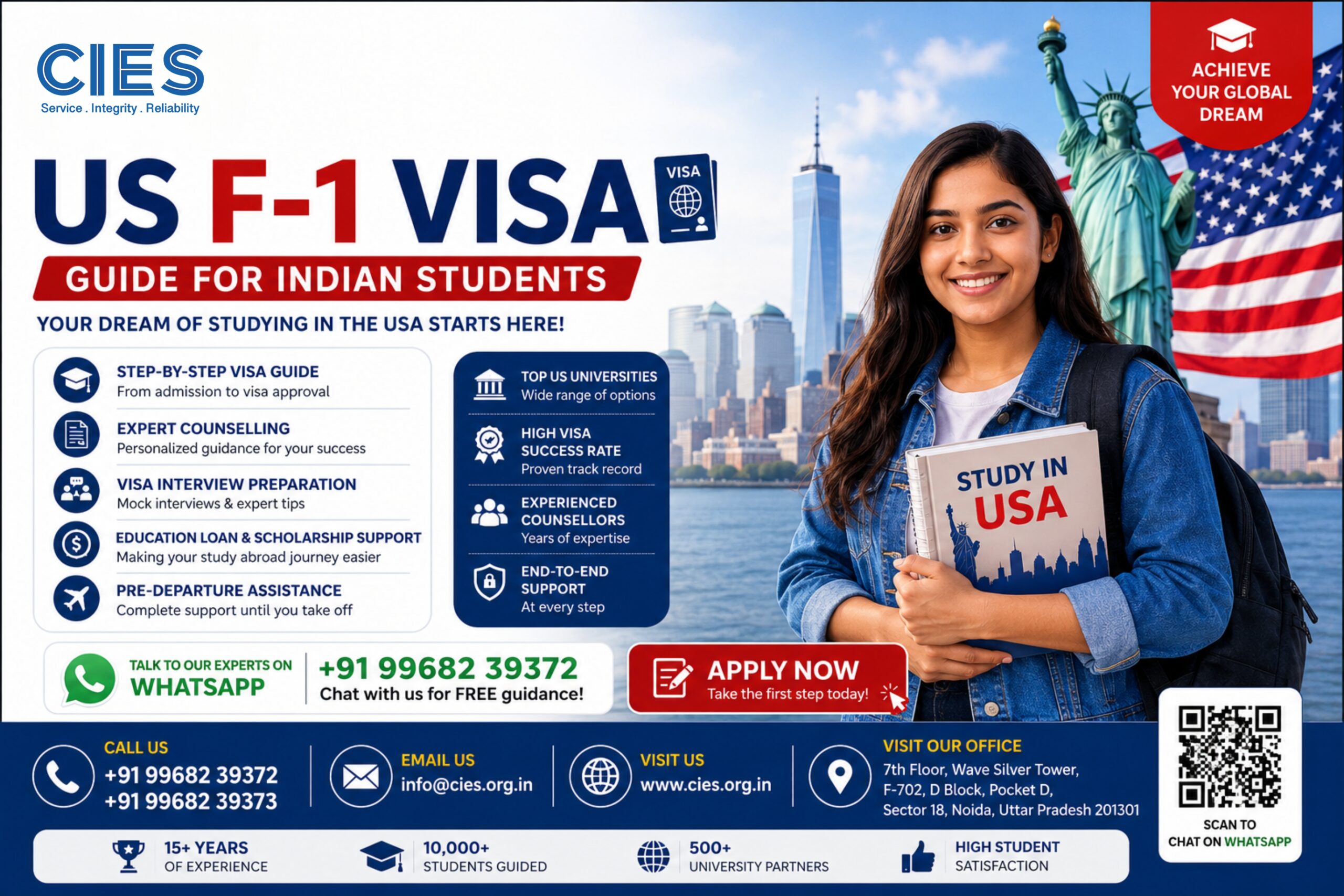
        Planning to study in the United States? Obtaining a US F-1 Visa is one of the most important steps for Indian students pursuing higher education in the USA. Whether you’re applying for a bachelor’s, master’s, MBA, or PhD program, understanding the US F-1 Visas process—including eligibility, required documents, fees, interview preparation, and processing time—can help you avoid delays and improve your chances of approval. This complete 2026 guide covers everything you need to know before starting your study abroad journey.

        What is a US F-1 Student Visa?

        A US F-1 Visa is a non-immigrant student visa issued to international students enrolled in full-time academic programs at SEVP-approved institutions in the United States.

        The F-1 visa allows students to:

        • Study full-time
        • Live legally in the USA during their program
        • Work under authorized conditions
        • Apply for Optional Practical Training (OPT)
        • Become eligible for STEM OPT Extension (if applicable)

        For Indian students, the F-1 visa is the standard visa for studying in the United States.

        Why Indian Students Choose the USA

        The United States continues to be one of the world’s leading study destinations because of:

        • Globally ranked universities
        • Flexible education system
        • Research opportunities
        • Industry exposure
        • High graduate employability
        • Strong earning potential
        • International networking
        • Diverse student community

        Popular Study Destinations

        • New York
        • California
        • Texas
        • Illinois
        • Massachusetts
        • Florida
        • Pennsylvania

        Who Can Apply for US F-1 Visas for Indian Students?

        You are eligible if you:

        • Receive admission from a SEVP-approved institution
        • Obtain Form I-20
        • Demonstrate sufficient financial resources
        • Show strong academic intent
        • Prove non-immigrant intent
        • Meet English language requirements (if required)
        • Have a valid passport

        Eligibility Requirements

        1. Admission Letter

        You must receive admission into a recognized US institution.

        Examples include:

        • Universities
        • Colleges
        • Community Colleges
        • Language Institutes
        • Graduate Schools

        2. Form I-20

        Your institution issues Form I-20, which confirms:

        • Admission
        • Program duration
        • Estimated education cost
        • Student information
        • SEVIS ID

        Without a Form I-20, you cannot apply for an F-1 visa.

        3. Financial Capability

        Applicants must demonstrate enough funds to cover:

        • Tuition fees
        • Living expenses
        • Health insurance
        • Accommodation
        • Travel costs

        Financial proof may include:

        • Bank statements
        • Education loan approval
        • Scholarship letters
        • Fixed deposits
        • Sponsor documents
        • Income Tax Returns

        4. Genuine Student Intent

        Visa officers want assurance that applicants genuinely intend to study.

        You should clearly explain:

        • Why this university?
        • Why this course?
        • Future career plans
        • Why not study in India?

        Documents Required for US F-1 Visas for Indian Students

        Mandatory Documents

        • Valid Passport
        • DS-160 Confirmation Page
        • Visa Appointment Confirmation
        • Form I-20
        • SEVIS Fee Receipt
        • Passport-Size Photograph
        • Admission Letter

        Academic Documents

        • Class 10 Mark Sheet
        • Class 12 Mark Sheet
        • Graduation Certificates
        • Academic Transcripts
        • Degree Certificate
        • IELTS/TOEFL/PTE Scores (if applicable)
        • GRE/GMAT Scores (if applicable)

        Financial Documents

        • Bank Statements
        • Fixed Deposits
        • Education Loan Sanction Letter
        • Income Tax Returns
        • Salary Slips
        • Sponsor Affidavit
        • CA Statement (Optional)

        Step-by-Step Application Process

        1. Secure University Admission
        2. Receive Form I-20
        3. Pay the SEVIS I-901 Fee
        4. Complete the DS-160 Application
        5. Pay the MRV Visa Fee
        6. Schedule VAC & Visa Interview Appointments
        7. Attend Biometrics Appointment
        8. Attend the F-1 Visa Interview

        US F-1 Visa Fees (2026)

        Fee Approximate Amount
        SEVIS I-901 Fee USD 350
        Visa Application (MRV) Fee USD 185
        Passport Photos Additional
        Travel Expenses Varies

        Note: Always verify the latest government fees before making a payment.

        US F-1 Visa Processing Time

        Stage Estimated Time
        University Admission 2–8 Weeks
        I-20 Issuance 1–3 Weeks
        Visa Appointment Depends on Availability
        Visa Decision Usually, immediately after the interview
        Passport Delivery 3–10 Working Days

        Common US F-1 Visa Interview Questions

        • Why do you want to study in the USA?
        • Why did you choose this university?
        • Why this course?
        • Who is sponsoring your education?
        • What do your parents do?
        • What are your future plans?
        • Do you intend to work in the USA?
        • Why not study in India?

        Tips to Crack the F-1 Visa Interview

        • Answer confidently.
        • Be honest.
        • Keep responses concise.
        • Maintain eye contact.
        • Know your university and course.
        • Understand your financial documents.
        • Explain your career goals clearly.
        • Carry organized documents.

        Reasons for F-1 Visa Rejection

        • Weak financial documentation
        • Inconsistent answers
        • Poor interview performance
        • Lack of genuine academic intent
        • Inadequate English communication
        • Missing documents
        • Insufficient ties to the home country

        Can Indian Students Work on an F-1 Visa?

        On-Campus Employment

        • Up to 20 hours per week during academic sessions
        • Full-time during official breaks

        Curricular Practical Training (CPT)

        Students may participate in internships that are part of their academic curriculum.

        Optional Practical Training (OPT)

        Eligible graduates can work in their field of study after completing their degree.

        STEM OPT Extension

        Students with qualifying STEM degrees may apply for an extended period of work authorization, subject to current regulations.

        Benefits of US F-1 Visas for Indian Students

        • Access to globally recognized education
        • Exposure to advanced research
        • Networking opportunities
        • Practical work experience
        • Career development
        • International exposure
        • Diverse campus environment
        • Potential pathway to long-term professional opportunities through separate immigration processes

        Expert Tips for Visa Success

        • Apply early.
        • Select the right university.
        • Prepare strong financial documents.
        • Practice interview questions.
        • Review your DS-160 carefully.
        • Keep your answers truthful.
        • Stay calm during the interview.
        • Demonstrate clear academic objectives.

        Frequently Asked Questions (FAQs)

        Is the F-1 visa mandatory for Indian students studying in the USA?

        Yes. Most full-time academic programs require an F-1 student visa.

        How much bank balance is required?

        There is no fixed amount. You should demonstrate sufficient funds to cover tuition and living expenses as listed on your Form I-20.

        Can parents sponsor my education?

        Yes. Parents, guardians, or other eligible sponsors can financially support your education.

        Can I work while studying?

        Yes. F-1 students may work on campus under authorized conditions and may become eligible for CPT or OPT.

        Can my visa be rejected?

        Yes. Incomplete documentation, insufficient financial evidence, or failure to establish eligibility may lead to refusal.

        How early can I apply?

        Students can generally apply for an F-1 visa after receiving their Form I-20 and paying the required fees. Visa issuance and entry timelines are subject to current U.S. regulations.

        Final Thoughts

        Obtaining US F-1 visas for Indian students is a crucial step toward studying in one of the world’s leading education systems. With careful planning, complete documentation, strong financial preparation, and a confident interview, Indian students can significantly improve their chances of visa approval.

        Start your application early, understand every requirement, and prepare thoroughly for your interview. With the right guidance and preparation, your journey to studying in the United States can begin smoothly.

        🎓 Ready to Study in the USA?

        Turn your Study Abroad Dream into reality with CIES Overseas Education. Our experienced counsellors provide personalized guidance to help you secure admission to top U.S. universities and prepare a successful US F-1 Student Visa application.

        🌟 Why Choose CIES Overseas Education?

        ✅ Free Career & University Counselling
        ✅ Personalized Course & University Selection
        ✅ Application & Admission Assistance
        ✅ SOP, LOR & Resume Guidance
        ✅ Scholarship & Education Loan Support
        ✅ Complete US F-1 Visa Documentation
        ✅ Mock Visa Interview Preparation
        ✅ Pre-Departure Briefing & Ongoing Support

        🎁 Book Your FREE 30-Minute Counselling Session

        Get personalized guidance from our experienced study abroad experts and receive:

        • 🎯 Personalized Study Plan
        • 🏛 University Shortlist Based on Your Profile
        • 💰 Tuition Fee & Living Cost Estimates
        • 🎓 Scholarship Opportunities
        • 📄 US F-1 Visa Eligibility Assessment
        • 🛂 Complete Admission & Visa Roadmap

        🏆 Why Students Trust CIES Overseas Education

        ✔ Personalized One-to-One Counselling
        ✔ Experienced Study Abroad Advisors
        ✔ Admission Assistance for Top Global Universities
        ✔ Transparent Admission Process
        ✔ End-to-End Visa Support
        ✔ High Student Satisfaction

        ⏳ Limited FREE Counselling Slots Available!

        Our expert counsellors offer personalized guidance to a limited number of students each week. Reserve your FREE consultation today and begin your journey to studying in the USA with confidence.


        🎓 Book Your FREE Consultation Now


        📍 Contact CIES Overseas Education

        Address:
        7th Floor, Wave Silver Tower, F-702, D Block, Pocket D,
        Sector 18, Noida, Uttar Pradesh 201301

        📞 Phone: +91-9968239372 / +91-9968239373

          FAQ

          Q1. What is the US F-1 visa for Indian students?

          The US F-1 visa is a non-immigrant student visa that allows Indian students to pursue full-time academic studies at SEVP-approved institutions in the United States.

          Q2. What documents are required for an F-1 visa?

          Key documents include a valid passport, Form I-20, DS-160 confirmation, SEVIS fee receipt, visa appointment confirmation, academic transcripts, and financial proof.

          Q3. How much does a US F-1 visa cost in 2026?

          Applicants generally pay a SEVIS I-901 fee (USD 350) and a non-refundable visa application fee (USD 185), in addition to any incidental costs.

          Q4. Can Indian students work on an F-1 visa?

          Yes. Eligible students may work on-campus and, if authorized, participate in CPT or OPT programs.

          Q5. How long does the F-1 visa process take?

          Processing times vary based on university timelines, appointment availability, and administrative processing. Applying several months before your course start date is recommended.


          June 17, 2026

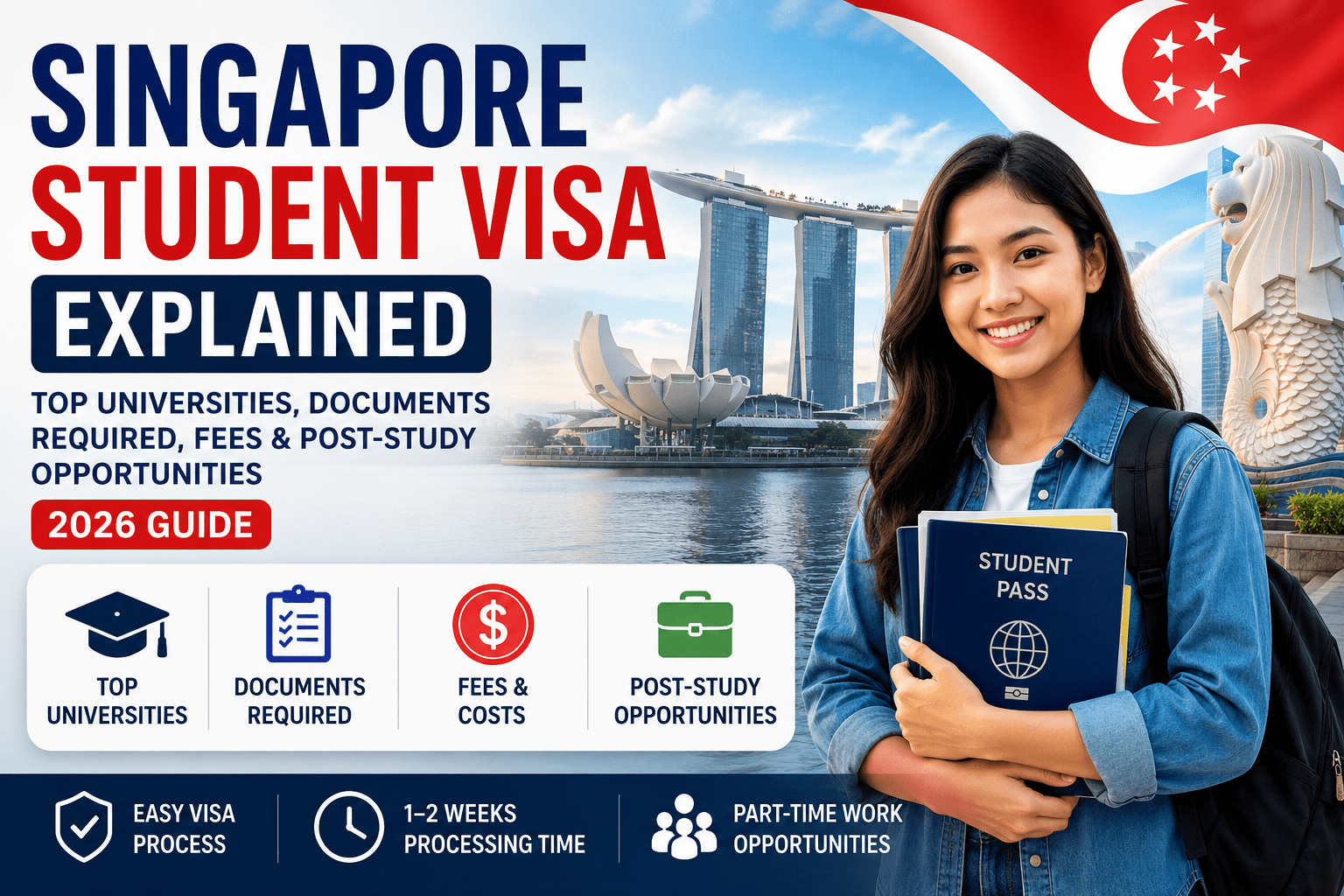
          Singapore Student Visa requirements are an essential consideration for international students planning to study in one of Asia’s leading education hubs. Singapore offers world-class universities, globally recognized degrees, excellent career opportunities, and a safe multicultural environment. This guide explains everything about the Singapore Student Visa (Student Pass), including eligibility, required documents, application fees, processing times, top universities, and post-study work opportunities in 2026.

          Quick Facts About Singapore Student Visa (2026)

          Category Details
          Visa Type Student Pass
          Issuing Authority Immigration & Checkpoints Authority (ICA)
          Application Mode Online via SOLAR System
          Processing Fee SGD 45
          Student Pass Issuance Fee SGD 60
          Entry Visa Fee (If Applicable) SGD 30
          Processing Time 1–2 Weeks
          Work Rights Limited Part-Time Work (Eligible Students)
          Post-Study Options Employment Pass, S Pass

          What Is a Singapore Student Visa?

          A Singapore Student Visa, officially called a Student Pass, is a permit issued by Singapore’s Immigration & Checkpoints Authority (ICA) that allows international students to study full-time at approved educational institutions in Singapore.

          Any international student enrolling in a full-time academic program generally requires a Student Pass before commencing studies.

          Why Study in Singapore?

          Globally Ranked Universities

          Singapore is home to some of Asia’s highest-ranked universities, recognized worldwide for academic excellence and research innovation.

          International Career Opportunities

          As a global financial and technology hub, Singapore provides graduates with access to multinational companies and diverse employment opportunities.

          Safe and Modern Environment

          Singapore consistently ranks among the safest countries in the world, making it an attractive destination for students and families.

          Multicultural Society

          Students experience a diverse international environment with strong Asian and global cultural influences.

          Industry-Focused Education

          Singapore universities emphasize practical learning, internships, innovation, and entrepreneurship.

          Top Universities in Singapore for International Students

          National University of Singapore (NUS)

          • Engineering
          • Computer Science
          • Medicine
          • Business
          • Law
          • Data Science

          Nanyang Technological University (NTU)

          • Engineering
          • Artificial Intelligence
          • Robotics
          • Business Management
          • Environmental Sciences

          Singapore Management University (SMU)

          • Business Administration
          • Economics
          • Finance
          • Accounting
          • Information Systems

          Singapore Institute of Technology (SIT)

          Known for applied learning and strong industry partnerships.

          Singapore University of Technology and Design (SUTD)

          • Design Innovation
          • Engineering
          • Technology
          • Artificial Intelligence

          Singapore University of Social Sciences (SUSS)

          • Social Sciences
          • Human Resources
          • Business Studies
          • Public Administration

          Singapore Student Visa Eligibility Requirements

          • Receive admission from an approved institution.
          • Enroll in a full-time course.
          • Possess a valid passport.
          • Demonstrate sufficient financial resources.
          • Submit required supporting documents.
          • Meet immigration and health requirements.

          Documents Required for Singapore Student Visa

          Students should prepare the following documents:

          Personal Documents

          • Valid Passport
          • Passport Biodata Page
          • Recent Passport-Sized Photograph
          • Birth Certificate (if required)

          Academic Documents

          • Educational Certificates
          • Academic Transcripts
          • Graduation Certificates
          • English Language Test Scores (if required)

          Admission Documents

          • Offer Letter
          • Admission Confirmation
          • Registration Acknowledgement

          Financial Documents

          • Bank Statements
          • Sponsor Documents (if applicable)
          • Proof of Financial Support

          Additional Documents

          • Medical Reports (if requested)
          • Identity Verification Documents
          • Family Information Documents

          How to Apply for a Singapore Student Visa

          Step 1: Obtain Admission

          Apply and receive an offer from a recognized Singapore institution.

          Step 2: Access the SOLAR System

          The institution will register your details in Singapore’s Student’s Pass Online Application & Registration (SOLAR) system.

          Step 3: Submit Student Pass Application

          Complete the online Student Pass application.

          Step 4: Pay Visa Fees

          Submit the applicable processing fee.

          Step 5: Receive In-Principle Approval (IPA)

          Approved students receive an IPA letter.

          Step 6: Travel to Singapore

          Use the IPA letter for entry into Singapore.

          Step 7: Complete Student Pass Issuance

          Complete the final verification process and receive your Student Pass.

          Singapore Student Visa Fees (2026)

          The estimated government fees are:

          Fee Type Amount
          Application Fee SGD 45
          Student Pass Issuance Fee SGD 60
          Entry Visa Fee SGD 30
          Total Estimated Fees SGD 105–135

          Additional institution-specific administrative fees may apply.

          Singapore Student Visa Processing Time

          Most Student Pass applications are processed within:

          • 1 Week for many applicants
          • Up to 2 Weeks for visa-required nationals
          • Longer for complex cases requiring additional verification

          Students should ideally apply at least 2 months before course commencement.

          Cost of Studying in Singapore

          Tuition Fees

          Program Type Annual Tuition Fee
          Diploma Programs SGD 10,000–20,000
          Bachelor’s Degrees SGD 15,000–50,000
          Master’s Degrees SGD 20,000–60,000

          Living Expenses

          • Accommodation: SGD 500–1,500/month
          • Food: SGD 300–600/month
          • Transportation: SGD 80–150/month
          • Miscellaneous Expenses: SGD 200–500/month

          Average annual living expenses range from SGD 10,000–20,000.

          Can International Students Work While Studying in Singapore?

          Yes. Eligible international students studying at approved institutions may work part-time during academic sessions and full-time during approved vacation periods, subject to Singapore regulations and university policies.

          Students should verify eligibility with their institution before accepting employment.

          Post-Study Work Opportunities in Singapore

          Employment Pass (EP)

          Suitable for highly skilled professionals meeting salary and qualification requirements.

          S Pass

          Designed for mid-skilled professionals employed by Singapore-based organizations.

          Popular Employment Sectors

          • Information Technology
          • Artificial Intelligence
          • Data Analytics
          • Finance & Banking
          • Engineering
          • Healthcare
          • Logistics
          • Business Consulting

          Frequently Asked Questions (FAQs)

          Is Singapore good for international students?

          Yes. Singapore offers globally recognized education, high safety standards, excellent infrastructure, and strong employment opportunities.

          How much does a Singapore Student Visa cost?

          The government fees typically range between SGD 105 and SGD 135, depending on individual circumstances.

          How long does Singapore Student Visa processing take?

          Most applications are processed within 1–2 weeks.

          Can Indian students work while studying in Singapore?

          Eligible students enrolled in approved institutions may work part-time according to Singapore regulations.

          Is IELTS required for a Singapore Student Visa?

          IELTS requirements depend on the university and course. Some institutions may accept alternative English proficiency qualifications.

          Can students stay in Singapore after graduation?

          Graduates can remain in Singapore if they secure employment and qualify for an Employment Pass or S Pass.

          Conclusion

          Singapore continues to be a premier destination for international education in 2026. With top-ranked universities, industry-oriented programs, strong career prospects, and a streamlined Student Pass process, Singapore offers an ideal environment for academic and professional growth.

          Students planning to study in Singapore should begin preparing early, ensure all documents are complete, and explore available scholarship and career opportunities to maximize their educational journey.

          Study in Singapore with CIES Overseas Education

          Planning to pursue higher education in Singapore? CIES Overseas Education provides:

          • ✅ University Admissions Guidance
          • ✅ Singapore Student Visa Assistance
          • ✅ SOP & Documentation Support
          • ✅ Scholarship Counseling
          • ✅ Education Loan Assistance
          • ✅ Pre-Departure Support

          Office Address:
          7th Floor, Wave Silver Tower, F-702, Sector 18, Noida, Uttar Pradesh 201301
          Phone: +91-9968239372 / 73
          Email: info@cies.org.in
          Website: www.cies.org.in

          Book Your Free Counseling Session

          Whether you’re planning for a bachelor’s, master’s, diploma, or professional program in Singapore, our experienced advisors are here to guide you every step of the way.

          🚀 Start Your Singapore Study Journey Today with CIES Overseas Education!

            June 17, 2026

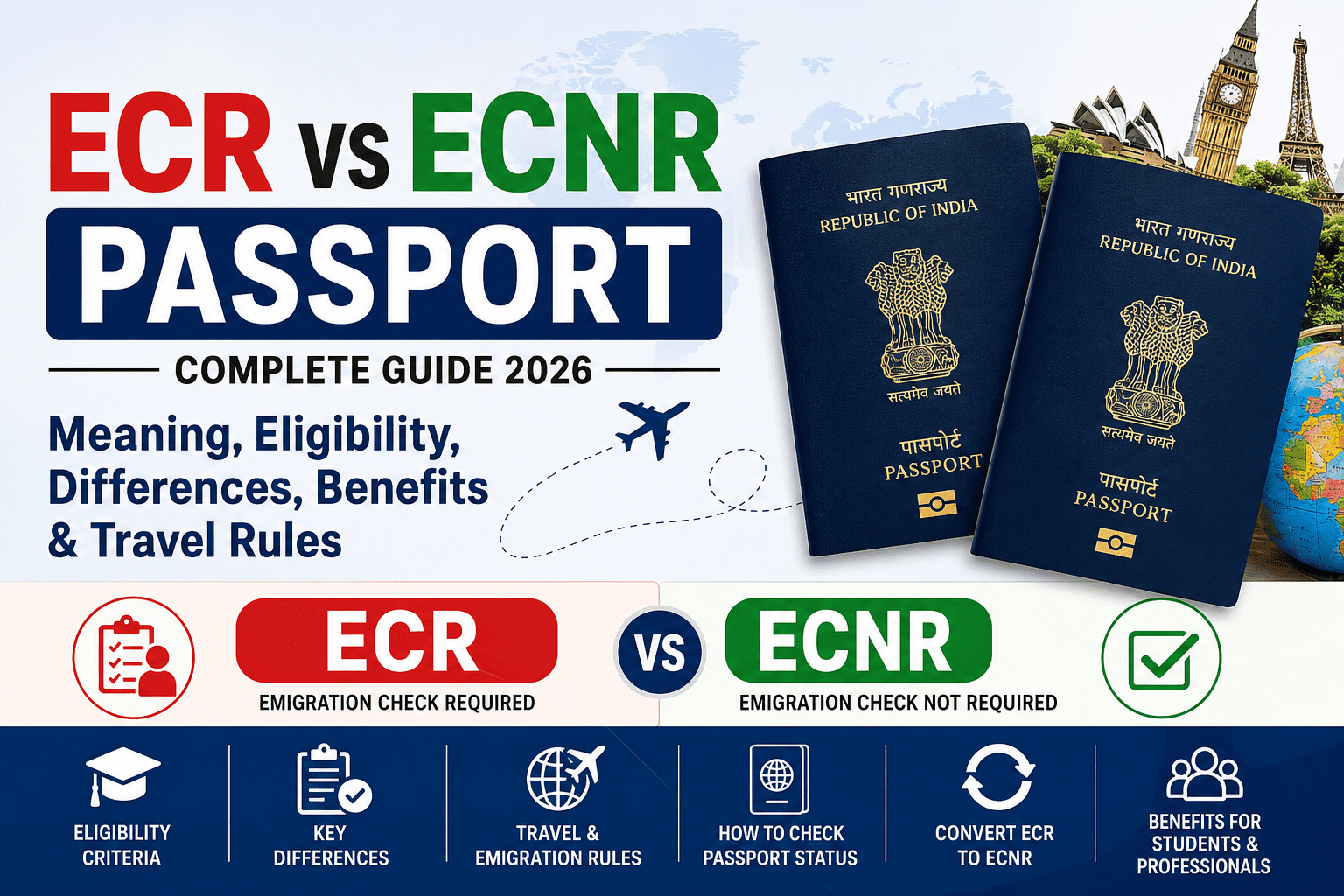
            ECR and ECNR on Indian passports are among the most important distinctions that Indian travelers, students, and overseas job seekers should understand before planning international travel. Knowing the difference between ECR and ECNR passport categories can help you avoid immigration issues, understand emigration requirements, and ensure a smooth visa application process. In this guide, we explain everything about ECR vs ECNR passport status, eligibility criteria, benefits, and how to check your passport category.

            What is ECR on an Indian Passport?

            ECR (Emigration Check Required) is a passport category introduced by the Government of India to protect Indian citizens with lower educational qualifications from exploitation while seeking employment in certain foreign countries.

            Passport holders classified under ECR must obtain emigration clearance from the Protector of Emigrants (POE) before traveling to designated countries for employment purposes.

            Purpose of ECR

            The ECR system helps:

            • Protect migrant workers from fraudulent recruitment agencies
            • Prevent human trafficking and labor exploitation
            • Ensure workers receive legal employment contracts
            • Safeguard the rights of Indian workers abroad

            What is ECNR on an Indian Passport?

            ECNR (Emigration Check Not Required) means the passport holder does not need emigration clearance before traveling abroad for employment or other purposes.

            Individuals with higher educational qualifications or who meet specific eligibility criteria are generally granted ECNR status.

            Benefits of ECNR Status

            • No requirement for emigration clearance
            • Faster immigration processing
            • Greater flexibility for overseas travel
            • Simplified employment opportunities abroad
            • Convenient international mobility

            ECR vs ECNR on Indian Passport: Key Differences

            Feature ECR Passport ECNR Passport
            Full Form Emigration Check Required Emigration Check Not Required
            Emigration Clearance Mandatory for certain employment travel Not required
            Eligible Individuals Generally, below a Class 10 qualification Class 10 pass and above, or eligible categories
            Travel Restrictions Additional clearance for specific countries No such restrictions
            Immigration Process More documentation may be required Simplified process
            Overseas Employment Subject to POE clearance Direct employment travel permitted

            How to Check Whether Your Passport is ECR and ECNR on Indian passports?

            ECNR Passport

            If there is no ECR stamp or endorsement on your passport, it is generally considered ECNR.

            ECR Passport

            Older passports may contain a stamp stating:

            Emigration Check Required

            Newer passports may specifically indicate ECR status in the observation section.

            Who Qualifies for ECNR Status?

            Educational Qualification

            Individuals who have passed:

            • Class 10 (Matriculation) or higher
            • Senior Secondary (12th)
            • Diploma programs
            • Undergraduate degrees
            • Postgraduate degrees

            Income Tax Payers

            • Individuals who pay income tax
            • Individuals who paid income tax in previous assessment years

            Professional Categories

            • Doctors
            • Engineers
            • Chartered Accountants
            • Scientists
            • Teachers
            • Lawyers
            • Journalists

            Government Employees

            • Central Government employees
            • State Government employees
            • Public Sector Undertaking employees

            Senior Citizens

            Individuals aged 50 years or above generally qualify for ECNR.

            Children

            Children below 18 years are usually issued ECNR passports.

            Spouses and Dependents

            Spouses and dependent children of ECNR holders may also qualify.

            Which Countries Require Emigration Clearance for ECR Passport Holders?

            • United Arab Emirates (UAE)
            • Saudi Arabia
            • Qatar
            • Oman
            • Kuwait
            • Bahrain
            • Malaysia

            Government policies may change, so travelers should verify current requirements before departure.

            Can ECR Passport Holders Travel Abroad for Tourism?

            Yes.

            ECR passport holders can travel internationally for:

            • Tourism
            • Family visits
            • Business meetings
            • Higher education
            • Medical treatment

            Emigration clearance is generally required only when traveling for employment to notified countries.

            How to Convert an ECR Passport to ECNR?

            Required Documents

            • Class 10 certificate
            • Higher education certificates
            • Degree certificates
            • Income tax records
            • Professional qualification certificates
            • Government employment proof

            Application Process

            1. Apply for a passport reissue.
            2. Select the option for updating personal particulars.
            3. Submit ECNR eligibility documents.
            4. Attend verification if required.
            5. Receive an updated passport with ECNR status.

            Importance of ECR and ECNR for Students Planning to Study Abroad

            Students pursuing international education generally benefit from ECNR status.

            Popular study destinations include:

            Frequently Asked Questions (FAQs)

            Is a Class 10 qualification sufficient for ECNR?

            Yes. Individuals who have passed Class 10 (Matriculation) are generally eligible for ECNR status.

            Can ECR passport holders get a student visa?

            Yes. ECR status does not prevent obtaining a student visa.

            Is ECNR mentioned on the passport?

            In most modern passports, ECNR may not be explicitly printed. Absence of an ECR endorsement generally indicates ECNR status.

            Can I work abroad with an ECR passport?

            Yes, but emigration clearance may be required when traveling for employment to notified countries.

            Can ECR status be removed?

            Yes. Eligible individuals can apply for a passport reissue and submit supporting documents for ECNR conversion.

            Conclusion

            Understanding the distinction between ECR and ECNR on Indian passports is crucial for anyone considering international travel, employment, or higher education abroad. ECNR status offers greater travel flexibility, while ECR serves as a protective mechanism for certain categories of workers seeking overseas employment.

            Before applying for a visa or planning international travel, always verify your passport category and update it if you meet ECNR eligibility requirements.

            Ready to Study Abroad? Let CIES Overseas Education Guide You!

            Whether you’re planning to study in Canada, Australia, the UK, France, Germany, Ireland, New Zealand, or other top destinations, understanding your passport status is just one step in your international education journey.

            At CIES Overseas Education, our experienced counselors help students with:

            • ✅ University & College Admissions
            • ✅ Student Visa Assistance
            • ✅ SOP & LOR Guidance
            • ✅ Scholarship Support
            • ✅ Education Loan Assistance
            • ✅ Career Counseling & Course Selection
            • ✅ Pre-Departure Guidance

            Don’t let documentation or visa procedures delay your dream of studying abroad. Get expert support from a trusted study abroad consultancy.

            Contact CIES Overseas Education Today

            📍 Address:
            7th Floor, Wave Silver Tower, F-702, D Block, Pocket D, Sector 18, Noida, Uttar Pradesh 201301
            📞 Phone: +91-9968239372 / +91-9968239373
            🌐 Website:
            www.cies.org.in

            📧 Email:
            info@cies.org.in

            Book Your Free Study Abroad Consultation Now!

            Take the first step toward your global education journey with expert guidance from CIES Overseas Education. Contact our team today and discover the best universities, courses, scholarships, and visa options tailored to your goals.

            ✈️ Study Abroad with Confidence | 🎓 Achieve Your Academic Goals | 🌍 Build a Global Future


              June 16, 2026

              Master Spoken English with Expert Guidance at CIES Overseas Education

              In today’s competitive world, strong communication skills can set you apart from the crowd. Whether you’re preparing for higher education, planning to study abroad, attending job interviews, or aiming for career growth, enrolling in spoken English classes can be a game-changer.

              If you are looking for the best spoken English classes in Noida, CIES Overseas Education offers comprehensive English-speaking programs designed to enhance fluency, confidence, pronunciation, and overall communication skills.

              This guide explores everything you need to know about spoken English classes, their benefits, course structure, and why CIES Overseas Education is a preferred choice for learners in Noida.

              Why Are Spoken English Classes Important?

              English is the most widely used language in international business, education, and professional communication. However, many individuals struggle to speak confidently despite understanding grammar and vocabulary.

              Joining professional spoken English classes helps learners:

              • Improve fluency and pronunciation
              • Build confidence in conversations
              • Enhance presentation skills
              • Perform better in interviews
              • Prepare for study abroad requirements
              • Communicate effectively in professional settings

              Looking to study abroad? Read our guide on Study Abroad Consultant in Noida.

              Benefits of Joining an English Speaking Course

              1. Boosts Career Opportunities

              Employers value candidates who can communicate effectively in English. Strong spoken English skills improve interview performance, workplace interactions, and career advancement opportunities.

              2. Builds Confidence

              Many learners hesitate to speak English due to fear of making mistakes. Regular practice sessions help overcome anxiety and develop self-confidence.

              3. Enhances Academic Success

              Students planning to study abroad benefit significantly from spoken English training. Improved communication skills contribute to better classroom participation and academic presentations.

              4. Improves Social Communication

              English is commonly used in international travel, networking events, and digital communication. Spoken English classes help learners interact confidently in diverse environments.

              5. Develops Leadership Skills

              Effective communication is a key leadership trait. Learning to express ideas clearly can enhance your influence and professional presence.

              What Do Spoken English Classes Include?

              At CIES Overseas Education, spoken English classes focus on practical communication rather than theoretical learning.

              Vocabulary Enhancement

              Students learn frequently used words and expressions that improve everyday communication.

              Grammar for Speaking

              Essential grammar concepts are taught in a practical manner to support accurate sentence formation.

              Pronunciation Training

              Correct pronunciation improves clarity and helps learners sound more natural while speaking.

              Listening Practice

              Exposure to different accents and speech styles enhances listening comprehension.

              Group Discussions

              Interactive discussions encourage learners to express opinions confidently.

              Public Speaking Activities

              Presentation exercises help students overcome stage fear and improve communication effectiveness.

              Role-Play Sessions

              Real-life scenarios such as interviews, meetings, and social interactions prepare learners for practical situations.

              Who Should Join Spoken English Classes?

              Spoken English classes are suitable for:

              • School students
              • College students
              • Working professionals
              • Job seekers
              • Entrepreneurs
              • Homemakers
              • Study abroad aspirants
              • Individuals preparing for IELTS interviews
              • Anyone seeking to improve communication skills

              Why Choose CIES Overseas Education for Spoken English Classes in Noida?

              Experienced Trainers

              Our trainers use practical teaching methods focused on real-world communication.

              Interactive Learning Environment

              Students actively participate in discussions, presentations, and speaking activities.

              Personalized Attention

              Small batch sizes ensure individual guidance and regular feedback.

              Focus on Confidence Building

              The program emphasizes reducing hesitation and improving self-expression.

              Study Abroad Support

              As an overseas education consultancy, CIES understands the importance of communication skills for international education success.

              Flexible Learning Approach

              Courses are designed to accommodate students, professionals, and other learners with varying schedules.

              How to Improve Spoken English Faster

              Practice Daily

              Use English in everyday conversations whenever possible.

              Read Regularly

              Reading newspapers, books, and articles improves vocabulary and comprehension.

              Watch English Content

              Movies, documentaries, and educational videos expose learners to natural speech patterns.

              Think in English

              Developing the habit of thinking in English can enhance fluency.

              Learn New Vocabulary

              Aim to learn and use a few new words each day.

              Avoid Fear of Mistakes

              Mistakes are a normal part of the learning process. Confidence develops through practice.

              Common Challenges in Learning Spoken English

              Lack of Confidence

              Many learners understand English but hesitate to speak. Guided practice can help overcome this barrier.

              Limited Vocabulary

              Regular reading and vocabulary exercises gradually expand language proficiency.

              Pronunciation Issues

              Professional feedback helps learners correct pronunciation errors.

              Fear of Judgment

              Supportive classroom environments encourage active participation without fear.

              Spoken English Classes in Noida: Growing Demand

              Noida has emerged as a major educational and corporate hub. As multinational companies expand their presence in the region, the demand for spoken English classes in Noida continues to increase.

              Students preparing for higher education, professionals seeking promotions, and individuals planning to study abroad increasingly recognize the value of strong communication skills.

              Investing in spoken English training can significantly improve both personal and professional prospects.

              Frequently Asked Questions (FAQs)

              What are spoken English classes?

              Spoken English classes are training programs designed to improve fluency, pronunciation, vocabulary, and confidence in speaking English.

              Who can join spoken English classes?

              Anyone interested in improving communication skills can enroll, including students, professionals, homemakers, and study abroad aspirants.

              How long does it take to improve spoken English?

              The duration varies based on individual learning pace and consistency. Regular practice accelerates improvement.

              Are spoken English classes beneficial for interviews?

              Yes. They help candidates communicate confidently and effectively during job interviews.

              Why Choose Professional English Communication Training?

              Noida offers access to experienced trainers and quality learning environments that support personal and professional development.

              Conclusion

              Strong communication skills are essential in today’s interconnected world. Whether your goal is academic success, career advancement, international education, or personal growth, spoken English proficiency can create valuable opportunities.

              Enrolling in spoken English classes provides structured guidance, practical experience, and the confidence needed to communicate effectively.

              If you are searching for reliable spoken English classes in Noida, CIES Overseas Education offers a learner-focused approach designed to help individuals achieve fluency and confidence in English communication.

              Take the first step toward transforming your communication skills and unlocking new possibilities for your future.

              Contact CIES Overseas Education

              Address: 7th Floor, Wave Silver Tower, F-702, D Block, Pocket D, Sector 18, Noida, Uttar Pradesh 201301
              Phone: +91-9968239372 / +91-9968239373
              Email: info@cies.org.in

              Contact CIES Overseas Education today to learn more about our spoken English classes and begin your journey toward confident communication.

              Start Your English Learning Journey Today

              At CIES Overseas Education, we help students and professionals develop effective communication skills through interactive learning methods and personalized guidance.

                June 16, 2026

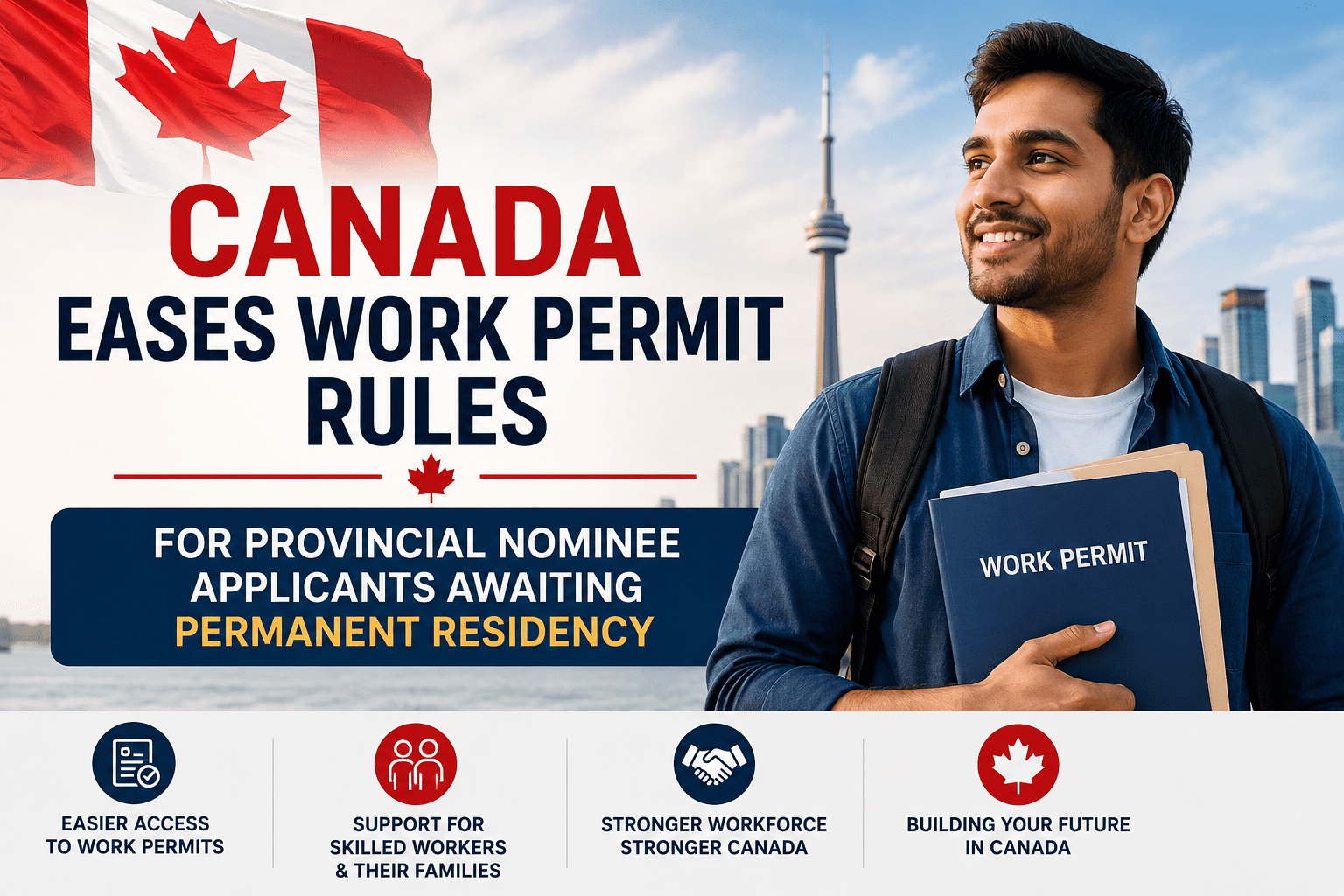
                Canada has introduced temporary measures to support Provincial Nominee Program (PNP) applicants awaiting processing of their permanent residency (PR) applications. The latest update from Immigration, Refugees and Citizenship Canada (IRCC) aims to reduce uncertainty for skilled workers and their families by easing access to work permits during the PR process.

                For many immigrants, maintaining legal work status while awaiting a PR decision has been a significant challenge. The new policy provides relief by allowing eligible applicants to continue contributing to Canada’s workforce without facing employment interruptions.

                  What Are the New Work Permit Changes?

                  IRCC has announced temporary operational measures that make it easier for eligible provincial nominee applicants and their spouses to obtain work permits while awaiting permanent residency decisions.

                  Under the updated guidelines:

                  • Certain in-Canada PNP applicants can apply for work permits before receiving their Acknowledgement of Receipt (AOR).
                  • Alternative proof of PR application submission may be accepted.
                  • Eligible spouses may also qualify for open work permits.
                  • The measures aim to prevent skilled workers from losing their legal status due to processing delays.

                  The temporary measures took effect on June 9, 2026, and are expected to remain in place until December 31, 2026.

                  Why Has Canada Introduced These Measures?

                  Canada continues to rely heavily on immigration to address labour shortages across multiple sectors, including healthcare, technology, skilled trades, and construction.

                  However, extended processing timelines have created challenges for many provincial nominee applicants whose existing work permits may expire before their permanent residency applications are finalized.

                  The new measures are designed to:

                  • Support economic growth by retaining skilled workers.
                  • Reduce disruptions to employers experiencing labour shortages.
                  • Improve the immigration experience for applicants and their families.
                  • Facilitate smoother transitions from temporary to permanent resident status.

                  Understanding the Provincial Nominee Program (PNP)

                  The Provincial Nominee Program allows Canadian provinces and territories to nominate individuals with the skills and experience needed to support local economies.

                  Each province operates its own streams tailored to specific labour market demands. Receiving a provincial nomination can significantly strengthen an applicant’s pathway toward Canadian permanent residence.

                  Popular PNP destinations include:

                  Ontario Immigrant Nominee Program (OINP)

                  Ontario targets skilled workers, international graduates, and entrepreneurs through various immigration streams.

                  British Columbia Provincial Nominee Program (BC PNP)

                  British Columbia frequently invites candidates working in healthcare, technology, childcare, and skilled trades.

                  Alberta Advantage Immigration Program (AAIP)

                  Alberta focuses on addressing labour shortages through targeted pathways for eligible foreign workers.

                  Manitoba Provincial Nominee Program (MPNP)

                  Manitoba offers pathways for skilled workers and international graduates seeking long-term settlement opportunities.

                  Who Benefits from the New Work Permit Rules?

                  The updated policy may benefit:

                  Provincial Nominee Applicants

                  Individuals who have already submitted their permanent residency applications under eligible PNP streams may qualify for work permit support.

                  Spouses and Common-Law Partners

                  Eligible spouses may receive open work permits, enabling them to work for most employers in Canada.

                  Canadian Employers

                  Businesses experiencing labour shortages can retain experienced employees who might otherwise lose work authorization.

                  Temporary Residents Transitioning to PR

                  The policy supports Canada’s broader immigration objective of helping temporary residents become permanent residents.

                  What Documents May Be Accepted?

                  According to recent updates, applicants who have not yet received an Acknowledgement of Receipt (AOR) may be able to submit alternative documentation, including:

                  • Confirmation emails showing PR application submission.
                  • Proof of fee payment.
                  • Other documentation requested by IRCC officers.

                  These temporary accommodations address delays associated with completeness checks and AOR issuance.

                  What Does This Mean for International Students and Workers?

                  Many international graduates and skilled workers use provincial nominations as a pathway to permanent residence.

                  The new work permit flexibility offers greater security by helping eligible individuals remain employed while awaiting immigration decisions. This continuity benefits both applicants and the Canadian economy.

                  For prospective immigrants, the changes highlight Canada’s ongoing commitment to attracting and retaining global talent.

                  How Does This Support Canada’s Immigration Strategy?

                  Canada has consistently emphasized the importance of transitioning temporary residents into permanent residents.

                  By easing work permit requirements for provincial nominee applicants, IRCC aims to:

                  • Strengthen regional labour markets.
                  • Encourage long-term settlement across provinces.
                  • Enhance the efficiency of Canada’s immigration system.
                  • Improve outcomes for newcomers already contributing to Canadian communities.

                  Frequently Asked Questions (FAQs)

                  Can PNP applicants apply for work permits without an AOR?

                  Under the temporary measures, certain eligible in-Canada applicants may use alternative proof of PR application submission instead of an AOR.

                  Do these changes apply to applicants outside Canada?

                  The temporary measures primarily apply to eligible individuals already residing in Canada.

                  Can spouses receive work permits?

                  Yes. Eligible spouses and common-law partners may qualify for open work permits under the updated policy.

                  Are these measures permanent?

                  No. The current operational measures are temporary and are expected to remain in effect until December 31, 2026.

                  Why has IRCC introduced these changes?

                  The measures address processing delays and help prevent employment disruptions for provincial nominee applicants awaiting permanent residency decisions.

                  Final Thoughts

                  Canada’s decision to ease work permit rules for Provincial Nominee Program applicants awaiting permanent residency represents an important step toward creating a more flexible and supportive immigration system.

                  For thousands of skilled workers and their families, the new measures provide reassurance that they can continue living and working in Canada while their permanent residence applications move through the processing stages.

                  If you are planning to immigrate to Canada through the Provincial Nominee Program, staying informed about the latest IRCC updates can help you navigate the immigration process more effectively.

                  Need guidance on your Canada immigration journey? Consult experienced study abroad and immigration professionals to understand your eligibility and choose the pathway that best aligns with your goals.

                    June 15, 2026

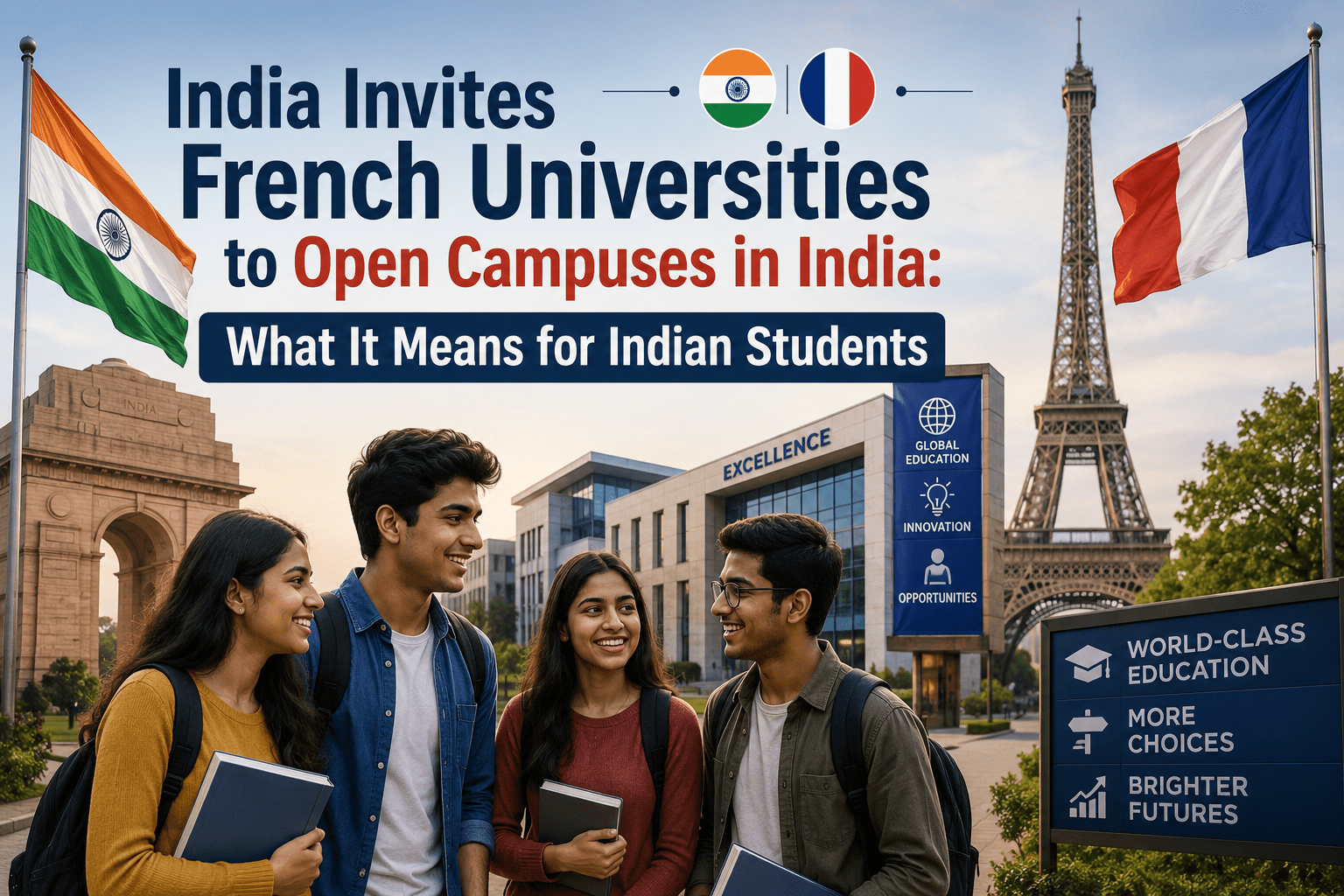
                    India has extended an invitation to leading French universities to establish campuses within the country, marking a significant development in Indo-French educational cooperation. The initiative aligns with India’s vision under the National Education Policy (NEP) 2020 to internationalize higher education and provide students with access to world-class academic opportunities closer to home.

                    The decision could reshape the future of higher education in India by enabling students to pursue internationally recognized French degrees without relocating overseas. It also strengthens the strategic partnership between India and France, which has expanded beyond diplomacy and trade into innovation, research, and education.

                    If implemented successfully, French universities in India could create new pathways for academic excellence, global employability, and international collaboration.

                    What Is the Announcement About?

                    India has encouraged reputed French higher education institutions to consider establishing campuses in India. The proposal is part of broader efforts to deepen educational ties between the two countries and expand access to international education.

                    The move supports India’s goal of becoming a global knowledge destination while giving Indian students more options to pursue internationally accredited programs within the country.

                    Quick Facts: French Universities in India

                    Key Information Details
                    Initiative India invites French universities to open campuses
                    Objective Increase access to international education in India
                    Policy Support National Education Policy (NEP) 2020
                    Potential Benefits Global degrees, lower costs, research collaboration
                    Target Students Indian students seeking international education
                    Possible Fields Business, Engineering, AI, Hospitality, Fashion, Sports Management

                    Why Is India Inviting French Universities?

                    Several factors explain why India is actively encouraging French universities to establish campuses.

                    Strengthening Indo-French Relations

                    India and France have developed a robust strategic partnership over the years. Education has emerged as one of the key pillars of this relationship.

                    Academic collaborations help promote innovation, cultural exchange, and long-term cooperation between institutions.

                    Supporting NEP 2020 Goals

                    One of the objectives of NEP 2020 is to internationalize Indian higher education by facilitating the entry of top foreign universities into the country.

                    French universities opening campuses in India directly supports this vision.

                    Expanding Access to Quality Education

                    Thousands of Indian students aspire to study abroad but face financial and logistical barriers. International campuses within India could make global education more accessible.

                    Encouraging Research and Innovation

                    French institutions are internationally recognized for excellence in research. Their presence in India could stimulate collaborative projects involving students, researchers, industries, and governments.

                    Benefits of French Universities Opening Campuses in India

                    International Degrees Without Relocation

                    Students may be able to earn French qualifications while remaining in India, reducing the need to move abroad.

                    Reduced Cost of Education

                    Studying overseas often involves expenses related to:

                    • Tuition fees
                    • Accommodation costs
                    • Travel expenses
                    • Health insurance
                    • Daily living expenses

                    French university campuses in India could significantly reduce these costs.

                    Exposure to Global Teaching Standards

                    Students would gain access to international curricula, innovative teaching methodologies, and multicultural learning environments.

                    Better Career Opportunities

                    Graduates with globally recognized degrees often enjoy enhanced employment prospects in both domestic and international job markets.

                    Strong Industry Connections

                    French institutions frequently collaborate with multinational organizations, creating internship opportunities and valuable professional networks.

                    Which Programs Could Be Offered by French Universities in India?

                    French universities are globally recognized for excellence across a variety of disciplines.

                    Business and Management Programs

                    France is home to some of Europe’s leading business schools. Potential programs may include:

                    • International Business
                    • Marketing
                    • Finance
                    • Entrepreneurship
                    • Luxury Brand Management

                    Engineering and Technology Courses

                    France has established itself as a leader in innovation and engineering education.

                    • Mechanical Engineering
                    • Aerospace Engineering
                    • Civil Engineering
                    • Computer Science
                    • Artificial Intelligence

                    Hospitality and Tourism Management

                    As one of the world’s top tourism destinations, France has substantial expertise in hospitality education.

                    • Hotel Management
                    • Event Management
                    • Tourism Operations
                    • Culinary Arts

                    Fashion and Luxury Management

                    France is synonymous with fashion innovation and luxury brands.

                    • Fashion Marketing
                    • Luxury Retail Management
                    • Brand Strategy
                    • Product Development

                    Sports Management Education

                    French institutions may also offer programs designed for the growing global sports industry.

                    • Sports Marketing
                    • Athlete Management
                    • Event Operations
                    • Sports Business Development

                    What Does This Mean for Indian Students?

                    The arrival of French universities in India could transform educational choices for thousands of students.

                    Students may benefit through:

                    • Internationally recognized degrees
                    • Lower educational expenses
                    • Increased academic flexibility
                    • Exchange opportunities with France
                    • Enhanced global employability
                    • Exposure to diverse learning environments
                    • Access to international faculty members

                    For many families, this model offers the advantages of overseas education while maintaining the comfort and affordability of studying in India.

                    Challenges That Need Attention

                    Maintaining Academic Standards

                    Institutions must ensure that programs delivered in India uphold the same quality and rigor as those offered at their French campuses.

                    Regulatory Approvals

                    Foreign universities must comply with Indian regulations governing international branch campuses.

                    Tuition Affordability

                    Programs should remain financially accessible to a broad spectrum of Indian students.

                    Faculty Recruitment

                    Success will depend on attracting experienced faculty capable of delivering globally competitive education.

                    The Role of France in Global Education

                    France has consistently ranked among the preferred destinations for international students due to its strong academic reputation.

                    The country offers:

                    • High-quality education systems
                    • Research-driven institutions
                    • Diverse academic programs
                    • Strong industry partnerships
                    • An increasing number of English-taught courses

                    The expansion of French institutions into India reflects their growing commitment to international engagement.

                    Future of Indo-French Educational Collaboration

                    Educational cooperation between India and France is expected to continue expanding through initiatives such as:

                    • Student exchange programs
                    • Joint degree initiatives
                    • Collaborative research projects
                    • Faculty mobility programs
                    • Innovation partnerships
                    • Industry-academia collaborations

                    French campuses in India could become an important milestone in this evolving relationship.

                    Frequently Asked Questions (FAQs)

                    Are French universities opening campuses in India?

                    India has invited French universities to establish campuses in the country. Individual institutions will need to assess opportunities and obtain necessary approvals before launching operations.

                    Why is India encouraging French universities to come?

                    India aims to internationalize higher education, improve access to global academic standards, and strengthen educational cooperation with France.

                    Will students receive French degrees in India?

                    If French universities establish campuses in India, students may receive qualifications recognized by the parent institution, subject to regulatory guidelines.

                    Will studying at French campuses in India be cheaper?

                    Potentially, yes. Students may save money on international travel, accommodation, and living expenses compared to studying abroad.

                    Which courses could French universities offer in India?

                    Possible fields include business, engineering, technology, hospitality, fashion, luxury management, and sports management.

                    Can students transfer to France after studying in India?

                    Transfer and exchange opportunities may be available depending on institutional policies and program structures.

                    Key Takeaways

                    • India has invited French universities to establish campuses in the country.
                    • The initiative supports the objectives of NEP 2020.
                    • Indian students could gain access to internationally recognized education at reduced costs.
                    • French institutions may introduce programs across multiple disciplines.
                    • The move has the potential to strengthen research, innovation, and academic collaboration between India and France.

                    Conclusion

                    India’s invitation to French universities represents an important step toward creating a more internationally connected higher education ecosystem. By bringing globally respected institutions closer to Indian students, the initiative could redefine educational accessibility and expand opportunities for future generations.

                    For students aspiring to obtain international qualifications without the challenges associated with relocating abroad, French university campuses in India may offer an attractive alternative. As discussions progress and partnerships evolve, this development could become one of the most significant transformations in India’s higher education landscape.

                      June 15, 2026

                      India-France talks between Prime Minister Narendra Modi and French President Emmanuel Macron have once again highlighted the strength of the strategic partnership between the two countries. The latest India-France talks focused on expanding cooperation in education, defence, innovation, trade, and sustainability. As global dynamics continue to evolve, these discussions underscore the shared commitment of India and France to promoting peace, economic growth, and international collaboration.

                      Why the India-France Talks Matter

                      The India-France talks are important because they shape cooperation between two major global partners. India and France have maintained strong diplomatic ties for decades, and regular high-level meetings help both nations address emerging challenges and seize new opportunities.

                      The recent discussions reflected a common vision for:

                      • Strengthening economic partnerships
                      • Advancing educational collaboration
                      • Enhancing defence cooperation
                      • Supporting climate action initiatives
                      • Encouraging innovation and technology exchange

                      India-France Talks on Education Cooperation

                      Education emerged as one of the most promising areas during the India-France talks. Both countries expressed interest in expanding academic partnerships, increasing student mobility, and promoting research collaboration.

                      Opportunities for Indian Students

                      The growing educational relationship between India and France may provide Indian students with:

                      • Greater access to French institutions
                      • Increased exchange opportunities
                      • Collaborative research programs
                      • International learning experiences
                      • Potential expansion of French campuses in India

                      These developments align with India’s goal of internationalizing higher education under the National Education Policy (NEP) 2020.

                      India-France Talks on Defence Partnership

                      Defence cooperation has remained a cornerstone of India-France relations. The India-France talks reaffirmed both nations’ commitment to maintaining regional stability and strengthening security partnerships.

                      Areas of collaboration include:

                      • Joint military exercises
                      • Maritime security initiatives
                      • Defence technology cooperation
                      • Strategic dialogue on global security issues

                      The continued partnership contributes to a secure and rules-based international order.

                      India-France Talks on Trade and Investment

                      Economic cooperation featured prominently in the India-France talks. France is among India’s important economic partners in Europe, with significant investments across sectors.

                      Both countries aim to:

                      • Increase bilateral trade
                      • Promote business partnerships
                      • Encourage investment flows
                      • Support startups and innovation ecosystems

                      Enhanced economic cooperation has the potential to generate employment opportunities and foster sustainable development.

                      Innovation and Technology in India-France Talks

                      Innovation was another major theme during the India-France talks. India and France recognize the importance of technological advancement in addressing future challenges.

                      Key areas of interest include:

                      • Artificial Intelligence
                      • Digital transformation
                      • Space research
                      • Clean technologies
                      • Scientific collaboration

                      Joint initiatives in these sectors can accelerate progress and create new opportunities for researchers and entrepreneurs.

                      Climate Action and Sustainable Development

                      The India-France talks also emphasized environmental responsibility and climate cooperation. Both countries have consistently supported global efforts to combat climate change.

                      Potential areas of collaboration include:

                      • Renewable energy projects
                      • Sustainable infrastructure development
                      • Green technologies
                      • Climate resilience programs

                      These efforts demonstrate a shared commitment to achieving long-term sustainability goals.

                      How India-France Talks Benefit Indian Students

                      Indian students stand to gain significantly from stronger India-France relations. Educational partnerships can open doors to international exposure while supporting academic excellence.

                      Benefits may include:

                      • Access to globally recognized programs
                      • Cross-cultural learning experiences
                      • Enhanced research opportunities
                      • Improved employability prospects
                      • International networking possibilities

                      Students aspiring to pursue higher education with a global perspective should closely follow developments arising from the India-France talks.

                      Frequently Asked Questions

                      What are the India-France talks?

                      India-France talks refer to the official discussions held between leaders of India and France to strengthen bilateral cooperation across sectors such as education, trade, defence, and innovation.

                      Who participated in the recent India-France talks?

                      Prime Minister Narendra Modi and French President Emmanuel Macron held the official discussions aimed at advancing the strategic partnership between the two countries.

                      Why are the India-France talks important?

                      The India-France talks help shape cooperation on critical global issues while creating opportunities in education, business, technology, and sustainability.

                      How can Indian students benefit from India-France cooperation?

                      Students may benefit through increased academic collaborations, research initiatives, exchange programs, and broader access to international educational opportunities.

                      The Future of India-France Relations

                      The India-France talks reflect a partnership built on trust, shared values, and mutual aspirations. As both nations continue to collaborate across strategic sectors, the relationship is expected to grow stronger in the coming years.

                      For students, professionals, researchers, and businesses, the outcomes of these discussions represent opportunities to engage with a dynamic and future-focused international partnership.

                      Conclusion

                      The recent India-France talks reaffirm the importance of cooperation between two influential global partners. From education and innovation to defence and sustainability, the discussions between Prime Minister Narendra Modi and President Emmanuel Macron highlight a commitment to building a more prosperous and interconnected future.

                      As India and France deepen their strategic relationship, the benefits are likely to extend beyond governments, creating meaningful opportunities for citizens, institutions, and industries in both countries.

                      1 2 3 9