
WHITE PAPER
Prepared for: Academic & Career Advisory Stakeholders
Region Focus: India (Global Comparison Context)
Executive Summary
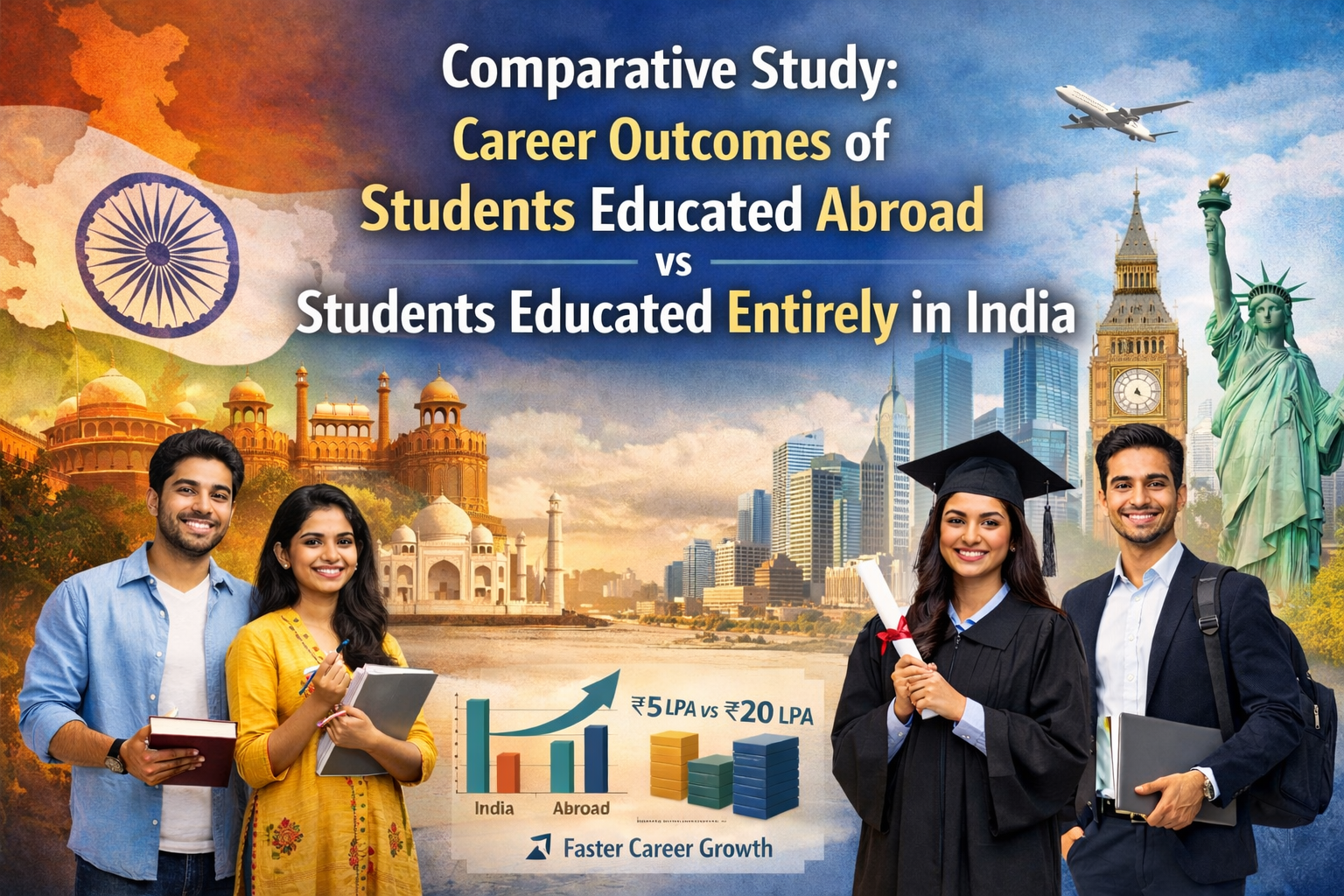
This white paper evaluates career outcomes of students who pursued higher education abroad versus those who completed their entire education in India. Using data from global employer surveys, the India Skills Report, OECD statistics, and recruitment industry compensation benchmarks, the study identifies measurable differences in employability, salary progression, career mobility, and return on investment (ROI).
The findings indicate that international education often delivers:
-
Higher employability rates
-
Strong salary premiums
-
Faster career progression
-
Greater global mobility
However, domestic education remains financially efficient and highly effective when obtained from Tier-1 Indian institutions.
1. Employability Outcomes
Graph Reference: Employability Rate Comparison
Key Data Sources:
-
QS Global Employer Survey
-
UK Graduate Outcomes Survey
-
India Skills Report (Wheebox)
Findings
| Category | Employability Rate |
|---|---|
| International Graduates | ~85% |
| Indian Graduates (Overall) | ~48% |
Interpretation
International graduates demonstrate significantly higher employability due to:
-
Industry-integrated curricula
-
Structured internship exposure
-
Global academic environments
-
Strong soft-skills and communication training
In contrast, India continues to face a documented skill gap, with approximately half of graduates considered industry-ready, except those from premier institutions.
2. Salary Benchmark Comparison
Graph Reference: Average Starting Salary Comparison
Market Data: Recruitment Firms & Industry Reports
| Category | Average Starting Salary |
|---|---|
| International Graduates (Returnees) | ₹20 LPA (average benchmark) |
| Indian Graduates (Non-Tier 1) | ₹5 LPA |
Observations
International degree holders returning to India often secure 2–4x higher entry-level compensation.
Salary premiums are particularly strong in:
-
Technology
-
Finance
-
Consulting
-
Data Science & Artificial Intelligence
Tier-1 Indian institutions remain competitive but represent a limited proportion of the total graduate population.
3. Career Progression Speed
Graph Reference: Years to Reach Mid-Level Position
| Category | Average Years to Mid-Level |
|---|---|
| International Graduates | 4 years |
| Indian Graduates | 7 years |
Interpretation
Global exposure, leadership-focused education models, and cross-cultural competence accelerate promotion cycles within multinational and global organizations.
International graduates frequently:
-
Transition faster into managerial roles
-
Access overseas leadership pathways
-
Benefit from strong global alumni ecosystems
4. Return on Investment (ROI)
Graph Reference: Estimated ROI Recovery Period
| Category | ROI Recovery Period |
|---|---|
| International Education | ~5 years |
| Indian Education | ~8 years |
Investment vs Return Analysis
Although overseas education involves higher upfront costs (typically ₹20–60 lakh), higher salary trajectories often compress the ROI recovery period.
Domestic education offers:
-
Lower financial risk
-
Slower salary acceleration (except elite institutions)
5. Sector-Wise Comparative Strength
Strong Advantage – International Education
-
Artificial Intelligence & Emerging Technologies
-
Global Finance & Investment Banking
-
International Business & Supply Chain
-
Research & Innovation
Strong Advantage – Domestic Education
-
Government Services
-
Public Sector Units (PSUs)
-
Family Business Ecosystem
-
Competitive Examinations
6. Risk Analysis
| Factor | International Education | Indian Education |
|---|---|---|
| Financial Exposure | High | Moderate |
| Visa Dependency | Yes | No |
| Global Mobility | High | Limited |
| Market Saturation | Moderate | High |
7. Strategic Conclusion
International education statistically offers:
-
Higher employability probability
-
Strong salary premiums
-
Faster career mobility
-
Leadership-track acceleration
Domestic education remains optimal when:
-
Obtained from Tier-1 institutions
-
Targeting government or PSU careers
-
Budget sensitivity is a primary concern
Final Insight
Career advantage is not determined solely by geography, but by:
-
Institutional quality
-
Industry integration
-
Skill relevance
-
Global exposure
However, aggregated data trends clearly indicate that internationally educated graduates hold measurable advantages in employability metrics, salary growth, and leadership acceleration—particularly within multinational and global corporate ecosystems.